
Best Industrial Dehumidifiers For Large Water Damage – 2026 Reviews

Water damage never announces itself politely. You find it as a damp smell in the basement, a soft spot near the water heater, or a crawl space that stays humid days after the storm has passed. In those moments, a standard household dehumidifier can feel like a bucket in a flood. Large water damage needs a machine built to pull serious moisture, run for long stretches, and drain itself without constant attention.
The tricky part is that the word industrial gets used loosely. Some units are commercial-grade in name only, while others are genuinely sized for restoration work. The differences that matter most are capacity at AHAM conditions, pump drainage and hose lift, low-temperature defrost, and whether the body actually fits the space you need to dry.
We looked across the industrial dehumidifier market to separate restoration-ready machines from oversized basement units. This guide is organized around the jobs buyers actually face: flooded basements, low-clearance crawl spaces, and active water-damage sites where the unit may run for days.
Best Industrial Dehumidifiers for Large Water Damage – 2026 Reviews

Storm SLGR 850X – LGR Restoration Power with Built-In Pump
The Storm SLGR 850X is built for heavy water-damage work: 180 PPD at saturation, 85 pints at AHAM, and coverage up to 2,300 square feet. A built-in pump, retractable handle, wheels, and stackable body make it a practical job-site unit.

Defender XP235 – High-Capacity Crawlspace Drying
The Defender XP235 targets very large wet spaces with up to 235 pints per day at saturation, 100 pints at AHAM, and coverage up to 8,000 square feet. A built-in pump, 16-foot drain hose, and R32 system make it a hands-off high-capacity option.
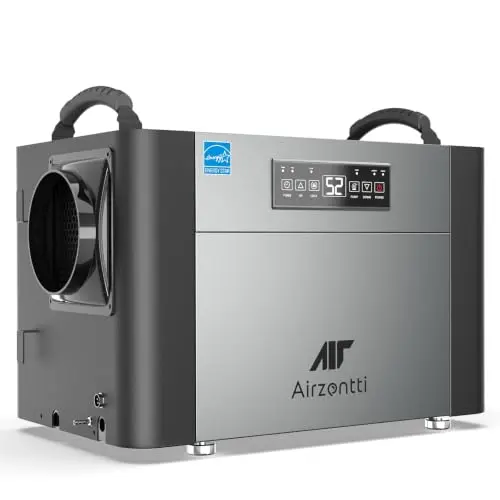
ACD155P-PG100(B) – Ductable Whole-Space Drying
The ACD155P is a 155-pint commercial dehumidifier rated for spaces up to 7,500 square feet, with 220 CFM airflow and a built-in pump. A duct collar, leveling feet, and Energy Star certification make it flexible for attics, basements, and job sites.
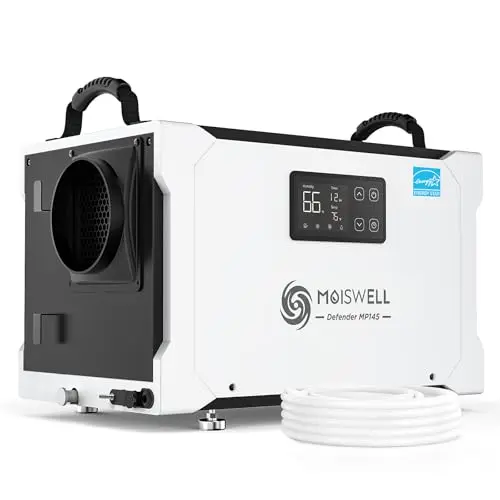
Defender MP145 – Energy-Star Drying for Large Basements
The Defender MP145 removes up to 155 pints per day at saturation and 70 pints at AHAM, with coverage up to 6,000 square feet. It adds Energy Star efficiency, a built-in pump, and a long drain hose for hands-off drying.
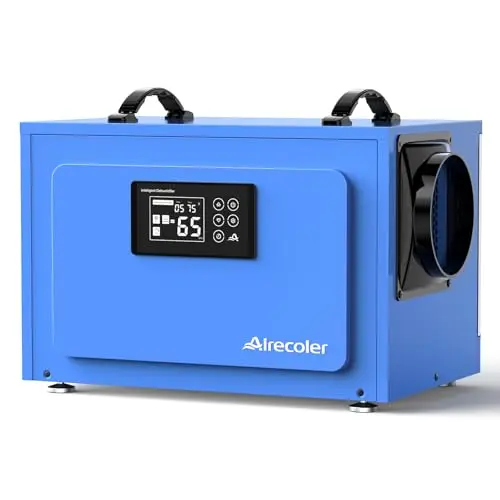
GT-X5 – Compact Commercial Restoration
The GT-X5 delivers up to 125 pints per day at saturation and 60 pints at AHAM, with coverage up to 6,000 square feet. Its compact metal body, drain hose, timer, and auto defrost suit crawl spaces and smaller restoration jobs.
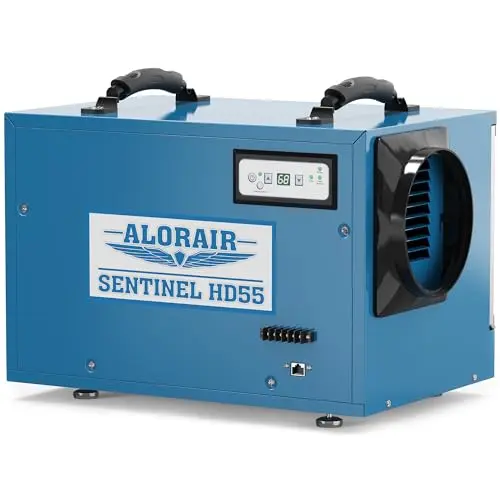
Sentinel HD55 – Crawlspace-Focused Commercial Drying
The Sentinel HD55 is a 113-pint crawlspace and basement dehumidifier with 53 pints at AHAM and coverage up to 1,200 square feet. It runs tankless with a drain hose, adds auto defrost, and uses a metal casing for commercial durability.
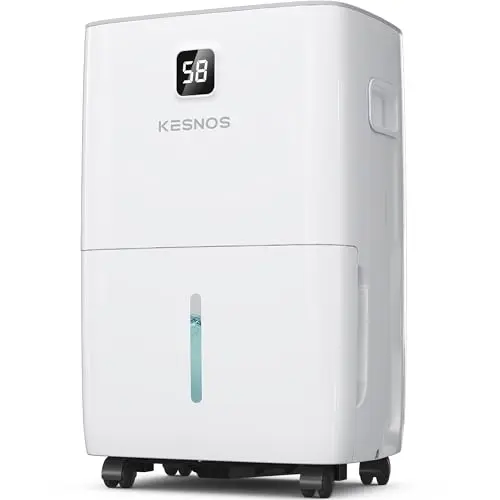
JD-N – Budget Large-Room Moisture Control
The JD-N is a 150-pint large-room dehumidifier with coverage up to 7,500 square feet, a 2.12-gallon tank, and continuous drain hose option. It adds a front humidity display, two fan speeds, and a MIRAGE sleep mode.
How We Evaluated These Industrial Dehumidifiers for Large Water Damage
We didn’t run a controlled drying-chamber test or measure moisture removal with calibrated instrumentation. What we did: cross-referenced seven industrial dehumidifier models from five distinct brands across six decision axes – AHAM and saturation capacity, pump and drainage setup, low-temperature defrost, footprint and portability, ducting and airflow, and warranty coverage. We triangulated published specifications, feature sets, owner feedback where available, and use-case fit for large water-damage restoration. That means we looked at how each unit would behave in a flooded basement, a low-clearance crawl space, and an active job site where the machine may run for days.
The scoring framework weighted real-world performance (70%) – how well each unit matches the demands of wet basements, crawl spaces, and active job sites – against feature differentiation (30%) – pump lift, ducting, compactness, and other advantages that separate one model from another. We also weighed how easy each unit is to move, drain, and service between jobs. We have no commercial relationship with any brand here; recommendations track fit and differentiation, not brand preference. A few things we can’t tell you: how each unit holds up after years of service or how loudly it runs in your specific room. What we can: map capacity, drainage, and footprint to the job you’re facing. If you’re drying a flooded basement, the Storm SLGR 850X is your match; if you need maximum capacity, the Defender XP235 serves you better.
How to Choose the Right Industrial Dehumidifier for Large Water Damage
1. What Makes an Industrial Dehumidifier Ready for Water Damage?
Industrial dehumidifiers are not just bigger basement units. For large water damage, the useful distinction is restoration-grade capacity, pump drainage, and low-temperature defrost. A unit that only hits its number in a warm room may disappoint when the space is cool and wet. Look for AHAM pints as the everyday benchmark and saturation pints as the maximum-demand figure.
2. Capacity Ratings: Saturation Pints vs. AHAM Pints for Large Water Damage
AHAM capacity is the number to compare across brands because it reflects a standard test condition. Saturation capacity is higher and useful for heavy water damage, but it is not the everyday number. For a flooded basement, aim for 70 to 100 AHAM pints; for a confined crawl space, 50 to 70 AHAM pints can be enough. If you’re tackling a large restoration job, the Storm SLGR 850X is the pick.
3. Pump Drainage and Hose Lift on Industrial Dehumidifiers
A built-in pump changes the workflow on water-damage jobs. It lets condensate climb vertically through a hose, so you can drain into a sink, utility tub, or outside without a floor drain. Check the maximum lift and hose length before you buy. Gravity drain is fine when the layout allows it, but a pump is the difference between set-and-forget and constant checking. For maximum capacity with pump drainage, the Defender XP235 is the pick.
4. Low-Temperature Operation and Auto Defrost on Water Damage Jobs
Auto defrost matters when the dehumidifier runs in a cool basement, crawl space, or unheated job site. Frost buildup can stop moisture removal, so a unit that monitors coil temperature and cycles defrost is easier to live with. Pair that with a low-temperature operating range and memory restart if power may be interrupted.
5. Footprint, Ducting, and Placement for Large Water Damage
Footprint and ducting decide whether an industrial dehumidifier actually fits the wet zone. A compact body can slide into a crawl space; a duct collar can push dry air into an attic or closed room. Wheels and handles help, but these units are still heavy enough that two-person handling is sometimes wise. For tight crawl spaces, the Sentinel HD55 is the pick.
6. Warranty and Service Life for Industrial Dehumidifiers
Warranty coverage varies a lot in this category. Look at the split between full coverage and longer parts-only coverage on the refrigeration system. Service access and filter replacement also affect long-term ownership. A robust warranty does not replace a good drain setup, but it matters on equipment that may run for days.
7. Matching an Industrial Dehumidifier to Your Water Damage Scenario
Match the industrial dehumidifier to the job: heavy standing water calls for high AHAM capacity and a pump; a damp crawl space may need only a compact tankless unit; an occupied home may favor quieter operation and a tank option. Do not size only by square footage. Consider ceiling height, moisture load, and drainage options.
Frequently Asked Questions
1. What's the difference between the AlorAir Storm SLGR 850X and the Moiswell XP235?
The Storm SLGR 850X is a compact LGR-style unit rated for 180 PPD at saturation and 2,300 square feet, with a built-in pump and stackable body. The Defender XP235 pushes higher capacity: 235 pints at saturation and up to 8,000 square feet. Choose AlorAir for a more compact restoration box; choose Moiswell when maximum moisture removal is the priority.
2. How does the Airzentti ACD155P compare with the Moiswell Defender MP145?
Both are 155-pint units, but they solve different problems. The ACD155P covers up to 7,500 square feet and includes a duct collar for targeted drying. The Defender MP145 covers up to 6,000 square feet, carries Energy Star certification, and has a stronger stated 5-year warranty. For ducted attic or crawl-space drying, Airzentti is the better fit; for efficient open-room drying, Moiswell is the pick.
3. How much capacity do I need for large water damage?
Use AHAM pints as your baseline, not the saturation number. For a large flooded basement, 70 to 100 AHAM pints is a practical target; for heavy commercial water damage, go higher. Square footage helps, but ceiling height, moisture load, and drainage matter just as much. If you need a restoration-grade starting point, the Storm SLGR 850X is the pick.
4. Are industrial dehumidifiers actually portable enough for job sites?
They are portable in a job-site sense, not a carry-it-up-a-ladder sense. Most models here weigh between 40 and 65 pounds, and wheels or handles help on flat surfaces. Check the footprint, cord length, and duct collar if you plan to move it between rooms. A compact unit like the Sentinel HD55 is easier to place in crawl spaces than a full-size restoration box.
5. Do I need a built-in pump for water damage restoration?
A built-in pump is not mandatory, but it is the difference between flexible drainage and being stuck near a floor drain. Pumps lift condensate vertically, so you can route water to a utility sink or outside. Check maximum lift, hose length, and pump reliability. If you want a high-capacity pump-equipped unit, the Defender XP235 is the pick.
Final Verdict
For most large water-damage jobs, the Storm SLGR 850X is the answer. It pairs real restoration capacity with a built-in pump, a compact stackable body, and strong warranty coverage. If the wet area is enormous, the Defender XP235 gives you the highest capacity here and still drains hands-free. If you are working to a tighter budget in a medium-size space, the GT-X5 covers the essentials with a compact metal body and a long warranty. And for a crawl space where a full-size restoration unit will not fit, the Sentinel HD55 is the purpose-built choice. Buy for the job in front of you: capacity and pump first, then footprint and ducting.
