
Best Italian Espresso Machines – 2026 Reviews

There’s a specific coffee people mean when they say Italian espresso. Short, intense, a thick cap of crema, drunk standing up before the day starts. Recreating it at home is less about owning the most expensive box on the counter and more about knowing which part of the Italian tradition you’re actually buying into.
That tradition splits two ways. One path is the moka pot, the stovetop fixture in nearly every Italian kitchen – cheap, unbreakable, and genuinely capable of a dense, syrupy cup. The other is the pump machine, where a proper pump, stable brew temperature, and a steam wand that makes real microfoam do the work. Confusing the two is where most shopping goes wrong, and it’s why people buy a 20-bar machine expecting moka-pot coffee or a moka pot expecting latte art.
We looked across both paths and the full price spectrum, from a cast aluminum stovetop classic to a bean-to-cup setup with a grinder built into the machine. Two things separate the strong options from the rest: how steady the brew temperature holds through a shot, and whether the steam wand can actually texture milk rather than just blasting it with hot steam. Get those right and the rest is footprint and convenience. Here’s how the field stacks up.
Best Italian Espresso Machines – 2026 Reviews
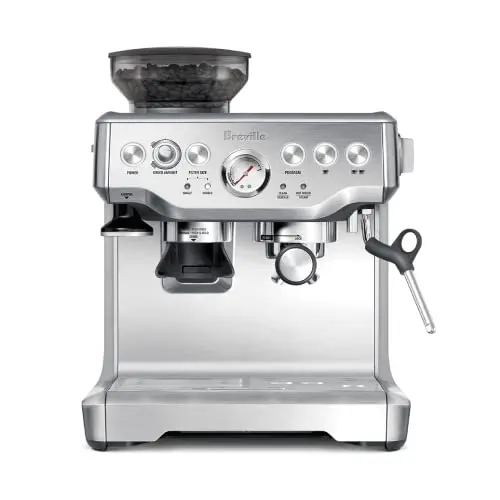
Barista Express BES870XL – Built-In Grinder, Cafe-Style Shots
The Barista Express is the closest thing in this lineup to a full home espresso bar. A conical burr grinder sits on top and doses straight into the portafilter, so you go from whole beans to a finished shot without a second appliance on the counter. Digital PID regulation holds brew temperature steady, and low-pressure pre-infusion eases into the puck instead of hitting it all at once.
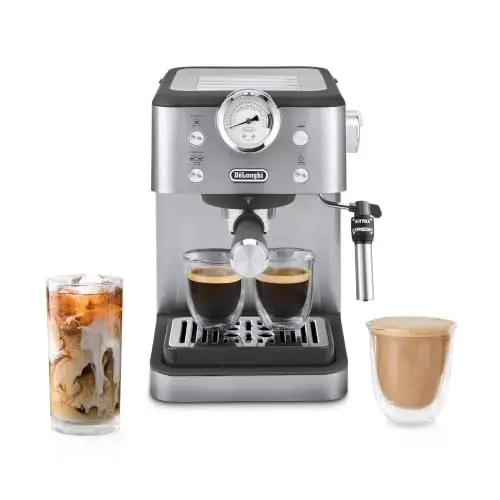
Classic Signature EM450M – Italian Thermoblock Speed
De’Longhi’s Classic Signature leans on Thermoblock heating to cut warm-up time, then hands you preset single and double shots so the dose is repeatable. The adjustable two-setting steam wand switches between silky steamed milk and drier microfoam for latte art. A pressure gauge on the front keeps you honest about extraction, and the compact stainless body fits a small kitchen.

Classic Stovetop Espresso – The Authentic Moka Route
No pump, no cord, no electronics. The Primula is a cast aluminum moka pot that builds pressure with steam on gas, electric, ceramic, or even propane stovetops and produces six demitasse servings in a few minutes. Fill the base with water, add ground coffee to the funnel filter, set it on the heat, and listen for the gurgle.

ECMG0 – Pre-Infusion and Gauge in a Compact Body
The Gevi packs pre-infusion, NTC temperature control, a visible pressure gauge, and a hot water function into a full stainless housing that’s only about five and a half inches wide. The steam wand’s nozzle pops off for cleaning, and the hot water spout doubles for Americanos, tea, and warming cups before a shot.
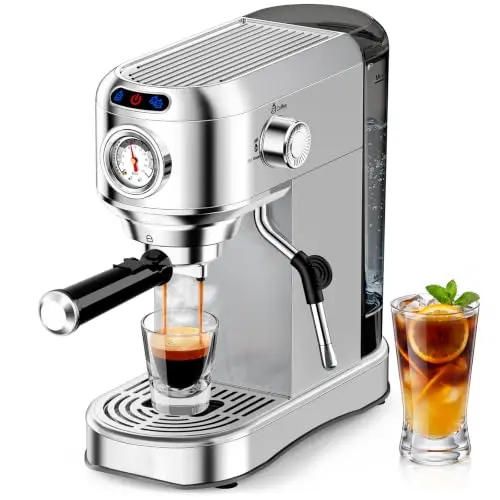
ST-699B – Slim 20-Bar Starter Machine
At just over five inches wide, the AERCANA takes up roughly a sheet of paper’s worth of counter. It pairs a 20-bar pump with a visible pressure gauge and a 1450W heating system rated for a preheat in the twenty-second range. A detachable 34oz tank and removable drip tray keep the daily routine simple.
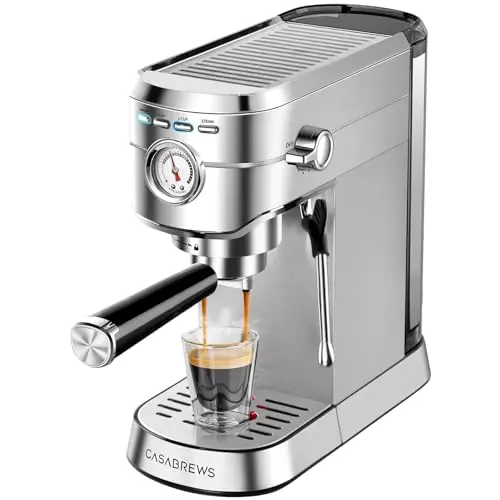
CM5418 – Gauge-Guided 20-Bar Brewing
The CM5418 is a compact brushed stainless semi-automatic with a 20-bar Italian pump, a 1350W boiler, and a front-facing pressure gauge so you can watch the extraction instead of guessing at it. The 34oz tank detaches for refilling, and single- and double-shot baskets plus a tamper-spoon come in the box.

C5010 Slim – PID Control in a Narrow Body
CHULUX keeps the C5010 to 5.5 inches wide while still fitting in a 20-bar Italian pump, a powerful boiler, pre-infusion, a pressure gauge, and food-grade materials through the boiler, tank, brew head, silicone lines, filter, and steam wand. A 40oz tank and 25-minute auto shut-off cover the daily-use basics.

3700 Essential – Bigger Tank, Simple Controls
The 3700 Essential strips the pressure gauge and drops the price, keeping the 20-bar Italian pump, 1350W heating, and a steam wand for microfoam. Its 43.9oz tank is the largest in this compact group, so refills come less often, and the drip tray lifts straight out for cleaning.
How We Evaluated These Italian Espresso Machines
A few things we can’t tell you: how each of these pumps and heating elements behaves after a year of daily doubles, or how the seals hold up against hard water. What we can tell you is how they stack up on paper and against the way people actually brew. We cross-referenced 8 espresso machines from 7 brands – one stovetop moka pot and seven pump machines – across 5 decision axes: pump and pressure system, temperature stability, milk-frothing capability, footprint and water capacity, and build materials with included accessories. Each axis earns its place. Pressure tells you how much headroom the pump has for steam; temperature stability decides whether tomorrow’s shot tastes like today’s; frothing capability determines whether milk drinks are in play at all.
We triangulated published specifications, absorbed owner feedback where available, and mapped every machine against three realistic buyer profiles: the fast-morning single shot, the person learning to texture milk, and the purist who wants the stovetop method. The scoring framework weighted real-world fit (70%) – how well a machine delivers the short, concentrated, crema-topped shot this category is named for – against feature differentiation (30%), meaning an integrated grinder, a pressure gauge, pre-infusion, or a wider tank. Seven distinct brands appear here and we have no commercial relationship with any of them; recommendations track fit and differentiation, not brand preference. If you want the shortest path to cafe-style shots, the Barista Express is the pick; if you’d rather keep the spend modest and still get real microfoam, the Classic Signature EM450M is where we’d point you.
How to Choose the Right Italian Espresso Machine
1. What Actually Makes an Italian Espresso Machine Italian
Italy doesn’t have a lock on espresso hardware, but it does set the vocabulary. The phrase Italian espresso machine tends to cover two things: machines with an Italian-made pump at the core – most of the 20-bar units in this category use one – and machines built around Italian brewing convention, meaning a short, concentrated shot pulled at roughly nine bars through a finely ground puck.
There’s an older definition too, and it matters. In most Italian homes the espresso machine is a stovetop moka pot, not a countertop appliance. It never generates nine bars, but it produces a dense, syrupy coffee that behaves much like espresso once milk hits it. If authenticity matters more than repeatability, the moka is the more Italian answer. If consistency matters more, you want a pump.
2. Moka Pot or Pump Machine: Which Route Fits You
Start with how you drink coffee. If it’s one or two small cups a day and you take them black, a moka pot delivers the most flavor per dollar and per square inch of counter. No warm-up, no descaling, nothing electronic to fail. The tradeoffs are real, though: no crema, no steam wand, and a brew that punishes inattention.
If milk drinks are the point – cappuccino, flat white, the occasional iced latte – you need a steam wand, and that means a pump machine. That’s where the decision actually gets made for most people. A pump machine also gives you a double-wall filter basket and repeatable dose control, which no stovetop can match.
3. Pressure Ratings and Temperature Stability in Italian Espresso Machines
Ignore the bar-count arms race. Twenty bar at the pump doesn’t mean twenty bar at the puck – machines regulate down to roughly nine bars for extraction, and the extra headroom mostly buys steam power and consistency. A 15-bar pump paired with good temperature control will beat a 20-bar machine that swings hot and cold.
Temperature is the spec that shows up in the cup. PID control and Thermoblock heating are the two approaches here: PID holds a target tightly, while Thermoblock heats water on demand through a metal block, which is fast but can run cool if you don’t let it stabilize. Either works. What you don’t want is a machine with neither, and if temperature consistency is your priority, the Barista Express BES870XL is the pick.
4. Milk Frothing: The Skill Gap Nobody Warns You About
A steam wand is only as good as the hand on the pitcher. Nearly every machine in this category can produce microfoam; the difference is how much control the wand gives you. A two-setting steam wand with a dedicated microfoam position is far more forgiving than a single knob that jumps from nothing to full blast.
Budget for the transition, too. Machines without a dual boiler or heat exchanger need to cool down between steaming and brewing, and several models here will trip overheat protection if you push them. Steam first, then brew, or wait out the cool-down cycle rather than fighting the flashing lights.
5. Footprint, Water Capacity, and Countertop Reality
Espresso machines are wider than they look in photos once you account for the portafilter handle and the headroom to lift a tank out. Anything under about six inches wide is genuinely small-kitchen friendly, and several machines here sit in that range. Check removable water tank placement as well – a rear tank you can’t lift out under a cabinet becomes a daily annoyance.
Capacity matters more than you’d expect. A 34oz water tank is fine for a couple of shots a day; a bigger reservoir buys you a few more mornings between refills but usually adds width. Neither is inherently better. If you’d rather refill less often, the 3700 Essential carries the largest tank in the compact group.
6. What Italian Espresso Machines Cost at Each Tier
At the entry level you’re choosing between a moka pot and a bare-bones pump machine. Both make real coffee; neither gives you a grinder or much temperature control. Expect stamped metal and plastic, and expect to buy a separate burr grinder.
The mid-range is where most people should land, and the Classic Signature EM450M sits squarely in it. This band is where you get a pressure gauge, pre-infusion, a usable steam wand, and stainless housing – the features that separate decent shots from repeatable ones. Above that, you’re paying for the grinder to live inside the machine, which is the single biggest upgrade available in this category.
Frequently Asked Questions
1. What's the difference between the Breville Barista Express and the De'Longhi Classic Signature?
The Barista Express is a bean-to-cup setup with a built-in grinder, so it replaces both your grinder and your machine, and it adds PID temperature control and pre-infusion. The Classic Signature is a compact pump machine with Thermoblock heating, preset single and double shots, and a two-setting steam wand – you supply the grinder. Pick the Barista Express if you want one appliance doing everything; pick the De’Longhi if you already own a grinder and want faster mornings in less space.
2. Is a moka pot really an espresso machine?
By the brewing definition, no – a moka pot builds roughly one to two bars of pressure rather than the nine bars of a pump machine, and it produces no true crema. By the cultural definition, absolutely: the stovetop moka is what most Italian households actually use, and it’s been that way for generations. The resulting coffee is denser and more concentrated than drip and holds up beautifully in milk. Just don’t expect the pump-machine shot you’d get from a 20-bar unit.
3. Does an Italian espresso machine need to be made in Italy?
No, and it’s worth being clear about. The Italian pump inside a machine is often the Italian component, while assembly and branding can come from anywhere. What actually matters is whether the machine follows the brewing convention: a fine grind, a firm tamp, roughly nine bars through the puck, and a short extraction. Several machines in this roundup are built outside Italy and still pull proper Italian-style shots – and brand heritage is a marketing signal, not a flavor one.
4. CASABREWS CM5418 vs. Gevi ECMG0: which compact 20-bar machine should you pick?
They’re close cousins. Both are 20-bar semi-automatics with a built-in pressure gauge and a steam wand, both compact, both with comparable tank sizes. The Gevi adds pre-infusion, NTC temperature control, a hot water function, and a cup warmer; the CASABREWS counters with a clean brushed stainless body and the same 1350W boiler. If you want the fuller feature set, the Gevi ECMG0 is the one. If the simpler, better-looking machine appeals, the CASABREWS is fine.
5. How do you keep a pump espresso machine running long-term?
Three habits cover most of it: clean the brew path regularly, descale on whatever schedule your water hardness demands, and never leave milk sitting on the steam wand. Use filtered water if your tap runs hard – scale is what kills heating elements. And give the machine time to reach stable temperature before your first shot, because brewing before the group is fully hot is the most common cause of sour, inconsistent espresso.
Final Verdict
For most people shopping this category, the Barista Express BES870XL is the answer – it’s the only machine here that removes the grinder variable entirely, and that’s the difference between espresso that’s occasionally good and espresso that’s repeatable. If the spend is hard to justify, the Classic Signature EM450M gets you Italian design, fast Thermoblock heat-up, and a genuinely usable steam wand for far less. And if authenticity matters more than convenience, the Primula Classic Stovetop is the one that’s been in Italian kitchens for generations: six cups, no electronics, nothing to break but a gasket. Build a coffee bar, buy the Breville. Want a compact daily driver, buy the De’Longhi. Want to taste what the fuss is about before spending real money, start on the stove.
