
Best Japanese Bed Frames – 2026 Reviews

The phrase Japanese bed frame gets used for two pieces of furniture that barely overlap. One is the low platform bed with joinery-inspired connections and a Japandi finish – clean lines, no box spring, the mattress sitting a few inches off the floor. The other is the tatami-style slat base: a panel you unroll on the floor so a futon or shikibuton can breathe underneath it.
That split is the first thing to sort out, because it decides everything else. If you sleep on a standard mattress, you’re shopping for a platform, and the specs that matter are slat spacing, center support, and how low you actually want to sleep. If you sleep on a futon, you’re shopping for airflow and something that disappears when you’re not using it – and most frames in this category are simply wrong for you.
The second axis is construction honesty. Plenty of frames wear the Japanese label as a style tag while being engineered wood with a laminate grain. Others genuinely use mortise-and-tenon style joinery and solid material. We looked at both, weighed what each one is actually for, and came back with picks for the platform shopper, the futon sleeper, and the buyer who wants the look without the spend.
Best Japanese Bed Frames – 2026 Reviews

Thor – Solid Wood Japanese Joinery Platform
A solid wood queen platform built around joinery-style connections rather than exposed hardware. The Thor ships in a single compact carton, assembles with tool-free connections and the included hardware, and sits at 14 inches with roughly 10 inches of clearance underneath. Rounded corners, a reinforced center support rail, and a quiet slat deck round it out.

Japanese Joinery Bamboo Bed Frame – Headboard Comfort
A king platform in FSC-certified Moso bamboo with an upholstered, high-density headboard. Joinery-inspired mortise-and-tenon connections pair with a reinforced metal center beam and anti-noise strips, and the platform sits low with about eight inches of storage clearance underneath. Rounded edges and a lacquered finish keep the look clean.

Foldable Floor Bed Frame – Roll-Up Base for Futons
A roll-up slat base made for Japanese futons rather than Western mattresses. Seventeen one-piece pine slats with one-inch gaps sit just over an inch off the floor, creating airflow under the bedding. Nylon straps let it fold for storage, pre-installed anti-slip mats protect hard floors, and it arrives ready to use with no assembly.
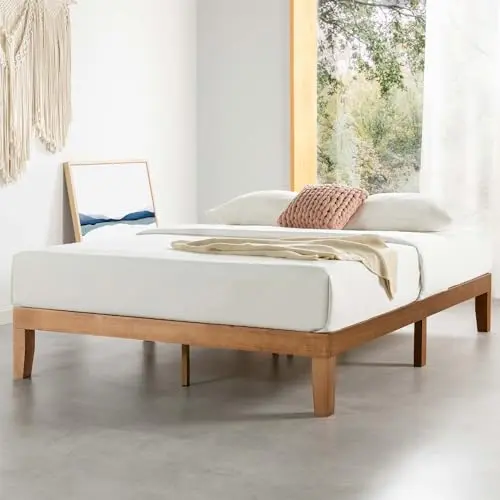
Naturalista Classic – Solid Pine Platform Bed
A 12-inch solid pine platform with wooden slats, non-slip tape, and a mid-century silhouette. No box spring required – the slat deck carries the mattress directly, and the frame is rated to 1000 pounds. Assembly is straightforward, and spot cleaning with a damp cloth is the extent of the maintenance.

Floor-Standing Platform Bed – Low-Profile Minimalist Look
A floor-standing platform in walnut-finish engineered wood, sitting just under eight inches tall with no headboard and no legs. Reinforced cross beams and wood slats support the mattress without a box spring, and the low, flat base keeps dust from collecting underneath. Built for small rooms and minimalist bedrooms.
How We Evaluated These Japanese Bed Frames
We didn’t put these frames through a workshop stress test or a full year of nightly use. What we did: cross-referenced 5 Japanese bed frame models from 5 distinct brands across 6 decision axes – joinery and connection method, frame material, slat construction and spacing, height and under-bed clearance, assembly complexity, and mattress compatibility. We triangulated published specifications, audited each brand’s stated weight capacity and care instructions, and mapped feature sets against the two buyer profiles this category actually serves: people furnishing a Japandi-style bedroom, and people sleeping on a Japanese futon or shikibuton who need a breathable base rather than a tall platform.
The scoring framework weighted real-world fit (70%) – how well each frame delivers on its stated use case, from joint stability to slat support – against feature differentiation (30%) – the details that separate one frame from the next, like upholstered headboards, roll-up storage, or hand-sanded edges. We have no commercial relationship with any brand here; recommendations track fit and differentiation, not brand preference. If you want the most convincing joinery build, the Thor is your match; if you sleep on a futon and need airflow, Lobotou serves you better.
One honest limit: we did not assemble these frames ourselves, torque-test the joints, or measure slat sag over months of use. No review of bed frames can promise how a joint holds up after years of nightly load. What we can tell you is how the construction claims, published specs, and owner feedback line up – and where they don’t.
How to Choose the Right Japanese Bed Frame
1. What Actually Makes a Bed Frame Japanese
The term gets applied loosely, so it helps to know what’s actually being described. In practice these frames lean on three things: a low sleeping height, visible natural materials – wood, bamboo, or a pine slat deck – and joinery-inspired connections instead of exposed metal bracketry. The Japandi look most shoppers picture is Japanese minimalism blended with Scandinavian warmth, which is why so many options land in walnut or natural finishes with softly rounded corners.
What it is not is a formal standard. Some frames here use real mortise-and-tenon style joints, others hide conventional bolts behind a clean facade, and one is a roll-out slat panel with no joinery at all. All three get the label. The differences surface in how they hold up, not in the marketing copy.
2. Joinery and Slats: What Actually Holds the Mattress Up
Slats do the real work on any platform bed frame, and two numbers matter more than the rest. Slat spacing determines how evenly a mattress is supported – narrow gaps are better, and they matter even more for foam, which can sink between wide gaps. A center support rail is the other thing to look for on queen and king sizes; without one, the middle of the deck takes all the load, and that’s where complaints start.
Joinery is the other half of the story. Real mortise-and-tenon connections spread force across the joint rather than concentrating it at a bolt hole, which is why joinery-built frames tend to stay quiet longer. If joinery is genuinely what you’re shopping for, the Thor is the clearest example here – it’s the only frame in this group that makes the joint itself the selling point.
3. Height, Clearance, and the Futon Question
Height splits this category harder than any other spec. A floor bed sits a few inches off the ground for a clean, low silhouette; a platform frame runs 12 to 14 inches and gives you under-bed clearance for bins and a vacuum. Neither is better – it depends on whether you want the room to feel open or you want somewhere to put your luggage.
If you sleep on a futon or shikibuton, the question changes entirely. Those mattresses need to breathe, and a solid deck traps moisture underneath. A tatami-style slat base is the answer, and the Lobotou base is built for exactly that job: just over an inch tall, with one-inch slat gaps and no assembly.
4. Wood, Bamboo, and Engineered Wood Compared
Solid pine is the entry material and it’s honest about what it is: light, easy to move, and soft enough to dent. Hardwoods such as rubberwood hold up better over time. Moso bamboo sits somewhere between – dense, dimensionally stable, and often certified, which is why it shows up on the higher-end frames. Engineered wood with a laminate finish gets you a convincing look at the lowest cost, but it won’t age the way solid material does.
Whichever you pick, check the slat material separately from the frame material. Plenty of solid wood frames ship with plywood or softwood slats, and that’s the part that fails first. If certification and a bamboo build are the priority, the Yechen is the frame here organized around that.
5. Matching a Japanese Bed Frame to Your Mattress and Room
Mattress compatibility is where most returns happen. Confirm the frame’s listed size matches your mattress exactly – a queen frame and a queen mattress from different makers can differ by an inch or two, and low-profile frames have less tolerance. Foam mattresses are the most slat-sensitive; innerspring and hybrid models are more forgiving of wider gaps.
Then think about the room. A no-headboard design against a wall reads as a clean, low platform, but floating it in the middle of a large bedroom can look unfinished. Assembly time is the last practical variable – joinery-style frames are quoted anywhere from 20 to 30 minutes, and a first-timer should budget more.
6. Budget, Mid-Range, and Premium Japanese Bed Frames
The category breaks into three clean tiers. At the entry tier you’re getting solid pine or engineered wood, basic slats, and a frame that’s fine for one person or a guest room. The mid-range tier adds hardwood or bamboo, better slat decks, and more careful finishing. The premium tier is where joinery, headboards, and heavier center support show up.
Spend up if you want the frame to outlast a mattress cycle or two. Stay entry if the bed is going in a spare room and you’d rather put the money into the mattress. Both are defensible – the mistake is paying mid-range money for an entry-tier slat deck.
Frequently Asked Questions
1. What's the difference between the Thor and the Yechen Japanese joinery bed frames?
Both borrow from joinery traditions, but they’re solving different problems. The Thor is a solid wood platform with a walnut finish and no headboard – the more furniture-like, joinery-forward build, quoted at around 20 minutes to assemble. The Yechen adds an upholstered headboard, uses FSC-certified Moso bamboo, and backs the slat deck with a metal center beam, but it’s heavier and listed in king size only. Pick the Thor for build quality; pick the Yechen if a headboard is non-negotiable.
2. How does a roll-up slat base compare to a solid platform frame?
They serve different sleepers. The Lobotou is a slatted floor panel that rolls up for storage, sits about an inch off the floor, and exists to give a futon airflow – no frame, no legs, no assembly. A solid platform frame raises the mattress 12 inches or more, takes a standard mattress without a box spring, and gives you clearance underneath. If you sleep on a Western mattress, you want the platform; if you sleep on a shikibuton, the Lobotou base is the tool for the job.
3. Are Japanese bed frames actually lower than standard platform beds?
Usually, but not always. The floor-standing and tatami-inspired designs here run between roughly one inch and eight inches, while the more conventional platform frames sit at 12 to 14 inches. That’s still lower than a traditional bed with a box spring, which is where the reputation comes from. Low profile is a design choice rather than a rule, so check the listed height before you buy – especially if anyone in the house has knee or hip issues.
4. Will a Japanese bed frame work with a standard American mattress?
Yes, as long as you match sizes. Every frame here is listed in standard U.S. sizes, and slat-based support works with foam, innerspring, and hybrid mattresses without a box spring. Two caveats: slat spacing matters most for all-foam beds, so narrow gaps are safer, and some frames only come in one size – the Yechen is king-only, for instance. Measure your mattress before ordering, since queen sizing varies slightly between manufacturers.
5. How much assembly is involved in a Japanese joinery bed frame?
Less than you’d expect, and it varies. The Thor is quoted at about 20 minutes with tool-free connections and arrives in a single carton; the Yechen runs closer to 30. The Lobotou base needs no assembly at all – it unrolls and sits down. Budget extra time regardless: sorting hardware and reading the diagram first usually saves more time than it costs, and having a second person helps on queen and king sizes.
Final Verdict
For most shoppers, the Thor is the answer. It’s the one frame here where the Japanese joinery label describes actual construction rather than a finish choice – solid wood, quiet slats, tool-free assembly, and a silhouette that reads Japandi without trying too hard.
If you sleep on a futon, none of the platforms make sense. The Lobotou exists for that exact job, and it delivers airflow with zero assembly. And if you want a real wood platform on a tighter budget, the Mellow covers the fundamentals at the entry tier – just go in knowing the pine slats are the part to watch.
Buy for how you actually sleep. A joinery frame is wasted on a shikibuton, and a one-inch slat base is wasted on an innerspring queen.
