
Best Keurig-Type Coffee Makers – 2026 Reviews

Pod coffee machines all look roughly the same on a shelf and behave completely differently at 6:30 in the morning. The gap shows up fast: how hot the cup actually gets, whether you’re locked into pods or can drop in loose grounds, and how often you’re refilling a reservoir that looked bigger in the product photos.
Two things separate the machines worth owning from the ones that end up in a cabinet. The first is brew flexibility – the spread of cup sizes on offer and whether the brewer handles both pods and grounds. The second is the reservoir-to-footprint trade-off: a big removable tank means fewer refills, but it also means a machine that claims a serious slice of counter real estate and may not clear your upper cabinets.
We compared the current pod brewers across the major brands, from compact travel-friendly units to full combo machines with carafes and milk frothers. What follows is a market-level guide, not a pitch for one label – the right pick depends on whether you drink one black cup a day or run a household where somebody wants a latte and somebody else wants a pot.
Best Keurig-Type Coffee Makers – 2026 Reviews
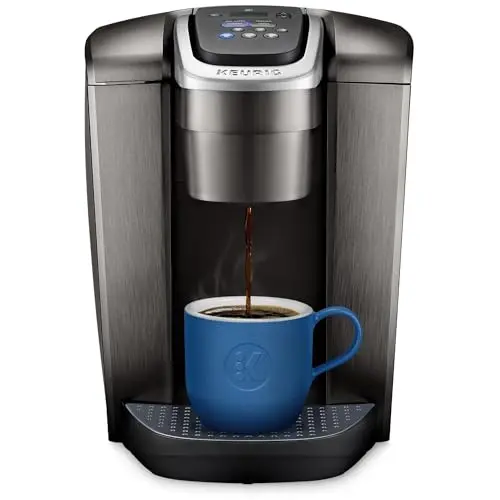
K-Elite – Strength Control and Iced Coffee
A full-featured single-serve brewer covering the widest spread of cup sizes here – 4, 6, 8, 10, and 12 ounces – with a strong brew setting and a dedicated iced coffee button. The 75-ounce reservoir lifts off for refilling, and the drip tray comes out to clear taller travel mugs.
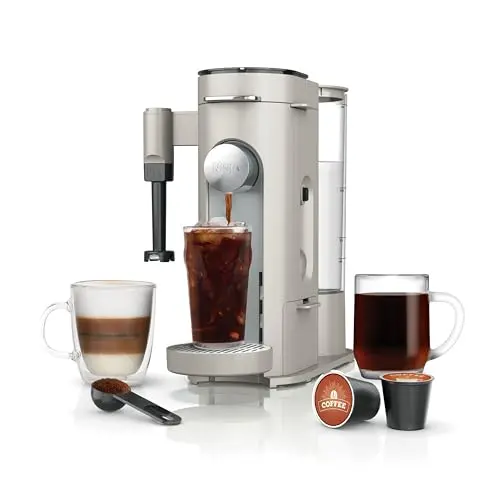
PB051ST – Pods, Grounds, and a Built-In Frother
A combo brewer that takes K-Cup pods or loose grounds, offers four brew styles including Classic, Rich, Specialty, and Over Ice, and stretches to 24-ounce cups. The 56-ounce reservoir is removable and a folding milk frother handles lattes and cappuccinos.
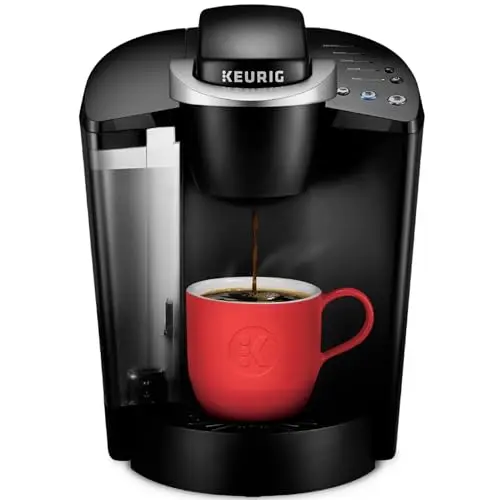
K-Classic – Straightforward Pod Brewing
The uncomplicated option: three brew sizes at 6, 8, and 10 ounces, a 48-ounce removable reservoir, plain button controls, and auto-off after two hours idle. It ships with a water filter handle and a starter set of pods.
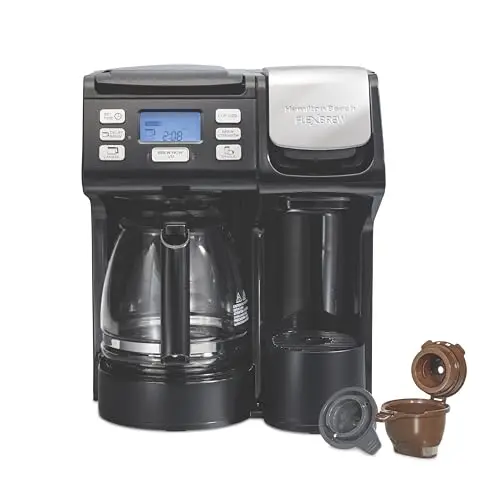
FlexBrew Trio – Single Serve Plus 12-Cup Carafe
A three-way brewer: a single cup from a pod, a single cup from grounds, or a full 12-cup glass carafe. A shared 56-ounce reservoir feeds both sides, and the single-serve side is rated for a cup in about 90 seconds.
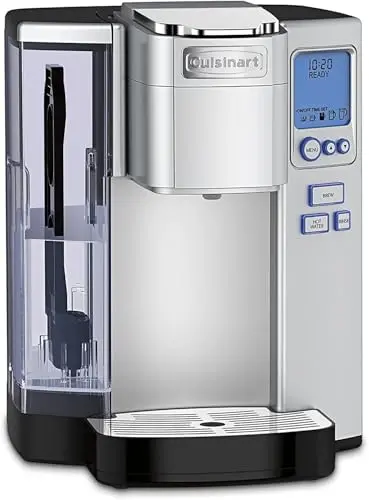
SS-10P1 – 72-Ounce Reservoir and Hot Water Tap
A programmable single-serve pod brewer with a 72-ounce reservoir, five cup-size settings, a separate hot water dispenser, and a reusable filter alongside a built-in charcoal water filter. The backlit LCD manages auto on/off and adjustable brew temperature.
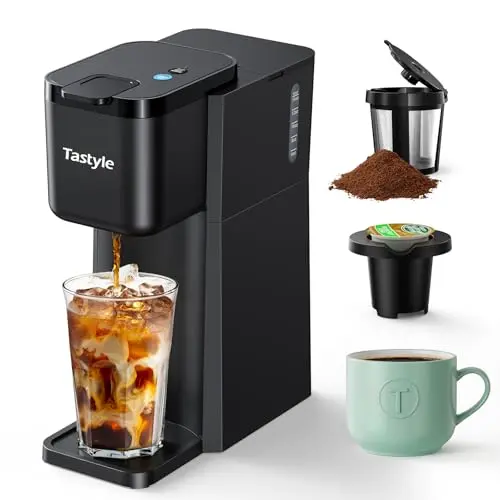
K310IC – Compact Hot and Iced Brewer
A compact brewer that handles both K-Cup pods and grounds, brewing 6 to 14 ounces hot or over ice, with a descaling reminder and self-cleaning cycle. Small enough for a dorm desk, office nook, or RV counter.
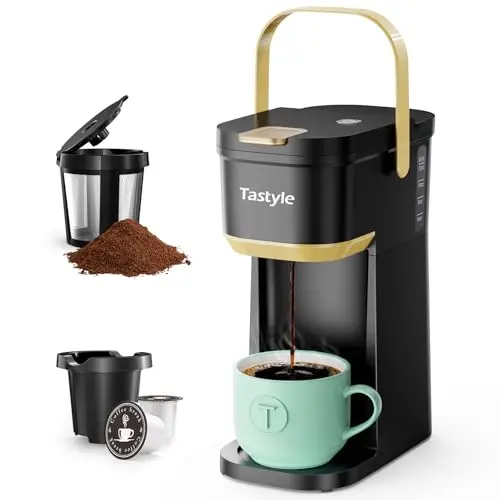
K302 – Travel-Ready Brewer with Carry Handle
A portable single-serve brewer for pods or up to 20 grams of grounds, with a built-in carry handle and a visible 12-ounce tank marked at 6, 8, 10, and 12 ounces. ETL certified and rated at 800 watts.
How We Evaluated These Keurig-Type Coffee Makers
We didn’t run lab temperature probes or timed brew cycles with calibrated equipment. What we did: cross-referenced 7 pod coffee makers from 5 distinct brands across five decision axes – brew size range, reservoir capacity and refill frequency, coffee input flexibility (pods versus grounds), footprint and counter fit, and maintenance features like descaling reminders and removable tanks. We also mapped each model against representative buyer profiles: one-cup-a-day drinkers, split households, small kitchens, and people who brew on the road.
We triangulated published specifications, feature sets, and owner feedback where available, then weighed how each brewer would hold up in daily use rather than how long its feature list is. The scoring framework weighted real-world fit (70%) – how well a machine delivers on the way people actually brew – against feature differentiation (30%) – the extras that genuinely change a routine, like a milk frother or a separate hot water dispenser.
We have no commercial relationship with any brand here; recommendations track fit and differentiation, not brand preference. A note on what we can’t tell you: we didn’t measure brew temperature across repeated cycles or run these machines for months to see what fails first – owner feedback is our best signal there, and it’s uneven across this lineup. If you want the widest brew range in a pod-first machine, the K-Elite is your match; if pods and grounds with a frother sounds more like your morning, the PB051ST is the better call.
How to Choose the Right Keurig-Type Coffee Maker
1. What Separates a Good Pod Coffee Maker From a Great One
Most brewers in this category will make a drinkable cup. The gap shows up in three places: brew temperature consistency, brew size range, and whether the machine gives you any control over strength. A brewer that offers only one or two cup sizes forces you to adapt to it rather than the other way around.
The other separator is maintenance design. A removable reservoir, a descaling reminder, and dishwasher-safe parts sound boring until you’ve scrubbed a fixed tank with a bottle brush. Those details decide whether you still like the machine in month eight.
2. Brew Size Range in Single Serve Coffee Makers: Why 4 to 24 Ounces Matters
Brew size range is the most useful spec to check first. A 6-ounce setting is where you get the strongest, most concentrated cup from a pod; 10 to 12 ounces is what most people actually drink in a travel mug. If you routinely fill a 20-ounce tumbler, only a handful of machines here can do it in one pass.
Watch the difference between pod brew sizes and grounds brew sizes. Several machines offer a wider range with loose coffee than with pods, so the number on the box may not describe the way you brew. A strong brew setting is worth having too – it slows the flow rather than adding more coffee, which changes texture more than caffeine.
3. Reservoir Size and Refill Frequency: What Actually Saves You Time
Reservoir capacity ranges widely here, and the difference matters most in shared kitchens. A small fixed tank means a refill per cup; a larger removable tank can carry a household through a morning. Removable is the key word – topping up a fixed tank from a pitcher is the most common everyday annoyance in this category.
Bigger isn’t automatically better, though. More tank volume usually brings a larger counter footprint, so measure your space before you fall for a spec sheet. If you brew one cup a day and drink it standing up, a compact unit with a small tank is the smarter trade.
4. Pods, Grounds, or Both: Choosing Your Coffee Input
Pure pod machines are the simplest and the most limiting. Dual-input brewers that accept both K-Cup pods and loose grounds let you buy whatever roast you like, which usually costs less per cup and tastes fresher. The trade-off is a reusable brew basket to rinse after every grounds brew.
If you’re committed to pods, verify K-Cup compatibility explicitly – a few machines accept only the original pod format. If you want grounds, check the maximum grounds capacity; small baskets produce weak cups because there simply isn’t enough coffee in the chamber.
5. Footprint and Counter Clearance for Pod Coffee Makers
Counter footprint is where spec sheets mislead most often – height matters as much as width if you have upper cabinets. Several brewers here sit tall enough to need open space above them, and the pod handle adds clearance when it swings open.
If you brew into a travel mug, look for a removable drip tray. Without one, a tall mug won’t fit and you’ll end up brewing into a cup and pouring. For split households where someone wants a pot and someone wants a pod, a FlexBrew Trio style machine covers both from one counter spot.
6. Keurig K-Elite vs. Ninja PB051ST: Which Pod Coffee Maker Fits Your Routine?
These two represent the main philosophies in this category. The K-Elite is a pod-first machine that does pods well, adds a separate hot water tap, and keeps a narrow-ish profile for its reservoir size. The PB051ST is a flexibility play – grounds, pods, four brew styles, and a frother.
Choose the Keurig if you drink plain coffee and tea and want hot water on demand without a kettle. Choose the Ninja if you want iced coffee, milk-based drinks, or the option to grind your own beans. Neither is objectively better; the question is which routine you’re actually buying for.
7. Descaling, Cleaning, and Making a Pod Coffee Maker Last
Descaling is the maintenance task people skip and later blame on the machine. Hard water leaves calcium deposits that slow the pump and cool the brew. A descaling reminder is genuinely useful here – several brewers in this lineup have one, and it removes the guesswork about timing.
Rinse the brew basket and pod holder after every use, run the self-cleaning cycle when prompted, and use filtered water if your tap runs hard. Owner feedback across this category repeatedly points to short service lives, and scale buildup is one of the more preventable causes.
Frequently Asked Questions
1. How does the Ninja PB051ST compare to the Keurig K-Elite?
The Keurig is pod-only and focused on doing pod coffee well: five brew sizes, a strong brew setting, iced coffee, and a separate hot water dispenser. The Ninja adds grounds brewing, four brew styles, and a built-in milk frother, and it reaches larger cup sizes. If you mostly drink black coffee and tea, the Keurig is the cleaner machine. If you want lattes or your own beans, the Ninja earns its footprint. Both have owner feedback about early failures, so keep the warranty paperwork.
2. Is the Cuisinart SS-10P1 a good alternative to a Keurig?
It is if reservoir capacity and a separate hot water dispenser rank high on your list – the tank is bigger than most, and the machine is fully programmable with adjustable temperature. The catch is brew temperature: lukewarm cups come up repeatedly in owner feedback, and the pump is louder than average. For the hottest cup, a Keurig-style pod-first brewer is the safer bet; for a big tank and a hot water tap, the Cuisinart SS-10P1 works.
3. Do third-party brewers like Tastyle work with standard K-Cup pods?
Yes – both Tastyle models list K-Cup compatibility and also accept loose grounds. What differs from the big brands is build consistency: feedback on the compact Tastyle K310IC leans positive on brewing and footprint, but includes units that stopped working early. Treat them as budget-tier machines with shorter expected service lives rather than direct equivalents.
4. How many cups can I brew before refilling the reservoir?
That depends on tank size and cup size. A small fixed tank means a refill per cup, while a removable reservoir in the larger range can carry a household through a morning of 8-ounce cups. Remember that brew size changes the math – 12-ounce cups drain a tank roughly twice as fast as 6-ounce cups.
5. Do I need a pod coffee maker if I only drink one cup a day?
A compact single-serve brewer fits that pattern well – no carafe to clean and no coffee sitting on a hot plate. Look for a small footprint, a removable drip tray if you use a travel mug, and a descaling reminder so the machine lasts. The trade-off is per-cup cost: pods are convenient but usually pricier than brewing grounds in the same machine.
Final Verdict
For most people, the K-Elite is the answer – five cup sizes, a strong brew setting, iced coffee, and a hot water tap without adding a kettle to the counter. It’s the pod brewer we’d point a friend toward first.
If your routine includes lattes, iced drinks, or your own ground coffee, the PB051ST does more for a similar footprint and adds a frother you’ll actually use. And when budget or counter space is the constraint, the Tastyle K310IC gets you hot and iced brewing in a genuinely small package, with the caveat that you’re trading service life for size.
Start with how you actually brew – pod or grounds, one cup or a pot, hot or iced – and the choice narrows fast.
