
Best Leg Elevation Pillows For Edema – 2026 Reviews

Swollen ankles and heavy legs have a way of making every other position feel wrong. For edema, the goal is not just to put your feet up-it is to elevate the legs above heart level, keep the knees and ankles supported, and stay comfortable long enough for the swelling to ease.
The difference between a helpful leg elevation pillow and a frustrating one usually comes down to height and angle, firmness, and whether the surface keeps your legs from sliding out of position. Adjustability matters, too, because edema needs vary from one person and one recovery stage to the next.
We looked across the market at both-leg wedges, single-leg recovery pillows, and adjustable foam designs to sort out which ones fit different edema needs. This guide focuses on practical fit-height, support, stability, and coverage-so you can choose the right leg elevation pillow for your situation.
Best Leg Elevation Pillows for Edema – 2026 Reviews
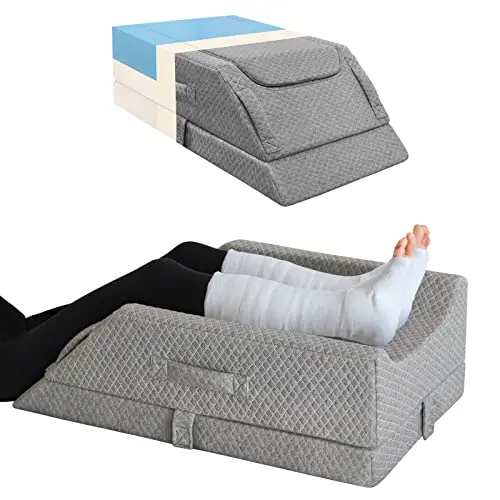
Adjustable Double-Leg Wedge – Cooling Gel Support for Swelling
A double-leg wedge with layered height adjustment, a wide U-shaped groove, and cooling gel memory foam. The cover is breathable, washable, and backed by a non-slip base with four handles for repositioning.

Single-Leg Wavy Groove Wedge – Keeps Knee and Ankle Aligned
A single-leg memory foam wedge with a wavy groove that lifts the foot and helps keep the knee straight. It adjusts between two heights with Velcro-secured layers and includes gel-infused foam, edge guards, and a washable cover.

Memory Foam Leg Wedge – Anti-Slip Support for Daily Swelling
A memory foam and high-density foam wedge sized for leg and knee elevation, with an anti-skid bottom, dual handles, and a removable washable cover. It is built for sleeping, reading, and recovery sessions on a bed or sofa.

Single-Leg Adjustable Wedge – Concave Support for Swelling
A single-leg memory foam wedge with adjustable 6- and 9-inch heights, concave sides to keep the foot centered, and a non-slip bottom. The cover is removable and washable for recovery use.

Two-Layer Foam Wedge – CertiPUR-US Support for Swelling
A two-layer foam wedge with CertiPUR-US certified foam, a jacquard cover, dual front handles, and a non-slip base. It is sized for both-leg elevation during sleep, reading, or post-surgery rest.

Three-Height Leg Wedge – Customizable Elevation for Swelling
A memory foam and high-density foam wedge with three height positions, a non-slip base, three handles, and a machine-washable cover. It is built for both-leg elevation during sleep, reading, or recovery.

Flat-Top Leg Wedge – Firm Post-Surgery Elevation
A flat-top foam wedge with a removable jacquard cover and machine-washable fabric. It is designed for leg, knee, and ankle elevation during sleep and post-surgery recovery.
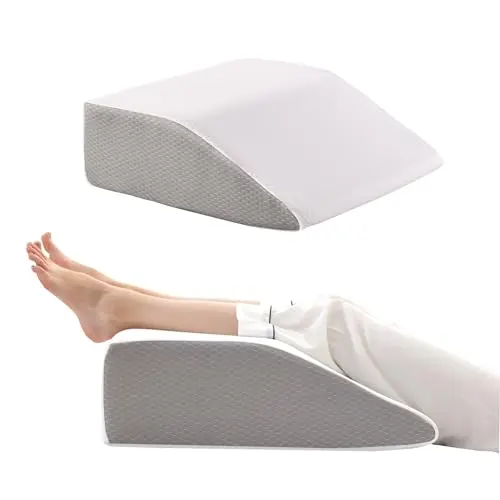
Firm Foam Leg Wedge – Durable Support for Swelling
A firm high-density foam wedge with a removable cover, ergonomic contour, and 8-inch height. It is built for leg, knee, and ankle elevation during sleep, reading, and recovery.

45-Degree Memory Foam Wedge – Contoured Leg Elevation
A memory foam and high-density foam wedge with a 45-degree incline, dual handles, a non-slip bottom, and a removable washable cover. It is sized for both-leg elevation during sleep, reading, and recovery.
How We Evaluated These Leg Elevation Pillows for Edema
We didn’t run clinical edema measurements, sleep-lab trials, or multi-week durability tests. What we did: cross-referenced 9 leg elevation pillow models from 8 distinct brands across six decision axes-elevation height and angle, firmness and pressure relief, leg and knee support, stability and grip, adjustability, and cover care and fit. We triangulated published specifications, feature sets, and owner feedback where available, then mapped each option against common edema scenarios such as bilateral swelling, single-leg recovery, and post-surgery rest. We kept the comparison grounded in what each pillow is asked to do at home: support a leg through hours of rest, not just look good in a product photo.
The scoring framework weighted real-world fit (70%)-how well each pillow delivers usable elevation for edema without sacrificing comfort-against feature differentiation (30%)-adjustability, cooling or foam upgrades, stability features, and cover quality. We also weighed how easy each pillow is to live with night after night: whether the cover washes cleanly, whether the base stays put, and whether the height can be adjusted without rebuilding the whole setup. We have no commercial relationship with the brands featured; recommendations track fit and differentiation, not brand preference. If you want adjustable both-leg elevation, the KingPavonini Adjustable Double-Leg Wedge is the strongest all-around choice. If one leg needs focused support, the KingPavonini Single-Leg Wavy Groove Wedge is the better match.
How to Choose the Right Leg Elevation Pillows for Edema
1. Why Height and Angle Matter for Edema
For edema, the pillow’s job is to raise the legs above heart level and hold them there comfortably. A shallow wedge may feel nice but do little for swelling; a steep one can be hard to stay on. Most useful designs land somewhere in the 6- to 10-inch range, with a gentle incline that supports the calves and keeps the knees from locking.
Adjustable height is a real advantage because edema changes. You may want a lower angle for reading and a higher one for rest. If you want to tune elevation without stacking pillows, the KingPavonini Adjustable Double-Leg Wedge is the pick.
2. Firmness, Foam, and Pressure Relief in a Leg Elevation Pillow
A leg elevation pillow needs enough firmness to hold its shape under the weight of your legs, but enough give to avoid pressure points. Memory foam tops soften the surface, while high-density foam bases keep the wedge from collapsing. For longer sessions, look for a cover that breathes and a foam that is certified where possible.
Softer is not automatically better. If you sink in too far, the effective elevation drops. If certified foam and a more affordable tier matter, the Ruqmuis Two-Layer Foam Wedge is the value pick.
3. Single-Leg vs Double-Leg Coverage for Edema
Bilateral edema usually calls for a double-leg wedge that supports both calves at once and keeps the legs from rolling apart. Unilateral swelling, ankle surgery, or a knee that needs to stay straight may be better served by a single-leg design with a groove or concave sides.
Coverage is a fit decision, not a quality ranking. A double-leg pillow is more efficient for both legs; a single-leg pillow is easier to position precisely. For one-sided swelling, the KingPavonini Single-Leg Wavy Groove Wedge keeps the knee straighter.
4. Stability, Handles, and Cover Care
Sliding is one of the quiet reasons a leg elevation pillow stops helping. A non-slip bottom or silicone grip makes a difference on smooth sheets, and handles let you reposition the wedge without sitting up and resetting everything. Raised edges or a groove can also keep the leg centered.
Because these pillows get daily use, removable washable covers are worth prioritizing. A large zipper opening makes the cover easier to take off, and a breathable fabric is more comfortable during longer sessions.
5. Adjustability and Fit: Matching a Leg Elevation Pillow to Your Body
Check the length, width, and max height before buying. A 24-inch length may be fine for some sleepers and short for taller ones. If you sleep on your back, a wider surface can help; if you move around, a narrower single-leg shape may be easier to manage.
Adjustable layers add flexibility but also more parts to keep aligned. Fixed wedges are simpler and often firmer. Match the pillow to your bed setup, your leg length, and how much elevation your clinician has recommended for edema.
Frequently Asked Questions
1. How high should a leg elevation pillow be for edema?
For many people, the target is a position that raises the legs above heart level without forcing the knees to lock or the hips to strain. A 6- to 10-inch incline is a common range, but the right height depends on your leg length, bed height, and what your clinician recommends. Adjustable pillows are useful because you can start lower and increase elevation as needed.
If you want both-leg adjustability, the KingPavonini Adjustable Double-Leg Wedge is the most flexible pick in this lineup.
2. What's the difference between the KingPavonini Adjustable Double-Leg Wedge and the MEGCXIT Memory Foam Leg Wedge?
The KingPavonini is a double-leg, height-adjustable wedge with a wide U-shaped groove, cooling gel memory foam, and a non-slip base with four handles. The MEGCXIT is a fixed-height 8-inch wedge with a memory foam top, anti-skid bottom, and dual handles. Choose the KingPavonini if you want to tune elevation and support both legs; choose the MEGCXIT if you prefer a simpler, set-and-forget wedge.
3. Is a single-leg or double-leg pillow better for edema?
It depends on whether the swelling is bilateral or one-sided. A double-leg wedge is more efficient for both legs and helps keep them from sliding apart. A single-leg design is better for focused ankle, foot, or knee recovery, especially when one leg needs to stay straight. If you have swelling in both legs, start with a double-leg pillow; if one leg is the main issue, a single-leg shape is easier to position.
4. What's the difference between the Ruqmuis Two-Layer Foam Wedge and the Bedluxe Firm Foam Leg Wedge?
The Ruqmuis uses a two-layer foam build with CertiPUR-US certified foam and a softer top layer, making it a more balanced choice for everyday swelling. The Bedluxe leans firmer with high-density foam and a contoured shape, which suits buyers who want structured support. Both are fixed-height wedges; the Ruqmuis is the value-oriented pick, while the Bedluxe is the firmer option.
5. Are memory foam leg elevation pillows too soft for edema?
Not necessarily. The useful combination is a soft memory foam top over a supportive high-density base. If the foam is too soft throughout, your legs can sink and the effective elevation drops. Look for a pillow that holds its shape, has a non-slip base, and keeps the legs comfortably supported without pressure points.
Final Verdict
For most buyers dealing with edema, the KingPavonini Adjustable Double-Leg Wedge is the answer. It combines adjustable height, a wide U-shaped groove, cooling gel memory foam, and a non-slip base, so it can handle both-leg elevation without feeling like a one-position compromise. If the swelling is concentrated in one leg, the KingPavonini Single-Leg Wavy Groove Wedge is the more focused recovery pick. Budget-conscious shoppers should look at the Ruqmuis Two-Layer Foam Wedge for certified foam and a straightforward fixed-height design. And if you want the widest spread of height settings, the jakoola Three-Height Leg Wedge gives you three positions to test. Start with the coverage you need, then choose the height and firmness that fit your recovery.
