
Best Maternity Pillows For Back Pain – 2026 Reviews

Somewhere in the second trimester, sleep stops being automatic. You roll onto your back, your lower back files a complaint, you shift onto your side, and now your hip aches and your belly feels like it’s hanging unsupported. The pillow pile you build at 3 a.m. – one behind you, one between the knees, one wedged under the bump – is usually the moment people start shopping for a maternity pillow.
The trouble is that “maternity pillow” describes a shape family, not a single product. The U-shaped body pillows that wrap both sides suit restless side sleepers. Compact wedge setups suit people whose real problem is ending up flat on their back. And two pillows that look identical in a listing photo can behave completely differently once the fill compresses underneath you – which is exactly where back-pain relief is won or lost.
So we cross-shopped the category the way you would: shape and coverage first, then fill behavior, cover fabric, and how each option holds up across a full night rather than a five-minute lie-down. What follows is a market survey, not a brand loyalty exercise – the pillows that genuinely help with back pain, plus the tradeoffs that only surface after a few weeks.
Best Maternity Pillows for Back Pain – 2026 Reviews
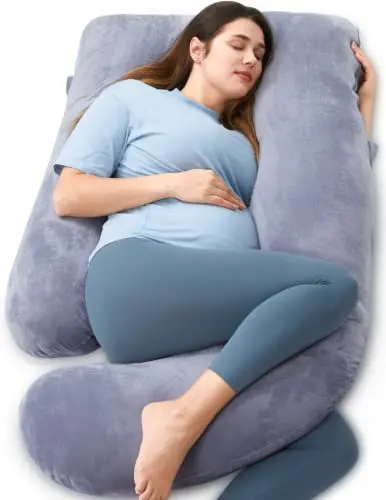
U-Shaped Full Body Pillow – All-Night Support for a Sore Back
Momcozy’s U-shaped body pillow wraps both sides of the body in one continuous hug, supporting head, back, belly, hips, and knees at once. The polyester fill is pitched at the balance point between soft and supportive, and the removable cover makes routine washing straightforward – useful when a pillow lives on your bed for months at a time.
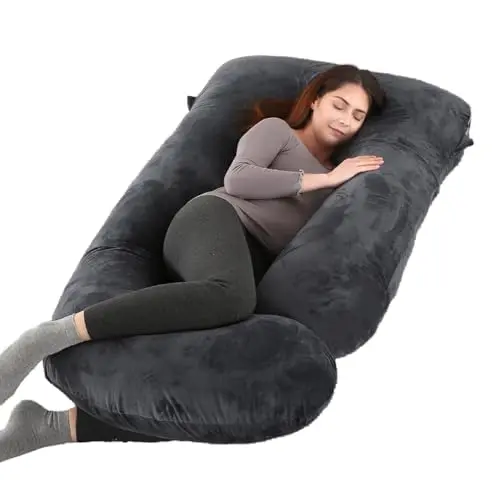
U Shape Pregnancy Pillow – Adjustable Fill for Tuned Support
A 57-inch U-shaped maternity pillow with one feature most rivals skip: a zippered inner cover that gives you direct access to the fill. Pull some out for a lower, softer loft; leave it full for firmer lumbar and belly support. Materials are OEKO-TEX STANDARD 100 certified, and the outer cover is machine washable.
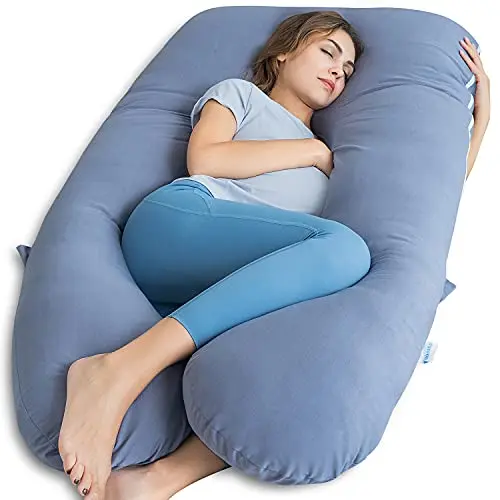
Cooling U-Shaped Maternity Pillow – Silky Cover for Hot Sleepers
A 55-inch U-shaped maternity pillow built around a breathable, silky cooling cover rather than a velvet one. It’s shaped to hold the belly and back together while encouraging side sleeping, and the cover is machine washable.
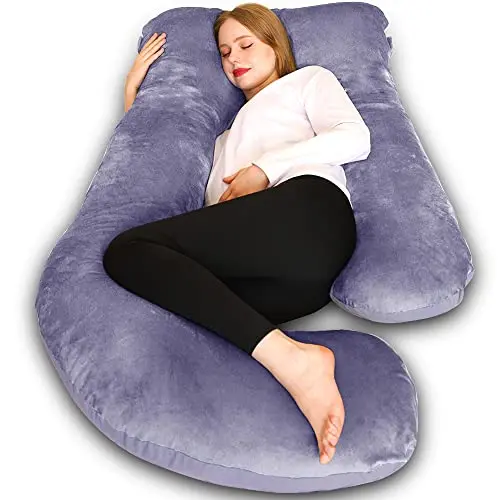
U-Shaped Full Body Pillow – Generous 58-Inch Coverage
A 58-inch U-shaped body pillow with a velvet outer cover and polyester fill, sized to run the full length of the body. The cover unzips at both ends and is machine washable, and the manufacturer backs it with a voluntary return window well beyond the standard retail period.
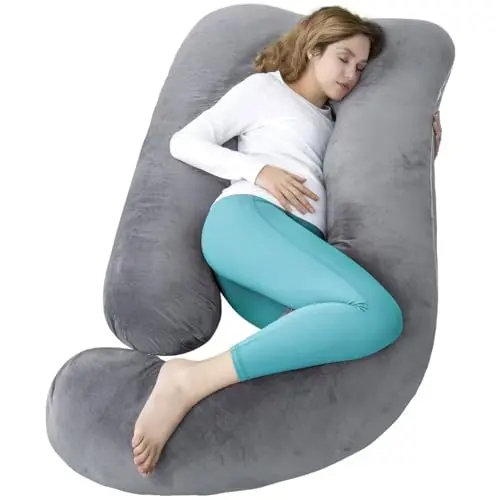
60-Inch U-Shaped Pillow – Extra-Large Asymmetric Wrap
A 60-inch U-shaped pillow with one side deliberately extended, so it wraps further around the body than a symmetrical design. Velvet cover, polyester fill, removable and machine washable. It’s also pitched at post-surgical recovery, not just pregnancy.
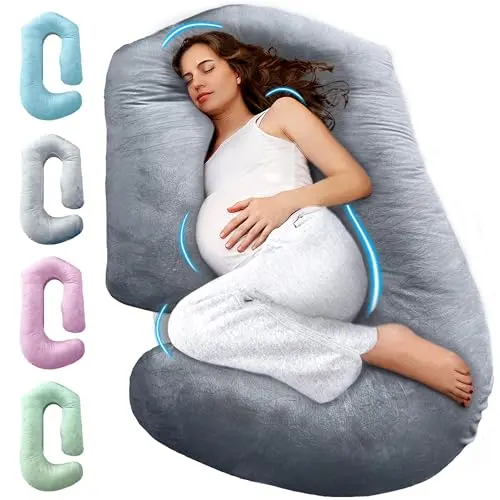
U+V+C Full Body Pillow – Three-Zone Contoured Support
A 57-inch pillow combining U, V, and C shaping – V for neck and head, C cradling the lower body, U bracing the upper and lower back. Filled with 7D polyester cotton, with a removable machine-washable cover and a 180-day warranty.
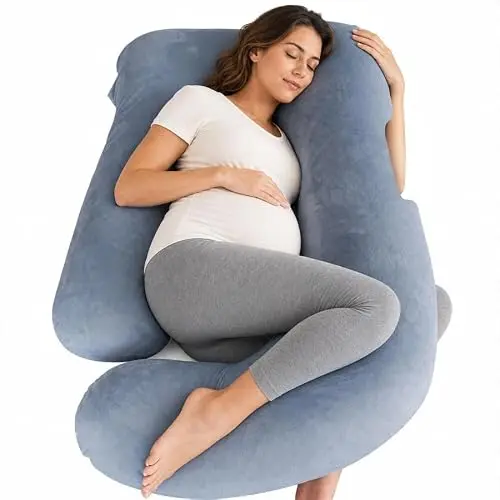
57-Inch U-Shaped Maternity Pillow – Soft All-Around Hug
A 57-inch U-shaped maternity pillow with a stretch-knit cover blending polyester and spandex over polyester fill. It supports head, back, belly, sides, knees, hips, and feet, and the cover is machine washable.
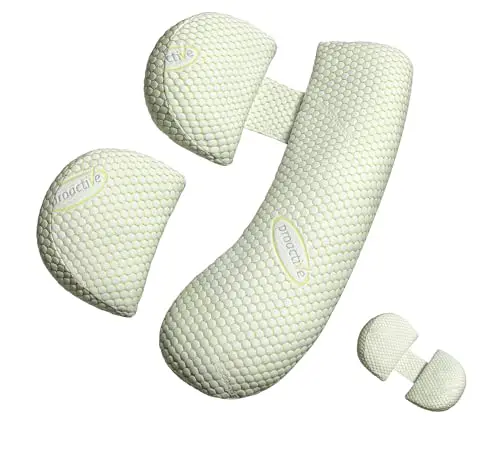
Adjustable Two-Piece Wedge – Compact Side-Sleeping Support
Not a U pillow at all – a two-piece adjustable wedge system. Two wedges sit behind and in front of you, linked by stretch panels, and the distance between them adjusts. Compact, lightweight, and machine washable.
How We Evaluated These Maternity Pillows for Back Pain
We didn’t run overnight sleep studies or pressure-mapping tests on a lab mattress. What we did: cross-referenced 8 maternity pillow models from 8 distinct brands across five decision axes – shape and body coverage, fill and loft, cover fabric and breathability, positioning flexibility, and care and warranty terms. We triangulated published specifications, feature sets, and owner feedback where available, then mapped each pillow against what back pain in pregnancy actually demands: stacked side-sleeping alignment, belly and lower-back support, and enough structure to stay put when you roll over at 3 a.m.
The scoring framework weighted real-world fit (70%) – how well a pillow holds the hips, belly, and lumbar spine through a full night – against feature differentiation (30%) – adjustable fill, cooling covers, warranty length, and shape innovation. We have no commercial relationship with any brand featured here; recommendations track fit and differentiation, not brand preference. If you flip sides constantly, the ALLOPERA is built for exactly that. If you sleep hot and need a cool surface against a sore back, the QUEEN ROSE is the smarter route.
Worth saying plainly: a maternity pillow is a positioning tool, not a treatment. It helps by keeping you on your side with the spine stacked and the belly supported, which is the mechanism most often linked to less overnight lumbar pressure. That’s the job every pillow in this lineup was judged against.
How to Choose the Right Maternity Pillows for Back Pain
1. U-Shaped vs. Wedge: Matching a Maternity Pillow to Your Back Pain
Two shape families are worth understanding before you shop. A U-shaped maternity pillow wraps both sides of the body, so your belly is supported in front and your lumbar spine is braced behind. A two-wedge setup does less but takes up far less room: one wedge behind the back to stop you rolling supine, one under or against the bump. If your pain is worst when you end up flat on your back, either works – the wedge is the more surgical tool, the U pillow the more comfortable one.
Coverage length matters more than most listings admit. Anything under about 55 inches tends to stop mid-calf on taller sleepers, which means knees and ankles go unsupported and the hip-alignment benefit quietly disappears. 58 to 60 inches is the safer zone. If you’re a committed side sleeper who flips often, the ALLOPERA is the pick here.
2. Fill, Loft, and Firmness: What Actually Relieves Lower-Back Pressure
Every pillow in this category is polyester-filled, but the amount and density vary enough to change how it behaves. A high-loft, densely filled pillow keeps your hips stacked and your lumbar spine straight. An under-filled one compresses flat under a belly and leaves you sagging toward the mattress, which is worse than no pillow at all. This is why adjustable fill is such a practical feature – you can remove fiber as your body changes instead of buying a second pillow at 32 weeks.
Firmness is personal, and no listing will settle it for you. Heavier sleepers and broad-shouldered side sleepers generally want more fill; lighter sleepers often find the same pillow over-stuffed. Some shoppers find dense fill under a velvet cover too warm and switch toward a cooling cover – a breathable silky or jersey surface makes a genuine difference when night sweats are already wrecking your sleep.
3. Momcozy vs. ALLOPERA: Which U-Shaped Maternity Pillow Suits Side Sleepers?
These are the two strongest all-rounders here, and they solve the same problem differently. The Momcozy arrives as a fixed, well-balanced package – a continuous U with fill that holds shape, no tuning required. The ALLOPERA asks for ten minutes of setup: open the inner zipper, pull out or add fill, close it up. Do that, and you get a pillow matched to your body at that point in pregnancy. Skip it, and it’s simply a decent U pillow.
Choose the Momcozy if you want something that works out of the box and you don’t mind it sleeping warm. Choose the ALLOPERA if you’ve already returned one pillow for being too firm or too flat and would rather not gamble again. Both support belly and back together, so the deciding factor is really how much control you want over firmness.
4. Cooling Covers, Washability, and Long-Term Value
A maternity pillow lives on your bed for six to nine months, often longer. That makes cover material a bigger deal than it sounds. Velvet and flannel feel wonderful in winter and become oppressive by the third trimester, when core temperature runs higher. Jersey, silky, and stretch-knit covers breathe better and are the safer bet for hot sleepers – the QUEEN ROSE is the clearest example of a pillow designed around that problem.
Check two care details before buying: whether the outer cover is removable and machine washable, and whether the inner pillow is spot-clean only. Most covers here wash fine; the fill almost never should go in a machine. Also weigh warranty length – coverage ranges from a standard retail return window up to a 180-day warranty, and the longer window is worth having when fill flattening is the most common long-term complaint.
5. How to Position a Maternity Pillow for Back Pain at Night
Shape matters less than placement. For lower-back pain, the goal is a stacked spine: an arm between the knees, one arm supporting the belly from the front, and the back arm tucked against the lumbar curve so you can lean into it. If your pain sits low in the sacroiliac area, knee support does most of the work – plenty of sleepers find that alone reduces morning ache.
Give any new pillow three to four nights before judging it, and adjust fill or position before deciding it’s wrong. If you keep waking flat on your back, that’s a positioning signal, not a comfort one: add a wedge behind you or rotate the U so one arm sits firmly against your spine.
Frequently Asked Questions
1. Do maternity pillows actually help with back pain?
They can, for a specific mechanical reason. Much pregnancy back pain is aggravated by lying flat on your back, which loads the lumbar spine. A maternity pillow works mainly by keeping you on your side and by stacking the hips and knees so the lower back isn’t twisted. The belly support is a secondary benefit – it stops the bump from dragging your spine forward.
What a pillow won’t do is treat an underlying issue. If pain radiates down a leg, comes with numbness, or doesn’t ease with positional changes, that’s a conversation for your clinician, not a bedding purchase. For ordinary mechanical lower-back ache, the positioning effect is real, which is why shape and coverage matter more than thread count.
2. What's the difference between the Momcozy and the QUEEN ROSE U-shaped pillows?
Mostly cover fabric and temperature. The Momcozy uses a standard removable cover over polyester fill and is widely described as sleeping warm. The QUEEN ROSE is built around a breathable silky cooling cover over a jersey base. Support is broadly similar – both wrap belly and back – but the QUEEN ROSE is slightly shorter at 55 inches and its U arms sit lower, so neck support is the weaker point. Go Momcozy for the more established all-round package, QUEEN ROSE if overheating is what’s wrecking your nights.
3. Is the ALLOPERA adjustable-fill pillow better than the PILLANI for firmness control?
Yes, if firmness control is the goal. The ALLOPERA lets you open the inner cover and physically remove or add fiber, so the loft can change as pregnancy progresses. The PILLANI has a fixed fill – a 7D polyester cotton that reads denser and more resilient than standard fiber – so its firmness is what it is.
The PILLANI wins on shape, though. Its V section supports the neck in a way a plain U pillow doesn’t, which some sleepers genuinely need. Pick ALLOPERA for tune-ability, PILLANI for a one-piece setup that replaces several pillows at once.
4. Can a maternity pillow help sciatica-related back pain?
5. How long can I keep using a maternity pillow after birth?
As long as it stays useful, which for many people is a while. U-shaped pillows work well as nursing and feeding support, as back support while sitting up in bed, and as a general body pillow for anyone with hip or shoulder discomfort. The main limitation is bed space – a 57-inch U pillow occupies more than half a queen mattress, so plenty of households retire it to the couch once the newborn phase ends rather than keeping it in the bed.
Final Verdict
For most people shopping this category with a sore back, the Momcozy is the answer. It supports the belly and the lumbar spine at the same time, the fill doesn’t flatten by morning, and it keeps working whether you flip sides twice a night or eight times. If your back pain shifts week to week and you’d rather tune the pillow than replace it, the ALLOPERA and its adjustable fill is the better long game. Sleepers who overheat should go straight to the QUEEN ROSE and its cooling cover. And if you want side-sleeping discipline without surrendering the mattress, the compact Oternal wedge pair is the one to try.
