
Best Mattress Toppers For Back And Hip Pain – 2026 Reviews

You wake up, roll toward the edge of the bed, and your hip lets you know about it before your eyes are even open. The mattress isn’t necessarily worn out. More often it’s simply the wrong firmness in the wrong places – too hard under a hip that digs in, or too soft under a lower back that spends the night in a slow twist.
That’s the tension any decent topper has to resolve. Soft enough to take pressure off the hip and shoulder, structured enough that your pelvis doesn’t sink below your spine. Get that balance wrong and you’ve spent money to make the problem worse, which is why a plush pad on an already-soft mattress and a dense foam slab on a brick-hard one both tend to disappoint.
The other half of the decision is less glamorous: whether the thing stays put, whether the “cooling” claims survive contact with a warm sleeper, and whether the cover can go in a washing machine. We looked across the major brands in this category – foam slabs, zoned spring constructions, and washable pillow tops – to sort out which designs genuinely address hip and lower-back pressure and which just feel nice for the first ten minutes.
Best Mattress Toppers for Back and Hip Pain – 2026 Reviews
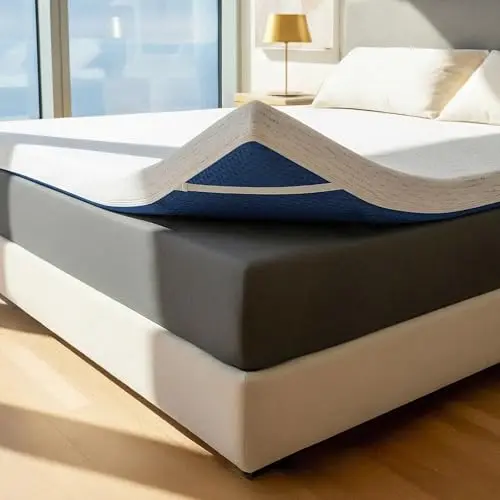
High Density 3-Inch Memory Foam Topper – Medium-Firm Support for Back and Hip Pain
A single continuous block of high-density memory foam – over three pounds per cubic foot – cut to a medium-firm feel that supports the hips and lower back instead of letting them sink. Gel infusion and a breathable knit cover help move heat, and the rayon cover zips off for machine washing.
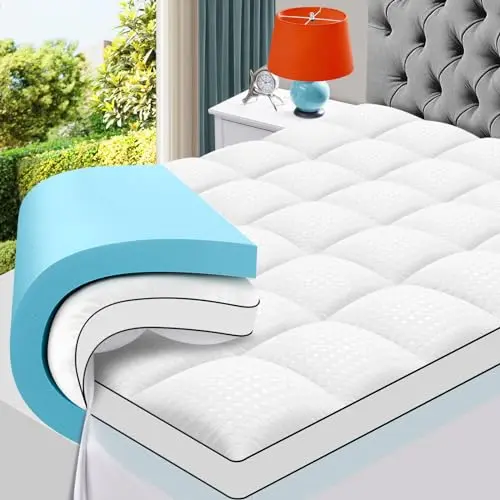
Dual Layer 4-Inch Memory Foam Topper – Gel Foam Base Plus Quilted Pillow Top
A two-piece system: a two-inch gel memory foam base and a two-inch quilted pillow-top cover that work together as four inches of medium support, or separately for a firmer or softer surface. The fitted skirt wraps mattresses up to 21 inches deep.

5-Inch Cooling Bamboo Air Layer Topper – Foam Support That Sleeps Cool
A five-inch pillow-top build with a gel and slow-recovery foam core wrapped in a bamboo viscose and polyethylene cooling-fiber cover. The waffle weave is designed to move air, and a full-edge elastic skirt grips mattresses up to 21 inches.

Octaspring 3-Zone Topper – Targeted Support for Hips and Lower Back
Instead of a flat slab, this topper uses hundreds of foam Octasprings arranged in three zones – firmer through the center for lumbar and hip support, gentler under the shoulders and legs. An anti-slip base and adjustable corner straps hold it in place.

Bamboo Rayon Pillow Top Topper – Cloud-Soft Pressure Relief With a 20-Inch Pocket
A plush pillow-top pad with a rayon-from-bamboo face, extra-length stretchy sides that fit mattresses up to 20 inches, and full machine washability. It’s the softest route to pressure relief in this lineup.
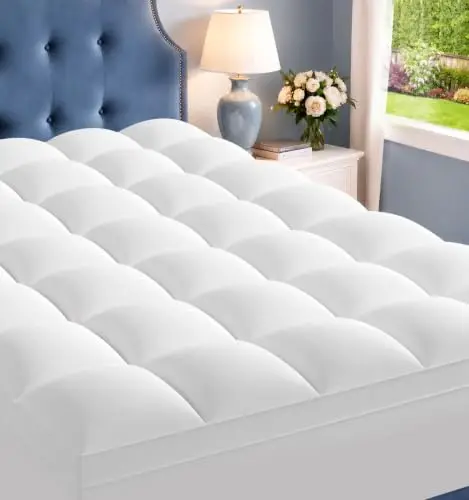
Extra Thick Pillow Top Topper – Down Alternative Plush Comfort
An overfilled down-alternative pillow top with box stitching to keep the fill evenly distributed, a brushed microfiber shell, and an 8-to-21-inch elastic deep pocket. Fully machine washable.
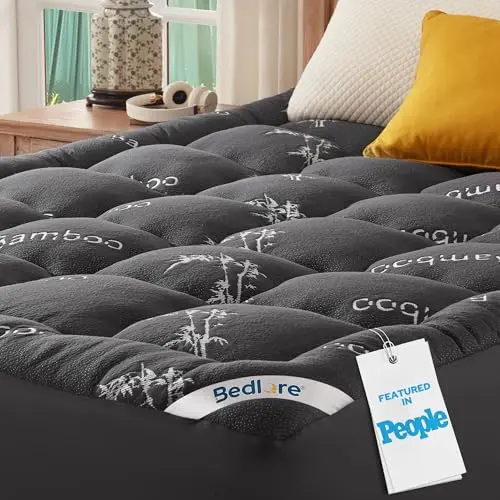
Bamboo Viscose Pillow Top Topper – Breathable Softness for Firm Beds
A quilted pillow-top topper in a bamboo viscose and polyester knit with stretchable pockets that fit mattresses from 6 to 18 inches. Breathable and machine washable, aimed at hot sleepers and sensitive skin.
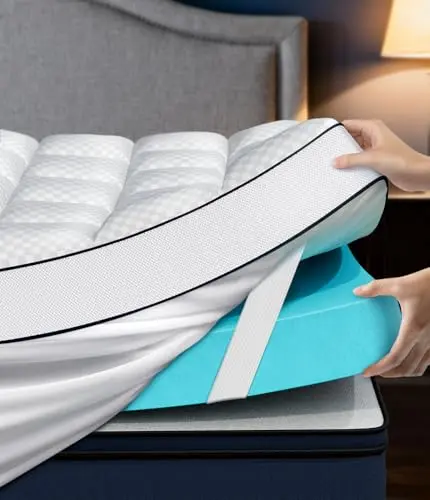
4-Inch Dual Layer Gel Topper – Configurable Firmness With Corner Straps
A four-inch two-piece topper combining two inches of gel memory foam with a two-inch diamond-stitched 3D air mesh cover, held by a 360-degree deep pocket and four corner straps. CertiPUR-US and OEKO-TEX certified.
How We Evaluated These Mattress Toppers for Back and Hip Pain
We didn’t run clinical pressure mapping or sleep-lab trials. What we did: cross-referenced eight mattress toppers from eight distinct brands across six decision axes – foam type and density, thickness, firmness tier, pressure-relief design, fit and stay-put hardware, and breathability. We triangulated published specifications, feature sets, and owner feedback where available, then mapped each option against the sleep profiles that show up most often with this complaint: side sleepers whose hips dig in, back sleepers who need lumbar support, and hot sleepers who can’t tolerate foam heat.
The scoring framework weighted real-world fit for painful backs and hips at 70% against feature differentiation at 30% – the design decisions that separate a topper built for pressure relief from a generic plush pad. We have no commercial relationship with any brand featured here; recommendations track fit and differentiation, not brand preference. If you want the closest thing to a safe bet for hip pressure, the ViscoSoft High Density is the pick. If you sleep hot and still need support, the DOWNCOOL 5-Inch is the better match.
How to Choose the Right Mattress Topper for Back and Hip Pain
1. Support vs. Pressure Relief: The Balance That Matters for Back and Hip Pain
Back and hip pain from a mattress usually comes from one of two directions. If the surface is too soft, your hips sink out of alignment with your shoulders and your lower back spends the night in a slow twist. If it’s too firm, pressure concentrates at the two heaviest contact points – hip and shoulder – and you wake up stiff and tender.
That’s why the wrong topper makes things worse. A plush pillow top on an already-soft mattress adds sink; a dense foam slab on a mattress you already find hard can feel like a board. What you want is medium-firm support with a forgiving top surface: enough give to relieve pressure, enough structure that your hips don’t bottom out.
2. Memory Foam, Down Alternative, or Octaspring: Which Topper Material Fits Your Pain Pattern?
High-density memory foam is the most common answer for pain because it conforms to your body and spreads load across a wider area. Density matters more than the marketing – anything around three pounds per cubic foot or better resists bottoming out. Lower-density foam feels wonderful in the first week and flattens within a year.
Down alternative pillow tops are a different tool. They soften a hard mattress beautifully and sleep cooler than foam, but they don’t add real support. If your pain comes from a mattress that’s too firm, that’s fine. If it comes from one that’s lost its structure, they won’t help. Zoned designs take a third approach, varying firmness across the surface so the center supports hips and lumbar while the ends stay soft. If you want a soft landing and don’t need to rebuild support, the ELEMUSE is the pick in this lineup.
3. How Thickness and Foam Density Affect Back and Hip Pain Relief
Two inches is a tweak. Three inches is the point where a topper starts changing how a mattress feels – enough material to redistribute pressure without turning your bed into a different piece of furniture. Four and five inches add plushness and can genuinely help side sleepers whose hips dig in, but past four inches you risk a surface that feels unstable and swallows your posture.
Foam density and thickness do different jobs. Thickness controls how deep you sink; density controls how long the topper keeps doing that. A three-inch high-density topper will outlast a four-inch low-density one every time. Heavier sleepers and side sleepers should lean toward more thickness; back sleepers who need alignment should prioritise density and medium-firm support over loft.
4. Staying Put: Why Deep Pockets and Corner Straps Matter More Than You Think
A topper that slides is worse than no topper. Every shift creates a wrinkle under your hip, and you spend the night micro-adjusting instead of sleeping. Look for deep pockets – most good ones fit mattresses from about 6 to 21 inches – or a fitted skirt with elastic all the way around rather than four skimpy corner bands.
Memory foam slabs often rely on weight and friction alone, which works until it doesn’t. Corner straps or an anti-slip base are worth paying for. If your mattress is unusually deep or sits on an adjustable frame, check this spec before anything else. The Niagara Sleep Solution is a good example of a budget topper that still gets the fit right, with stretchy sides long enough for thick pillow-tops.
5. Sleeping Hot? What Cooling Claims on a Mattress Topper Actually Mean
Every topper claims to sleep cool; very few genuinely do. Gel-infused foam helps a little, mostly by conducting heat away for the first hour or so. Bamboo viscose covers feel cooler to the touch and wick moisture better than polyester. Air-mesh and waffle-weave surfaces are the most reliable of the lot, because they let air circulation do the work instead of a coating that washes out.
The honest version: no topper is air-conditioned. If you sleep hot, avoid thick solid foam with a tight cover and favour a breathable face fabric over a dense fill. And if heat is what wakes you up, a cooler topper may do more for your sleep quality than an extra inch of cushioning.
6. ViscoSoft High Density vs. Dormeo Octaspring: Two Approaches to Back Support
These two represent the opposing philosophies in this category. The ViscoSoft High Density is a uniform slab of dense, medium-firm memory foam: simple, predictable, supportive the same way everywhere, with a washable cover and a long trial window. It suits back and side sleepers who want consistent support and don’t mind a firm surface.
The Dormeo Octaspring varies firmness across the surface instead – firmer through the middle where your hips and lumbar sit, softer toward the shoulders and legs. That’s a better match when pain is concentrated at the hip and lower back rather than spread across the whole body. The trade-offs are real: it arrives firm, takes roughly a month to settle, and sits in the premium tier. Want set-and-forget support? Go ViscoSoft. Want a topper that treats different parts of your body differently? The Octaspring is the more targeted design.
7. What to Budget for a Mattress Topper That Actually Helps
Toppers split into three rough tiers, and it’s worth knowing what each one buys. Entry-level pillow tops are the cheapest route to a softer bed – washable, breathable, effective at taking the edge off a hard mattress, but they’re comfort layers rather than support layers and they’ll compress over time.
Mid-range memory foam is the value sweet spot for back and hip pain. This is where you find high-density foam, real thickness, and washable covers for a sensible spend. Premium engineered toppers – zoned constructions, spring-in-foam designs – charge for specificity. They solve a narrower problem better; they don’t necessarily last longer.
One rule of thumb: don’t spend the price of a new mattress on a topper. If your mattress is visibly sagging or more than a decade old, a topper is a patch, not a repair.
Frequently Asked Questions
1. Can a mattress topper really help back and hip pain?
It can, but only when the topper addresses the right problem. If your mattress is too firm, a plush or medium pillow top relieves the pressure that builds at your hips and shoulders. If your mattress has lost its support, you need a dense foam layer that restores alignment – a soft pad will just let your hips sink deeper.
What a topper can’t do is fix a mattress that’s sagging in the middle or worn out. Think of it as a correction for a mattress that’s the wrong firmness, not a repair for one that’s broken.
2. What's the difference between the ViscoSoft High Density and the Dormeo Octaspring?
They solve back support in opposite ways. The ViscoSoft High Density is a uniform medium-firm memory foam slab – the same support everywhere, which suits sleepers who want predictable alignment and a simple, washable cover. The Dormeo Octaspring varies firmness across three zones, staying firmer under hips and lumbar while softening at the shoulders and legs.
Choose the ViscoSoft for consistent support and a lower spend. Choose the Octaspring if your pain is concentrated at the hip and lower back and you’re willing to wait out a break-in period for a more targeted design.
3. Which cooling mattress topper is better for hot sleepers with back pain?
Start with the DOWNCOOL 5-Inch. Its cooling-fiber face fabric and waffle-weave air layer move heat better than a standard knit cover, and it still packs a gel memory foam core with genuine support – the combination most cooling toppers fail to deliver. The catch is hand wash only care.
The Niagara Sleep Solution feels cooler than foam and is machine washable, but it’s a comfort layer rather than a support layer. If your mattress is already supportive and you just want less heat, it works. If you need cushioning that holds your hips up, go with the DOWNCOOL.
4. How long does a memory foam topper take to expand after unboxing?
Most arrive vacuum-compressed and need 48 to 72 hours to reach full loft. Lay it flat in a well-ventilated room rather than making the bed straight away – the factory scent needs somewhere to go, and trapping it under sheets slows the process.
Expect the foam to feel firmer than advertised on day one. Some designs, including zoned spring constructions, keep softening for up to a month. Judging a memory foam topper after one night is the most common mistake buyers make.
5. Will a mattress topper fix a mattress that's already sagging?
No – and this is the single most important thing to get right before you buy. A topper adds comfort and pressure relief on top of a sound surface. It can’t restore lost support, and on a sagging mattress a soft topper will follow the dip rather than correct it.
Test your mattress first: lie on your back and see whether your hand slides easily into the gap under your lower back. If there’s a real hollow, a dense foam topper buys you a few months at best. If the surface is flat but too hard, that’s exactly the problem a topper is built to solve.
Final Verdict
For most people dealing with back and hip pain, the ViscoSoft High Density is the answer – a medium-firm, high-density slab that supports the hips without turning your bed into a brick, plus a washable cover and a generous trial window. If you sleep hot and still want real cushioning, the DOWNCOOL 5-Inch pairs a cooling face fabric with foam support that holds up. Shoppers who mostly need to soften a hard mattress should look at the Niagara Sleep Solution, which delivers surprising pressure relief for an entry-level pad. And if you want support that’s firmer under your hips and softer at the shoulders, the Dormeo Octaspring is purpose-built for exactly that – just give it a few weeks to settle into its medium feel.
