
Best Memory Foam Contour Pillows – 2026 Reviews

You wake up, turn your head, and there it is again – that dull pull at the base of your neck. Most people blame the mattress. More often than not, it’s the pillow: too tall, too flat, or shaped for a sleeper you’re not.
Contour pillows exist to solve exactly that, but the category has a hidden second decision baked into it. The contour is the shape – a raised edge, a dipped center, sometimes a butterfly wing. The memory foam is the fill, and that’s where pillows quietly diverge. Some foam recovers in a second and never really conforms; some turns brick-hard in a cold bedroom; some goes flat within a season. Slow rebound and honest loft adjustability are the two things that separate a pillow you keep from one you shove in the closet.
What follows is a survey of the market rather than a pitch for one label. We looked at what each pillow actually offers – foam behavior, height range, cover fabric, certifications, care – and matched those to back, side, and stomach sleepers so you can route yourself to the right one instead of guessing.
Best Memory Foam Contour Pillows – 2026 Reviews
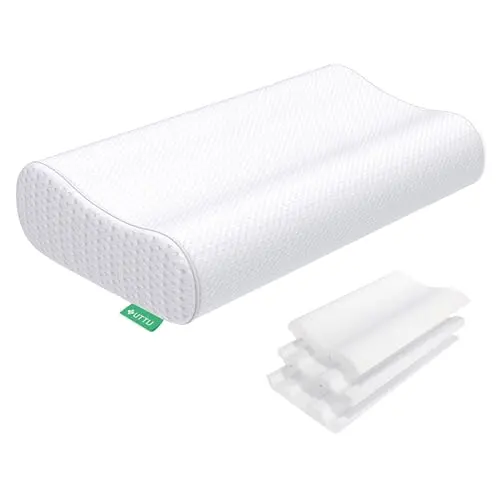
Sandwich Pillow – Adjustable Three-Layer Neck Support
A three-layer sandwich build that lets you pull out the middle slab and drop both contours by a little over an inch, so one pillow can serve back, side, and stomach sleepers. The Dynamic Foam is formulated to hold its feel in a cold bedroom instead of firming up like most memory foam.
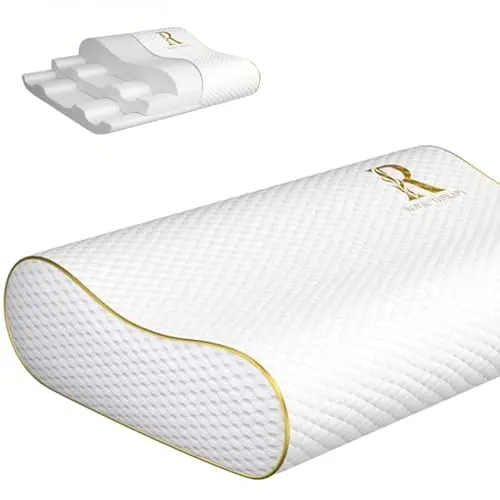
Contour Memory Foam Pillow – Three-Layer Adjustable Loft
The premium end of this lineup: a three-layer foam stack you can thin out for different shoulder widths, CertiPUR-US foam, and an OEKO-TEX rayon-from-bamboo cover. Medium firmness with a more ventilated build than most contour pillows.

Butterfly Cervical Pillow – Dual-Height Cooling Support
A butterfly contour rather than a classic high-low wave, with dual heights of roughly four and five inches and a cooling nylon-spandex cover. The winged shape supports head, neck, shoulders, and upper back at once, which suits sleepers who roll between positions.

Contour Cervical Pillow – CertiPUR-US Slow Rebound
Two neck support levels in a single pillow, with slow-rebound foam that recovers over three to five seconds and a breathable cover with mesh sides. CertiPUR-US certified and sized closer to a standard pillow than a compact cervical wedge.

Contour Memory Foam Pillow – Firm Ergonomic Support
A firm, high-profile contour – roughly 4.8 inches at the peak – with a silky hypoallergenic cover and a wedge-style ergonomic build. The firmest option in this roundup, and the clearest choice for sleepers who want their neck held up rather than cradled.

Certified Contour Cervical Pillow – Dual-Height Cooling
Certified slow-rebound foam with two contour heights and a cool-silk cover. Carrying both CertiPUR-US and OEKO-TEX puts it in rare company at the affordable end of the category.

Slow Rebound Cervical Pillow – Two Heights, Mesh Cover
Five-second slow-rebound foam with two neck heights, a breathable mesh-sided cover, and a removable machine-washable pillowcase. A straightforward, low-risk entry into contour pillows with the fundamentals covered.
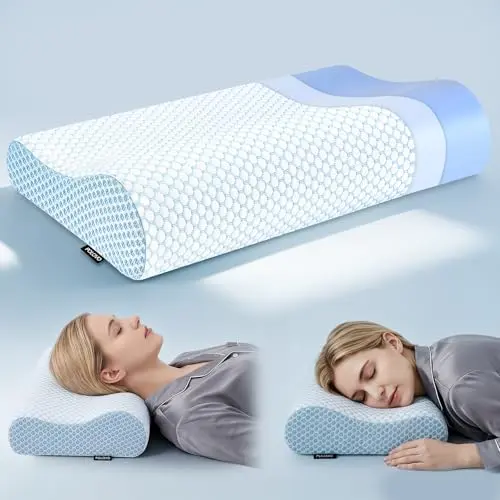
Neck Support Memory Foam Pillow – Soft Dual-Height
A soft-leaning contour pillow with two heights, slow-rebound foam, and a washable mesh-sided cover. The most forgiving, plush-feeling option in this roundup, aimed at sleepers who find contour pillows too rigid.
How We Evaluated These Memory Foam Contour Pillows
A few things we can’t tell you: how a pillow feels on night thirty, or how much loft a given foam loses after a year of eight-hour compression. What we can tell you is how eight memory foam contour pillows from seven brands stack up on paper and in owner experience. We cross-referenced eight models across seven distinct brands against six decision axes – loft height and adjustability, foam density and rebound speed, firmness profile, cover fabric and breathability, certifications, and care requirements – then triangulated published specifications, feature sets, and owner feedback where available against representative buyer profiles for this category.
Scoring weighted real-world fit at 70% – how well a pillow’s loft, firmness, and shape match the sleepers it claims to serve – against feature differentiation at 30% – certifications, adjustability range, cover quality, and temperature behavior. We mapped every option to back, side, and stomach sleepers separately, because a contour that works for one position routinely fails another. We have no commercial relationship with any brand featured here; recommendations track fit and differentiation, not brand preference. If you want the widest adjustability, the UTTU Sandwich Pillow is the one to beat. If you’d rather pay for materials and certifications, the Royal Therapy memory foam pillow earns its tier.
How to Choose the Right Memory Foam Contour Pillows
1. What Makes a Contour Pillow Genuinely Memory Foam
Contour describes the shape; memory foam describes the fill. Those are two separate decisions, and most shopping mistakes happen when you conflate them. A contour pillow has a raised edge and a dipped center – sometimes a gentle wave, sometimes a butterfly. Memory foam is a viscoelastic foam that warms to body temperature and slowly returns to shape.
The phrase to look for is slow rebound. Foam that springs back instantly is closer to conventional fill with a fancy label. Genuine memory foam takes three to five seconds to recover after you press it, which is what lets it conform without pushing back. Foam density matters too – higher density holds shape longer, while cheap low-density foam goes flat within months. If you want a pillow that publishes its rebound window and certification report ID, the Anvo contour pillow is unusually transparent about it.
2. Loft Height and Adjustability Matter More Than Contour Shape
Aesthetics aside, loft is the spec that decides whether a pillow works. Too high and your chin gets pushed toward your chest; too low and your neck sags. No single fixed height suits everyone, which is why adjustable loft is the most useful feature in this category.
Two approaches dominate. The first is a removable middle layer – a three-slab sandwich you can thin out. The second is a dual-height design, where one long edge sits higher than the other and you simply flip the pillow. Dual-height is simpler; layer-based adjustment gives a wider range. If range is what you’re after, the UTTU Sandwich Pillow delivers the most of it. Note the actual numbers: a high contour near five inches suits broad shoulders and side sleeping, while a low contour around three and a half inches suits back and stomach sleepers.
3. Matching a Memory Foam Contour Pillow to Your Sleep Position
Side sleepers need the most loft, because the gap between mattress and head is widest at the shoulder. Look for a high contour in the four-and-a-half to five-inch range and a shape that wings out to clear the shoulder rather than press into it – which is why the VYLEE cervical neck pillow is the pick here.
Back sleepers want the neck supported without the head tipping forward – the low side of a contour plus a center dip that holds the head neutral. Stomach sleepers need the flattest profile available, which usually means removing a layer or choosing the lower edge. If you flip between positions overnight, a dual-height pillow is far more practical than a single fixed contour.
4. Covers, Cooling, and Machine Washability
Memory foam traps heat, and a hot pillow is a pillow you wake up on. The practical fix is the cover, not the foam. Look for breathable mesh sides, synthetic covers that feel cool to the touch, and a zipper that lets you remove the whole thing for washing.
Two care notes worth knowing. First, never put the foam core in a washing machine – covers only. Second, most foam pillows ship compressed and need a day or two to fully expand, sometimes with a mild off-gassing smell that fades once the pillow airs out. Judge the pillow on night three, not night one.
5. Certifications Worth Checking Before You Buy
You’re pressing your face into this thing for eight hours a night, so third-party testing isn’t marketing fluff. CertiPUR-US covers foam content – no ozone depleters, no heavy metals, low VOC emissions. OEKO-TEX applies to the fabric and tests the cover for harmful substances.
Not every pillow in this category carries both, and the ones that do tend to be built with more care. If certifications aren’t listed at all, treat that as information too.
6. Budget, Mid-Range, and Premium Memory Foam Contour Pillows
At the entry level, you get slow-rebound foam, dual heights, and a washable cover – the fundamentals, without certifications or premium fabrics. That is genuinely enough for most people. The mid-range adds better covers, wider adjustability, and often a more consistent foam that doesn’t stiffen in a cold room.
The premium tier buys three-layer construction, foam and fabric certifications, and covers made from bamboo-derived rayon or cool-silk synthetics. What it doesn’t reliably buy is a dramatic comfort upgrade – at every tier, fit matters more than price. The Royal Therapy memory foam pillow is the clearest example of a premium option that earns its tier through materials rather than magic.
Frequently Asked Questions
1. UTTU Sandwich Pillow vs. Royal Therapy: which adjustable contour pillow should you buy?
Both are three-layer pillows with removable middle slabs, so the adjustability story is similar. The UTTU Sandwich Pillow uses the brand’s Dynamic Foam, formulated to stay soft in a cold room – the practical upshot is a pillow that doesn’t turn firm on winter nights. It’s a medium feel with a high contour around five inches.
The Royal Therapy steps up on materials: CertiPUR-US foam and an OEKO-TEX bamboo rayon cover, with a similar medium firmness and a more ventilated build. Choose Royal Therapy if you want the better cover and certifications; choose the UTTU if you want the wider adjustment range for the money.
2. EPABO vs. Ylekto cervical pillow: how do the firmness profiles compare?
They sit at opposite ends of the firmness spectrum. The EPABO contour pillow is the firmest option in this roundup, with a peak near 4.8 inches and a wedge-style ergonomic build that lifts the neck rather than cradling it. The brand is upfront that the first week or two can feel uncomfortable while you adjust.
The Ylekto dual-height pillow is medium, with two contours around 5.3 and 3.7 inches and CertiPUR-US plus OEKO-TEX certification behind it. Go EPABO if you’ve found memory foam too soft to hold alignment; go Ylekto if you want a middle-of-the-road feel with third-party testing attached.
3. Is all memory foam the same, or does density actually matter?
Density matters, and it’s the spec most listings hide. Higher-density foam holds its shape and support for years; low-density foam feels great for a few months and then compresses into a thin slab. Brands that publish density or a rebound window are telling you something useful.
The other variable is temperature response. Standard memory foam hardens in a cold bedroom, which is why some pillows feel different in January than in July. Several options here address that directly – UTTU’s Dynamic Foam and Polovo’s formulation both claim a consistent feel year-round.
4. Are memory foam contour pillows good for side sleepers?
They can be the best option available, provided the high contour is tall enough. Side sleeping opens the widest gap between mattress and head, so you need roughly four and a half to five inches of loft plus a shape that clears the shoulder instead of pressing into it.
Butterfly-shaped designs handle the shoulder problem better than a simple wave, which is why the VYLEE cervical neck pillow is our pick for side and combination sleepers. If your shoulders are narrow, the lower edge of a dual-height pillow will usually suit you better than the high side.
5. How long does it take to adjust to a contour pillow?
Give it one to two weeks. A contour pillow changes the angle your neck rests at, and muscles adapted to a flat pillow will notice. Some brands say so directly – EPABO warns that the first two weeks can feel uncomfortable while your body adjusts to the correct position.
Two practical tips: start on the lower side and move up if you need more lift, and air the pillow out for a couple of days before judging it, since compressed foam needs time to expand. If it still feels wrong after two weeks, the loft is probably mismatched rather than the pillow being defective.
Final Verdict
For most people, the UTTU Sandwich Pillow is the answer. The three-layer build gives you real range between a high side-sleeper profile and a flatter stomach-sleeper setup, and the Dynamic Foam keeps its feel when the bedroom turns cold. It’s the pillow we’d hand to a friend who doesn’t yet know what they need.
If materials matter more to you than adjustability, the Royal Therapy memory foam pillow earns its premium with certified foam and a bamboo rayon cover. Firm-pillow loyalists should go straight to the EPABO contour pillow, the only genuinely firm option here. And if you want to spend as little as possible while still getting slow-rebound foam and two heights, the Ylekto slow rebound pillow is the sensible starting point.
