
Best Multi Charging Cables – 2026 Reviews

There’s a drawer in most homes with four or five cables in it, and somehow none of them is the one you need. Multi charging cables exist to end that hunt – one cord, several tips, no digging. The catch is that they aren’t interchangeable, and the differences matter far more than the packaging suggests.
Two things separate a genuinely useful multi cable from a frustrating one. The first is connector mix: how many of the outputs are USB-C, and whether Lightning and Micro-USB ends are still there for the older gear you haven’t retired. The second is input flexibility – plenty of these cables still assume a USB-A wall charger, which is a problem once everything you own has moved to USB-C. A third factor shows up after you’ve bought it: how the cable behaves when you plug in more than one device, because a shared power ceiling means everyone slows down together.
We looked across the market rather than at one brand’s lineup, from pocket-sized retractables to six-foot braided cords with four outputs. The picks below cover different households and different bags, and each entry flags what that cable gives up to get there.
Best Multi Charging Cables – 2026 Reviews
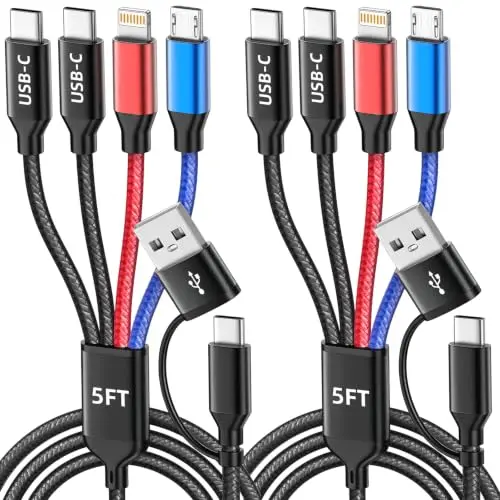
4-in-2 Dual Type-C – USB-A and USB-C Input Flexibility
A four-output cable with dual USB-C ports alongside Lightning and Micro-USB, and it accepts either a USB-A or a USB-C charger on the input side. Two five-foot braided cords come in the box.
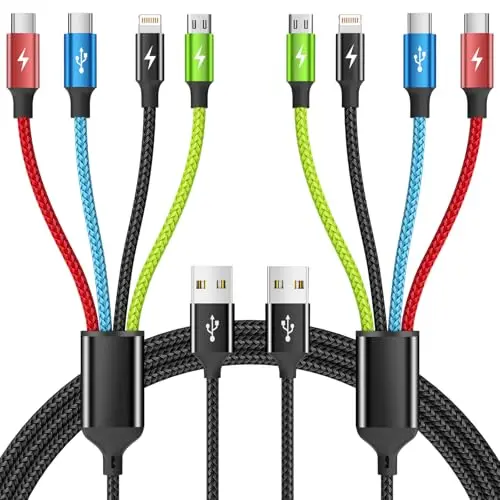
4-in-1 Dual USB-C – Two Type-C Outputs, Two 5ft Cords
A four-in-one with two USB-C outputs alongside Lightning and Micro-USB, sold as a pair of five-foot nylon-braided cords. One USB-C connector also carries data.
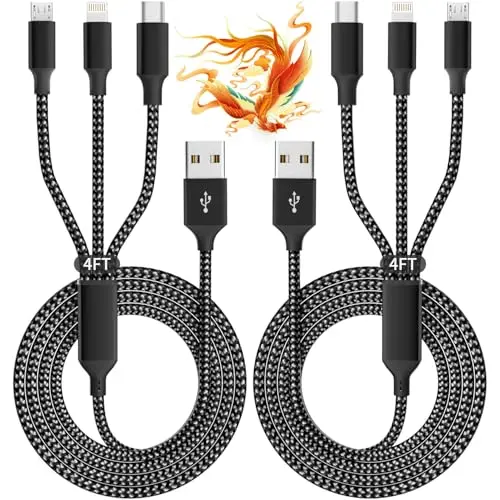
3-in-1 Nylon Braided – Two-Pack for Mixed-Device Homes
A three-in-one with Type-C, Lightning, and Micro-USB outputs, sold as a pair of four-foot braided cords. Thickened tinned copper wiring is the pitch for stable overnight charging.
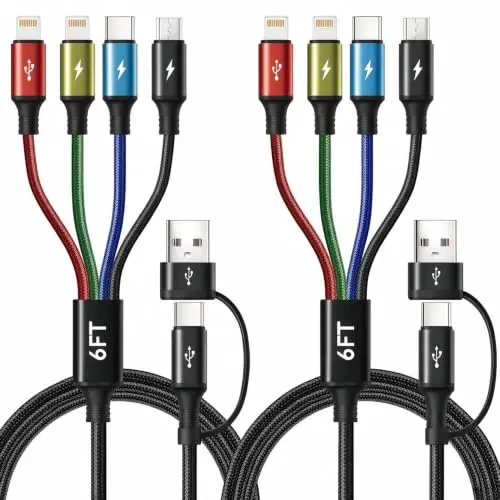
6-in-1 Multi Cable – Four Outputs From Either Input
A six-in-one design that pairs USB-A and USB-C inputs with four outputs, including dual Lightning connectors. Two six-foot braided cords are included.
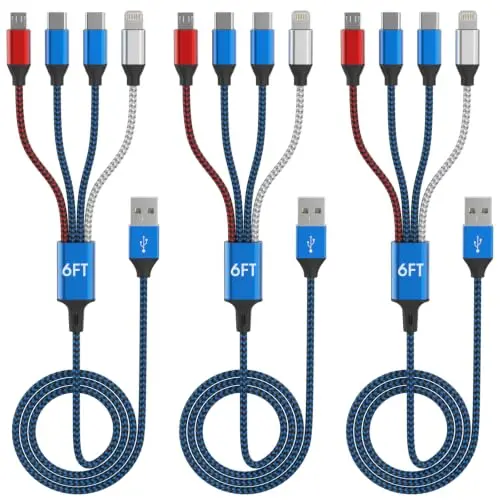
4-in-1 Three-Pack – Six-Foot Reach for Shared Spaces
A four-in-one with two Type-C ports, Lightning, and Micro-USB, sold as a three-pack of six-foot nylon-braided cords. Built for backseats and shared rooms rather than pockets.
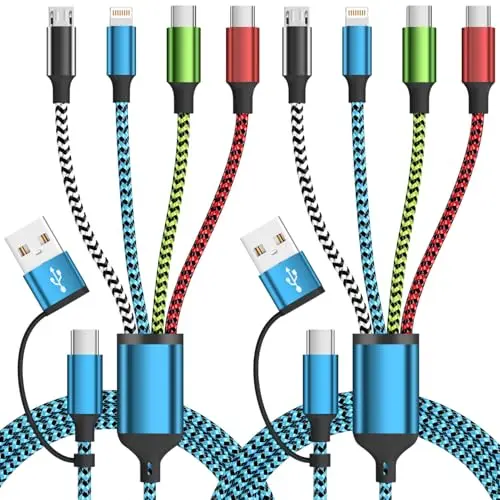
4-in-2 Dual Type-C – Swaps Between Old and New Chargers
A four-in-two with USB-A and USB-C inputs feeding dual USB-C, Lightning, and Micro-USB outputs. Two five-foot braided cords per pack.
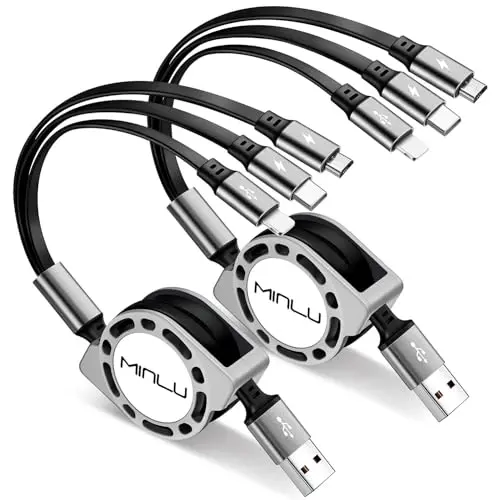
3-in-1 Retractable – Pocket-Sized Car and Travel Cord
A retractable three-in-one with Lightning, USB-C, and Micro-USB tips that coil back into a compact body. Two four-foot cords are included.
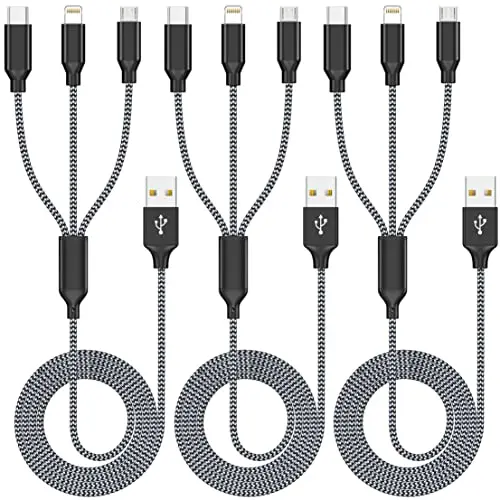
MFi-Certified 3-in-1 – Three Cords for Lightning Households
An Apple MFi-certified three-in-one with Lightning, USB-C, and Micro-USB tips, sold as three four-foot braided cords with aluminum housings.
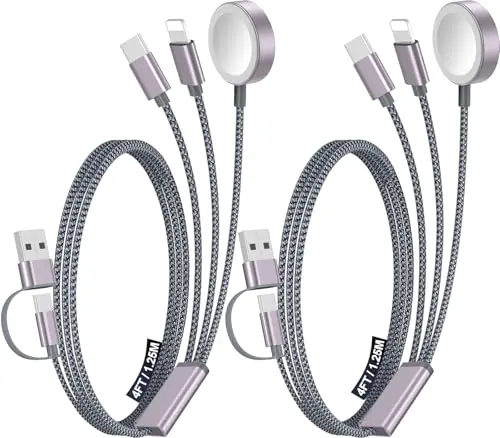
3-in-2 With Apple Watch Charger – Watch, Phone, and USB-C
A three-in-two built around a magnetic Apple Watch charger, with Lightning and USB-C outputs plus USB-A or USB-C input. Two four-foot cords come in the box.
How We Evaluated These Multi Charging Cables
A few things we can’t tell you: we didn’t hook these cables to a USB power meter to measure real amperage, and we didn’t run them through months of daily plugging. What we can tell you is how they stack up on paper and in owner feedback. We cross-referenced 9 multi charging cable models from 7 distinct brands across 5 decision axes – connector mix, input type, simultaneous charging behavior, build and strain relief, and data or CarPlay support where it’s offered. We triangulated published specifications, feature lists, and owner feedback where available, then mapped each cable against representative buyer profiles: the two-phone household, the car console, the travel bag, and the Apple Watch wearer.
The scoring framework weighted real-world fit at 70% – how well a given connector mix serves the devices you actually own – against feature differentiation at 30%, meaning the technical advantages that separate one cable from the next. Dual USB-C output, switchable USB-A or USB-C input, and a built-in watch charger all count there; a longer cord on its own does not. We have no commercial relationship with any brand in this lineup, so recommendations track fit and differentiation rather than brand preference. If you’re juggling two USB-C phones, the MPATIBY 4-in-2 Dual Type-C is the natural starting point; if the strongest owner sentiment in the group is what you want behind a purchase, the Firsting 4-in-1 is the alternative we’d point you toward.
How to Choose the Right Multi Charging Cables
1. Connector Mix: How Many USB-C Ports Do You Actually Need?
Count the devices you’d realistically plug in at once. If a phone, a tablet, and a pair of earbuds all use USB-C, a cable with a single Type-C output forces you to take turns. That’s the argument for dual USB-C outputs, which has become the most useful single upgrade in this category over the past couple of years.
The older ends still earn their place. Lightning covers iPhones up to the 14 series and most iPads, while Micro-USB handles game controllers, older e-readers, Bluetooth speakers, and power banks. A three-tip cable with two Type-C ports and one Lightning typically covers more real households than a four-tip cable with only one Type-C. If that describes your setup, the Firsting 4-in-1 is built around exactly that mix.
2. Input Type: USB-A, USB-C, or Both?
The end that plugs into your charger gets ignored, and it shouldn’t. A USB-A input works with the cheap wall bricks and car chargers most people already own. A USB-C input works with newer adapters, laptop ports, and power banks. Cables that accept both are the most flexible option and save you from carrying an adapter just to use your own cord.
This is also where a lot of disappointment starts. Plug a dual-input cable into a low-wattage charger and three devices will charge slowly or only intermittently. Match the cable to the adapter you’ll actually use, not the one you’d like to own.
3. How Multi Charging Cables Split Power Across Devices
Almost every multi cable quotes a total output figure rather than a per-port number, and that distinction matters. A cable rated at 3A total doesn’t give 3A to each device; it divides that across everything connected. Plug in one phone and it charges normally. Plug in three and each one trickles.
Some cables add smart current distribution to allocate power more sensibly, and a few need a higher-wattage adapter before they’ll charge multiple devices at all. If simultaneous charging is the whole reason you’re buying, the MPATIBY 4-in-2 Dual Type-C is the one that handles it most predictably in this lineup.
4. Length, Braiding, and the Strain Relief That Actually Fails
Most multi cables die at the connector, not in the middle. Laser-welded or reinforced strain relief where the tip meets the housing is the part worth checking, along with braided nylon sleeving that resists being compressed into a bag every day.
Length is a genuine tradeoff. Four feet keeps a nightstand or car console tidy; six feet reaches the backseat but leaves slack on the floor. If your household charges from a third row or a shared couch, the Plnhixt 4-in-1 leans into that with long cords in a multi-pack.
5. Retractable vs Braided Multi Charging Cables
Retractable cables trade ruggedness for portability. The housing keeps the cord from tangling in a bag and takes up less room in a glovebox, but the mechanism is an extra moving part that fixed cables don’t have. Braided cords are simpler and generally survive longer.
Neither is wrong. If the cable lives in a pocket or a console and gets used for short top-ups, retractable makes sense. If it’s plugged in and left alone for months, plain braided is the safer buy.
6. Data Transfer and CarPlay: What Multi Cables Actually Support
Charging is assumed; data transfer is not. On most multi cables, exactly one connector – usually Lightning or one designated USB-C – carries data, while the rest are charge-only. That’s fine for most people, but it matters if you rely on CarPlay, which needs a data-capable Lightning connection.
Check which port carries the data before you buy, and check the speed: 480Mbps is the common ceiling here, enough for file transfers and navigation but not for serious storage work. If you need sync on a USB-C device, confirm the cable designates a USB-C port for it rather than assuming all four do.
Frequently Asked Questions
1. What's the difference between the MPATIBY 4-in-2 Dual Type-C and the Firsting 4-in-1?
Both put two USB-C outputs on a five-foot braided cord and sell as a two-pack. The MPATIBY adds USB-C input alongside USB-A, so it works with newer adapters without an adapter of its own. The Firsting is USB-A input only but carries the more consistent owner sentiment of the two. Pick the MPATIBY if your chargers are moving to USB-C; pick the Firsting if lower-risk long-term feedback matters more to you.
2. Do multi charging cables actually fast charge?
Rarely all at once. Most quote a total output of 3A or 4A that gets divided across connected devices, so a single phone charges reasonably while three devices together will be slow. Real speed also depends on your adapter and the charging protocol your phone supports – a multi cable rarely negotiates the highest speeds a dedicated single-purpose cable would. Treat these as convenience cables, not performance ones.
3. Why do some multi charging cables only support data on one port?
Cost and complexity. Wiring data lines to every connector means more conductors and tighter manufacturing tolerance, so most designs route data through a single designated port – often Lightning for CarPlay, or one USB-C for file transfer – and leave the rest charge-only. It’s worth confirming which port that is before you buy.
4. Is a retractable multi charging cable durable enough for daily use?
It depends on how it’s used. A retractable housing is excellent for a glovebox or a bag because it stops the cord tangling and takes minimal space. But the retraction mechanism is an extra failure point, and the cord itself tends to be thinner than a braided one. For a cable that lives in a fixed spot and gets plugged in daily, a plain braided cord is the safer long-term bet.
5. Minlu 6-in-1 vs Plnhixt 4-in-1: which is better for a family car?
Both lean toward shared charging. The Minlu gives you four outputs from either a USB-A or USB-C charger, including dual Lightning, which suits a car full of iPhones. The Plnhixt goes the other way with three six-foot cords and dual USB-C, which is better when reach from the front outlet to the third row is the actual problem. If passengers fight over the plug, the Minlu 6-in-1 wins; if they fight over distance, the Plnhixt does.
Final Verdict
For most households, the MPATIBY 4-in-2 Dual Type-C is the right starting point. Two USB-C outputs plus a USB-C input cover the devices people carry now, and the five-foot braided build holds up to daily use. If you’d rather lean on the strongest owner sentiment in the group, the Firsting 4-in-1 offers the same dual-C thinking with a USB-A input.
On a tighter budget, the MPATIBY 3-in-1 two-pack gets three connector types into two bags for very little. And if a long reach matters more than port count, the Plnhixt 4-in-1 three-pack solves the backseat problem outright. Nobody needs all four – pick the one that matches the drawer you’re trying to empty.
