
Best Multifunction Counter Surveillance Bug Detectors – 2026 Reviews

A hotel room, an unfamiliar office, a rental car you picked up an hour ago. The uncomfortable part of counter surveillance isn’t the technology – it’s that you have no idea what a normal room is supposed to look like until you start hunting for the wrong things.
The market’s answer is a crowded shelf of pocket-sized detectors, and the word multifunction is doing an enormous amount of work on most of those boxes. Some genuinely bundle three or four detection methods. Others stick a big number on the front and call a single RF receiver a six-in-one. The gap between those two things is the whole reason this guide exists.
Two axes separate the options that hold up. The first is detection breadth – RF scanning catches anything actively transmitting, but it’s blind to a wired camera and close to useless against a magnet-mounted tracker that only wakes up now and then. Infrared and magnetic modes cover those gaps, and not every device has them. The second is usability under pressure: a detector you’re fumbling with at midnight in a dark room is one you’ll quietly stop carrying. We compared models across the major brands in this space with both in mind.
Best Multifunction Counter Surveillance Bug Detectors – 2026 Reviews

S620 – Multimode Sweeps in a Pocket Body
The S620 packs several separate detection modes into a case small enough to lose in a jacket pocket. An extendable antenna steadies RF pickup in bigger rooms, adjustable sensitivity lets you walk a signal down toward its source, and the infrared mode makes hidden lenses show up as a bright reflection in a darkened room. It also handles magnetic GPS trackers and doubles as a door or luggage alarm.
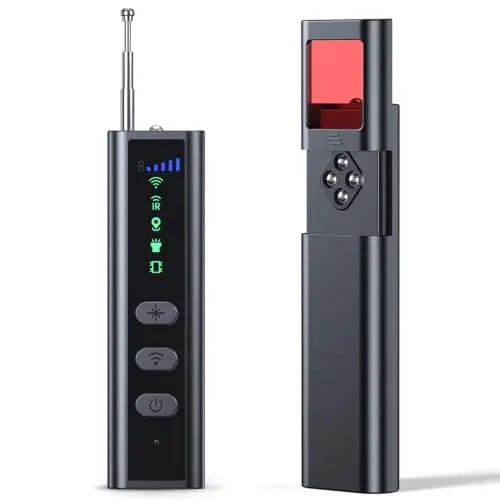
Q-T002 – Readable Signal Strength On Screen
A no-nonsense three-mode scanner with one feature many pocket units skip: an actual display. The screen shows which detection mode is active and how strong the RF signal is, so you can watch the reading climb as you close in rather than guessing from beeps. It adds a flashlight and a personal alarm for everyday carry.
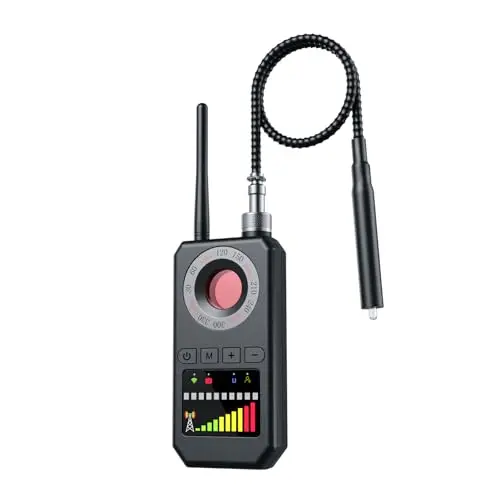
6-in-1 RF Detector – Flexible Probe for Vehicle Sweeps
Built around a flexible probe and a higher frequency ceiling than the rest of this lineup, this one is aimed squarely at people sweeping vehicles and tight spaces. It reads magnetic fields for trackers stuck under a bumper, and the narrow probe reaches wheel wells and undercarriage gaps that a flat handheld simply can’t.

G007 Pro – Triple-Alert Pocket Scanner
A pocket-sized multi-function scanner with an unusually loud personality: it alerts with flashing LEDs, vibration, and adjustable audio at the same time, so a detection is hard to miss even in a noisy lobby. Six sensitivity steps and a quoted 1 MHz-8 GHz range cover the usual camera, bug, and tracker territory.

Privacy Pen Detector – Discreet RF Scanning
The most discreet shape in this lineup: a pen-style body with a single button, no menus, and RF-only detection. It’s built for people who want to sweep a room quickly without pulling out something that looks like a piece of surveillance gear.
How We Evaluated These Multifunction Counter Surveillance Bug Detectors
We didn’t run lab-grade RF calibration or controlled signal-strength measurements. What we did: cross-referenced 5 bug detector models from 5 distinct brands across five decision axes – detection methods offered, frequency and sensitivity range, alert style and usability, portability and battery life, and how candidly each listing describes its own limitations. We triangulated published specifications, feature sets, owner feedback where available, and use-case fit against three buyer profiles: the frequent traveler, the vehicle owner, and the occasional renter who just wants a room checked before unpacking. Where owner feedback was thin, we leaned on published specifications and scored those picks more conservatively rather than guessing.
The scoring framework weighted real-world fit (70%) – how well a detector serves the scenario it’s aimed at – against feature differentiation (30%) – the capabilities that actually separate one unit from the next. We have no commercial relationship with any of these brands; recommendations track fit and differentiation, not brand preference. We also weighed how honest each product’s own documentation is, because in this category the marketing routinely outruns the hardware.
The lineup splits cleanly. If you want the widest spread of detection modes in something pocket-sized, the S620 is the match. If a vehicle sweep is the job, the VigilEye RF detector earns its place.
How to Choose the Right Multifunction Counter Surveillance Bug Detector
1. What Makes a Bug Detector Genuinely Multifunction
A detector earns the multifunction label when it covers more than one way of finding a device. The baseline is RF detection – a receiver that reacts when it senses a radio signal in the bands cameras, bugs, and trackers use. That catches anything actively transmitting, which is most consumer spy gear.
What it doesn’t catch is the quiet stuff. A camera wired to record locally puts out no RF at all. A magnet-mounted GPS tracker may only wake up and transmit intermittently. That’s why infrared lens scanning and magnetic field detection matter: the first makes a hidden lens visible as a reflection in a dark room, the second picks up the magnet holding a tracker to a car. A unit with all three is multifunction in a way that means something. A unit with one receiver and a big number on the box is not.
2. RF, Infrared, and Magnetic: How Each Detection Mode Works
Think of them as three different questions. RF answers ‘is something broadcasting here?’ Sweep slowly, start at the highest sensitivity setting, and step it down as you close in – that’s the standard technique on nearly every device in this category, and it’s the only way to turn a vague alert into a direction.
Infrared answers ‘is there a lens I can’t see?’ You dim the room, look through the finder, and watch for a bright pinpoint reflection. It’s slower and more manual, but it’s the only method that works on a camera with no radio. Magnetic detection answers ‘is there something stuck to this vehicle?’ – a short-range check you run along bumpers, wheel wells, and under seats. Skipping any one of the three leaves a blind spot.
3. Sensitivity, Frequency Range, and Why False Alarms Are the Real Enemy
Spec sheets love frequency numbers – 1 MHz to 8 GHz here, up to 10 GHz there. Wider coverage is genuinely better, but the practical difference between the two is smaller than the marketing implies, because the devices you’re hunting mostly live in well-trodden bands. What actually decides whether a detector is usable is false alarm handling. Every router, every pair of Bluetooth earbuds, every phone in the room is broadcasting.
The fix is procedural, not technical. Switch off what you can, sweep at high sensitivity first, then walk the sensitivity down and re-check the spots that still light up. Detectors with adjustable sensitivity and a visible signal-strength indicator make that narrowing process far less frustrating than something that only beeps faster.
4. Bug Detector Size, Battery, and Alert Style for Hotel Checks
You will only use a detector you actually have with you. Slim pen-style bodies disappear into a laptop bag; handheld units with probes are bulkier but reach places a flat device can’t. If vehicle sweeps are part of the routine, a flexible probe is close to essential – bending into a wheel well is not something a rectangular handheld does well.
On power, look for USB-C rechargeable batteries rather than disposables, and treat quoted runtime as an optimistic ceiling. Alert style matters more than people expect: vibration plus light is the combination that works in a loud lobby, a dark room, or anywhere you’d rather not announce that you’re scanning.
5. What Counter Surveillance Detectors Cost at Each Price Tier
Entry-level detectors give you RF scanning, an infrared mode, and basic alerts in a small body. That’s enough for a hotel-room check, and it’s where most buyers should start.
Mid-range units add wider frequency coverage, better false-alarm filtering, probes or gain antennas, and multiple alert types. You’re paying for usability more than raw detection ability. Premium pen-style devices often cost more while offering fewer detection modes – you’re buying discretion and form factor, not capability, so be honest with yourself about which of those you actually need.
6. Matching a Bug Detector to Your Actual Scenario
If your concern is hotel rooms and unfamiliar offices, prioritize infrared scanning plus a quiet alert mode – the S620 covers both and adds a door alarm for nights away. If a vehicle is the worry, the probe and magnetic sensor on the VigilEye RF detector are built for exactly that sweep. And if you’d rather see signal strength as a reading than guess from beeps, the Q-T002 is the straightforward pick.
Frequently Asked Questions
1. What's the difference between the ERYITRDK S620 and the VigilEye RF detector?
They’re aimed at different jobs. The S620 is the broader everyday tool: RF scanning with an extendable antenna, an infrared lens scan, magnetic detection for trackers, and a door-handle alarm that turns it into a travel safety device. The VigilEye pushes toward vehicle work – a flexible probe that reaches into wheel wells, a quoted range up to 10 GHz, and a magnetic sensor built for confirming a tracker.
If you want one device for hotel rooms, the S620 is the more natural fit. If you’re primarily sweeping a car, the probe makes the VigilEye the better tool.
2. How does the Qyzue Q-T002 compare to the CountureMode G007 Pro?
The Q-T002 wins on feedback. Its display screen shows the active mode and a rising signal-strength reading, which makes it much easier to walk a signal down to its source. CountureMode counters with a triple alert system – LEDs, vibration, and adjustable audio at once – plus six sensitivity levels and an SOS alarm, which is more useful when you’re scanning somewhere loud or don’t want to stare at a screen.
The tradeoff is detection breadth: CountureMode is RF-focused without an infrared lens finder, while the Q-T002 includes one.
3. Do I need a multifunction detector, or is a basic RF bug sweeper enough?
It depends on what you’re worried about. RF scanning alone handles transmitting cameras, wireless bugs, and most off-the-shelf spy gear, and that covers the majority of realistic scenarios. Where it fails is the quiet stuff: a camera recording to a local card emits nothing, and a magnetic GPS tracker may only transmit in bursts.
Adding infrared scanning closes the camera gap; adding magnetic detection closes the tracker gap. If you travel constantly or sweep vehicles, the extra modes earn their keep. If it’s an occasional hotel-room check, an RF-plus-infrared unit is enough.
4. Can a hidden camera detector find a wired camera that doesn't transmit?
Not with RF. A camera that records to internal storage and never sends a signal is invisible to a radio receiver, which is why infrared lens detection exists – you darken the room and look for the reflection off the lens itself. Every detector in this lineup that includes an infrared mode can do this; the pen-style units that are RF-only cannot. If that scenario matters to you, factor it into your choice before you buy.
5. Are pen-style bug detectors as capable as larger units?
Usually not, and that’s the tradeoff. The Nilcozy privacy pen detector is genuinely the easiest unit here to carry and operate – one-key scanning, no menus, slim enough to forget about – but it’s RF-only, with no infrared or magnetic modes and no display.
You’re paying for discretion and form factor rather than detection breadth. If you need to catch a silent camera, a larger multifunction unit will serve you better.
Final Verdict
For most people, the S620 is the answer. It covers RF, infrared, and magnetic detection in one pocket-sized body, adds a door alarm that’s genuinely useful on the road, and does it without making you learn a menu system. That combination is why it takes the top slot.
If you’re mainly worried about a vehicle, go with the VigilEye flexible-probe detector – the bendable probe and magnetic sensor are purpose-built for tracking down something stuck under a bumper. Prefer to see the signal instead of hearing it? The Q-T002 gives you a readable display at the entry-level tier. And if the only thing stopping you from carrying a detector is how bulky they are, the Nilcozy pen detector solves that problem at the cost of detection breadth.
Pick the modes that match your actual scenario. Everything else is spec-sheet noise.
