
Best Neck Pillows For Kids – 2026 Reviews

Twenty minutes into a road trip, the head starts the slow droop – chin to chest, a sudden snap upright, then the droop again. A regular pillow doesn’t fix that. Neither does an adult travel pillow scaled down, which is the mistake a lot of families make on the first attempt.
What separates a kids’ neck pillow that works from one that ends up in the footwell comes down to two things: whether the shape actually holds a small head upright in the seat your child sits in, and whether the thing can survive being washed, dropped, and occasionally used as a stuffed animal. Age-based sizing matters more here than in almost any other travel accessory, because the distance from a 4-year-old’s chin to shoulder is nothing like a 10-year-old’s.
We looked at the kid-focused options across the market – adjustable velcro designs, hooded memory foam, and simple fixed U-shapes – and matched each one to the way families actually travel: car seats, short hops, and long-haul flights. Here’s how they stack up for kids specifically.
Best Neck Pillows for Kids – 2026 Reviews
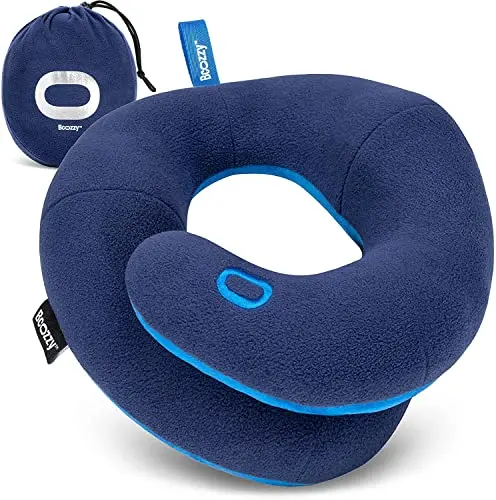
Kids Travel Pillow – Velcro Fit for Ages 3-7
A kid-sized travel pillow that closes with a curved velcro strap instead of a fixed U, so the fit adjusts to your child’s neck rather than the other way around. Sized for ages 3 to 7, with a microfleece and microsuede shell over a down-alternative fill.
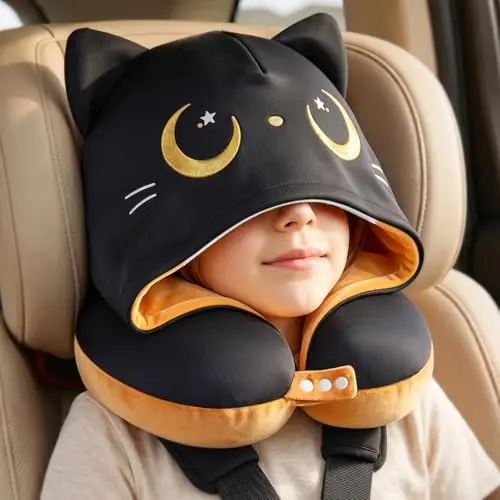
Hooded Kids Travel Pillow – Certified Memory Foam Comfort
A reversible, hooded memory foam pillow for kids and teens, certified to ASTM F963 and CPSIA standards. The hood cuts light and muffles cabin noise on flights, and the two-sided cover swaps between cool ice silk and soft fleece.
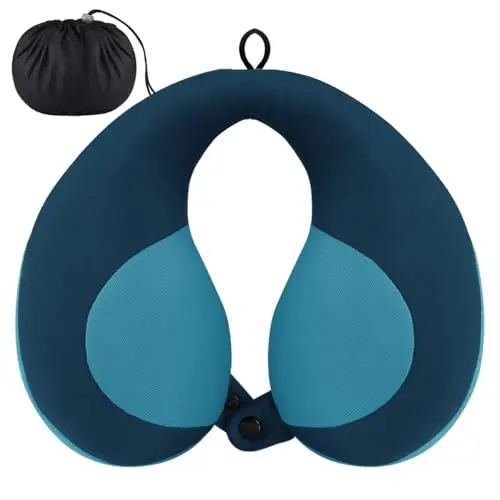
Kids U-Shape Travel Pillow – Chin Support for Car Seats
A budget-friendly U-shaped pillow built for upright, strapped-in positions, with thicker sides, a snap-button closure, and a breathable honeycomb cover. Designed for toddlers and children on car rides and flights.
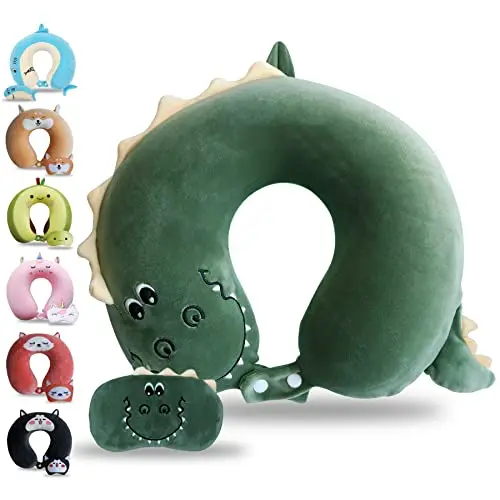
Cartoon Kids Travel Pillow – Memory Foam with Sleep Mask
A soft velvet U-pillow with embroidered cartoon characters and a slow-rebound memory foam core. Ships with a matching sleep mask, making it a fun pick for kids who resist wearing anything that looks like travel gear.
How We Evaluated These Neck Pillows for Kids
We didn’t strap these pillows onto sleeping kids during a cross-country flight, and we didn’t run lab tests on foam density or compression. What we did: cross-referenced 4 neck pillow models from 4 distinct brands built specifically for children across 5 decision axes – age and size fit, chin-and-head support geometry, fabric and fill, care and cleaning, and travel-day practicality. We triangulated published specifications, manufacturer safety documentation where it exists, aggregated owner feedback where available, and mapped each pillow against the way families actually travel: car seats, airplanes, strollers, and the school run. Owner feedback was uneven across the lineup – some models have a deep well of long-term reports, others are newer and thinner on data – so we weighed it as a signal rather than a verdict.
Our scoring framework weighted real-world fit (70%) – how well a pillow holds a small head upright in the seat your child actually sits in – against feature differentiation (30%) – the design choices that separate one option from the next, like an adjustable closure, a light-blocking hood, or a named safety certification. We have no commercial relationship with any of the brands featured; recommendations track fit and differentiation, not brand preference. If your child falls asleep in a car seat more often than on a plane, the INFANZIA kids pillow is the practical starting point. If you’re flying and want light blocking and a certified build, the Mewaii hooded pillow is the better match.
How to Choose the Right Neck Pillow for Kids
1. Why Kids' Neck Pillows Are Built Differently From Adult Ones
An adult U-shaped pillow assumes a neck long enough for the U to settle under the jaw. Kids don’t have that. Their chin-to-shoulder distance is short, so a full-size pillow tends to push the head forward instead of supporting it – the opposite of what you want. Kid-specific pillows compensate by reducing the back height, thickening the sides, and, in some designs, adding a chin rest or a closure that keeps the whole thing from migrating around the neck.
A pillow that fits correctly supports the head without changing the angle of the neck. If your child’s chin is being pushed toward their chest, the pillow is too tall. That single check rules out more bad options than any spec sheet will.
2. Sizing a Neck Pillow for Kids: Age Ranges and Fit Checks
Most kids’ pillows are sold as one size with a broad age claim, and that’s where fit problems start. Age-banded sizing – like the small and medium options BCOZZY builds for ages 3 to 7 and 8 to 12 – is rare and worth seeking out, because a pillow that fits a 4-year-old will be marginal on a 9-year-old. Two quick checks: the pillow should meet the jaw without lifting it, and it shouldn’t be loose enough to slide down onto the shoulders mid-nap. If your kid sits between sizes, size down. A slightly small pillow stays in place better than an oversized one that pushes the head forward.
3. Car Seats vs Airplanes: Matching the Pillow to Your Kid's Travel Routine
Road trips and flights put different demands on a pillow. In a car seat, the head tends to fall sideways and forward, and the pillow has to work around a harness and a high backrest – a sturdier, more structured shape helps, and a thin back panel keeps the pillow from pushing your child’s head off the headrest. On a plane, the seat is upright, the cabin is bright, and shoulder room is limited, so a slimmer profile and something to cut the light matter more.
For car-seat-heavy families, the INFANZIA kids pillow is built around that upright, strapped-in position. For flights, the Mewaii hooded pillow adds light blocking and a chin-friendly shape for kids who will wear a hood.
4. Materials, Safety, and Washing: What Actually Matters for Kids
Fill matters less than fit, but it still shapes the experience. Memory foam holds a shape and can feel firm at first; down-alternative fill is softer and more forgiving against a small face. Look for certification claims where they exist – ASTM F963 and CPSIA are the standards a kids’ product should be able to name, and a manufacturer that lists them is showing its work.
Washing is the underrated spec. A pillow that travels with a child will get sticky, dropped, and occasionally sneezed on. Machine-washable models beat ones that need hand washing, and a removable cover is the next best thing. Always air-dry rather than tumble-dry memory foam, and reshape the insert while it’s still damp.
5. BCOZZY vs INFANZIA: Two Ways to Keep a Child's Head Upright
These two represent the main schools of thought. The BCOZZY wraps and closes with a curved velcro closure, so the fit is custom and the pillow can sit asymmetrically – helpful for kids who slump to one side. The INFANZIA is a fixed U with a snap button and thicker sides, which is simpler to put on a half-asleep child and easier to get right without fiddling.
The adjustable approach adapts better as a child grows; the fixed U is quicker and more predictable at 6 a.m. in a parking lot. Neither is universally better – it comes down to whether your kid will tolerate a fitting process or needs something you can slap on in three seconds.
6. What Should You Expect to Pay for a Neck Pillow for Kids?
Kids’ neck pillows cluster into two broad tiers. Budget-friendly fixed U-shapes land at the bottom and are perfectly serviceable for occasional car rides, though the fill tends to be softer and the covers simpler. Mid-range to premium options add adjustable fit systems, memory foam, hoods, certifications, and better covers – the features that matter if the pillow travels often or gets handed down to a younger sibling.
Our take: don’t pay extra for fabric patterns, do pay extra for adjustability and washability, since those two things determine whether the pillow gets used twice or for years.
Frequently Asked Questions
1. What age can a child start using a travel neck pillow?
Most kid-specific pillows are designed for ages three and up, which is a reasonable starting point. Younger toddlers generally can’t reposition their own head when a pillow shifts, and a neck pillow isn’t recommended for crib use or unsupervised sleep. Fit matters more than the age on the label: if the pillow pushes your child’s chin toward their chest, it’s too tall regardless of what the packaging claims.
Start with a short-trip trial before relying on it for a long flight, and check the harness fit in a car seat – a pillow should never sit under or interfere with the straps.
2. What's the difference between the BCOZZY Kids pillow and the INFANZIA kids pillow?
They solve the same problem in opposite ways. The BCOZZY uses a curved velcro closure so you can shape the pillow around your child’s neck, and it comes in age-banded sizes with a down-alternative fill that’s soft and machine washable. The INFANZIA is a fixed U-shape with a snap button, a breathable honeycomb cover, and a lower price tag; it’s quicker to put on and better suited to a car seat, but it offers no fit adjustment.
If your child is between sizes or slumps to one side, the adjustable option is the safer bet. If you want simple and inexpensive, the INFANZIA kids pillow covers the basics well.
3. BCOZZY vs Mewaii: which is the better airplane pillow for kids?
For flights specifically, the hood is the difference-maker. The Mewaii hooded pillow pulls up over the eyes and ears to block light and muffle cabin noise, and it carries ASTM F963 and CPSIA certification with a memory foam core. The BCOZZY has no hood, but its fit is more customizable and it’s fully machine washable, which counts for a lot on a trip where the pillow ends up on the floor.
Choose the hood if your kid will actually wear it. Choose adjustability if they won’t.
4. Do kids' neck pillows actually stop the head from falling forward?
Partly, and it depends on geometry more than fill. A properly fitted pillow reduces the drop by filling the gap between the jaw and the shoulder, but no pillow will hold a deeply asleep child’s head perfectly upright for hours. Designs with chin support or an adjustable closure tend to do better than loose U-shapes that gap at the front.
Expect improvement, not a guarantee. If your child’s head still flops, the pillow is likely too tall or too loose rather than too soft.
5. How do you clean a kids' travel neck pillow?
Check the care label before you buy, because it varies more than you’d expect. Some models are fully machine washable and can go straight into a gentle cycle; others have a removable cover but a hand-wash-only shell. Memory foam shouldn’t go in the dryer – air-dry both the cover and the insert, and reshape the foam while it’s still damp.
If your child is prone to carsickness or eats snacks in the car, prioritize a washable model from the start rather than improvising later.
Final Verdict
For most families, the BCOZZY Kids pillow is the answer – the velcro fit is the closest thing here to a custom fit for a small neck, and the machine-washable build survives real life with a child. If you’re shopping on a budget, or your kid mostly rides in a car seat, the INFANZIA kids pillow handles the basics for far less with a shape built for an upright, strapped-in position. And if you’re boarding a long flight, the Mewaii hooded pillow earns its keep with light blocking, a certified build, and memory foam that holds its shape. Start with fit, then decide what the extras are worth to you.
