
Best Organic Duvet Inserts – 2026 Reviews

An organic duvet insert should be one of the simpler purchases in your bedding rotation. Then you start reading labels. One cover claims GOTS certification, the next mentions only OEKO-TEX, and the fill inside ranges from cleaned down clusters to finely shredded feather fiber. Those details decide how the insert sleeps, how long it stays lofty, and whether the word organic is doing any real work.
Two things separate a good organic insert from a mediocre one: the certification trail on the cotton shell, and the construction holding the fill in place. A cover without a named third-party standard is just cotton with marketing on top. An insert with sewn-through stitching flattens into thin, cold seams long before a baffle-box build does.
We compared organic-certified inserts from several brands across the category, weighing how each balances warmth, loft, feather containment, and care. What follows is a guide built around the questions that actually change your decision – not a brand loyalty exercise.
Best Organic Duvet Inserts – 2026 Reviews
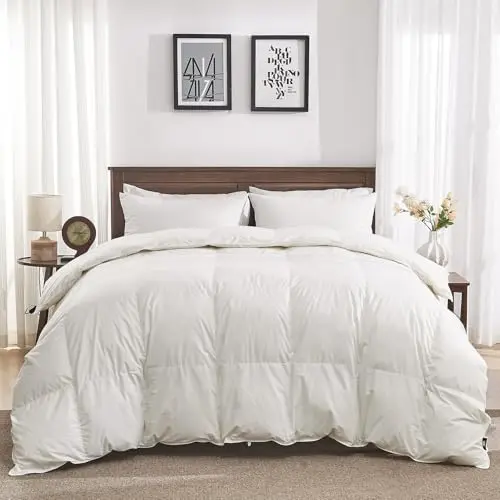
Goose Feather Down Comforter ME224-K – Baffle-Box Warmth in Organic Cotton
A king-size insert with a 100% organic cotton shell, a 3D baffle interior, and medium all-season warmth. At about two and a half inches of loft it’s the plushest option here without crossing into heavy winter territory.
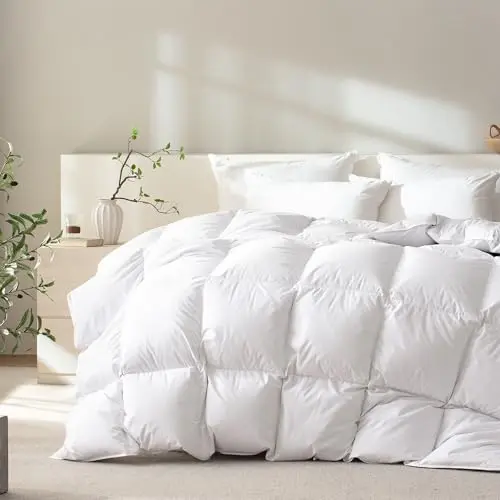
Hungarian Feather Down Comforter – GOTS-Certified Organic Cover
A king-size feather and down fiber insert with the strongest organic paper trail in this lineup – the 100% cotton cover is certified to the Global Organic Textile Standard. Box-stitched, eight-tabbed, and machine washable at medium all-season warmth.

Goose Feather Down Fiber Comforter – Organic Cotton Hotel Loft
A queen-size goose feather and down fiber insert wrapped in 100% organic cotton and built with baffle boxes for even loft. It aims squarely at the hotel-bed feel, with eight anchor tabs and a machine-washable build.

CK138-K Feather Down Duvet Insert – Lightweight Organic Cotton Comfort
A king-size feather and down fiber insert with a 100% organic cotton cover, OEKO-TEX and RDS certification, and a leaner fill that suits warm sleepers. Box-baffle chambers spread warmth evenly without the heft.
How We Evaluated These Organic Duvet Inserts
A few things we can’t tell you: how each insert feels after a full winter of nightly use, or how the fill holds up past a dozen wash cycles. What we can promise is a comparison built on what manufacturers publish, what the certifications actually cover, and how the pieces fit together on a real bed. We cross-referenced four organic duvet inserts from four distinct brands across six decision axes – cover certification, fill composition, construction style, warmth and weight, size and tab design, and care requirements. We triangulated published specifications, third-party certification claims from GOTS, OCS, OEKO-TEX, RDS and DOWNPASS, and owner feedback where available, then mapped each insert against the buyer profiles that come up most: hot sleepers, cold-room sleepers, king-bed owners fighting coverage gaps, and anyone replacing an insert that went flat in two seasons.
The scoring framework weighted real-world fit (70%) – warmth delivery, breathability, and whether the listed dimensions actually cover the bed – against feature differentiation (30%) – certified organic cotton, baffle construction, tab count, and machine washability. We have no commercial relationship with any brand featured; recommendations track fit and differentiation, not brand preference. If you want the most balanced organic insert for a king bed, the Oaken-Cat ME224-K is the pick; if the paper trail matters most, the WENERSI Hungarian Feather Down Comforter carries the strongest certification story.
How to Choose the Right Organic Duvet Insert
1. What Actually Makes a Duvet Insert Organic
Nearly every insert in this category calls itself soft, breathable, and hotel-quality. Very few can show you documentation for the word organic. In practice, an organic duvet insert almost always refers to the cotton shell – the fill is feather, down fiber, or polyester, and none of those carry an organic label. So the first question is which part of the product the claim covers.
The second is who verified it. A cover described as pure cotton or natural is marketing language. A cover certified to GOTS or OCS has been traced from fiber to finished fabric by an independent body, with limits on dyes and processing chemicals along the way. That gap is the whole ballgame if organic is your reason for shopping.
2. GOTS, OCS, OEKO-TEX, RDS: Which Certifications Matter
The certification alphabet is where most shoppers give up, so here’s the short version. GOTS is the strictest textile-level organic standard and covers the whole supply chain, chemical inputs included. OCS verifies organic content but says less about processing. OEKO-TEX Standard 100 tests the finished fabric for harmful substances – useful, but it is not an organic claim. And RDS or DOWNPASS address animal welfare and traceability in the down and feather supply, not farming methods.
An insert that stacks several of these – an organic cover certification, a responsible-down standard, and a safety test on the finished fabric – gives you a fuller picture than one leading with a single badge. Treat a lone OEKO-TEX mention as a floor, not a finish line.
3. Baffle Box vs Sewn-Through: Why Construction Decides Warmth
Construction is the spec nobody advertises loudly, and it’s the one you feel in year two. Sewn-through box stitching pulls the top and bottom shells together at every seam, which stops fill from shifting but creates thin, cold lines where the fabric meets. Baffle box construction inserts a fabric wall between chambers so the fill can fully loft – warmer, more even, and usually a little heavier.
Feather-heavy fills add a second worry: migration. A dense shell weave and reinforced seams matter as much as the quilting pattern, because once a quill finds a gap it keeps finding it. If leakage complaints dominate the feedback on a listing, believe them.
4. Matching Fill Weight and Warmth to Your Bedroom
Almost everything here is sold as all-season, which is a marketing term rather than a measurement. What actually varies is fill weight and loft: a leaner insert in the seven-to-eight pound range sleeps cool and layers well, while a heavier, baffled build holds more warmth for cold rooms. Neither is better – they’re aimed at different sleepers.
Hot sleepers should chase medium warmth with visible loft instead of maximum fill, then pair it with a breathable cover. If you run warm year-round, the Cobnom CK138-K is the leaner option in this lineup.
5. Sizing, Corner Tabs, and Duvet Cover Fit
Standard sizing is 90 x 90 inches for a queen and 106 x 90 inches for a king, but standard drifts. An insert that runs an inch or two narrow lets the corners of your duvet cover go slack, which reads as a lumpy bed no matter how good the fill is. Measure your cover, not just your mattress.
Corner tabs are the other half of that equation. Four loops are the minimum; eight tabs – four corners plus four side midpoints – keep the insert from migrating inside the cover. If shifting is your main frustration, the WENERSI Hungarian Feather Down Comforter uses eight and holds position better for it.
6. Washing and Keeping an Organic Duvet Insert Lofty
Every insert in this category arrives vacuum-packed and flat. Give it a few hours – or fifteen minutes on low heat in a dryer with a couple of dryer balls – before you judge the loft. Straight out of the bag it always looks thin, and that’s not the product you bought.
Long term, a duvet cover is the single best protector, since you wash the cover weekly and the insert rarely. Care instructions split into two camps: machine washable and dry-clean-only. Aggressive washing degrades natural fill faster than dirt does, so gentle cycles with cold water and low-heat drying are the safer path. If you’d rather not think about it, the L Lovsoul organic cotton comforter is machine wash and dry with no caveats attached.
Frequently Asked Questions
1. Are all organic duvet inserts actually certified organic?
No, and this is the most common place shoppers get misled. In most listings, organic refers to the cotton cover, not the fill – down, feather, and polyester aren’t organic materials in any meaningful sense. Some brands back the claim with GOTS or OCS certification, verified by a third party. Others use looser language like pure cotton or natural, which means nothing legally.
A separate badge, OEKO-TEX Standard 100, tests the finished fabric for harmful substances. It’s a good sign but not proof of organic farming. If organic is why you’re shopping, look for the certification name rather than the word.
2. What's the difference between the Oaken-Cat ME224-K and the WENERSI feather down comforter?
Both are king-size, medium-warmth inserts with organic cotton shells, but they solve different problems. The Oaken-Cat ME224-K leans on 3D baffle construction and a thicker 2.5-inch loft, with RDS and DOWNPASS tracking on the fill and a shell weave that resists leakage. The WENERSI counters with GOTS-certified cotton – the stricter organic standard – plus 750+ fill power and eight corner tabs for cover security.
Short version: take the Oaken-Cat for chambered construction and a plusher feel, the WENERSI if the certification trail is your priority.
3. How does the L Lovsoul organic cotton comforter compare with the Cobnom CK138-K?
They sit at opposite ends of the warmth scale. The L Lovsoul organic cotton comforter is the fuller of the two, with baffle boxes, eight corner tabs, and a genuine hotel-loft feel – though owner feedback flags feather leakage and seam wear as the recurring risk. The Cobnom is deliberately leaner, with a quill-free down fill and box-baffle chambers that suit warm sleepers and summer use.
Choose L Lovsoul for a plush all-season bed; choose Cobnom if you overheat and want something you can layer.
4. Do organic feather and down inserts work for hot sleepers?
They can, provided you pick the weight deliberately. Down and feather fill is known for breathability and warmth-to-weight ratio, but an overfilled insert traps heat no matter what’s inside it. Look for medium warmth with visible loft, a breathable cotton cover, and ideally baffle construction so the fill doesn’t pack down into cold spots.
Hot sleepers should treat the cover as part of the system too. A breathable linen or percale duvet cover shifts the feel more than most people expect, and it’s cheaper to change than the insert.
Final Verdict
For most shoppers, the Oaken-Cat ME224-K is the answer. Baffle chambers, a certified organic cotton shell, and a fill weight that works in January and July – it’s the insert we’d point a friend toward first.
If the certification trail is what brought you to organic bedding, the WENERSI Hungarian Feather Down Comforter carries GOTS on the cover plus eight tabs that keep a duvet cover behaving. Warm sleepers should drop to the leaner Cobnom CK138-K instead of fighting a heavy comforter. And if machine washability is non-negotiable, the L Lovsoul organic cotton comforter is worth a look – just watch the seams.
Sort by warmth first, then certifications, then care. Get those three in order and the choice makes itself.
