
Best Over-The-Door Full Length Mirrors – 2026 Reviews

A full-length mirror should earn its floor space. If your bedroom is tight, a leaning mirror can eat a corner, and a wall mount can mean drilling into a rental. That is why over-the-door full length mirrors are so appealing: they use the back of a door you already have and keep the floor clear. The catch is that not every door mirror is equally stable, adjustable, or safe.
The over-the-door format lives or dies on fit. Door thickness, the gap between door and frame, and the mirror’s hanging height decide whether it sits flush or swings crooked. Glass safety and frame material matter too, especially in dorm rooms and family homes. A mirror with a beautiful arch but flimsy brackets is not a good buy.
This guide surveys the category across brands and focuses on the details that separate a solid door mirror from a frustrating one: mounting hardware, viewing size, frame construction, and how much adjustment you get. The goal is to help you pick the right mirror for your door, not to push one brand.
Best Over-the-Door Full Length Mirrors – 2026 Reviews
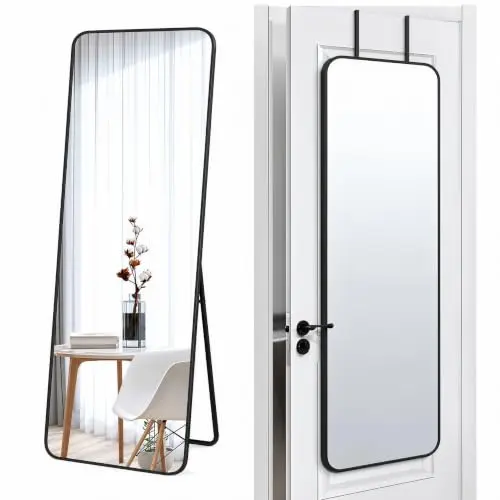
57×20 Three-Way Full Length Mirror – Door, Wall, or Floor Flexibility
A large three-way full-length mirror that can hang over a door, mount to the wall, or stand on its own. The tempered glass and aluminum frame give it a more substantial feel than basic door mirrors.
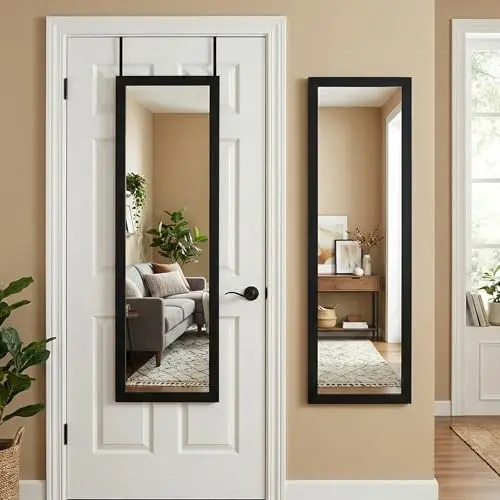
15×51 Over-the-Door Mirror – Classic Black Wood Frame
A classic black engineered-wood frame with a metal bracket system for over-the-door hanging. The 15×51 proportions suit traditional bedroom and bathroom doors.
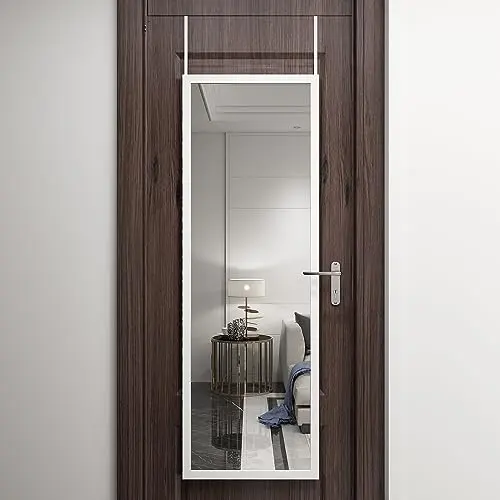
48×16 Over-the-Door Mirror – Lightweight Two-Way Mount
A lightweight 48×16 over-the-door mirror with two mounting methods and three suspension heights. A practical pick for small apartments and tight doors.

58×20 Over-the-Door Mirror – No-Drill Large-Format View
A large 58×20 door mirror with no-drill hooks, adjustable height, and shatterproof glass. It is built for buyers who want a bigger head-to-toe view without wall damage.
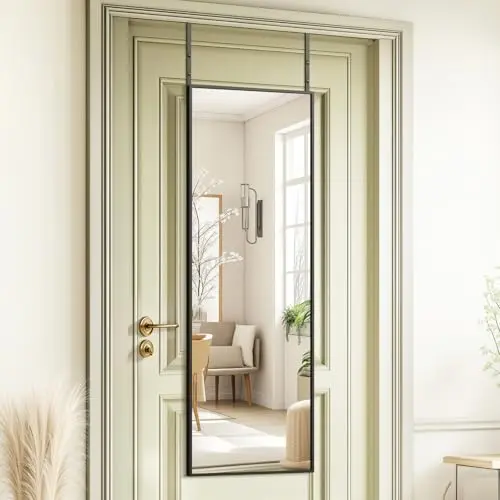
48×14 Tempered Glass Door Mirror – No-Drill Five-Height Hanging
A slim 48×14 tempered-glass mirror with five height settings and no-drill hanging. The lightweight design is aimed at closets, bedrooms, and rental spaces.
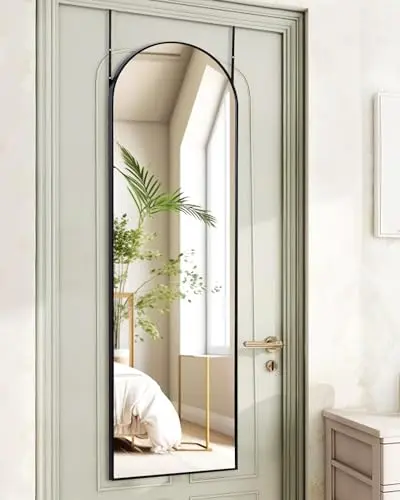
48×14 Arched Door Mirror – Slim Aluminum No-Drill Install
An arched 48×14 door mirror with a slim aluminum frame and adjustable height. The explosion-proof backing adds a safety layer for family homes.
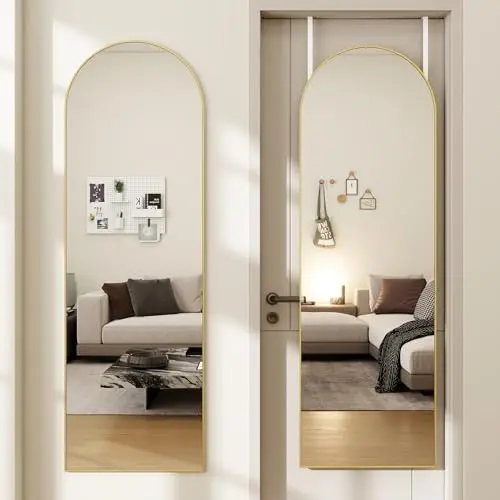
48×14 Arched Door Mirror – Gold Aluminum Frame
A gold arched 48×14 mirror with a thin aluminum frame, adjustable hooks, and wall-mount hardware. It leans decorative while staying practical for daily outfit checks.

16×50 Arched Door Mirror – Black Aluminum Frame
A 16×50 arched mirror with a black aluminum frame and tempered glass. It offers over-the-door hanging with a softer silhouette than a standard rectangle.
How We Evaluated These Over-the-Door Full Length Mirrors
We didn’t hang each mirror on a door for months or measure reflection distortion in a lab. What we did: cross-referenced 8 over-the-door full length mirror models from 8 distinct brands across five decision axes – mounting method, frame material, glass safety, viewing size, and installation hardware. We triangulated published specifications, feature sets, and owner feedback where available, then mapped each option against common door setups and buyer profiles. We also weighed how each mounting system interacts with common interior doors, including trim clearance, door swing, and the reality of rental-friendly no-drill setups.
The scoring framework weighted real-world fit and performance (70%) – how well each mirror matches its stated door, wall, or leaning use – against feature differentiation (30%) – unique advantages in glass, hardware, adjustment, and frame design. We audited the lineup for relevance to the over-the-door format and for practical details like door thickness, height settings, and included parts. Where the owner-feedback signal was uneven, we leaned more heavily on documented specifications and installation design. We have no commercial relationship with the brands featured; recommendations track fit and differentiation, not brand preference. This is not a spec-sheet ranking; it is a fit guide for different doors and rooms. If you want the largest and most flexible setup, the SCWF-GZ is the pick; if a classic wood frame and bracket mount matter more, the Americanflat serves you better.
How to Choose the Right Over-the-Door Full Length Mirror
1. Why the Over-the-Door Full Length Mirror Format Works in Small Rooms
An over-the-door full length mirror is a space-saving move first and a decor choice second. It uses vertical door space that would otherwise be blank, so you do not sacrifice floor area to a leaning mirror or give up wall space to art. The tradeoff is that the door must be able to carry the mirror without binding, and the door gap needs to be wide enough for the hooks or bracket.
This format is especially useful in bedrooms, closets, dorms, and rentals where drilling is restricted. But it is not automatically renter-proof: a bracket that screws into the door or wall is still a permanent-ish install. Look for a true no-drill setup if you need to move the mirror between rooms.
2. Measure the Door, Mirror, and Viewing Height Before You Buy
The most common disappointment with a full length mirror is not glass quality; it is viewing height. A 48-inch mirror hung too high can cut off your shoes, while a 57-inch mirror may crowd a short door. Measure from the top of the door to the floor, then subtract the mirror height and the hardware clearance. Adjustable hangers help, but they only move the mirror a few inches.
Check the door width against the mirror width. A 14-inch mirror is compact but narrow; a 16-inch model is a useful middle ground; a 20-inch model gives the widest view but may overlap trim or feel oversized in a hallway. Door trim and door swing matter as much as the listed dimensions. If the door opens into a tight space, a mirror that sticks out too far will be annoying.
3. Frame Material and Glass Safety for a Full Length Mirror
Frame material affects weight, durability, and how the mirror reads in a room. Aluminum alloy is the most common step-up choice: it is light, rust-resistant, and slim. Engineered wood gives a warmer furniture look but can be heavier and less forgiving if the door slams. Polystyrene is the budget option; it is light, but it can feel less substantial.
Glass safety is the other half of the decision. Tempered glass and a protective film back are worth prioritizing in dorms, kids’ rooms, and busy hallways. These features do not guarantee the mirror will survive a hard impact, but they reduce the chance of dangerous shards. If the product listing does not name the glass type, assume it is basic annealed glass and treat it more carefully.
4. Installation Hardware and Hanging Stability
Hardware is where cheap door mirrors reveal themselves. A metal bracket that screws into the door can be very stable, but it requires careful alignment and leaves holes. Adjustable hooks are faster and more rental-friendly, but they depend on the door gap and can let the mirror shift if the padding is thin. A no-drill setup is not automatically better; it is better only if the hooks fit your door and the mirror stays level.
If you want a classic bracket mount and a wood frame, the Americanflat is the pick. If you need a no-drill setup with multiple height choices, the Kosmonia is the better fit. Either way, check that the included screws, anchors, and pads are all present before you start.
5. Full Length Mirror Size, Shape, and Room Fit
Shape is mostly aesthetic, but it affects how much mirror you get. A rectangular mirror maximizes viewing area within its dimensions. An arched silhouette softens the top edge and can make a narrow door mirror feel more decorative. A black frame is the safest match for modern and traditional rooms; a gold frame is more of a design statement.
If you want the largest, most flexible setup in this category, the SCWF-GZ is the pick. It offers a 57×20 view and can hang over a door, mount to the wall, or stand with a back leg. For a tighter door, stay with a 48×14 or 48×16 mirror and put the saved width toward a better frame or safer glass.
6. How Much Mirror Do You Need for a Dorm or Rental?
For a dorm or rental, prioritize rental-friendly hardware, a manageable weight, and a size that fits a standard interior door. A 48×14 mirror is the easiest to move and store, while a 15×51 or 48×16 model gives a little more width without becoming bulky. If the door is shared or closes often, a padded hook and a shatter-resistant back matter more than a decorative frame.
Do not overbuy length. A taller mirror can be great in a bedroom, but in a dorm it may hit the door frame or sit too high for a short user. Adjustability is the feature that lets one mirror work for different heights and door setups.
Frequently Asked Questions
1. Are over-the-door full length mirrors safe for renters?
Usually yes, because the best over-the-door full length mirrors use padded hooks or bracket systems that hang without drilling. The main risks are door gap fit and door thickness; if the hooks are too thick, the door may not close cleanly. Check the mirror’s weight and the included hardware before you commit. A no-drill setup is ideal for rentals, but a wall-mounted model with screws still needs landlord approval.
2. What's the difference between the SCWF-GZ and the Americanflat over-the-door mirror?
The SCWF-GZ is the larger, more flexible option: a 57×20 viewing area, three mounting modes, and tempered glass. The Americanflat is narrower at 15×51 and uses a classic engineered-wood frame with a metal bracket. If you want a bigger head-to-toe view and floor-stand flexibility, the SCWF-GZ is the pick. If you want a furniture-like black frame and a simpler door bracket, the Americanflat fits better. Both are full length, but they solve different room problems.
3. How do the KOMCOTE and Kosmonia door mirrors compare?
Both are 48×14 compact mirrors with aluminum frames and no-drill hanging. The KOMCOTE has an arched top and an explosion-proof film, so it leans decorative. The Kosmonia is a rectangle with 2mm tempered glass and five height settings, which gives it more adjustment. Choose the KOMCOTE for a softer silhouette; choose the Kosmonia if you prioritize tempered glass and precise height tuning. Neither is as wide as a 16- or 20-inch door mirror.
4. Will an over-the-door mirror fit my door?
It depends on door thickness, door gap, and trim clearance. Most over-the-door hooks need a standard interior door, and some models list a thickness range such as 1.4 to 1.7 inches. Measure the door width, the distance from the top edge to the floor, and the space between the door and frame. If the mirror is too tall, it may drag; if the hooks are too thick, the door may not close. Adjustable hangers help, but they cannot fix a door that is too thick.
5. What should dorm renters look for in an over-the-door full length mirror?
A lightweight 48×14 or 15×51 mirror is usually the easiest dorm pick because it hangs without tools and does not eat floor space. Look for included hooks, protective glass film, and a frame that can survive moving in and out. The Americanflat is a strong dorm choice if you want a classic wood frame and a straightforward bracket, while a no-drill Kosmonia-style mirror is better if drilling is forbidden. Avoid the widest 20-inch models unless you have measured the door and closet clearance.
Final Verdict
For most buyers, the SCWF-GZ is the answer. It pairs the largest 57×20 viewing area with three mounting modes, so it works over a door, on a wall, or as a leaning floor mirror. If you are working with a tighter budget or a smaller door, the whitebeach gives you a useful 48×16 reflection without the premium tier. For a larger bedroom or dorm where you want no-drill convenience and a wide view, the Antok is the premium pick. And if a classic wood frame matters more than multi-way mounting, the Americanflat remains the most furniture-like choice. Start with your door measurements, then choose the mirror that fits your wall, your height, and your hardware comfort level.
