
Best Packing Cubes In Canada – 2026 Reviews

There’s a moment on every trip when a suitcase stops being a container and becomes a dig site. You’re crouched on a hotel floor at midnight, excavating for a clean shirt, and everything you folded neatly three days ago has fused into one dense, undifferentiated block. Packing cubes exist to prevent that moment – but not all of them do it equally well.
Two things separate cubes that earn their keep from the ones that end up in a drawer. The first is structure: does a cube hold its shape when it’s full, or does it slump into a soft sack the moment you lift it? The second is whether it compresses. A second zipper running around the perimeter can pull a four-inch cube down to an inch or two, which is the difference between fitting a week in a carry-on and paying for a checked bag.
Canadian travel adds its own wrinkle. Winter layers eat volume in a way summer clothes never do, and a checked bag on a domestic flight is money you’d rather spend elsewhere. So the sets worth buying here need to earn their space, not just look tidy in a drawer. We compared what’s actually available across brands and price tiers, and the picks below reflect how each set behaves in real luggage rather than how it photographs.
Best Packing Cubes in Canada – 2026 Reviews
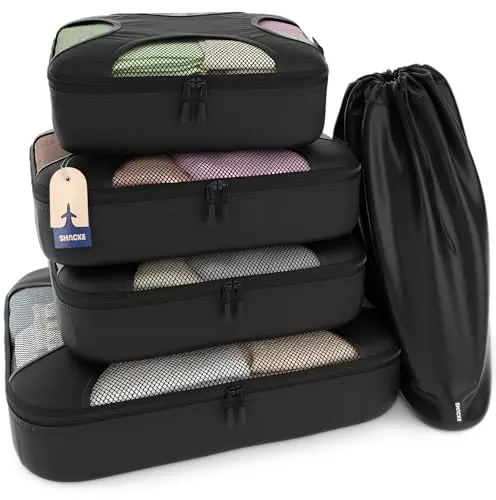
5-Set Packing Cubes – Structured Organization with Laundry Bag
Four cubes from extra large down to small, plus a dedicated laundry bag. Each cube is four inches deep, built from water-resistant nylon, and topped with a breathable mesh panel so you can see what’s inside without unzipping anything.
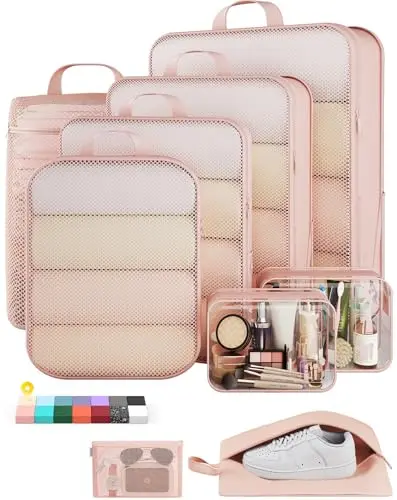
9-Piece Compression Packing Cubes – Full Kit with Toiletry Bags
Nine pieces: four compression cubes from small to extra large, two clear PVC toiletry and makeup bags, a machine-washable laundry bag, a shoe bag, and a zippered pouch. The cubes use a second zipper to flatten contents and are sized for suitcases from roughly 20 to 34 inches.
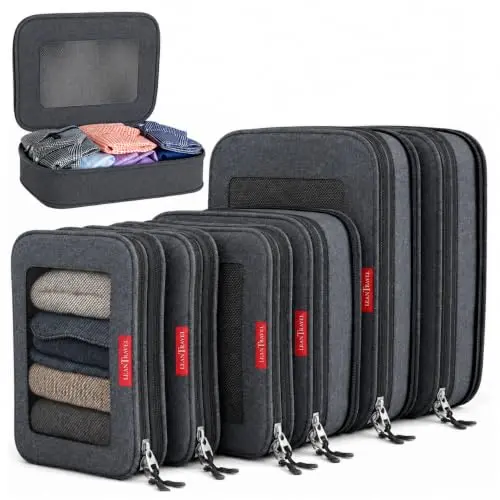
Premium Compression Packing Cubes – Heavy-Duty 6-Pack
A six-piece compression set with a reinforced side structure, 300D polyester shell, and anti-catch zippers. The second zip pulls each cube from four inches down to roughly one, and the mesh top keeps contents visible without unzipping.
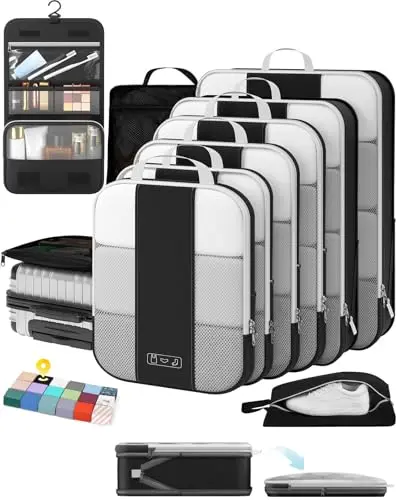
10-Piece Compression Packing Cubes – Garment Bag Included
A ten-piece compression kit built around four cubes from small to extra large, plus a hanging toiletry bag, garment bag, shoe bag, machine-washable laundry bag, and pouch. The mesh panels are densely perforated, and the whole set is sized for 20 to 32 inch suitcases.
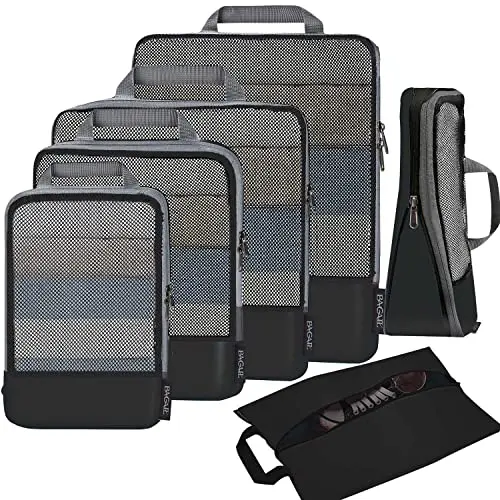
6-Set Compression Packing Cubes – 320D Fabric Build
A six-piece compression set built from 320D fabric with a half-mesh lid. Compression runs through a middle zipper around the cube, and double-way zippers open wide enough to load each bag like a clamshell.
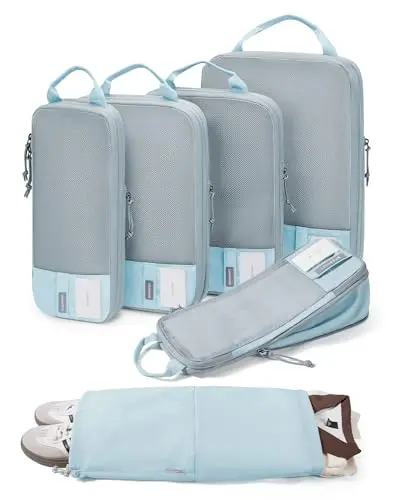
6-Set Compression Packing Cubes – Lightweight Space Saver
A six-piece compression set split into large for jackets and trousers, medium for shirts, and small for underwear and socks. Each cube carries an outer compression zipper, an ID tag pocket, and a mesh lid, with a drawstring laundry bag in the set.
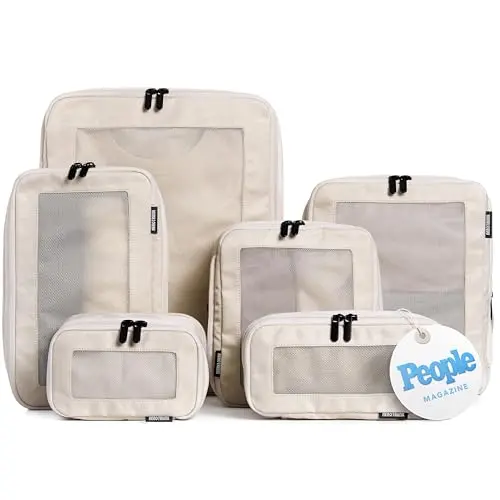
Compression Packing Cubes 6-Pack – Nylon Twill Build
A six-piece compression set in nylon twill with breathable mesh tops and a double-zipper compression design. The brand sizes its sets to the bag: two pieces for a backpack, four for a carry-on, six for checked luggage. Backed by a one-year warranty.
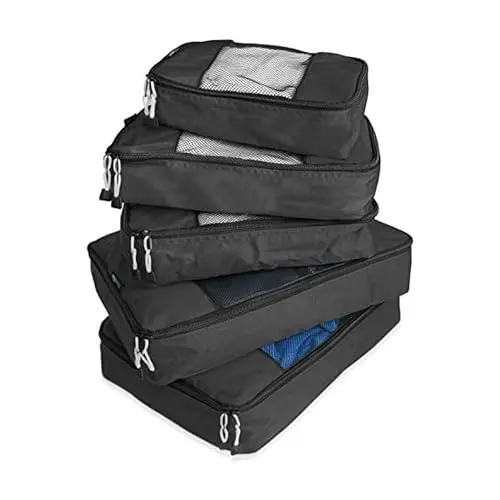
5-Piece Packing Cube Set – Ripstop Pattern Design
Five pieces – one small, two medium, two large – in a poly ripstop shell with mesh front panels and webbing grab handles. Hand wash and hang dry, and the patterned exterior makes your cubes easy to identify on a shared trip.
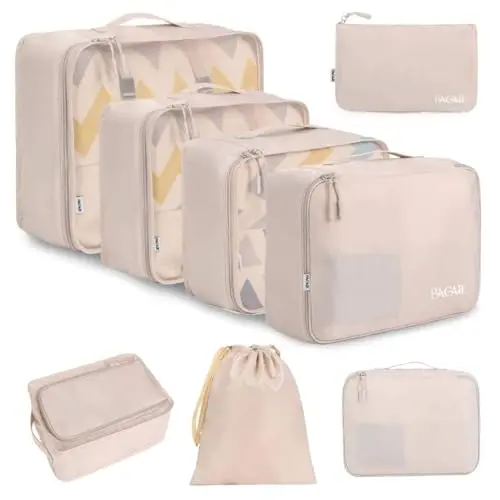
8-Set Packing Cubes – Budget-Friendly Organization
An eight-piece organizer set in water-repellent polyester with mesh top panels and double-way zippers on extended cord pulls. The smallest bag fits a tote, weekender, or backpack, while the larger cubes handle a full checked bag.
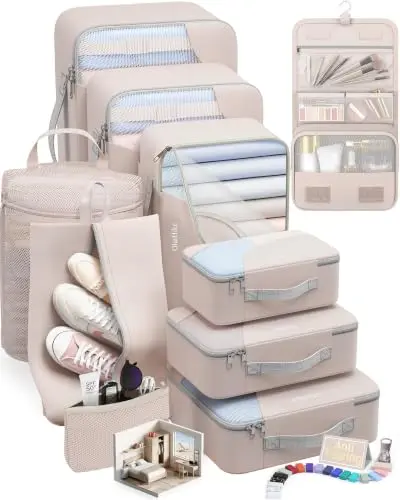
10-Piece Packing Cubes – Toiletry and Shoe Bags Included
Six cubes in graduated sizes plus a hanging toiletry bag, laundry bag, shoe bag, and accessory bag. Built from anti-tearing, water-resistant polyester with reinforced double seams and two-way metal zippers, with side handles on each cube.
How We Evaluated These Packing Cubes
We didn’t gate-check these through a winter of connecting flights. What we did: cross-referenced 10 packing cube sets from 8 distinct brands across six decision axes – cube dimensions and capacity, fabric weight and construction, zipper hardware, compression mechanism, included accessories, and how each set maps to carry-on versus checked luggage.
We triangulated published specifications, feature sets, and owner feedback where available, then weighed each set against realistic packing scenarios: a four-day business trip in a carry-on, a two-week trip with a checked bag, and a weekend where you’re sharing space with someone else’s things. Fabric claims were compared at face value – denier ratings, stitching density, and zipper hardware where disclosed – since those are the numbers that tend to predict how a cube ages.
The scoring framework put real-world packing fit at 70% – how much usable volume a set actually delivers and how well it holds up in transit – against feature differentiation at 30% – compression performance, accessory range, and anything that solves a problem the others don’t. We have no commercial relationship with any brand featured here, so recommendations track fit and differentiation rather than brand preference. If you want the set most travelers should simply buy, the Shacke 5-Set is the safe answer; if you’re committed to squeezing a carry-on to its limit, the LeanTravel Premium Compression Packing Cubes earn their place.
How to Choose the Right Packing Cubes
1. Compression vs. Standard Packing Cubes: What Actually Saves Space
A standard cube is a box. A compression cube is a box with a second zipper running around its perimeter that pulls the top and bottom panels closer together. That’s the entire mechanical difference, and it’s the one that matters when you’re trying to fit a week into a carry-on. Compression cubes typically flatten from about four inches to one or two, depending on what’s inside.
The catch: compression rewards soft, foldable items – t-shirts, knitwear, underwear. Try to compress stiff jeans or a structured jacket and you’ll fight the zipper and gain almost nothing. That’s why a mixed approach often works best: compression cubes for clothing, a standard cube or two for shoes, chargers, and anything bulky that won’t squash.
2. How Many Packing Cubes Do You Need for a Carry-On?
For a carry-on, three to four cubes is the practical sweet spot: one large for trousers and shirts, one medium for tops, one small for underwear and socks, and a fourth if you’re packing shoes or gym gear separately. Sets with eight to ten pieces suit checked luggage, family trips, or travelers who genuinely separate categories.
Pay attention to cube dimensions rather than piece count. Four well-sized cubes will usually outperform eight cubes too small to hold a folded sweater. Check depth too – four to four and a half inches is the common standard, and deeper cubes eat carry-on volume fast.
3. Fabric, Stitching, and Zippers: What Survives the Baggage Belt
Most packing cubes are polyester or nylon. The useful number is denier: 300D and above signals a denser weave that resists abrasion, while thinner fabrics pack lighter but wear faster. Neither is wrong – it’s a weight-versus-longevity trade.
Stitching matters more than fabric branding. Look for reinforced seams and a structured sidewall – piping, cross-stitching, or a stiffened panel – because a cube that collapses when lifted defeats the purpose. Zippers are the other failure point; two-way zippers with anti-catch teeth and generous pulls are worth prioritizing, especially on compression cubes where the zip sits under real tension.
4. Packing for a Canadian Winter: Why Cube Depth Matters
Winter travel in Canada changes the math. A sweater, a liner, gloves, and a hat can fill a cube on their own, and bulky knits don’t compress the way summer clothing does. If you’re flying out of a cold city in January, lean toward sets with at least one genuinely large cube and treat compression as a bonus rather than a solution.
The other winter consideration is damp clothing. A dedicated laundry or shoe bag keeps a snow-damp scarf away from everything else – a small thing that makes a big difference over a week.
5. Shacke vs. Veken: Structured Cubes or a Full Compression Kit?
These two represent the main fork in the road. The Shacke 5-Set is a standard structured cube set – four sizes plus a laundry bag, no compression zipper, and a build that holds its shape when fully packed. It’s the choice if you fold neatly and want cubes that behave like drawers.
The Veken 9-Piece goes the other direction: four compression cubes plus toiletry, shoe, laundry, and accessory bags. You get more pieces and more ways to organize, at the cost of a little more fuss on packing day and a fabric that isn’t built for the heaviest use.
6. What Different Price Tiers Get You in Packing Cubes
Entry-level sets get you functional cubes and a mesh panel, usually in lighter fabric with simpler zippers. Mid-range is where compression zippers and accessory kits show up – the OlarHike 10-Set and similar sets live here, and this is the tier most travelers should shop.
Premium sets buy you heavier fabric, reinforced structure, and branded zipper hardware, which matters if you fly often or pack tight. What you’re paying for is longevity and less wrestling, not a fundamentally different packing experience.
Frequently Asked Questions
1. Do compression packing cubes actually save meaningful space?
Yes, with caveats. The compression zipper pulls the panels together and can cut a cube’s thickness by more than half, but the savings depend entirely on what’s inside. Soft knits and t-shirts compress well; denim, structured jackets, and shoes barely move. Compression also adds a step to packing and puts real tension on the zip, so poorly made compression cubes are the ones that fail first.
2. What's the difference between the Shacke 5-Set and the LeanTravel Premium Compression Cubes?
The Shacke 5-Set is a standard structured set – no compression zipper, four sizes, and a laundry bag, with cross-web stitching that keeps the walls upright. The LeanTravel Premium Compression Packing Cubes add double-zipper compression and reinforced piping, so they pack flatter but demand more careful loading. Choose Shacke if you want simple and sturdy; choose LeanTravel if carry-on volume is your binding constraint.
3. How do the Veken 9-Piece and OlarHike 10-Piece compression sets compare?
Both are compression sets bundled with accessory bags, aimed at travelers who want one purchase to cover everything. The Veken set leans on two PVC toiletry bags and a shoe bag, while the OlarHike compression set adds a hanging toiletry bag and a garment bag for dressier clothing. Veken’s cubes run small to extra large; OlarHike’s four compression cubes cover the same spread. Pick based on whether you’d actually use a garment bag or a second clear toiletry pouch.
4. Will packing cubes fit standard Canadian carry-on luggage?
Usually, if you check the numbers first. Most major Canadian carriers publish carry-on limits in the rough neighbourhood of 21 by 15 by 9 inches, though it’s worth confirming with your airline before you buy. A set of four cubes laid side by side typically fills that footprint with room left for a pair of shoes. Measure your actual bag – piece count doesn’t guarantee a fit, and a smaller set matched to your suitcase beats a large one that doesn’t.
5. How do you pack for a Canadian winter with packing cubes?
Start with the bulkiest item and give it the largest cube. Sweaters and fleece liners don’t need compression – they need space, so a standard cube works better than a squashed one. Use a small cube or shoe bag for gloves, a hat, and a scarf, and keep a separate laundry bag for anything that comes back damp. If you’re layering, rolling thin base layers into a medium compression cube saves the most room.
Final Verdict
For most travelers, the Shacke 5-Set is the answer – cubes that hold their shape, a laundry bag that earns its place, and a build that outlasts most suitcases. If you’d rather squeeze a carry-on to the last inch, the Veken 9-Piece gives you compression plus a full accessory kit without climbing to the premium tier. Frequent flyers who want the sturdiest construction in the lineup should look at the LeanTravel Premium Compression Packing Cubes. And if you’re outfitting a family or just want maximum pieces for minimum outlay, the BAGAIL 8-Set is the budget play, with the durability trade-off that comes with it.
