
Best Patio Umbrellas With Lights – 2026 Reviews

There’s a specific moment when a patio umbrella with lights earns its keep: the sun drops, the plates are still out, and nobody wants to go inside. A plain umbrella leaves you sitting in the dark right then. A lit one keeps the table usable for another hour or two without dragging an extension cord across the deck.
The catch is that the lighting half of the equation is where quality varies most. Some canopies glow evenly rib by rib. Others put out a dim stripe and quit halfway through a season. Panel placement, charge behavior, and switch design matter as much as the canopy itself, and the frame has to survive the weather long after the novelty wears off.
We looked across the market at lit table umbrellas, offset cantilever designs, and oversized double-sided canopies, weighing shade coverage against lighting performance and build. Below you’ll find picks for a standard four-to-six-seat table, for big dining setups, for patios where a center pole simply won’t work, and for anyone who wants good evening light without spending much.
Best Patio Umbrellas with Lights – 2026 Reviews

9' Solar LED Patio Umbrella – Fade-Resistant Canopy on an Aluminum Pole
A 9-foot market umbrella with 24 solar LEDs tucked into the ribs and a rust-free aluminum pole instead of the painted iron most umbrellas at this level use. Crank lift and push-button tilt handle the daily open and close, and the polyester canopy is treated for fade and water resistance.

10FT Cantilever Umbrella – 360-Degree Rotation with Base Included
A 10-foot cantilever umbrella that gets the center pole out of your sightline entirely, with 360-degree rotation, infinite tilt across a 45-degree arc, and 32 solar LEDs. It arrives as a complete kit: cross base, two sandbags, and a cover.

10FT Solar LED Umbrella – Solution-Dyed Fabric for Big Dining Tables
A 10-foot round umbrella sized for six-to-eight-seat tables, with 32 solar LEDs, an 180g solution-dyed polyester canopy rated UV 50+, and a tilt adjustment that slides along the pole instead of flipping at the hub.

15FT Double-Sided Umbrella – 135 Square Feet of Lit Shade
A double-sided 15-by-7.5-foot rectangular umbrella that throws up to 135 square feet of shade, sold with a cross base, weight bag, and 32 solar LEDs. Built for long furniture runs and wide decks rather than a single round table.

9 ft Solar Umbrella – 32 LEDs on a 1.5-Inch Pole
A 9-foot solar umbrella with 32 LEDs spread across eight ribs, a 1.5-inch pole, and separate controls for the light and the canopy. Straightforward, widely used, and easy to live with.
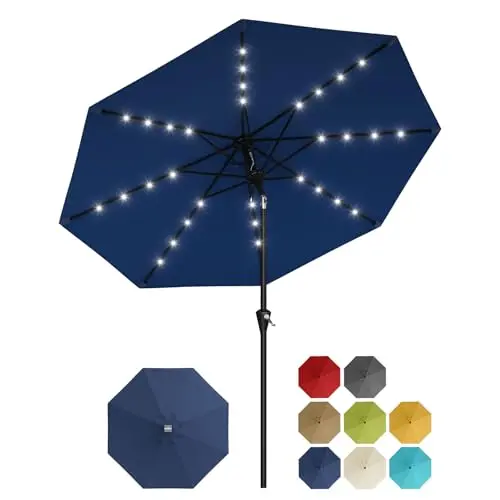
9FT Solar Patio Umbrella – UPF 50+ Canopy with 32 Lights
A 9-foot solar umbrella with 32 LEDs, an UPF 50+ water-resistant canopy, and a dedicated light switch, priced at the entry end of the category. Covers a four-to-six-seat table.
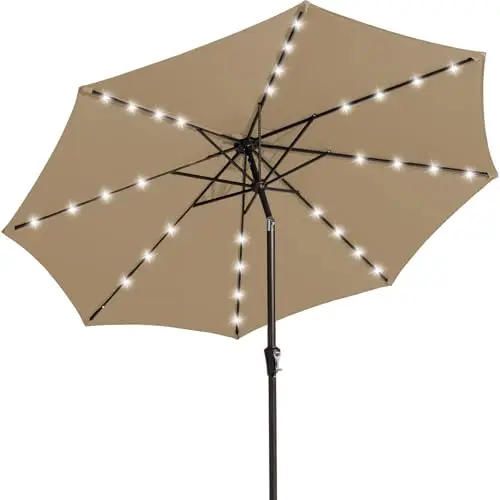
9' Solar Market Umbrella – Vented Canopy, Antique Bronze Frame
A 9-foot market umbrella with a vented canopy, solar lighting, and a powder-coated antique-bronze iron frame. Push-button tilt and a hand crank keep operation simple, and the canopy spans about 106 inches.

9ft Solar Patio Umbrella – Turquoise Canopy with 32 Lights
A 9-foot solar umbrella with 32 LEDs, a top-mounted panel, rotational tilt, and a turquoise canopy that’s the most distinctive color in this lineup. The pole detaches for storage.

9FT Solar Umbrella – Tool-Free Setup with 32 Built-In Lights
A 9-foot solar umbrella built around quick, tool-free assembly, with 32 LEDs set into the ribs, a powder-coated iron frame, and a vented water-repellent canopy.
How We Evaluated These Patio Umbrellas with Lights
We didn’t sit under these through a full season of sun, wind, and rain. What we did: cross-referenced 9 patio umbrella models from 9 distinct brands across five decision axes – canopy coverage and fabric spec, lighting setup (LED layout, panel placement, switch design), frame and rib construction, tilt and crank mechanics, and weather-resistance claims. We triangulated published specifications, feature sets, and owner feedback where available, then mapped each option against representative buyer profiles: a four-seat dining table, a six-to-eight-seat setup, a poolside lounger arrangement, and a wide deck that needs to be covered end to end.
The scoring framework weighted real-world fit (70%) – how well each umbrella actually delivers shade by day and usable light by night for its stated setup – against feature differentiation (30%) – structural or lighting advantages that change how you use it. We have no commercial relationship with any brand here; recommendations track fit and differentiation, not brand preference. For a standard table, the Sunnyglade solar LED umbrella is your match. If you need the pole out of the way entirely, the OLILAWN cantilever umbrella solves that problem.
One honest limit: we did not run wind-tunnel testing, measure light output with instruments, or time solar charge cycles in a lab. Our judgment rests on published specs, how the lighting and frame systems are engineered, and the pattern of experience reported by people who own them.
How to Choose the Right Patio Umbrella with Lights
1. Why the Lighting Spec Deserves More Attention Than the LED Count
Every umbrella here advertises LED numbers, and those numbers tell you less than you’d think. What shapes the experience is solar panel placement, the per-rib LED layout, and whether there’s a dedicated on/off switch. A panel mounted at the very top of the canopy catches sun all day; a small offset panel may not keep up if your patio is shaded for part of the afternoon.
The per-rib spread matters more than the total. Eight ribs with four lights each gives continuous light around the table, while cheaper arrangements concentrate it in one arc and leave half the seats dim. Expect ambient glow, not reading light, from any solar umbrella, so plan on a lantern if you’re actually working at the table after dark.
Charge expectations are consistent across the category: a solid day of sun yields roughly an evening of light, and cloudy days shorten that. Turn the switch off in daylight so the panel can do its job.
2. Match Canopy Size to the Table You Actually Own
A 9-foot canopy comfortably shades a 42-to-54-inch round, square, or rectangular table with four to six chairs. A 10-foot canopy handles six to eight chairs and is the size most people should buy if they’re unsure and have the room. Beyond that you’re into double-sided or cantilever territory.
Consider center-pole clearance too. A table umbrella needs either a hole in the table or a freestanding base; an offset cantilever needs neither. If your layout can’t accommodate a pole at all, whether that’s a sectional, a lounger row, or a long dining run, an offset design is the only thing that works. For a wide deck covering both seating and a table, the LEVELEVE 15FT double-sided umbrella is built for exactly that.
3. Frame and Rib Construction: What Survives a Second Summer
Aluminum poles don’t rust, which is why they turn up on umbrellas expected to stay outside. Powder-coated iron and steel are stronger and heavier, and the coating does the rust work, so a chip matters more than it would on aluminum. A 1.5-inch shaft is the standard for a 9-to-10-foot canopy.
Rib count affects how evenly the canopy holds its shape, and eight is the practical minimum at this size. The parts that fail first are rarely the ribs themselves; they’re the tilt joint, the hub, and the point where the top cap meets the mast. A vented canopy helps by letting wind pass through instead of lifting the whole umbrella.
4. Sunnyglade vs Kingdura vs Blissun: Choosing Between Lighted Table Umbrellas
These three overlap heavily on paper, all offering a nine-or-ten-foot span and integrated solar lighting, so the split comes down to fabric and frame. The Sunnyglade leans on an aluminum pole and fade-resistant polyester, the better bet for a patio that sees weather. The Kingdura goes bigger at 10 feet and swaps in solution-dyed polyester, the more colorfast option, with a pole-slider tilt that’s easier to reach than a hub button.
The Blissun sits between them: 32 LEDs, a 1.5-inch pole, a separate light switch, and a straightforward push-button tilt. If even shade across a six-to-eight-seat table matters most, the Kingdura 10FT solar umbrella is the pick. If you want the most established 9-foot table umbrella in this group, the Sunnyglade solar LED umbrella is the safer call.
5. What Each Price Tier Actually Buys
At the entry end you get a 9-foot canopy, 32 lights, and painted iron. The umbrella works, but the finish and the tilt mechanism are where corners were cut. Step up a tier and you typically gain solution-dyed or coated fabric, a better shaft, and a vented top. The premium tier is where cantilever designs, included bases, thicker steel, and yarn-dyed 220GSM canopies live.
Budget for a base separately in most cases. It’s frequently not included, and it isn’t optional on a freestanding umbrella. If you want the most umbrella for the least money, the Garvee 9FT solar umbrella is the value pick in this lineup.
6. Base Weight, Storage, and Off-Season Care
Base requirements scale with canopy size and are non-negotiable. A 9-foot freestanding umbrella wants at least 26.5 lbs; a 10-foot canopy over an eight-seat table wants far more, and manufacturers often specify 55 to 66 lbs. Sand-filled bases are the practical answer, and sandbag systems get you there without hauling a concrete block.
Close the umbrella during windy days and store the canopy dry. Wipe the frame with a damp cloth, keep the solar panel clear of debris, and check the panel plug connection before the season starts, since several of these ship with the panel disconnected for transit. In winter, take the canopy down or cover it. That’s the single biggest factor in getting more than two seasons out of the fabric.
Frequently Asked Questions
1. Are the solar lights on a patio umbrella bright enough to sit under?
Bright enough to see your guests, not bright enough to read a book. The 32-LED models with four lights per rib produce the most even coverage, while 24-LED designs are noticeably softer. The light is ambient and warm, aimed at making an evening table pleasant rather than illuminating a task.
Two practical notes: turn the on/off switch off during the day so the panel charges, and expect roughly an evening of runtime from a full day of sun. Cloudy days and shaded patios cut that down.
2. What's the difference between the Sunnyglade and the Blissun solar umbrella?
Both are 9-foot lit table umbrellas, and the split is fabric and structure. The Sunnyglade uses a rust-free aluminum pole and a fade-resistant, water-repellent canopy with 24 LEDs. The Blissun runs 32 LEDs on a heavier 1.5-inch pole with eight iron ribs and adds a dedicated light switch.
Choose the Sunnyglade if the umbrella sits out in weather and pole corrosion worries you. Choose the Blissun if you want more light points and a beefier shaft. Neither ships with a base.
3. Do I need to buy a base separately for a lighted patio umbrella?
Usually, yes. Most of these ship without one, and a freestanding 9-footer needs at least 26.5 lbs of ballast; larger canopies need considerably more. If the umbrella passes through a table hole, the table plus a modest base does the job.
If you’d rather not shop for a base separately, the OLILAWN 10FT cantilever umbrella includes a cross base, two sandbags, and a cover in the box.
4. LEVELEVE double-sided vs OLILAWN cantilever: which covers more?
Different shapes for different spaces. The LEVELEVE is a 15 x 7.5-foot rectangular double-sided canopy spreading up to 135 square feet across a long furniture run. It shades a sofa and a table at once but needs that long footprint.
The OLILAWN is a 10-foot round cantilever on an offset mast: less total area, but it rotates 360 degrees and tilts through 45 degrees, so it can be aimed wherever the sun is. Both include a base. Long deck, go LEVELEVE; a single seating cluster that needs aiming, go OLILAWN.
5. What should I check on arrival before the return window closes?
Three things. First, find the solar panel – on several of these it ships loose in the packaging foam rather than attached, and it gets thrown out with the box. Second, unscrew the panel and confirm the plug connection; a loose plug is the most common reason lights don’t work out of the box. Third, charge it for a full day in direct sun and switch it on after dark before you get comfortable with it.
Then check the canopy seams and the tilt joint. Those are the parts that decide whether you get one season or several.
Final Verdict
For most patios, the Sunnyglade solar LED umbrella is the answer: a 9-foot canopy that covers a standard table, lighting that makes the evening genuinely pleasant, easy crank and tilt, and an aluminum pole that won’t rust while it sits out all summer.
If you’re spending less and still want 32 lights, the Garvee 9FT is the value pick. If your shade problem is a whole seating area rather than one table, the LEVELEVE 15FT double-sided umbrella is purpose-built for it. And if a center pole is a non-starter, the OLILAWN cantilever rotates, tilts, and arrives with its base.
Start with your table size, then pick the frame material you’re willing to maintain. That’s the whole decision.
