
Best Pillows For Herniated Disc In Neck – 2026 Reviews

A herniated disc in the neck has a way of announcing itself at 6 a.m. You wake with a hot ache running from the base of the skull into one shoulder blade, and the thing your head rested on all night becomes an obvious suspect. A pillow you happily used for years can turn into exactly the wrong shape once a disc is pressing on a nerve.
Two factors separate a pillow that helps from one that quietly works against you. The first is loft – the height your neck sits at relative to your head. Too tall and the chin tips toward the chest, flattening the cervical curve. Too low and the head drops back, loading the joint from the other direction. The second is rebound and firmness. A pillow that collapses under the weight of your skull offers nothing by 3 a.m., while one that pushes back too hard puts pressure right where an irritated disc least wants it.
That’s why the most useful cervical pillows on the market share a trait: they give you room to correct them. Removable layers, dual-height edges, a rotatable core, a pull-out insert – these are the details that let you fine-tune before your neck decides for you. We cross-shopped the major brands in this category to work out which designs offer real adjustment range, which use materials worth trusting, and which are just contour-shaped foam with better photography.
Best Pillows for Herniated Disc in Neck – 2026 Reviews
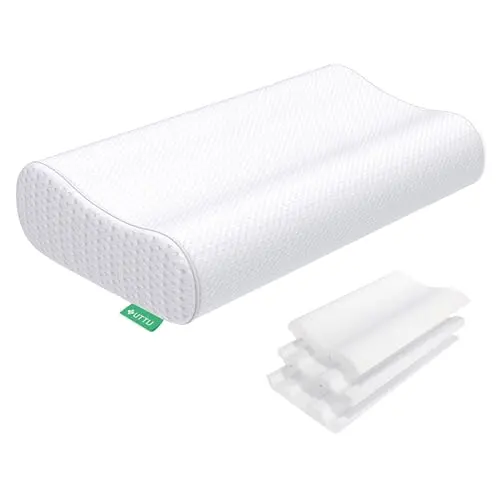
Sandwich Pillow – Three-Layer Adjustable Cervical Support
A three-layer memory foam pillow built around a simple idea: let the sleeper set the height. Out of the box it offers a high contour and a low contour, and pulling the middle layer drops both into lower profiles. The foam is UTTU’s own blend, formulated to stay soft in a cool room rather than firming up overnight.
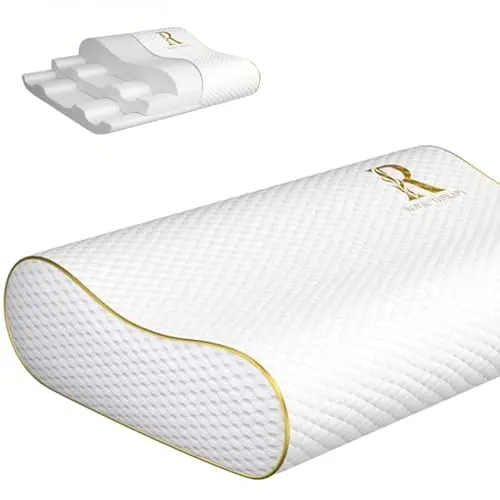
Memory Foam Cervical Pillow – CertiPUR-US Contour Support
A three-layer cervical pillow with a medium-firm feel, a ventilated foam core, and a removable bamboo-derived rayon cover. The middle layer comes out for a lower profile, and the contour is shaped around a mix of back and side sleeping.
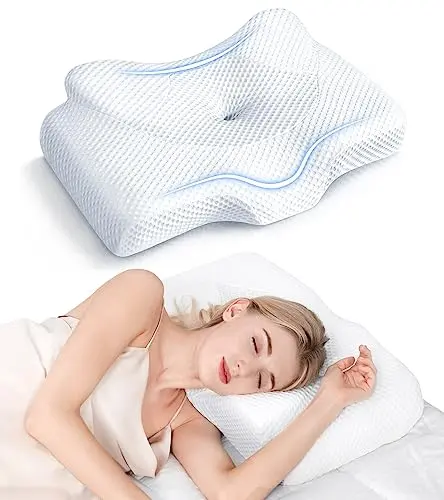
Cervical Pillow – Hollow-Center Pressure Relief
A cervical pillow with a hollowed center that cradles the skull instead of pressing up beneath it. Two thicknesses are built into one pillow – rotate it 180 degrees to switch – and a removable bottom insert adds another step of height adjustment.
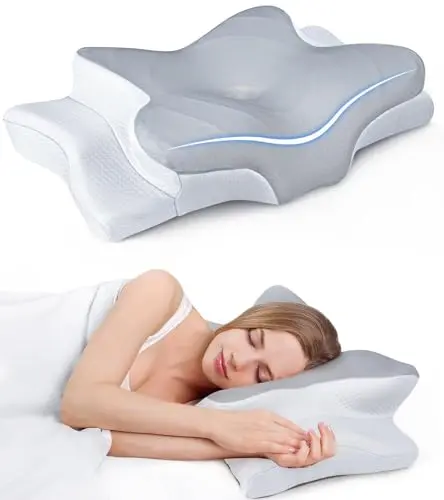
Cooling Cervical Pillow – Hollow Concave Contour
A hollow-concave contour pillow with a tilted center designed to cradle the head, six mapped support zones, and an Arc-Chill cooling cover. Flip it 180 degrees or pull the bottom insert to change the height.
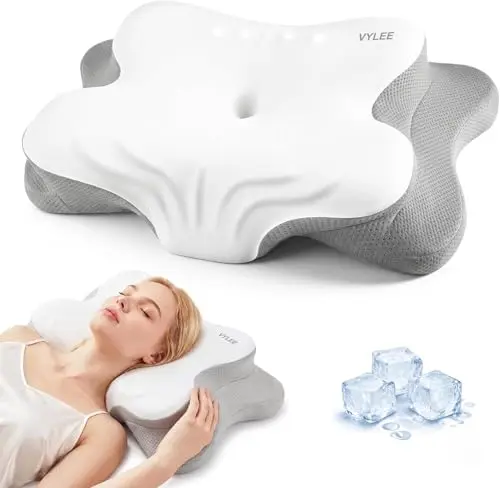
Butterfly Cervical Pillow – Five-Zone Contour with Cooling Cover
A butterfly-shaped contour pillow with five shaped zones for the head, neck, shoulders, and arms. It offers two heights – a lower side and a taller side – and ships with a removable nylon-spandex cooling cover.
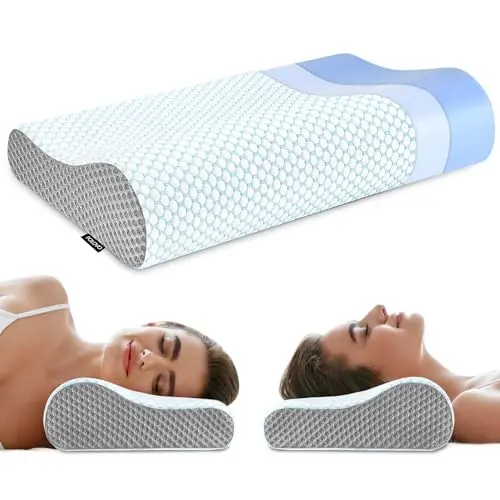
Memory Foam Neck Pillow – Dual-Height Slow Rebound
A contoured memory foam pillow with two neck heights, a five-second slow-rebound core, and a removable cover with mesh side panels for airflow. It’s the most affordable entry in this lineup.
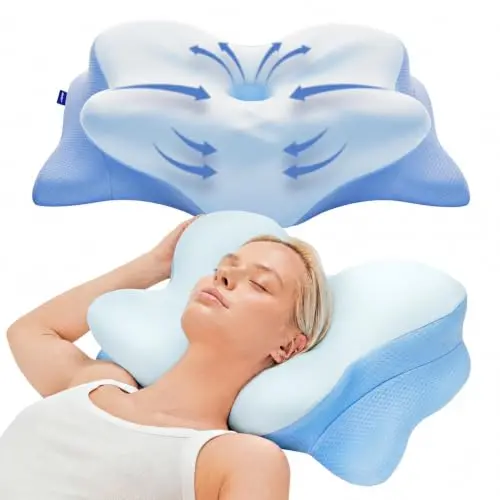
Ergo Cervical Pillow – Butterfly Contour with Cooling Cover
A butterfly-shaped cervical pillow in high-density memory foam with a cooling pillowcase included. It’s certified to CertiPUR-US and OEKO-TEX standards and built to keep the head gently elevated instead of propped.
How We Evaluated These Pillows for Herniated Disc in Neck
We can’t tell you which pillow will fix a herniated disc, and we’d be skeptical of anyone who claims to. What we did: cross-referenced seven cervical pillow models from seven distinct brands along six decision axes – adjustable loft range, contour geometry, foam density and rebound, cover breathability and washability, sleeping-position versatility, and third-party material certification. We triangulated published specifications, manufacturer feature claims, and owner feedback where available, then mapped each design against the needs of side, back, and stomach sleepers managing cervical disc discomfort.
The scoring framework weighted real-world fit at 70% – how plausibly a pillow holds the neck in neutral alignment for the sleeper it was built for – against feature differentiation at 30% – the design choices that actually separate one contour pillow from the next. We have no commercial relationship with any of these brands; recommendations track fit and differentiation, not brand preference. If you rotate through sleep positions during the night, the UTTU Sandwich Pillow gives you the most room to adjust. If direct pressure on the disc is the main problem, the Osteo cervical pillow and its hollow center is the better structural match.
A few things we can’t tell you: we didn’t sleep a full night on each pillow, and no buying guide can predict how your specific herniation responds to a change in loft. What we can tell you is which designs give you honest adjustment range before you commit – because that’s the one variable you can actually control.
How to Choose the Right Pillows for Herniated Disc in Neck
1. Why Adjustable Loft Beats Firmness for a Herniated Disc in the Neck
Most people shopping for a neck pillow start with firmness. It’s the wrong first question. What determines whether your neck is supported is loft – the height of the pillow under your neck relative to the height under your head – and there’s no universal answer because shoulder width, head size, and mattress firmness all change what neutral looks like for you.
A pillow that’s too tall pushes the chin toward the chest and flattens the cervical curve. Too low and the head drops back, loading the joint from the other direction. Neither is what you want when a disc is already irritated. That’s why removable layers, dual-height edges, and rotatable cores are the features to hunt for: they let you correct the height after a few nights instead of guessing again with a new purchase.
The practical test is simple. Lie on your back and check whether your chin sits level with your forehead. Then roll to your side and check whether the gap between shoulder and ear is filled without your head being pushed upward.
2. Matching a Cervical Pillow to Your Sleep Position
Side sleepers need the tallest loft of the three positions, because the pillow has to bridge the distance from mattress to ear. Back sleepers need the least – just enough to support the curve without lifting the chin. Stomach sleepers are the hardest case and generally need the flattest option available, which is why a pillow with a removable middle layer often serves them better than a fixed contour.
If you change positions during the night, dual-height pillows are the pragmatic answer: a taller side for side sleeping, a lower side for your back. If you spend most of the night on your side and have broad shoulders, the Royal Therapy pillow is the pick – its loft is specifically designed around different shoulder widths.
3. Foam Density, Rebound, and the Pillow That Goes Hard in Winter
Memory foam isn’t one material. Density and rebound speed vary enormously between pillows, and both change how a pillow behaves under your head at 2 a.m. versus how it felt in the store.
Slow-rebound foam compresses gradually and recovers over several seconds, so it molds rather than resists – generally more comfortable for side sleeping. Higher-density foam holds its shape longer but feels firmer. Then there’s the cold-weather problem: some foams stiffen noticeably in a cool bedroom, which is why a few brands now advertise cold-resistant formulations. If you keep your bedroom cold, that claim is worth taking seriously.
Whatever you buy, expect a break-in period of one to two weeks. Foam softens with body heat and use, and a pillow that feels slightly too firm on night one often feels right by night ten.
4. Cooling Covers, Certifications, and the Off-Gassing Question
Nearly every pillow in this category ships with a cooling cover. Treat that as a comfort feature rather than a temperature guarantee – a cover can feel cool to the touch without changing how warm you sleep. What matters more is whether the cover is removable and machine washable, and whether the fabric genuinely breathes.
Two certifications are worth knowing. CertiPUR-US covers foam emissions and heavy-metal content. OEKO-TEX covers textile safety for the cover and case. If you’re sensitive to smell, prioritize pillows carrying both. Most memory foam arrives with some odor regardless, and a day or two of airing out usually resolves it.
If night sweats are part of why you’re waking up, a cover with a dense mesh knit makes more practical difference than marketing language about temperature drops. The Cozyplayer cooling pillow is the one in this lineup where the cover genuinely earns the description.
5. Which Pillow Shape Suits a Herniated Disc in the Neck?
Shape is where these pillows actually diverge, and it’s worth understanding the three main families.
Contour or sandwich pillows have a raised neck roll and a dipped center, sometimes with removable layers. They’re the most common design and the easiest to adjust. Butterfly pillows add cut-outs for the shoulders and arms, which helps side sleepers stay put. Hollow-center pillows invert the usual approach entirely – instead of a bump pressing up beneath the neck, they drop the back of the skull into a depression and let surrounding foam support the curve. For a disc irritated by direct pressure, that last geometry deserves a serious look; the Osteo hollow-center pillow is the clearest example here.
None of these shapes is universally better. The right one depends on which direction your neck needs support from and how much you move at night.
6. What You Actually Pay For at Each Pillow Price Tier
The budget end of this category gets you contour foam, two heights, and a washable cover. That’s genuinely enough for plenty of people, and the Polovo neck pillow is the value example here.
Moving up the ladder buys three things: third-party certifications on both foam and cover, finer adjustment such as extra layers, removable inserts, and four heights instead of two, and better cover fabrics – bamboo-derived rayon and nylon knits rather than straight polyester. At the top of the range you’re also paying for consistency: denser foam that keeps its shape over years rather than months.
What you’re not buying is a medical device. These are positioning tools. If a cervical disc issue is causing radiating arm pain, numbness, or weakness, that’s a conversation for a clinician, not a shopping decision.
Frequently Asked Questions
1. What's the difference between the UTTU Sandwich Pillow and the Royal Therapy pillow?
Both are three-layer adjustable cervical pillows, and the mechanics are similar: pull the middle slab and the contour drops. The differences are materials and ceiling. The UTTU Sandwich Pillow gives you four usable heights once the middle layer is out, uses a cold-resistant foam that stays soft in a cool room, and lands in the more affordable half of this lineup. The Royal Therapy pillow costs more and puts that money into CertiPUR-US certified foam and a bamboo-derived rayon cover that wicks moisture better than polyester. Want the widest adjustment range for less money? UTTU. Want certified materials and a cover that feels premium against your skin? Royal Therapy.
2. Can a cervical pillow help with a herniated disc in the neck?
It’s a positioning tool, not a treatment. What a well-chosen pillow can do is keep your neck in neutral alignment overnight instead of holding it flexed or extended for seven or eight hours, and that alone can reduce the morning stiffness people with cervical disc issues describe. What no pillow can do is change the disc itself. If you’re getting radiating arm pain, numbness, or weakness, treat pillow shopping as a comfort measure alongside whatever your clinician recommends, not a substitute for it. Start with a design that offers adjustable loft so you can correct it after a few nights rather than starting over.
3. How do the Osteo and Cozyplayer hollow pillows compare?
They share the hollow-center idea but execute it differently. The Osteo drops the skull into a depression and adds two built-in thicknesses plus a removable bottom insert, so you get real height control; it’s also CertiPUR-US and OEKO-TEX approved. The Cozyplayer tilts its concave surface and adds six mapped contour zones for shoulders and arms, then pairs that with a genuinely cool-to-the-touch cover. Choose Osteo if foam firmness and certification matter most; choose Cozyplayer if you sleep hot and want shoulder cut-outs.
4. How long should I give a new neck pillow before deciding?
Give it one to two weeks, and adjust it before you give up. Foam softens with body heat, and a contour pillow feels strange for the first few nights even when the shape is right. Use the adjustment features early – pull a layer, flip the pillow, remove the insert – and note whether your morning stiffness is trending better, worse, or unchanged. If it’s worse after two weeks of genuine adjustment, that loft isn’t right for you, and a different height will serve you better than a different brand.
5. Do side sleepers and back sleepers need different pillows?
Yes, at minimum different lofts. Side sleeping needs a taller pillow to fill the gap between mattress and ear; back sleeping needs a lower one that supports the cervical curve without lifting the chin. If you do both in one night, a dual-height pillow is the practical answer – you want a taller side and a lower side rather than a single fixed contour. The VYLEE butterfly pillow is a good example, with a lower side and a taller side built into one shape, plus shoulder cut-outs that help you stay put once you’ve rolled over.
Final Verdict
For most people shopping this category, the UTTU Sandwich Pillow is the sensible first purchase – four usable lofts, foam that stays soft in a cold room, and a washable cover, all without pushing into premium territory. If you want certified foam and a cover that feels better against your skin, the Royal Therapy pillow is the upgrade worth paying for. If direct pressure on the disc is the main complaint rather than alignment, the Osteo cervical pillow and its hollow center are built for exactly that. And if you’d rather not spend much to find out whether a contour shape works for you at all, the Polovo neck pillow is the low-risk way in. Start with loft, not brand – your neck will tell you within a couple of weeks.
