
Best Pillows For Neck Pain And Arm Numbness – 2026 Reviews

You wake up and your hand is asleep. Not the quick pins-and-needles that fades when you shake it out, but the heavy, cotton-wool kind that hangs around through your first cup of coffee. Your neck is stiff too, and by mid-morning you’ve connected the two.
They’re usually connected. Overnight, your head, neck, and shoulder all share the same stack of support, and when that stack is wrong, the pressure doesn’t stay in one place. A pillow that’s too tall pushes the chin toward the chest and loads the cervical spine. One with no shoulder cutout leaves your arm folded and compressed for hours. Contour geometry and arm clearance are the two things that separate a pillow that actually helps from one that just feels nice for ten seconds in a store.
Below we’ve mapped the cervical pillow market around those two problems. Some models are built around a hollow center, some around a dual-height flip, and a few add channels or cutouts so your arm stops going numb in the first place. Which one fits you depends less on the name on the tag than on how you sleep and where your symptoms start.
Best Pillows for Neck Pain and Arm Numbness – 2026 Reviews
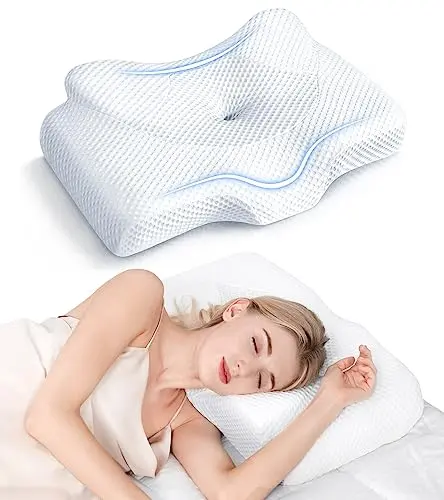
Osteo004 Cervical Pillow – Hollow Center for Neck Relief
A queen-size hollow-center contour pillow with a removable insert for extra height, wrapped in a 3D mesh case built to let heat escape.
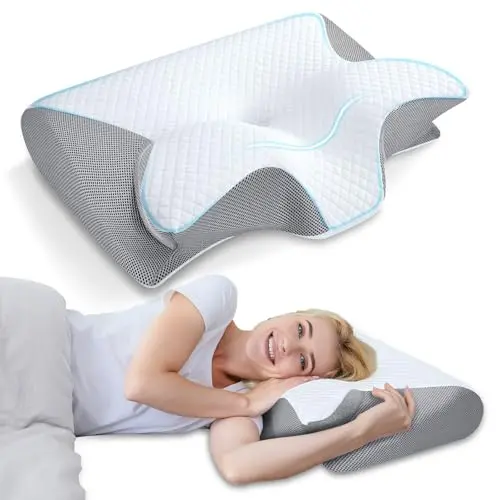
PL02 2-in-1 Cervical Pillow – Contour and Roll Combined
A two-sided design that gives you a contour on one face and a cylindrical neck roll on the other, with cutout wings that give your arms somewhere to rest.

1649 Dual-Layer Cervical Pillow – Soft and Firm in One
A detachable two-layer pillow with a soft face and a firm face, plus a hollow cutout along the edge where your hand can drop through.
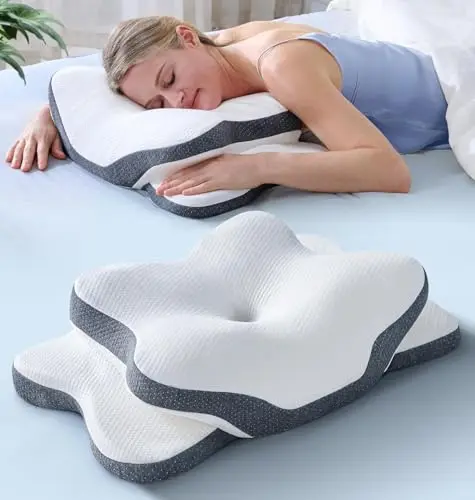
5X Relief Cervical Pillow – Six Contour Zones
A butterfly-shaped contour pillow with six support zones, armrest channels on both edges, and an open-cell foam core under a 3D mesh cover.
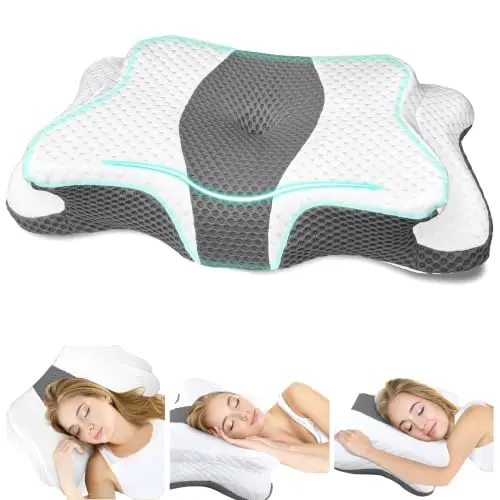
Butterfly Cervical Pillow – Thickened Neck Contour
A butterfly contour pillow with a thickened neck roll, a hollow center, and an ice silk cover, adjustable between two heights and a removable base layer.
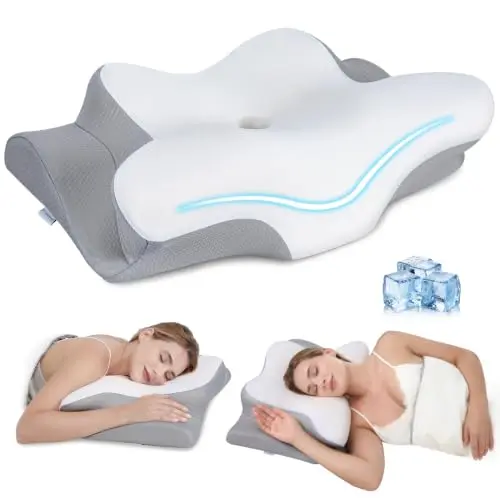
Dual-Height Cervical Pillow – Ice Silk Cooling
A compact dual-height butterfly contour in slow-rebound memory foam with a silky ice cover and a six-month warranty.

KH-YXZ-BT03 Cervical Pillow – Two-Level Sleep Heights
A butterfly contour with two distinctly different height levels, a 3-to-5-second rebound foam core, and a removable cooling cover.

BY-SJZ12 Butterfly Cervical Pillow – Dual Curve Heights
A butterfly-shaped orthopedic contour with two curve heights and a zippered ice silk cover that comes off for washing.

LYM101 Butterfly Cervical Pillow – Dual-Height Support
A butterfly contour pillow with a dual-height layout and a removable nylon-spandex cooling cover that zips off for the wash.
How We Evaluated These Pillows for Neck Pain and Arm Numbness
We didn’t sleep on these pillows for a month and chart out our mornings. What we did: cross-referenced nine cervical pillow models from nine distinct brands across six decision axes – contour geometry, height adjustability, foam density and rebound, cover breathability, cover care requirements, and sleep-position fit. We also weighed how each pillow behaves once the cover comes off, since cores that are spot-clean only ask more of you than a cover that goes straight into the wash.
The scoring framework weighted real-world fit for neck and shoulder support (70%) – how well each design addresses the two problems in this article, cervical strain and overnight arm compression – against feature differentiation (30%), meaning the design choices that actually separate one contour from another. We triangulated published specifications, feature sets, and owner feedback where available, then mapped each option to representative sleeper profiles: side sleepers with shoulder pressure, back sleepers with morning stiffness, and combination sleepers who change position through the night.
Two design details carried more weight than anything else in the final ranking: whether a pillow gives your arm a place to go, and whether you can change its height without buying a new one. Neither the certifications nor the price tier moved a pillow up the list on their own. We have no commercial relationship with any of the brands featured; recommendations track fit and differentiation, not brand preference. If you want the most broadly capable option, the Osteo004 is our pick. If the numb arm is the main complaint, the PL02 is built around it.
How to Choose the Right Pillows for Neck Pain and Arm Numbness
1. Why Contour Shape Beats Loft for Neck Pain Relief
A standard bed pillow supports your head. A cervical pillow supports your neck, and those are different jobs. The cervical curve is the inward arc your spine makes just below the skull, and a flat pillow leaves it hanging in midair while your head sinks into the middle. The result is the same dull tension you’d get from holding your chin up for an hour.
Contour pillows solve this with a raised edge that sits directly under that curve, paired with a recessed area for the skull. You’ll see the shape described as butterfly, hollow center, or dual contour. The vocabulary varies but the mechanics don’t. What matters is whether the raised edge sits at the right height for your frame and whether the recess is deep enough to keep your head from rolling off it.
2. Matching Pillow Height to How You Actually Sleep
Side sleepers need the most height, roughly the distance from your mattress up to the point where your neck meets your shoulder, so the head doesn’t tilt down toward the bed. Back sleepers need less. Stomach sleepers need least of all. This is why a dual-height pillow is worth prioritizing over a single-profile one: you rotate it 180 degrees and get a different loft without buying anything new.
If you change positions through the night, look for something with a removable layer or an extra insert. The DONAMA dual-layer is the most flexible of this group, since you can strip a layer to drop the height and pick a softer or firmer face on top of that.
3. Arm Numbness at Night: What a Pillow Can and Can't Fix
Numbness in the arm or hand overnight usually has one of two sources. Either your shoulder and arm are compressed against the mattress for hours, or the position of your neck is loading the nerve bundle that runs down through the shoulder. A pillow can help with both, but it helps differently.
For compression, look for armrest cutouts, hand channels, or winged sides that let your arm drop below the pillow line instead of folding up against your chest. For nerve-related numbness, the fix is alignment: a contour that keeps the neck supported and the chin roughly level. The HOMCA PL02 is the clearest example of the first approach, with cutout wings designed specifically to keep arms from going numb.
One caveat worth stating plainly: if the numbness comes with weakness, tingling that doesn’t resolve once you’re up and moving, or pain radiating down the arm, a pillow is not the answer. That’s a conversation with a clinician.
4. Firmness, Rebound, and the Adjustment Period
Firmness is the most contested spec in this category, and it’s why otherwise similar pillows draw such polarized reactions. Slow-rebound memory foam eases down over a few seconds instead of resisting immediately, which reads as softer on contact while still supporting underneath. Fast-rebound foam feels springier but can push back against the neck.
Give any new contour pillow one to two weeks before you judge it, because your neck is unlearning a habit. That said, if it’s painful rather than merely unfamiliar by day three, it’s the wrong height, not an adjustment period.
5. Cooling Covers, Certifications, and Care
Memory foam traps heat, so cover material matters more here than on a down pillow. Ice silk and 3D mesh are the two cover types you’ll encounter most, and both do a reasonable job of moving air. Whichever you pick, confirm the cover is removable and machine washable, since the foam core itself almost never is.
On certifications, CertiPUR-US covers foam content and emissions, and Oeko-Tex covers textile safety. Both are worth checking if you’re sensitive to smell or off-gassing, and you should expect to air out a new foam pillow for a day or two regardless.
6. What Each Price Tier Actually Gets You
Budget-friendly contour pillows get you the basic shape and a washable cover. Mid-range adds dual-height adjustment, denser foam, and certifications. Premium buys more layers, more repositioning options, and covers that feel noticeably cooler against the skin.
What you’re really paying for is adjustability. A pillow you can tune in two or three ways is far more likely to end up right than a fixed shape at any tier. If budget is the constraint, the Latree 5X Relief gets you contour zones, arm channels, and certifications without the premium markup.
Frequently Asked Questions
1. What's the difference between the Osteo cervical pillow and the HOMCA 2-in-1?
They solve the same problem from different angles. The Osteo004 uses a hollow center surrounded by a raised contour, and gets its adjustability from a 180-degree flip plus a removable insert. It’s the more forgiving shape if you’re not sure which position you’ll land in.
The PL02 is the more purpose-built of the two for arm issues. It pairs a contour face with a neck roll on the reverse and adds cutout wings plus an ear hole. If the numbness shows up on the side you sleep on, the wings are the deciding feature.
2. How does the DONAMA dual-layer pillow compare to the Latree 5X Relief?
The DONAMA is the adjustability play: two detachable layers, a softer face and a firmer face, and a hand rest cutout along the edge. It’s the one to pick if your firmness needs change from night to night or if you rotate between back and side.
The Latree is the fixed-shape play, done well, with six contour zones, dual arm channels, and an open-cell foam core that runs cooler than standard memory foam. Choose it if you already have a rough idea of the height and firmness you want.
3. Can a pillow actually help with arm numbness?
It can help with the version caused by positional compression, the arm that falls asleep because it’s been pinned under your body or folded against your chest for hours. A pillow with cutouts or channels gives that arm somewhere to go, which is a mechanical fix rather than a medical one.
If the numbness travels from your neck down the arm, or appears no matter how you sleep, a pillow isn’t the lever. Alignment still matters, but get the underlying cause checked first.
4. Do contour pillows work for stomach sleepers?
They can, but the fit is tighter. Stomach sleeping flattens the cervical curve and rotates the head to one side, so the ideal pillow is low profile. Several pillows here have a shallow side in the 3.5 to 4 inch range, and those are the ones stomach sleepers should start with.
If you end up on the shallow side and still wake with a stiff neck, the contour isn’t the problem, the height is. Rotate to the lower profile or pull the insert before you write off the pillow entirely.
5. Is a cervical pillow a good idea if you have a diagnosed neck condition?
Ask the clinician managing your condition first. A contour pillow changes how your neck is positioned for eight hours a night, and that’s not something to guess at with a disc issue or a history of cervical surgery.
For general morning stiffness with no diagnosis, a contoured support with adjustable height is a low-risk place to start. Look for CertiPUR-US foam and an easy return window, so a wrong fit doesn’t cost you.
Final Verdict
For most people waking up with a stiff neck and a tingling arm, the Osteo004 cervical pillow is the answer. The hollow center supports the cervical curve without forcing the chin up, the flip-and-insert system covers a wide height range, and the cooling cover makes it livable year-round.
If the numb arm is your loudest symptom, go with the PL02, whose cutout wings are the one feature here built specifically for it. If you change positions and firmness preferences overnight, the DONAMA dual-layer is the only pick that lets you rebuild the pillow night by night. And on a tighter budget, the Latree 5X Relief delivers contour zones and arm channels at a friendlier tier.
