
Best Pillows For Occipital Neuralgia – 2026 Reviews

If you’ve ever surfaced at three in the morning with that electric, shooting pain running from the base of your skull up over the back of your head, you already know why pillow shopping stops being a casual purchase. Occipital nerve pain doesn’t care about thread count. It cares where your head sits for eight hours.
The pillows that tend to work share two traits: a low enough loft that your chin doesn’t tuck toward your chest, and a contour that supports the neck without levering the skull forward. Get either one wrong and you spend the night slowly pressing the back of your head into a surface that’s already irritated. Sleep position matters just as much – a shape that’s right for a back sleeper can be actively wrong for a side sleeper who needs shoulder clearance.
We went through the cervical and contour pillow market with those two problems in mind and pulled out the models whose geometry gives you somewhere to go. Some are adjustable by removing a foam layer, one lets you take fill out by the handful, and one isn’t a sleep pillow at all but earns its spot for loosening a tight neck before bed. Here’s how they stack up.
Best Pillows for Occipital Neuralgia – 2026 Reviews
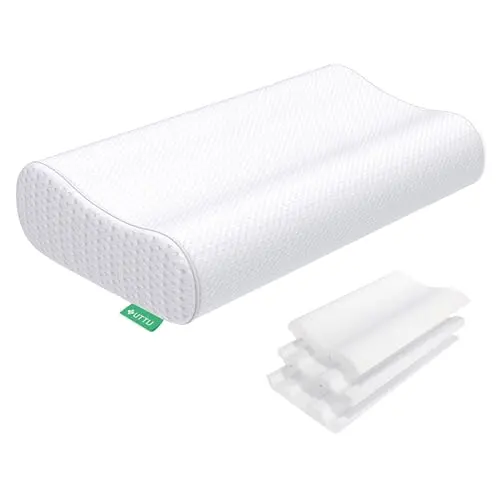
Sandwich Pillow – Three-Layer Adjustable Contour
A three-layer sandwich build that lets you pull out the middle slab and drop the loft by roughly an inch on both sides. You get a higher and a lower contour edge to choose from, and the foam is formulated to stay soft in a cool bedroom instead of firming up overnight.

Adjustable Curved Pillow – Shredded Fill You Control
A curved, shredded-fill pillow you can actually tune. It arrives firm, ships with extra fill, and lets you pull foam out through the zipper until the loft matches your neck. The queen-length shape gives your head room to roll without falling off the edge.
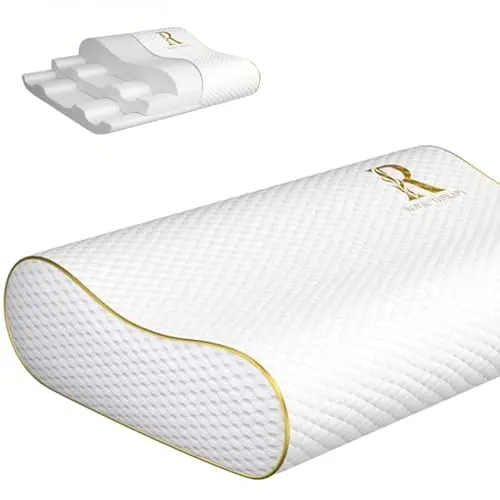
Contour Cervical Pillow – Bamboo-Cover Memory Foam
A three-layer memory foam contour with CertiPUR-US foam and a bamboo-derived cover. Medium firmness, a generous 24 by 14 inch surface, and a removable middle layer for dropping into a lower profile.
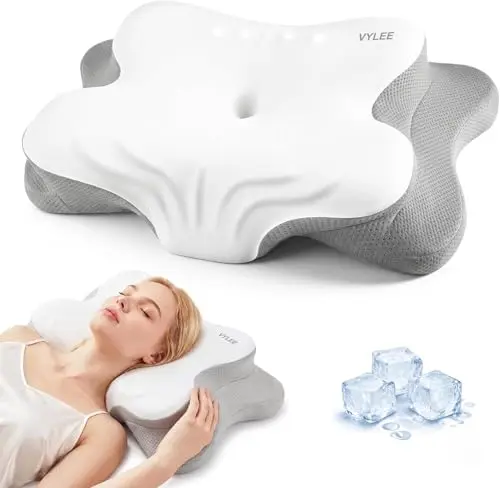
LYM101 – Dual-Height Butterfly Contour
A butterfly-shaped contour with two distinct heights – a lower edge for back and stomach sleepers and a taller edge for side sleeping. The nylon-spandex cover is cool to the touch and zips off for washing.
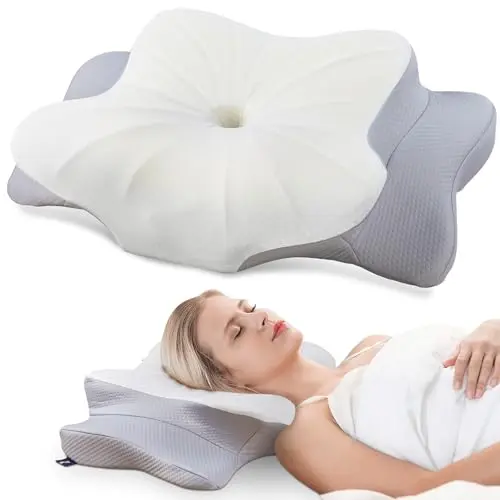
JK79 – Dual-Height with Armrest Grooves
A butterfly contour with armrest grooves, a cooling double-layer cover, and a hypoallergenic build. Two heights, a 24.8 by 15 inch surface, and a one-year warranty backing it up.
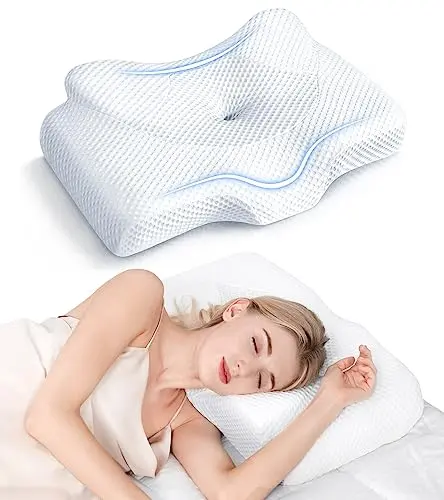
Osteo004 – Hollow-Center Pressure Relief
A contoured pillow with a hollow cutout in the center, designed to take pressure off the back of the head. Rotate it 180 degrees for a taller or lower profile, and pull the bottom insert for one more step down.
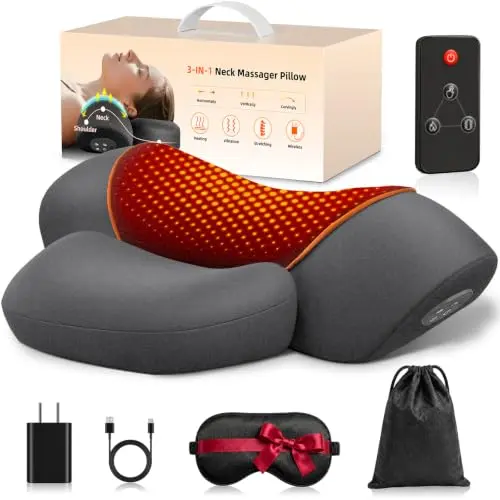
Neck Massager Pillow – Heat, Vibration, and Airbag Traction
Not a sleep pillow – a cordless device that combines heat, vibration, and rhythmic airbag traction to stretch and loosen the neck. Remote controlled, with three heat levels and a 30-minute auto-off.
How We Evaluated These Pillows for Occipital Neuralgia
We didn’t put these pillows through sleep-lab polysomnography or overnight pressure mapping. What we did: cross-referenced 7 pillow designs from 7 distinct brands across five decision axes – loft and height range, contour geometry where the skull meets the neck, foam or fill behavior, cover breathability and washability, and sleep-position fit for side, back, and stomach sleepers. We mapped each model against the specific problem occipital nerve sensitivity creates overnight: a head that tips forward, and a surface that presses on the sub-occipital ridge. We triangulated published specifications, firmness and dimension data, aggregated feedback where available, and use-case fit for each build.
A pillow can’t treat a nerve condition, so we scoped this to what a pillow genuinely controls – head and neck position over a night, and how much a sleeper can actually change it. We weighed how each build behaves in the first hour against the eighth. The scoring framework weighted real-world fit for neck-sensitive sleepers (70%), meaning neutral head position and genuine adjustability, against feature differentiation (30%) – cooling covers, posture-specific cutouts, warranties, and construction that sets one model apart. We have no commercial relationship with any brand here; recommendations track geometry and adjustability, not brand preference. If you want the most flexible starting point, the UTTU Sandwich Pillow is the one to try first. If you’d rather tune the loft by hand, the Sidney Sleep Adjustable Curved Pillow is the better match.
How to Choose the Right Pillow for Occipital Neuralgia
1. Why Loft Height Matters More Than Fill for Occipital Neuralgia
Occipital nerve pain runs along the back of the head, and it’s usually aggravated by the same two things night after night: sustained neck flexion and direct pressure on the base of the skull. A pillow can’t change the nerve, but it does control both of those for the hours you’re asleep. That makes loft height – how tall the pillow sits under your head – the single most important number in this category.
Too tall and your chin drifts toward your chest, stretching the structures at the back of the neck all night. Too low and your head hangs without support, which is its own kind of strain. The target is a neutral spine: head level, neck gently supported, no tilt in either direction. Most people land somewhere between roughly three and five inches, which is why pillows with two or three height settings beat fixed-shape models. If you genuinely don’t know where you sit, start with something adjustable, like the UTTU Sandwich Pillow, rather than guessing at a fixed loft.
2. Contour Shape and Where the Pillow Touches Your Skull
Contour pillows raise a ridge under the neck and dish out a cradle for the head. Done well, that keeps your neck supported and stops your head from rolling. Done badly, the ridge becomes a fulcrum and the surface pushes up right where you don’t want pressure. For occipital sensitivity, pay attention to the sub-occipital gap – the small space between the base of your skull and the mattress. A pillow that fills it too aggressively will feel fine for ten minutes and wrong by two in the morning.
The alternative is a hollow-center design, which removes material where the back of your head rests and supports the neck around it. It’s a different philosophy, and it suits back sleepers particularly well. If that’s the sensation you’re after, the Osteo Cervical Pillow is the model built around it.
3. Matching Pillow Height to Your Sleep Position
Back sleepers need the least loft and the most sub-occipital relief, so a low contour or a hollow center usually wins. Side sleepers need enough height to fill the gap between shoulder and ear – too low and the head drops sideways, loading the neck unevenly. Stomach sleepers need the lowest profile of all and often do better with a thin contour than a full cervical shape.
If you switch positions during the night, look for a pillow with two distinct heights and arm or shoulder cutouts, so rolling from your back to your side doesn’t put you on the wrong surface. The VYLEE LYM101 is built around exactly that scenario.
4. Adjustable vs. Fixed-Loft Pillows for Occipital Neuralgia
Fixed-loft pillows are simpler and usually cheaper, but you’re committing to a height before you know whether it’s right. Adjustable pillows fall into two families. The first is the layer-removal type, where a middle slab of foam comes out to drop the profile – effective, but it’s a two-setting choice rather than a continuum. The second is shredded fill, where you add or remove loose foam through a zipper and can land on any height you like. The layer-removal style is easier to live with; the shredded style is more precise.
Both are worth the small step up in this category, because the gap between a pillow that’s slightly too tall and one that’s just right is the gap between a bad week and a good one.
5. Covers, Foam, and Day-to-Day Pillow Maintenance
Look for a removable, machine-washable cover – you’ll wash it far more often than the foam, and the foam core itself almost never goes in a machine. CertiPUR-US certification is a reasonable baseline for memory foam and shows up on several models here. Cooling covers made from nylon-spandex blends feel noticeably cooler on first contact than polyester, which matters if you run hot.
Expect a manufacturing odor out of the box on compressed foam pillows; a day or two of airing usually clears it. Shredded-fill pillows need periodic fluffing and redistribution, and layer-removal foam should be kept out of direct sun.
6. What Changes as You Move Up the Price Tiers
Entry-level contour pillows get you foam and a washable cover. Mid-range models add adjustability, better cover fabrics, and certifications. The top of this category buys you premium cover materials, more careful contour geometry, and in some cases a warranty. What you’re generally not buying is a dramatically better night’s sleep – several mid-range pillows here hold their own against pricier ones.
Spend your money on height flexibility first and fabric second. A well-shaped budget pillow that lets you drop the loft will do more for a sensitive neck than an expensive pillow at the wrong height.
7. What a Pillow Can and Can't Do for Occipital Neuralgia
A pillow manages position. It cannot treat occipital neuralgia, and it won’t replace a diagnosis. What it can do is remove the nightly strain that tends to make a sensitive nerve angrier – keeping your head neutral, easing pressure at the base of the skull, and letting the muscles at the back of your neck relax. If the pain is sharp, radiating, or waking you repeatedly, that’s a conversation with a clinician, not a shopping decision.
Treat the pillow as one variable you control while you work out the rest. Give any new pillow a week before judging it, and change one thing at a time.
Frequently Asked Questions
1. What pillow height is best for occipital neuralgia?
There’s no universal number, but the goal is head level with the neck supported – no chin tuck, no sideways drop. For most people that lands somewhere between three and five inches, and side sleepers need the taller end of that range compared with back sleepers. Because it’s so individual, an adjustable pillow is usually the smarter first buy: the Sidney Sleep Adjustable Curved Pillow lets you add or remove fill until your head sits neutral, which is faster than cycling through fixed-height pillows.
2. What's the difference between the UTTU Sandwich Pillow and the Royal Therapy contour pillow?
Both are three-layer foam contours with a removable middle slab, so the core idea is the same. The UTTU uses a dynamic foam that stays softer in a cool room and comes in a slightly smaller footprint at a more approachable tier. The Royal Therapy adds CertiPUR-US foam and a bamboo-derived rayon cover that feels softer and handles moisture better, on a wider 24-inch surface. Choose the UTTU if you want the most affordable way to test a lower loft; choose the Royal Therapy if cover feel and a larger sleeping surface matter more to you.
3. How does the DONAMA cervical pillow compare with the VYLEE?
These two are the closest pair in the lineup – both use a butterfly contour with two heights and a cooling cover. The DONAMA adds armrest grooves, a softer feel, and a one-year warranty. The VYLEE counters with a five-zone shape and a nylon-spandex cover that feels colder on contact. If you wake with a numb arm, the DONAMA’s cutouts are the differentiator; if maximum cooling feel and a simpler surface matter more, the VYLEE is the better fit.
4. Can a pillow actually help with occipital neuralgia?
It can help with the part that happens in bed. A pillow doesn’t treat the nerve, but position and pressure are two of the biggest overnight aggravators, and both are things a pillow directly controls. Keeping the head neutral and off-loading the base of the skull gives a sensitive nerve less to react to. Think of it as removing a nightly irritant rather than fixing the underlying condition – and if symptoms are severe or getting worse, get a proper evaluation.
5. How long should you give a new pillow before deciding?
About a week of normal sleep, and longer for shredded-fill pillows you’re still tuning. Foam needs a day or two to fully expand, and your neck muscles need time to adjust from whatever height they’re used to. Judge it on how you feel in the morning, not the first ten minutes. If you’re still waking with the same sub-occipital pressure after a week of adjustments, the loft is wrong – change the configuration or change the pillow.
Final Verdict
For most people dealing with occipital nerve pain at night, the UTTU Sandwich Pillow is the answer. It gives you two contour heights out of the box and a third, lower option once you pull the middle layer – which is exactly the flexibility this problem demands, without a premium-tier price. If you’d rather shape the loft by hand, the Sidney Sleep Adjustable Curved Pillow lets you add or remove fill until your chin sits level. Side sleepers who need shoulder clearance should look at the VYLEE LYM101. And if neck tension is the part keeping you awake, the Neck Massager Pillow is a useful pre-bed tool, though it isn’t something you sleep on. Whichever you pick, give it a week and keep your clinician in the loop – a pillow manages position, not the nerve itself.
