
Best Pillows For Sleeping On Back – 2026 Reviews

Back sleeping looks like the easy position and is quietly the hardest one to shop for. You don’t need height to fill a shoulder gap, and you don’t need almost nothing the way stomach sleepers do. You need your head to sit level, your chin to stay neutral, and your neck to keep its natural curve – three things that start pulling against each other the moment a pillow is even slightly too tall or too flat.
That’s why this category is full of pillows claiming to work for everyone and landing in the middle for no one. Some lean on a shape – a raised edge under the neck, a hollow for the back of the head – to hold alignment while you’re unconscious. Others hand you fill you can add or remove, trading built-in support for control. Both approaches work, and which one suits you depends far more on your own neck than on anything printed on the packaging.
Below we’ve mapped the leading options across major brands against what back sleeping actually asks for: loft, contour, fill behavior, breathability, and how realistic the care instructions are. There’s a pick here for stiff mornings, for hot sleepers, for anyone shopping on a tight budget, and for people who are tired of buying a new pillow every year.
Best Pillows for Sleeping on Back – 2026 Reviews
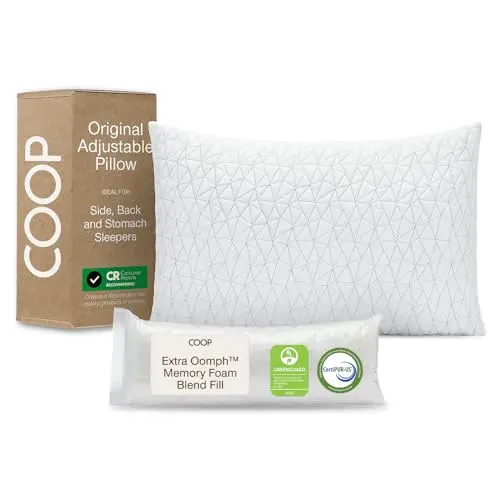
Original Adjustable Pillow – Dial In Your Back-Sleeping Loft
The adjustable pillow that made shredded fill mainstream. Coop ships the Original filled and leaves the tuning to you: unzip the liner, pull out foam until your head sits level, and keep the spare fill bag for later. The cover is a soft, breathable polyester-rayon blend, and the fill is a cross-cut memory foam and microfiber mix that molds without turning into a brick.
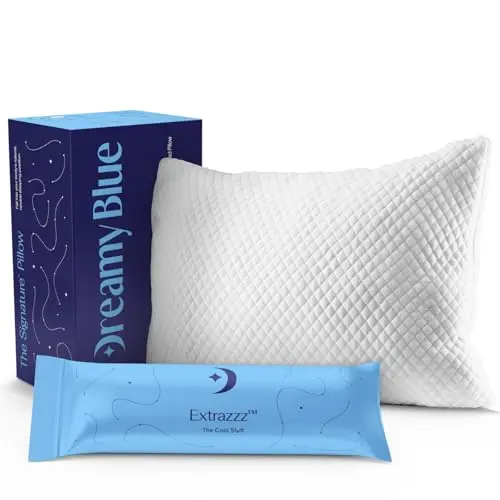
Signature Adjustable Pillow – A Fill That Moves Like Down
The Signature takes the adjustable-pillow idea and gives the fill a different personality. Instead of straight shredded foam, DreamyBlue blends cross-cut memory foam with down-like polyester tufts, so the pillow shifts when you move but still molds to your neck. The zipper is easy to reach, an extra bag of fill comes in the box, and the cover is bamboo-derived rayon.
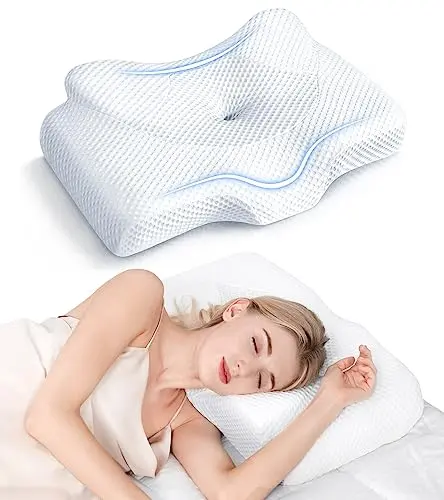
Cervical Pillow – Hollow-Center Support for Back Sleepers
A shaped cervical pillow with one genuinely useful trick: rotate it 180 degrees and you get a different height. The hollow center cradles the back of the head so your neck rests on the raised edges instead of being pushed forward, a design that suits back sleepers who wake up stiff. A removable insert adds a third height option, and the cover is a breathable 3D mesh.

Adjustable Curved Pillow – Contour Shape With Tunable Fill
The Sidney Sleep sits between a contour pillow and an adjustable one. The curved edge gives your neck something to rest against, while shredded visco foam inside can be added or removed to change the height. It arrives medium-firm, comes with extra fill, and has a removable polyester-rayon cover that machine washes.
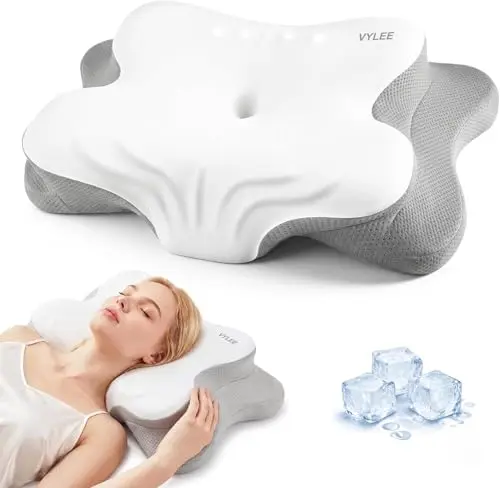
Cervical Neck Pillow – Dual-Height Contour With Cooling Cover
A butterfly-shaped contour pillow with two distinct heights built into one piece – a lower side and a taller side. Back sleepers typically use the lower edge to keep the head from tipping forward, while the side wings give the shoulders somewhere to rest. The foam is slow-rebound memory foam, and the cover is a cooling nylon-spandex blend that zips off for washing.
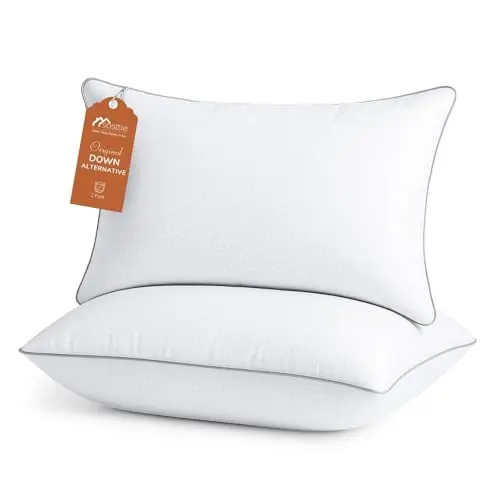
Firm Pillows Set of 2 – Plump Support at the Value End
A two-pillow set built around a firmer feel than most down-alternative options. The fill blends 3D and 7D hollow fibers, which gives the pillow a plump, springy structure rather than a soft collapse – useful if you want your head held up rather than cradled. Satin piping and an embossed pattern give it a hotel look, and both pillows machine wash.
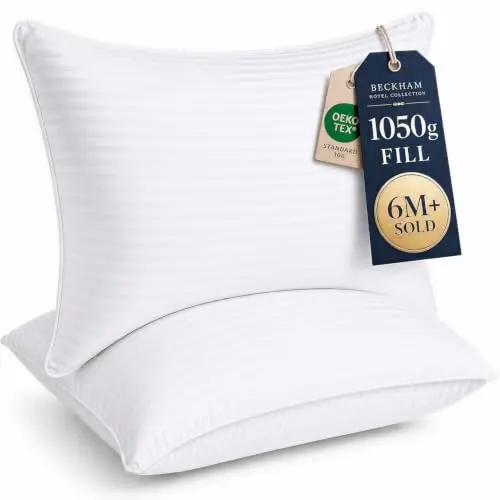
Bed Pillows Queen Set of 2 – Cotton Cover and a Cooler Surface
A down-alternative set with a 100% cotton cover, which is the detail that matters if you sleep hot. The fill is hollow fiber – feather-free, so nothing pokes through – and the medium-firm loft is designed to hold the head up rather than flatten under it. Two queen pillows per set, machine washable, and Oeko-Tex certified.
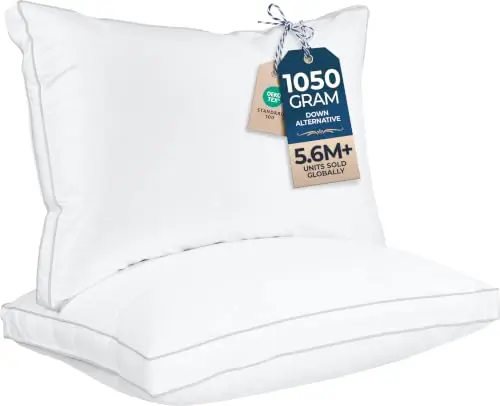
Gusset Bed Pillows Set of 2 – Structured Loft That Holds Shape
Gusseted edges are the whole point here. A sewn sidewall gives the pillow a structured frame, so the fill has somewhere to sit instead of spreading into a pancake. The cover is a breathable cotton-poly blend, the fill is plush, and the piping adds shape retention. Comes as a two-pack.
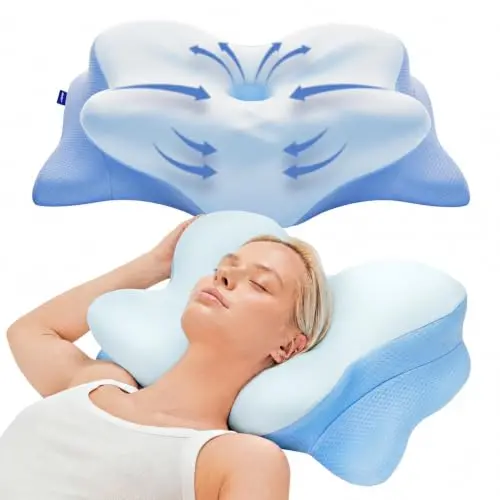
Ergo Cervical Pillow – Compact Butterfly Contour
A compact butterfly-contour pillow with a fixed shape and a cooling zip-off cover. The design lifts the head and supports the neck at an angle, which the manufacturer frames as helping keep airways open – the reason this shape gets discussed for quieter breathing. High-density memory foam absorbs movement, and the cover is removable and machine washable.
How We Evaluated These Pillows for Sleeping on Back
A few things we can’t tell you: how any of these pillows feel on night forty, or whether the foam in one holds up through a year of nightly compression. What we can tell you is how the lineup compares on paper and in accumulated owner experience. We cross-referenced 9 pillow models from 9 distinct brands against six decision axes that matter specifically for back sleeping – loft and loft adjustability, contour shape, fill material, cover breathability, care requirements, and published certifications. We triangulated manufacturer specifications, feature sets, and aggregated owner feedback where available, then mapped each pillow against the alignment needs of a back sleeper: head level, chin neutral, and the cervical curve supported rather than pushed forward.
The scoring framework weighted real-world fit (70%) – how well a pillow actually delivers neutral alignment for back sleeping – against feature differentiation (30%) – adjustability, cooling, certifications, and how specific the shape is to a real sleep problem. We audited certifications rather than taking marketing claims at face value, and we weighed care instructions carefully, since a pillow you can’t realistically clean stops being comfortable long before it stops being in your bed. We have no commercial relationship with any of the brands featured; recommendations track fit and differentiation, not brand preference. If you want one pillow you can keep tuning until the alignment is right, the Coop Home Goods Original is the pick; if you’d rather a shaped contour do that work for you, the Osteo Cervical Pillow is the better route.
How to Choose the Right Pillow for Back Sleeping
1. Why Back Sleeping Demands a Different Pillow Than Side Sleeping
Back sleepers get the least help from a pillow and the most damage from a bad one. On your back, your head mainly needs to stay level – roughly filling the natural curve between your neck and the mattress. Side sleepers need far more height to fill the gap between shoulder and ear, and stomach sleepers need almost none. That’s why a pillow marketed as suitable for every position often lands in the middle and satisfies nobody.
The tell is what happens to your chin. A pillow that’s too high pushes your chin toward your chest and tilts your head forward for eight hours. Too low and your chin tips up, your jaw drops open, and your lower neck takes the load. Neutral alignment – ears stacked over shoulders, chin level with the mattress – is the target, and it’s the standard we judged every pillow here against.
2. Loft Is the Whole Game: What Pillow Height Back Sleepers Actually Need
Loft is the height of a pillow under your head, and for back sleepers it matters more than fill material, cover fabric, or shape. Most adults land in a medium-loft range, but body size, mattress firmness, and how far you sink in all shift the number. A soft mattress lets your hips drop, which changes the angle your neck sits at.
This is the strongest argument for adjustable fill. A pillow you can unzip and re-tune lets you correct for a new mattress, a change in sleep position, or foam that stiffens in a cold bedroom. Fixed pillows can’t do that, which is why most of the picks here either adjust or lean on a contour shape to hold the right height for you.
3. Contoured vs. Flat Pillows for Back Sleeping
A contour pillow does the alignment work for you. The raised edge sits under your neck, the dip cradles your head, and the shape holds whether you’re awake or asleep. That’s genuinely helpful if you shift around at night, but it’s also a fixed opinion about your body – if the curve doesn’t match your neck, it can feel like the pillow is pushing your head forward.
A flat adjustable pillow is the opposite trade: no shape doing the work, but complete control over height. Back sleepers who wake with stiffness high in the neck often do better with contour; those who feel pressure at the base of the skull often do better with adjustable. If you want the shape to carry alignment for you, the Sidney Sleep Adjustable Curved Pillow is the pick, because it pairs a curve with fill you can still tune.
4. Fill Materials Compared: Shredded Memory Foam, Down Alternative, and Solid Foam
Shredded memory foam is the most accommodating fill for back sleepers. Loose pieces shift and settle, so the pillow molds to your head while staying adjustable. The tradeoff is maintenance: shredded fill can clump, and most brands suggest fluffing or a low-heat tumble every couple of weeks.
Down alternative is springier and lighter. Hollow fibers bounce back after you move, which keeps the pillow looking full, but the fill has no memory and tends to compress over months. It’s also not adjustable – you get the loft the factory decided on. Solid memory foam gives you a deliberate, fixed shape and slow-rebound support with zero tuning. Pick it when you want the shape itself to be the answer, not adjustable fill.
5. Coop Home Goods vs. DreamyBlue: Two Adjustable Approaches Compared
These two are the closest call in the lineup, and the difference is in how the fill behaves. The Coop Original uses cross-cut memory foam blended with microfiber, which gives it a denser, more substantial feel – you sink in a little and the pillow holds the position. DreamyBlue blends shredded foam with down-like polyester tufts, so the pillow moves when you shift instead of staying put.
For back sleeping, the practical difference is tuning range. Coop ships generously filled with a large spare bag, so you can go from plush to genuinely firm. DreamyBlue’s blend recovers faster but compresses under a heavier head, so some sleepers need to top it up more than once. If you want the widest firmness range from a single pillow, the Coop Home Goods Original gives you more headroom at the firm end.
6. Cooling, Certifications, and Care: What Actually Matters After Week One
Three practical details separate a pillow that stays good from one you stop liking. First, breathability: cotton and bamboo-rayon covers move air better than tight microfiber shells, and if you sleep warm that difference shows up by three in the morning. Second, certifications – CertiPUR-US covers foam content, while OEKO-TEX Standard 100 and GREENGUARD Gold address broader material and emissions standards. They aren’t decoration; they’re the only third-party assurance you get about what’s actually in the foam.
Third, care. A pillow you can machine wash is a pillow you’ll keep using; a spot-clean-only pillow slowly stops being pleasant to lie on. If hot sleeping is your main complaint, the Beckham Hotel Collection pillows pair a cotton cover with feather-free hollow fiber and wash in a machine, which is a hard combination to beat at the value end.
Frequently Asked Questions
1. What's the difference between the Coop Home Goods Original and the DreamyBlue Signature?
Both are adjustable shredded-fill pillows with zip access and a spare bag of fill, so the real difference is texture. Coop blends cross-cut memory foam with microfiber, which reads as denser and more supportive – it holds a shape and can be pushed quite firm. DreamyBlue mixes shredded foam with down-like polyester tufts, so it moves more and feels closer to a down pillow that happens to mold. The covers differ too: Coop uses a polyester-rayon blend, while DreamyBlue wraps its fill in bamboo-derived rayon. Back sleepers who want firmness headroom tend to prefer Coop; those who want a softer, more mobile feel lean DreamyBlue.
2. Is a contoured cervical pillow better than a flat pillow for back sleeping?
Better if your problem is upper-neck stiffness. A contour pillow puts a raised edge under your cervical curve, which supports the neck instead of letting it hang. The catch is fit: a contour that’s too tall will push your head forward, and you can’t adjust it. Flat adjustable pillows win when you need height control more than shape. A hybrid covers both – the Osteo Cervical Pillow gives you a hollow center plus two heights by rotating it, so you aren’t locked into one contour depth.
3. How do I know if my pillow is too high or too low for back sleeping?
Check your chin and shoulders in the morning. If your chin is tucked toward your chest or you wake with a stiff upper neck, the pillow is too high. If your chin tips upward, your jaw feels slack, or you wake with a dry mouth, it’s too low. Shoulder or arm numbness suggests a pillow lifting your upper body out of line. The practical test is lying flat and noticing whether your ears stack over your shoulders without you holding your head in place.
4. Sidney Sleep vs. Osteo: which one should a back sleeper pick?
Pick Sidney Sleep if you want a curved contour with tunable fill. It arrives medium-firm and you can add or remove shredded visco foam, so the height isn’t locked in. Pick Osteo if you prefer a fixed shape with selectable heights; its hollow center cradles the back of the head, and rotating the pillow changes the thickness. Sidney Sleep’s cover machine washes and the fill resists flattening, while Osteo leans on a 3D mesh case for airflow. Both are contour-first designs, so neither suits a back sleeper who wants a completely flat pillow.
5. Do back sleepers need a firm pillow or a soft one?
Neither extreme. Back sleeping wants a medium-firm pillow that holds its height without pushing your head up – soft enough to let your skull settle in slightly, structured enough not to collapse overnight. Very firm pillows tend to tilt the head forward; very soft ones let the chin drop. If you can’t find that middle ground in a fixed pillow, an adjustable fill gets you there faster, because you’re tuning height rather than guessing at it.
Final Verdict
For most back sleepers, the Coop Home Goods Original is the answer. It’s the one pillow here that lets you keep correcting the loft as your body, mattress, or the season changes, and that adjustability is worth more than any curve baked into foam. If you’d rather the shape do the work, the Osteo Cervical Pillow gives you a hollow center and two heights without any fill juggling. Budget-minded shoppers who just want a firm, supportive pair should look at the Sasttie Firm Pillows, and anyone who sleeps hot should start with the Beckham Hotel Collection cotton-cover set. Match the pillow to your specific alignment problem and you’ll stop rotating through pillows every year.
