
Best Pillows For Tinnitus – 2026 Reviews

The ringing is always loudest at 2 a.m. The house goes quiet, the fan clicks off, you finally lie down, and the sound you spent all day outrunning settles in for the night. Then you notice the pillow under your head. Maybe it’s too flat, so your neck is bent sideways. Maybe it’s pressing your ear into the mattress. Maybe it’s a memory foam slab that’s been radiating heat since eleven and you’re awake again, listening.
Here’s the honest version: no pillow quiets tinnitus. What a pillow can do is remove the three physical irritants that keep you awake around it – pressure on your ear, a neck angle that leaves you stiff by morning, and trapped heat that wakes you back up. Those are solvable problems, and they’re solved by different shapes.
So we surveyed the category by approach rather than by brand: the ear-cutout pillow, the cervical contour crowd, and the conventional cotton option for anyone who doesn’t want foam near their face. Below you’ll find which shape suits which kind of night, where each one falls short, and how to pick without buying three pillows to get there.
Best Pillows for Tinnitus – 2026 Reviews
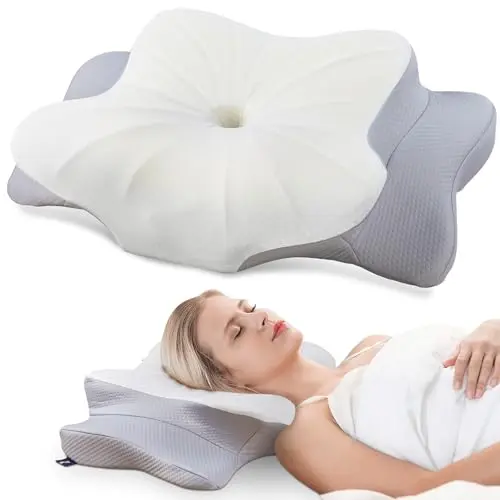
Cervical Contour Pillow – Dual-Height Support for Side Sleepers
A butterfly-shaped memory foam contour pillow with two loft heights on either side, armrest grooves tucked under the edges, and a removable, machine-washable cover. The 24.8 x 14.96 x 5.51-inch footprint gives you a genuine head-and-shoulder cradle rather than a flat rectangle.

Cooling Contour Pillow – Hollow Cradle with Q-Max Cover
A hollow-concave contour pillow with six support zones and a Q-Max 0.4 Arc-Chill cover over a breathable memory foam core. It measures 23.2 x 13.4 x 5.1 inches, and you can rotate it 180 degrees or pull the bottom insert to change loft.
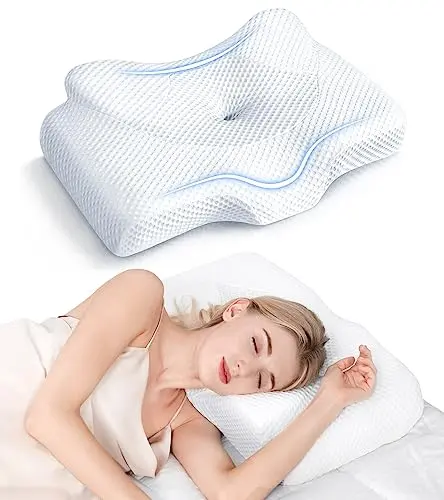
Osteo004 Cervical Pillow – Hollow Center with Three-Way Height
An ergonomic contour pillow built around a hollow center that cradles the head, with two thicknesses (5.2 and 4.1 inches) plus a removable bottom insert for a third height option. Queen size at 25.5 x 16.5 inches, with a 3D mesh pillowcase.

Ear Relief Pillow – 3.5-Inch Cutout for Side Sleepers
A small round cotton pillow, 9 inches across, with a 3.5-inch hole in the middle so your ear rests in open space instead of against fabric and mattress. The fill is adjustable through a hidden zipper, and the whole pillow is machine washable.
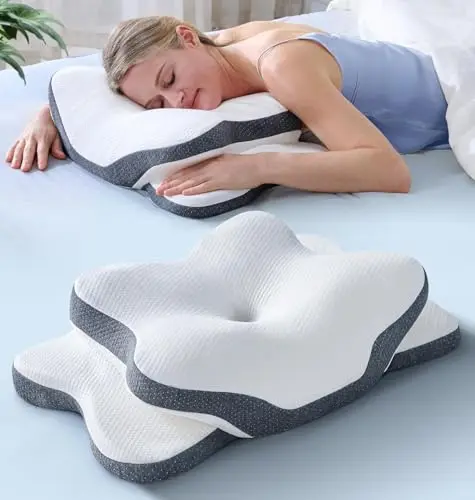
Six-Zone Contour Pillow – Arm Support for Side Sleepers
A butterfly-shaped contour pillow, 22.9 x 14.3 inches, with six support zones, armrests, a 95% open-cell memory foam core, and a 3D mesh pillowcase blended from bamboo rayon and polyester.

Butterfly Cervical Pillow – Dual 3.9- and 4.9-Inch Loft
A grey butterfly-contour memory foam pillow with two loft options – 3.9 inches and 4.9 inches – and a removable, machine-washable cooling cover in a nylon-spandex blend.
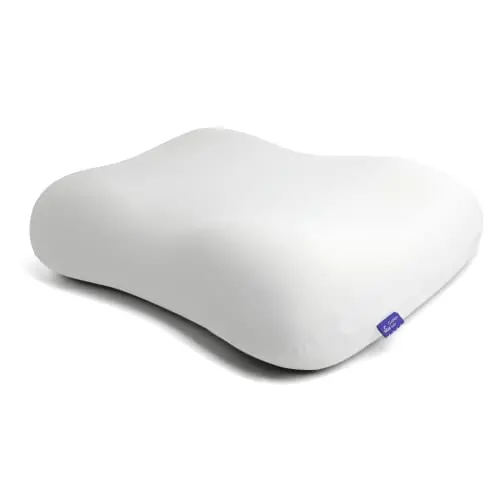
Deep Sleep Pillow – Sculpted Bolsters and Dual-Density Foam
A sculpted memory foam pillow shaped with raised side bolsters, a sweeping shoulder line, and a center contour. The dual-density core pairs a soft top layer with a firmer support base, and the cover is removable and washable while the core is not.
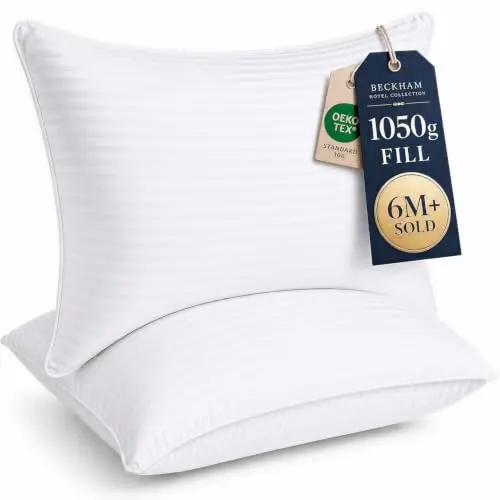
Bed Pillows Queen 2-Pack – Down Alternative with Cotton Cover
A two-pack of queen pillows, 20 x 28 inches with an 8-inch loft, filled with hollow-fiber down alternative and covered in a 100% cotton shell. OEKO-TEX STANDARD 100 certified and machine washable on a gentle cycle.
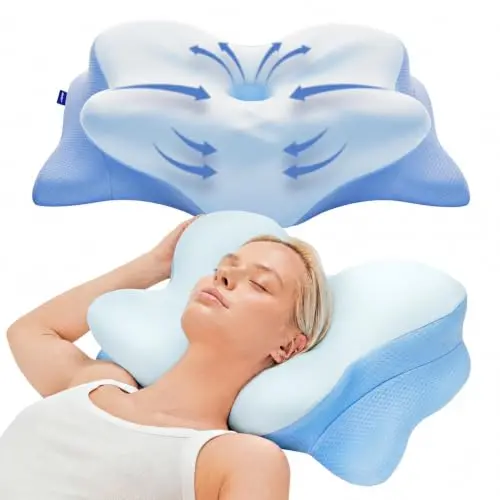
Derila Ergo Pillow – Butterfly Contour with Cooling Cover
A butterfly-shaped memory foam pillow, 21.25 x 14.17 x 4.72 inches, with a breathable zip-off cooling cover included. Medium firmness, certified to both CertiPUR-US and OEKO-TEX standards.
How We Evaluated These Pillows for Tinnitus
We didn’t run clinical sleep studies, measure overnight tension, or have anyone’s tinnitus assessed by an audiologist. What we did: cross-referenced 9 pillow models from 9 distinct brands across 6 decision axes – ear pressure relief, neck and cervical alignment, loft adjustability, cover breathability and cooling, sleeping-position fit, and care and certification. We triangulated published specifications, feature sets, and owner feedback where available against how each shape actually behaves for someone who needs to fall back asleep after the ringing wakes them up.
The scoring framework weighted real-world fit (70%) – how well a given pillow solves an actual overnight problem, whether that’s ear pressure, a kinked neck, or overheating – against feature differentiation (30%), meaning the specific design choices that separate one contour from the next. We have no commercial relationship with any of the brands here, and recommendations track fit and differentiation rather than brand preference. Nothing in this lineup treats tinnitus itself; what these pillows can change is the position of your head, the pressure on your ear, and how hot you sleep.
One honesty note: a pillow is a body-specific purchase in a way that sheets and duvets aren’t. A shape that fixes your partner’s neck can press on yours. If you’re an ear-pressure sleeper, the Wuronsa ear relief pillow targets that directly; if your problem is a stiff neck at four in the morning, start with the DONAMA dual-height contour.
How to Choose the Right Pillows for Tinnitus
1. Why a Pillow Matters More When You Have Tinnitus
Tinnitus doesn’t switch off when the lights do. In a quiet room there’s nothing left to mask it, so the sound you spent all day ignoring becomes the loudest thing in the house – and the longer you lie there listening, the harder it is to fall asleep. That loop is where a pillow earns its keep. It can’t quiet the ringing, but it can remove three physical irritants that keep you awake: ear pressure against the mattress, a neck angle that leaves you stiff by morning, and trapped heat around your face and head.
Those three problems don’t share a solution, which is why a lineup like this spans an ear-hole pillow, a cluster of memory foam contours, and a conventional cotton set. Buying the wrong type for your particular irritant is the most common mistake in the category.
2. Ear Pressure vs. Neck Alignment: Two Separate Problems
If you sleep on your side and wake with a sore, hot, or throbbing ear, the shape of your pillow is pressing on cartilage and skin all night. A cutout pillow solves that by giving the ear somewhere to sit – the Wuronsa ear relief pillow is the direct answer and works layered on top of a normal pillow. If instead you wake with a tight neck, headache, or jaw tension, the fix is a cervical contour: a shaped channel that keeps your head from sinking so far that your spine curves sideways.
Some people need both, and that’s fine – a small ear pillow on top of a contour shape is a workable combination. What you shouldn’t do is buy a deep contour for an ear problem and hope the cradle keeps pressure off the cartilage. It usually doesn’t.
3. Loft Height and Sleeping Position
Loft is the measurement that decides whether a pillow works. Side sleepers need enough height to fill the gap between the mattress and the side of their head – a 4.5 to 5-inch contour or a well-stuffed conventional pillow usually gets there. Back sleepers want less, so the chin doesn’t get pushed toward the chest. Stomach sleepers want the least of all, which is why a tall contour is a poor match no matter how good the specs look.
That’s why dual-height designs show up repeatedly here: they let you test two lofts without buying twice. If you already know what you need, a single fixed height is simpler and more affordable.
4. Cooling and Breathability in Pillows for Tinnitus
Heat is underrated as a tinnitus problem. Memory foam holds warmth, and if you wake up hot, you wake up alert – and a quiet, alert brain is exactly where ringing gets loud. Look for an open-cell foam core, a 3D mesh or Q-Max cover, or a cotton shell over hollow-fiber fill. The Cozyplayer cooling contour is the most complete cooling package in this lineup; a cotton set is the low-tech version of the same idea.
One caveat: no pillowcase beats a hot bedroom. If your room runs warm, fix the room first and the pillow second.
5. Common Pitfalls When Buying a Pillow for Tinnitus
The biggest one is buying too tall. A pillow an inch higher than your shoulder gap pushes your head forward all night, and you’ll blame the foam rather than the height. The second is expecting instant comfort – contour shapes take five to ten nights to feel normal, and the first two can be worse than the flat pillow you’re replacing.
Third is ignoring the ear entirely. Fourth is the smell: most memory foam ships compressed and needs 24 to 48 hours of airing before it’s usable. And fifth, keep expectations honest – nothing in this category cures tinnitus. What you’re buying is a better night’s sleep around it.
6. What Budget, Mid-Range, and Premium Pillows Get You
Entry-level picks mostly buy you one good idea: the ear-hole pillow is a small, low-cost support piece, and a basic contour at the bottom of the range gets the shape right without certifications or trial windows. Mid-range is where this category actually lives – CertiPUR-US or OEKO-TEX certification, dual heights, mesh covers, and washable cases all appear here. At the premium end you’re paying for denser foam, a better-feeling cover, and a trial period; the C Cushion Lab Deep Sleep Pillow is the clearest example, with a dual-density core and a cover that genuinely feels different.
Spend up only if you’ve already tried a contour and know the shape works for you. For a first attempt, mid-range with a trial period is the smarter money.
Frequently Asked Questions
1. Can a pillow actually help with tinnitus?
Not by treating the tinnitus itself. There’s no pillow that quiets the sound, and any product claiming to should make you skeptical. What a pillow can change is the sleep environment around the ringing: it can take pressure off your ear, hold your neck in a position that doesn’t leave you stiff and tense by morning, and keep you cool enough to fall back asleep when you wake in the middle of the night.
For some people that’s a meaningful quality-of-life difference. For others it’s neutral, because their tinnitus isn’t affected by neck position or ear pressure at all. It’s worth testing the cheap version first – an ear-hole pillow costs very little and tells you quickly whether ear pressure is part of your problem.
2. DONAMA vs. Osteo: which cervical pillow is the better pick for tinnitus?
Both are contoured cervical shapes with adjustable height, and both draw strong owner feedback on neck pain relief. The DONAMA gives you two heights by flipping it, plus armrest grooves that take pressure off your shoulder when you’re on your side. The Osteo adds a third height via a removable insert, and its hollow center cradle is more pronounced – some sleepers find that more supportive, others find it too firm.
Choose the DONAMA if you want simpler flip-and-go adjustment and a cooler cover. Choose the Osteo if you want more height options and don’t mind breaking in firmer foam.
3. Cozyplayer vs. C Cushion Lab Deep Sleep Pillow: which suits a hot sleeper?
Cozyplayer, fairly clearly. Its Q-Max Arc-Chill cover and 3D mesh backing are built around heat, and the open-cell foam lets air move through the core rather than trapping it. The C Cushion Lab answers a different question – how to keep your head from sliding off-center when you roll onto your side – with sculpted bolsters and a dual-density core.
If cooling is your main complaint, go Cozyplayer. If you want a defined side-sleeping position and a smoother, lower-drag cover, the C Cushion Lab is the better fit.
4. Is a pillow with an ear hole actually useful for tinnitus?
It’s the most direct tool in this lineup, with one caveat. The Wuronsa ear relief pillow puts a 3.5-inch cutout under your ear so cartilage isn’t compressed all night, and its product documentation specifically lists tinnitus, ear pain, and earplugs among intended uses. Owners mostly confirm it makes side sleeping possible without ear pain.
The caveat: at 9 inches across, it’s a support piece rather than a replacement pillow. Expect to use it on top of or alongside your regular pillow, and expect to adjust the fill, because it arrives firm.
5. How long should I give a new contour pillow before giving up on it?
Plan on five to ten nights. A contour shape asks your neck to hold a position it hasn’t held in years, and the first two nights often feel worse than the flat pillow you’re replacing. Give it a week of genuine use before you judge it, and adjust the height first – a lot of “too firm” complaints are really “too tall.”
Also give the foam 24 to 48 hours to fully expand out of the packaging before night one. Sleeping on a half-expanded pillow is a bad first impression you don’t need.
Final Verdict
For most people whose tinnitus gets louder at night, the DONAMA cervical contour is the answer: two lofts by flip alone, armrest grooves so your shoulder isn’t jammed all night, a breathable cover, and a shape most sleepers settle into within a week. If overheating is what pulls you awake, the Cozyplayer cooling contour pairs an open-cell core with the most convincing cooling cover here. If the sore spot is your ear rather than your neck, the Wuronsa ear pillow addresses that directly and costs almost nothing to try. And if you’d rather not sleep in foam at all, the Beckham Hotel Collection queen set is the cool, feather-free cotton option. Buy for the irritant that wakes you most often, not for the longest feature list.
