
Best Portable Door Locks For Travel – 2026 Reviews

Hotel room doors are built for the hotel, not for you. That’s the thing that lands on the first night of a trip – the deadbolt feels thin, the chain is decorative, and the peephole has no cover. A portable door lock is the small piece of hardware that closes that gap, the kind of thing you don’t think about until the door rattles at two in the morning.
Portable is the operative word. These devices have to fold flat enough for a pocket, install without a screwdriver, and come off in seconds if you need to leave in a hurry. The catch is that nearly every model depends on one physical assumption: your door has to open inward and leave a gap between the door and the frame. Get that wrong and the lock simply won’t seat, no matter how well it’s built.
We compared the field across brands – from bare stamped-steel pieces to adjustable versions with silicone bumpers, plus one set that adds a pressure-triggered alarm. Some seat in two seconds; others need a specific strike plate. Here’s how to tell which one belongs in your bag.
Best Portable Door Locks for Travel – 2026 Reviews
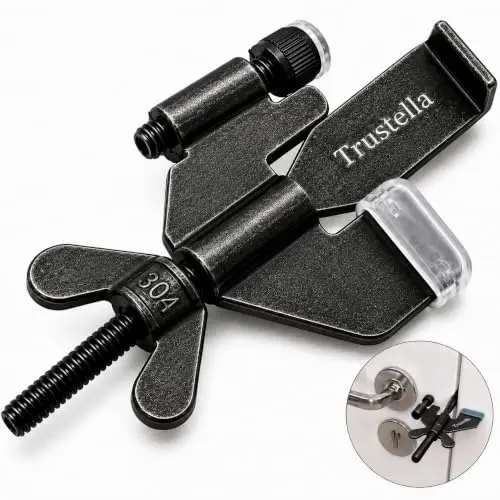
Portable Door Lock – Adjustable Fit With Silicone Caps
Trustella’s take on the travel door lock adds one thing most budget models skip: a hand-tightened adjustment mechanism. The stainless steel claw goes into the strike plate, the door closes, and you tighten the contact points by hand until the plate sits firm against the door. Silicone caps at those contact points reduce rattling and leave fewer marks on painted doors. It packs into a supplied travel pouch and needs no tools, drilling, or adhesive.
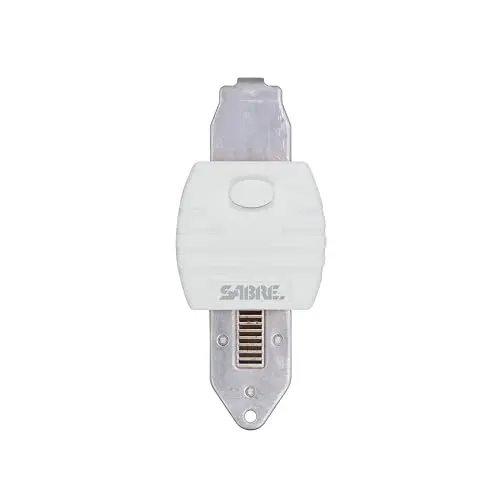
HS-PDL-WH – Metal-Bodied Lock Backed by a Warranty
SABRE’s portable door lock is a metal-bodied unit aimed squarely at travelers, shipping with its own travel bag and rated as TSA-approved. The claw seats into the strike plate of most inward-swinging hinged doors, and installation needs no tools or wiring. It’s the only lock in this lineup that ships with a stated manufacturer warranty, which is a meaningful difference for a device whose whole job is protecting you in unfamiliar rooms.
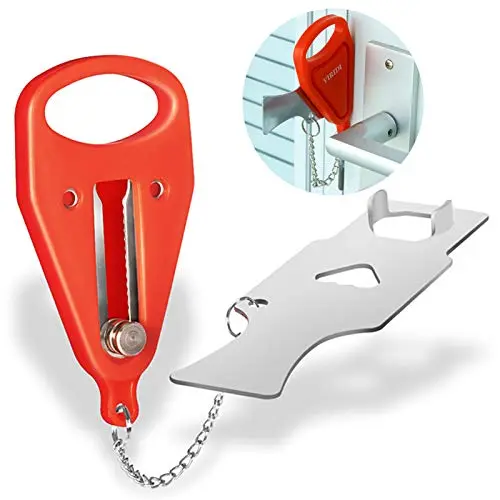
Portable Door Lock – 4.2-Ounce Pocket Backup
VIRIDI’s lock is the classic stamped-and-folded design: a stainless steel plate that clips onto the strike plate while the door is open, then a red key-driven knob pushes through a matching hole to lock it in place. It weighs about as much as a deck of cards, slips into most pants pockets, and comes with a small pouch. No drills, no screws, no tools.
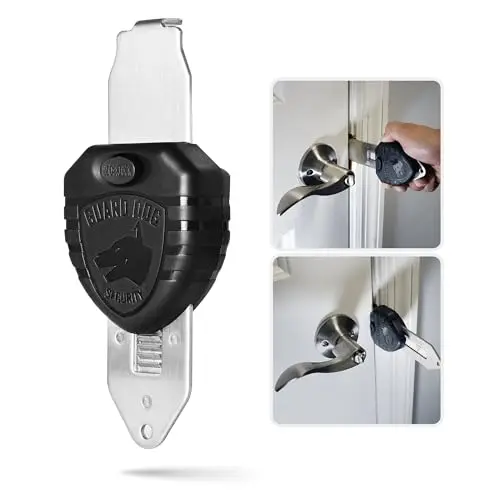
BlockLock – Heavier-Duty Stainless for Rentals
BlockLock is Guard Dog Security’s entry into the category, built from stainless steel with an electroplated, polished finish and a chunkier feel than the pocket-sized options. The install sequence is the standard one – metal piece into the door lock slot, door closed, handle groove seated over the stud on the metal sheet. It’s aimed at renters, students, and travelers who want a heavier piece of hardware rather than the smallest possible one.

Locker001 – Two Hole Sizes for Broader Door Fit
AceMining’s lock uses the familiar insert-close-seat sequence, but the metal sheet carries two holes of different sizes rather than one – a small design choice meant to widen compatibility across strike plate styles. The stainless steel body sits under a rugged ABS cover that’s there to protect the door under pressure, and the surfaces are electroplated and polished to keep the edges smooth.
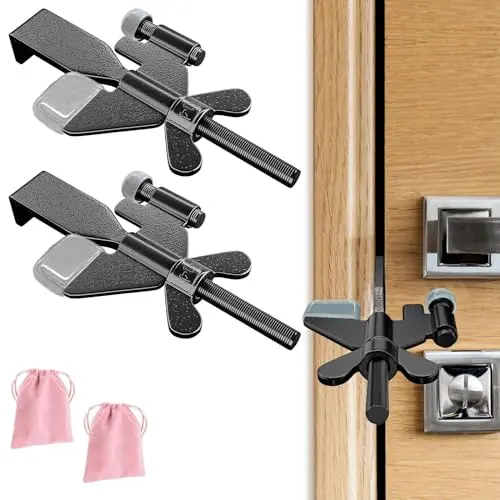
A01 Upgrade Two-Pack – Adjustable Locks With Silicone Caps
MASJENBU sells this one as a pair, which is the obvious play if you want one lock for your travel bag and one for the door you actually live behind. The A01 upgrade uses an adjustable wing nut for a hand-tightened fit, ships with silicone caps to protect the door and frame, and is built from 304 stainless steel. It arrives in a small pouch inside a gift box.
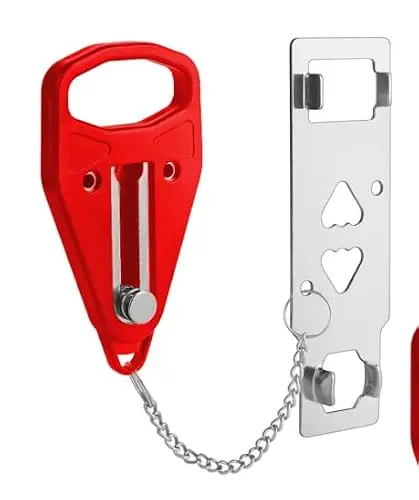
HL083 – Budget Steel Lock for Inward Doors
Jaswill’s HL083 is the budget entry: a rectangular stainless steel plate, polished finish, and the standard four-step install. The pitch is thickness – a heavier-gauge plate than the cheapest competitors – plus anti-rust treatment, in a package small enough for a pocket or handbag. It needs at least a 3mm gap between door and frame to seat properly.
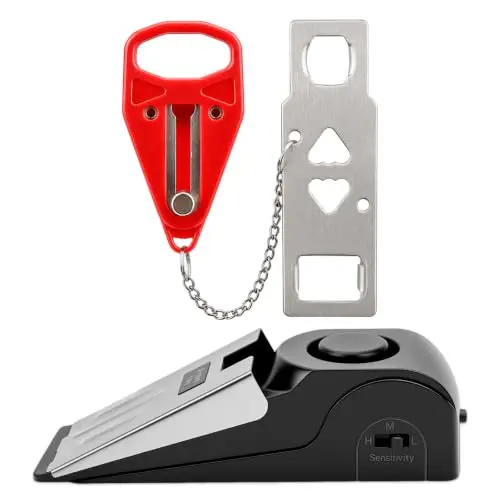
Lock and Alarm Set – Barrier Plus Warning
This is the only set in the lineup that pairs a portable door lock with a pressure-triggered alarm. The lock itself uses an upgraded two-hole design for wider door compatibility; the door stop is a stainless steel wedge with a non-slip base, three sensitivity settings, and a 120dB siren that fires when someone pushes the door against it. The alarm needs a 9V battery, which isn’t included.
How We Evaluated These Portable Door Locks for Travel
We did not install these locks on real hotel doors across a multi-city travel schedule, and we didn’t try to force any of them open. What we did: cross-referenced 8 portable door lock models from 8 distinct brands across five decision axes – door compatibility requirements, installation sequence, materials and build, portability and packed footprint, and included accessories. We triangulated published specifications, feature checklists, and owner feedback where available, then mapped each option against the realities of travel: unfamiliar doors, short stays, and the need to get out fast in an emergency.
Compatibility carried the most weight, because it’s the axis that decides whether the device works at all. Every lock here is limited to inward-opening hinged doors, but the gap tolerance and strike plate requirements vary enough to change who each one suits. A lock that won’t seat is a lock that doesn’t work, regardless of how well it’s built. The scoring framework weighted real-world fit and performance (70%) – will this seat on the door in front of you and hold – against feature differentiation (30%) – adjustability, door protection, alarms, and included extras.
We have no commercial relationship with any brand here; recommendations track fit and differentiation, not brand preference. If you want the most adaptable seat, the Trustella portable door lock is the pick; if warranty coverage matters more than adjustability, SABRE’s lock is the one to look at.
How to Choose the Right Portable Door Lock for Travel
1. What Actually Makes a Portable Door Lock Work
The mechanics are the same across every model here: a metal plate hooks into or over the strike plate on the door frame, the door closes so the latch engages, and a second contact point presses against the door to stop it swinging back. It’s a secondary physical barrier, not a replacement for the deadbolt. What it adds is resistance – the door won’t simply swing open even if someone has a key or a copied card.
The catch is that the whole system depends on geometry. A portable lock needs an inward-swinging hinged door and a gap between door and frame for the claw to sit in. Sliding doors, double doors, and outward-opening doors are all out. That’s not a quality problem – it’s the physics of the design.
2. Door Compatibility: The Check to Do Before You Buy
Strip everything else away and this is the deciding factor. Check three things: does the door swing inward on hinges, is there a visible gap between door and frame, and does the strike plate have an opening that will accept a metal claw? Gap requirements vary – some locks want a couple of millimetres of clearance, others specify more.
Strike plate shape matters just as much. A standard latch strike plate usually works. Recessed or mortised plates usually don’t, and neither do unusual frames or very thick doors. This is why the same lock draws wildly different verdicts – the doors were different, not the lock.
3. Choosing a Portable Door Lock for Travel: Adjustability Beats Brute Strength
For travel specifically, the feature that matters most is adjustability. A fixed claw gives you exactly one fit, and hotel doors are not standardised. An adjustable model with a hand-tightened nut or knob lets you take up slack until the plate presses evenly. That’s why the Trustella lock sits at the top of this list – it’s the most forgiving of the few millimetres of variance you’ll actually encounter.
Second on the travel list is door protection. Metal pressed against a painted door leaves marks, and rental deposits are real. Silicone or ABS contact caps are a small feature with outsized value. Third is packed size: a lock you don’t carry is a lock you don’t have.
4. Adjustable vs. Fixed: Which Portable Door Lock Fits More Doors
Fixed designs are simpler and usually cheaper, and when they fit, they fit well – there’s nothing to overtighten or misalign. The SABRE portable door lock is the fixed-design case done properly, with a metal body, a travel bag, and a manufacturer warranty behind it. Buy fixed if you know your door and want simplicity.
Adjustable designs trade that simplicity for tolerance. The wing-nut approach on the MASJENBU two-pack lets you dial the contact pressure instead of accepting whatever the door gives you. Buy adjustable if you’re locking unfamiliar doors night after night.
5. Alarms, Caps, and Other Add-Ons Worth Paying For
Two extras genuinely change the experience. Contact caps protect the door and cut rattling. A pressure-triggered door stop alarm adds a warning layer – a siren that fires when the door is pushed against the wedge, usually with adjustable sensitivity so normal hallway noise doesn’t set it off. If you’re traveling alone, that’s a meaningfully different product from a silent lock.
Skip most of the rest. Colours, gift boxes, and branded pouches don’t affect whether the door holds. One genuinely useful non-obvious extra: two locks in one set, which lets you keep one at home and one in the bag – the single most common reason people end up buying twice.
6. What a Travel Door Lock Should Cost
This is a budget-friendly category by nature. Nothing here is expensive in absolute terms, and the spread between the entry-level models and the premium pick is narrow enough that the decision should be about fit, not savings. Mid-range models generally add adjustability or door protection; the premium end adds brand accountability and a warranty.
There’s no correlation between price and security here, because all of these rely on the same basic mechanics. Paying more buys a better seat, better hardware, and someone to call if it fails – not a stronger barricade.
7. Care, Packing, and What to Check on Arrival
Keep a travel door lock dry. Stainless steel resists corrosion, but the plastic and plating on cheaper models don’t love a damp toiletry bag. Store it in its pouch rather than loose with keys, so the claw edges stay clean and don’t scratch anything else in your bag.
Do a dry run on the first night, before you’re tired: seat the lock, close the door, make sure it’s flush, then practise removing it in low light. The whole value of a portable lock is that it comes off fast if you need to leave.
Frequently Asked Questions
1. Are all portable door locks actually portable enough to carry?
Almost all of them are, in the literal sense. The lightest models here weigh about as much as a deck of cards and slip into a jacket pocket or the corner of a handbag. The differences show up in the details: a pouch or travel bag matters more than raw weight, because a bare metal claw snags on clothing and scratches phone screens.
The set-based options are the exception in spirit. A two-pack or a lock-and-alarm kit is portable as separate items but not as a single pocket carry. If packed footprint is your priority, buy one lock rather than a kit.
2. What's the difference between the Trustella lock and the SABRE portable door lock?
Both are stainless-bodied locks for inward-opening doors, and both come with a travel pouch. The difference is how they seat. Trustella uses an adjustable, hand-tightened mechanism with silicone contact caps, so it tolerates variance in door gaps. SABRE uses a fixed metal claw in a metal body, backed by a manufacturer warranty.
If you’re locking doors you’ve never seen before, the Trustella lock is the safer bet. If you’d rather have brand accountability and coverage, go with SABRE.
3. Will a portable door lock work on my hotel room door?
Usually yes, but it’s worth checking rather than assuming. Most hotel room doors swing inward on hinges and have a standard latch strike plate, which is exactly the configuration these locks are built for. Where it falls down: sliding doors, connecting doors between rooms, and doors with recessed or mortised strike plates.
The tell is the gap. If you can see light or slip a fingernail between the door and the frame, most of these will seat. If the door sits tight to the frame with no clearance at all, none of them will.
4. How does the MASJENBU two-pack compare to the Guard Dog BlockLock?
Different jobs. The MASJENBU set gives you two adjustable locks with silicone caps – one for the front door, one for the bag – which is the better structure for someone who wants ongoing protection at home plus travel coverage. Guard Dog’s BlockLock is a single, heavier-duty stainless unit with a polished finish and a noticeably chunkier feel. It’s the pick when you want the most substantial hardware rather than the most flexible arrangement.
5. Do I need the alarm version, or is a lock enough?
They solve different problems. A lock is a barrier; an alarm is a notification. If someone is trying the door, a silent lock stops them but tells you nothing. If you’re traveling alone or staying somewhere with a shared corridor, the Rerishom lock and alarm set adds that second layer – a 120dB siren with adjustable sensitivity.
Two caveats worth knowing before you pack it: the alarm needs a 9V battery that isn’t included, and the wedge design only works on hard flooring, not carpet.
Final Verdict
For most travelers, the Trustella portable door lock is the answer. The adjustable contact points solve the single biggest failure mode in this category – a lock that doesn’t sit flush because your door’s gap isn’t the one the manufacturer assumed – and the silicone caps keep you from leaving marks in someone else’s rental.
If warranty coverage and a recognized safety brand are worth a premium to you, the SABRE portable door lock is the one to buy. If you want a lock for the apartment and one for the carry-on, the MASJENBU two-pack covers both. And if you’re traveling alone and want a warning as well as a barrier, the Rerishom lock and alarm set is the only kit here that does both.
