
Best Prosumer Coffee Grinders – 2026 Reviews

The first grinder is an easy call. Almost anything with a burr beats the blade chopper gathering dust in the cabinet, and the coffee improves overnight. The second grinder is the hard one. By then you’re weighing doses, you’ve noticed your shots run fast some mornings and slow on others, and the machine that felt like an upgrade has quietly become the weak link in the chain.
That middle ground is what prosumer means here. These aren’t commercial shop grinders, and they aren’t plastic entry-level boxes either. What separates them is burr quality at fine settings, dosing control you can repeat without reaching for a scale every time, and enough adjustment range to move between espresso and pour-over without starting from scratch. Those three things decide whether a grinder disappears into your morning routine or turns into a daily negotiation.
We looked across the market – Baratza’s filter workhorses, Breville’s programmable all-rounder, and a cluster of newer brands undercutting both. Each grinder below is matched to the buyer it actually suits, along with the tradeoffs you’ll notice after the honeymoon ends.
Best Prosumer Coffee Grinders – 2026 Reviews
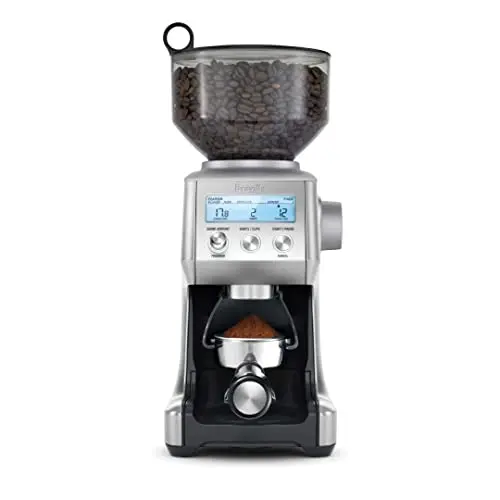
Smart Grinder Pro – Programmable Dosing for Espresso and Filter
The most complete prosumer package in this lineup. Sixty stepped settings, a programmable dose timer that adjusts in 0.2-second increments, and two portafilter cradles (small and large) let you grind straight into a basket without a dosing cup. The LCD shows grind setting, time, and shot or cup count, so a dialed-in routine becomes one button press away.
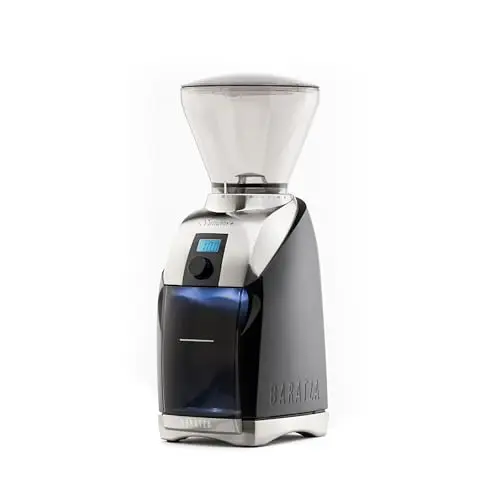
Virtuoso+ – Timed Dosing Built for Filter Brewing
The filter-brewing specialist that still handles espresso duty. Forty stepped settings on enhanced commercial-grade conical burrs, a 40-second digital timer adjustable to a tenth of a second, and an LED-backlit grounds bin that makes dosing easy in a dim kitchen. The sculpted metal top and base give it a more substantial feel than the plastic-bodied grinders here.
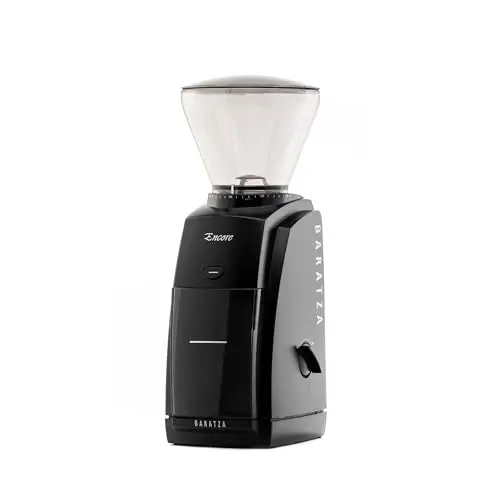
Encore – The Simple Path Into Specialty Grinding
The grinder most people land on when they outgrow a blade chopper. Forty settings on 40mm commercial-grade conical burrs, a front-mounted pulse button, and a plain on/off switch. No timer, no screen, no learning curve – just a compact machine that covers Aeropress through French press and drip.
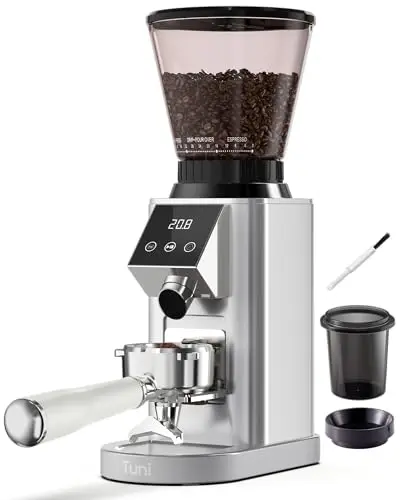
G1 – Anti-Static Grinding With a Portafilter Cradle
Prosumer features in an entry-level footprint. Forty-eight settings on a 40mm conical burr running at a slow 450 RPM, anti-static design, and a detachable portafilter holder sized for 54-58mm baskets. The LED touchscreen sets grind time in half-second steps up to 40 seconds, and a separate dosing cup collects larger batches.
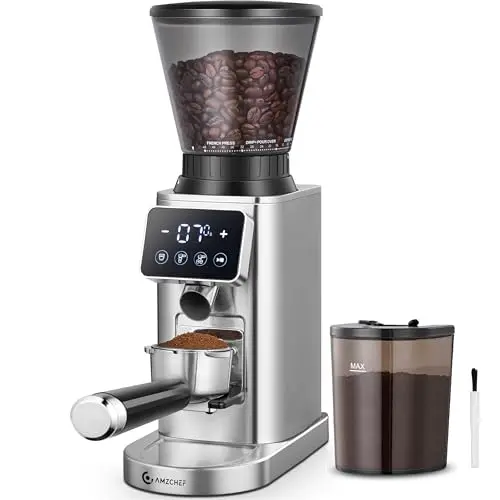
CG209 – Touchscreen Dosing, Less Static Mess
A convenience-first burr grinder. The LED touchscreen handles grind time and cup count, with a manual mode when you want to eyeball the dose. Forty-eight settings on 40mm stainless conical burrs, anti-static internals, and a 10.6-ounce hopper with a UV-blocking tint and a trap door so you can lift it off without spilling beans.
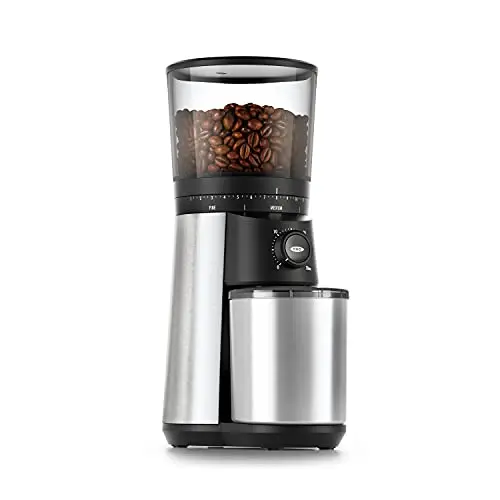
Brew Conical Burr Grinder – Quiet One-Touch Grinding
The quiet, low-fuss option. Forty-millimeter stainless conical burrs, 15 main settings with 43 micro-adjustments, and a one-touch start that remembers your last setting. The 12-ounce hopper is removable and tinted to block UV light, and coverage runs a full two years.
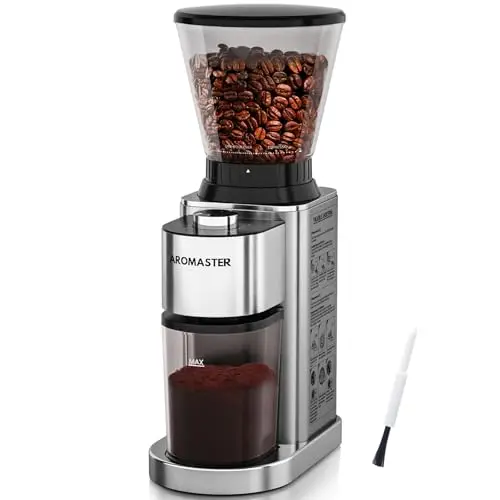
CG204 – Compact Anti-Static Conical Grinder
A compact conical burr grinder with 48 settings, an adjustable timer for dose control, and a removable ring burr that lifts out for cleaning. The anti-static tinted bin keeps grounds contained and limits UV exposure, and the grinding chamber handles up to 3.9 ounces at a time.
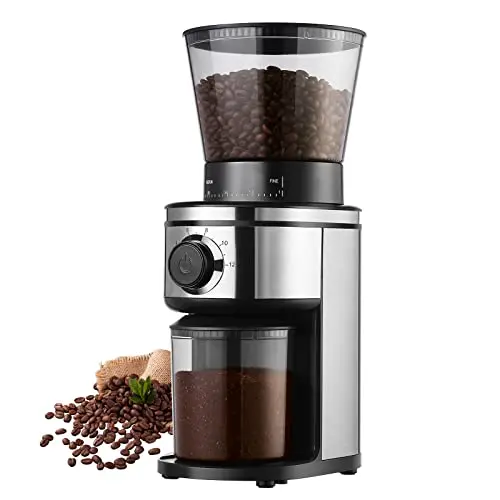
BG702S-PG – Slow-Grind Conical Burr Value
Thirty settings on 40mm stainless conical burrs, driven by a gear-reduction motor that turns slowly to keep friction heat down. The 10-ounce hopper auto-locks so you can lift it off without spilling, cup selection runs from 2 to 12, and a friction clutch protects the gear if a stone slips through.
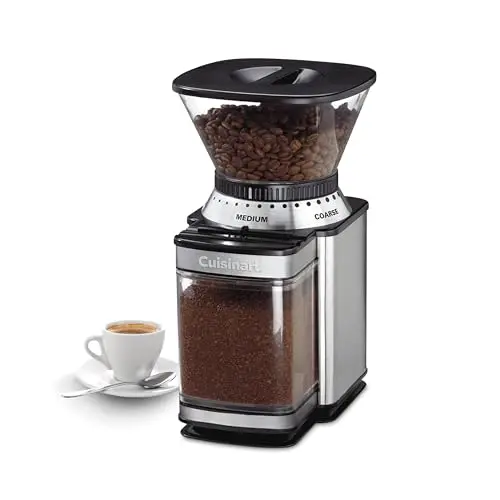
Supreme Grind DBM-8P1 – Affordable Flat Burr Entry
The least expensive route into flat burr grinding here. Eighteen grind positions span fine through extra-coarse, a slide dial sets anywhere from 4 to 18 cups, and the machine stops itself when the cycle finishes. The 8-ounce hopper is removable, and the grind chamber holds grounds for a large batch.
How We Evaluated These Prosumer Coffee Grinders
A few things we can’t tell you: we did not run particle-size analysis or timed grind-distribution screens in a lab, and we didn’t live with each of these grinders for months. What we can tell you is how they compare on the things that decide whether a machine suits a prosumer workflow. We cross-referenced 9 coffee grinders from 8 brands across six decision axes: burr type and size, grind-setting range and adjustability, dosing control, espresso capability, hopper capacity and workflow, and cleaning plus serviceability. We mapped published specifications and feature sets against owner feedback where available, then pressure-tested every option against three buyer profiles – the filter-only brewer, the home espresso beginner, and the tinkerer who wants one grinder for both.
The scoring weighted real-world fit at 70% – how well a grinder does the job its buyer actually has – against feature differentiation at 30%, meaning the capabilities that separate one machine from the next. Settings that look generous on paper matter far less than repeatability between doses, so that’s where the weight landed. We have no commercial relationship with any brand here; the ranking tracks fit and differentiation, not brand preference. If you split time between espresso and filter, the Smart Grinder Pro is the natural starting point; if pour-over is the whole point, the Virtuoso+ is worth the premium. Read the reliability notes as a summary of what owners report rather than our own long-term data.
How to Choose the Right Prosumer Coffee Grinder
1. What Makes a Coffee Grinder Prosumer-Grade
The line between entry-level and prosumer isn’t price, it’s repeatability. A basic burr grinder can produce a decent grind; what it usually can’t do is produce the same grind, dose after dose, in a range fine enough to dial in espresso. Prosumer machines add burr quality at the fine end and some form of dose control beyond holding a button and counting to five.
You’ll also notice the difference in serviceability. Burrs are wear items. A grinder designed so the upper burr lifts out without tools, and backed by a brand that sells replacement parts, will outlast one sealed inside a plastic shell. That matters far more than a bigger settings number on the box.
2. Conical vs Flat Burrs: What Changes in the Cup
Most grinders in this tier use conical burrs – a cone inside a ring – because they’re forgiving, reasonably quiet, and cheap to manufacture well. The Cuisinart Supreme Grind is the outlier here with flat burrs, which cut a different particle distribution. In practice, conical is the safer bet for someone splitting time between espresso and filter; budget flat burr sets tend to be less consistent, not more.
Burr size matters less than quality and alignment. A well-made 40mm conical set – Baratza’s Liechtenstein-made burrs, for instance – will beat a sloppy larger set every time, and it’ll hold that alignment longer.
3. Grind Settings, Steps, and Repeatability
Setting counts are marketing until you look at what they cover. Sixty settings mean nothing if they’re all clustered at the coarse end. What you want is enough resolution in the espresso range to shift a shot by a couple of seconds, plus enough range to reach a French press or cold brew grind without maxing out the dial.
Stepped adjustment is standard here and it’s fine – you learn the two or three positions your beans like. Stepless adjustment mostly lives on grinders above this class. If filter brewing is your priority, a 40-setting range like the Baratza Encore covers more than you’ll ever use.
4. Timed Dosing and Workflow: Where Budget Grinders Cut Corners
A timer is the single biggest workflow upgrade in this category. Grinding by eye works until you change beans and the dose shifts on you. Machines with programmable grind time – Breville’s Dosing IQ, the Virtuoso+’s tenth-of-a-second timer – let you set a dose once and repeat it, which is what turns a morning routine into something effortless rather than fussy.
Simpler options use cup selectors: pick 4, 8, or 12 cups and the grinder runs a proportional time. That’s fine for drip and near-useless for espresso, where you’re dosing a single basket. Know which brewer you are before you spend.
5. Baratza Virtuoso+ vs Breville Smart Grinder Pro: Which Prosumer Grinder Fits You
These two sit at the top of the lineup for different reasons. The Virtuoso+ is built around filter brewing: exceptional burrs, a precise timer, metal construction, and a design that prioritizes the grounds bin over portafilter gymnastics. The Smart Grinder Pro is built around espresso workflow: 60 settings, two portafilter cradles, programmed dosing, and an LCD that tracks shots and cups.
Choose the Virtuoso+ if you brew pour-over or drip most mornings and want the better cup plus the longer service life. Choose the Smart Grinder Pro if you pull shots and still want filter capability from the same machine, and you’d rather grind directly into the basket.
6. Static, Retention, and Cleaning: The Daily Annoyances
Static is the invisible spec. Cheap grinders throw grounds across the counter; the ones with anti-static design – the Tuni G1, AMZCHEF, Aromaster, and Ollygrin all claim it – keep both the counter and the dose cleaner. Retention, meaning grounds left inside the chute, is the other hidden cost: swap beans and the first dose is a blend of old and new.
For cleaning, look for a removable upper burr and an included brush. Grinders that need tools to open up tend not to get cleaned, and stale oils are the fastest way to make good beans taste flat.
Frequently Asked Questions
1. Do prosumer coffee grinders actually make better espresso?
Yes, though not because they cost more – because they give you control over the variables that matter. Espresso is unforgiving about particle consistency: a mix of fines and boulders channels water unevenly and produces sour and bitter notes in the same shot. A well-aligned conical burr set and fine-grained adjustment near zero let you actually dial in. The second factor is repeatability: a timed dose you can hit again tomorrow morning without re-thinking it.
If you only brew drip, the gap narrows considerably. A simpler machine like the Baratza Encore covers filter brewing well at a much lower outlay.
2. What's the difference between the OXO Brew Conical Burr grinder and the Baratza Encore?
They’re aimed at different buyers. The OXO Brew is the more automated machine: one-touch memory start, a 12-ounce removable hopper with UV-blocking tint, and a two-year warranty. Its 15 main settings with 43 micro-adjustments favor drip and French press, and the absence of a dose timer means grinding by ear or by scale.
The Baratza Encore gives you 40 settings on commercial-grade conical burrs, a pulse button for hands-on dosing, and a deeper parts-and-service ecosystem. Neither is espresso-focused. If you want a single-button routine, take the OXO; if you want room to experiment across brew methods, take the Encore.
3. Can a budget grinder like the Tuni G1 keep up with the Breville Smart Grinder Pro?
For filter brewing, largely yes – both grind consistently across a wide range. The gap shows up in espresso workflow. The Tuni G1 offers 48 settings, a half-second timer, and a 54-58mm portafilter holder, which is more than most budget machines even attempt.
What the Breville adds is programmable dosing in 0.2-second increments, two cradle sizes, and a two-year warranty. If you pull one shot a day, the G1 is plenty. If you’re chasing repeatable espresso and grinding into a basket every morning, the extra control earns its keep.
4. Do I need to single-dose with these grinders?
No, but it’s worth understanding the tradeoff. All of these have hoppers, so you can fill and forget for a week. The catch is retention: a little ground coffee stays in the chute, so the first dose after a bean change is a mix of old and new.
Single-dosing – weighing beans in and grinding the full amount – sidesteps that and makes dose consistency independent of the timer. It’s also why hopper size matters less than most buyers assume. Keep one bean in the hopper and brew daily, and you can stop overthinking it.
5. How much counter space do these coffee grinders need?
Less than you’d expect. Most of these run roughly 5 to 9 inches wide and 12 to 16 inches tall, so the real constraint is height under a cabinet, not footprint. The Aromaster is the tallest of the group at 16 inches; the Breville and Tuni sit closer to 15.
Leave clearance above the hopper so you can lift it off for refills, and check that the grounds container slides out without hitting your backsplash. A grinder you can’t comfortably refill is a grinder that ends up in a cupboard.
Final Verdict
For most people reading this, the Breville Smart Grinder Pro is the answer. It’s the only grinder here that handles timed espresso dosing and filter brewing without a second machine or a second workflow, and its warranty coverage is the most generous in the lineup.
If the budget is tighter, the Tuni G1 delivers anti-static grinding, a real timer, and a portafilter cradle for a fraction of the outlay – the tradeoff is a shorter track record. If filter coffee is the whole point and you want something built to be serviced rather than replaced, the Baratza Virtuoso+ is the premium pick, with the Encore as its simpler, cheaper sibling.
Start with your brew method. Everything else follows.
