
Best Red Light Therapy Hair Dryers – 2026 Reviews

A hair dryer that promises to dry hair faster while also being gentler on it is a reasonable thing to want. Red light therapy hair dryers sit at that intersection: they pair infrared or red-light heat with ionic airflow and heat-control features that are supposed to reduce the punishing blast of a traditional dryer. The catch is that the category is still loosely defined, so two dryers can both use the phrase while delivering very different things.
The most useful way to separate them is to look at how the red-light claim is implemented and how much real control you get over heat and airflow. A good option should dry efficiently without creating hot spots, feel balanced in your hand, and include attachments that match your hair. Noise and travel flexibility matter too, especially if the dryer will leave your bathroom.
We compared the models below across those practical axes, with an eye on which buyer each one suits rather than which brand shouts the loudest. If you want the most explicit red-light feature set, start at the top; if you’re curious on a budget or need dual voltage, the alternatives below make more sense.
Best Red Light Therapy Hair Dryers – 2026 Reviews
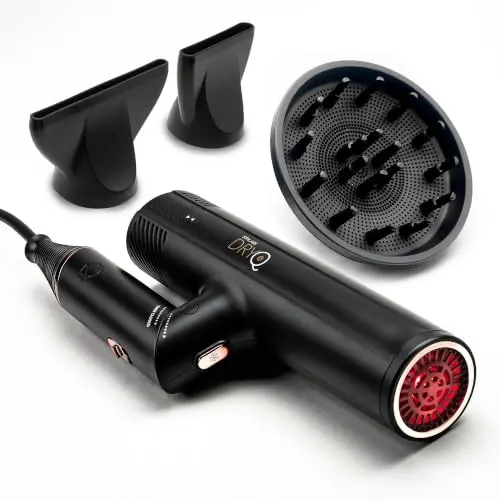
DryQ Infrared Hair Dryer – Red Light Therapy for Frizz Control
A red-light-focused dryer with intelligent heat control, magnetic attachments, and a travel-friendly dual-voltage design. It’s aimed at shoppers who want the specialized feature set without a salon-style bulk.
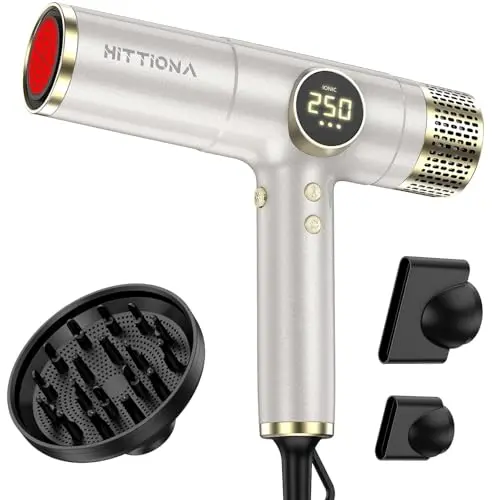
Infrared Ionic Dual Voltage Hair Dryer – Travel-Ready Red Light Therapy
A compact infrared ionic dryer with 2000W of airflow, dual voltage, and a diffuser for travel or curly-hair styling. It’s a strong fit if you want red-light-adjacent drying in a packable body.

Professional Hair Dryer – Quiet Far-Infrared Styling
A full-size 2000W dryer with far-infrared heat, ceramic tourmaline grilles, and a quieter motor. It’s built for daily styling with two nozzle shapes and a long cord.
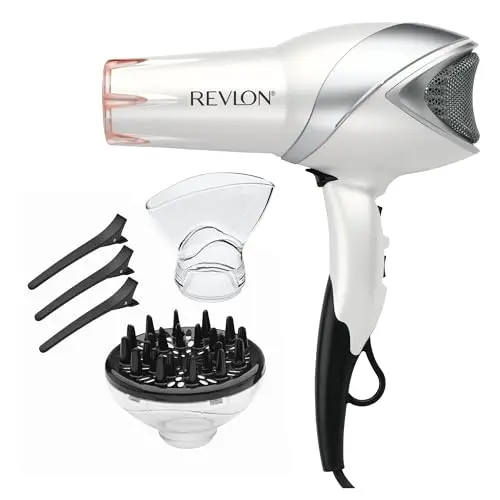
Infrared Ionic Hair Dryer – Budget-Friendly Frizz Control
An affordable infrared ionic dryer with 1875W of power, three heat settings, and a diffuser and concentrator in the box. It’s the low-commitment way to try infrared drying.
How We Evaluated These Red Light Therapy Hair Dryers
We didn’t run controlled lab tests on light wavelength output or measure surface temperature over time. What we did: cross-referenced 4 red light therapy hair dryers from 4 distinct brands across five decision axes – infrared or red-light implementation, heat control, airflow and drying speed, weight and noise, and attachments and travel practicality. We triangulated published specifications, feature sets, and use-case fit against representative buyer profiles for this category, and we audited owner feedback where available to see which strengths and caveats repeated. That means the rankings reflect researched fit rather than measured performance.
The scoring framework weighted real-world fit (70%) – how well each dryer delivers on its stated red-light and styling claims for the hair types it targets – against feature differentiation (30%) – the technical details that separate one model from another. We also weighed the practical ownership details that don’t show up in a spec sheet: how attachments seat, how balanced the body feels, and whether the controls are easy to adjust mid-style. We mapped each option to the buyer it suits: daily home styling, travel, curly-hair drying, or budget-conscious experimentation. Our recommendations track fit and differentiation, not brand preference. If you want the most complete red-light feature set, the DryQ is the match; if you need dual voltage and a packable body, the Hittiona Infrared Ionic is the stronger route.
How to Choose the Right Red Light Therapy Hair Dryers
1. Red Light Therapy Hair Dryers: What the Label Really Means
In a hair dryer, red light therapy usually refers to infrared or far-infrared heat that’s meant to dry hair from the inside out rather than by blasting the surface with hot air. The idea is that infrared heat can reduce the amount of time hair spends at high temperature, which may help limit cuticle stress and preserve shine. Far-infrared is the term many brands use for the longer-wavelength version of that claim.
Not every dryer that mentions infrared is built the same way. Some use a dedicated emitter, while others rely on ceramic or tourmaline elements that radiate heat differently. The practical question is whether the dryer gives you steady, controllable heat – not whether the phrase appears on the box.
2. Infrared vs. Ionic: How the Two Technologies Work Together
Negative ions are the other half of most red-light-adjacent dryers. They’re meant to help water evaporate faster and smooth the hair surface, which is why ionic dryers often feel like they leave hair less puffy. The combination matters because infrared heat without airflow control can still over-dry the ends.
Look for a dryer that pairs ionic output with a frizz control story you can actually use – multiple heat settings, a cool shot, and attachments that direct air where you want it. The goal is a smoother cuticle and a finish that doesn’t require a second pass with a flat iron.
3. Heat Control and Wattage: Matching Power to Your Hair
Intelligent heat control is the feature that separates a comfortable red-light dryer from a hot one. It can mean a sensor that adjusts output, a thermostat that holds a steady temperature, or simply a well-calibrated set of heat settings. Wattage tells you about drying power, but higher wattage isn’t automatically better if the heat isn’t controlled.
A cool shot is worth having regardless of your hair type. It helps set a style and gives you a way to finish without adding more heat. If you have fine or color-treated hair, prioritize a dryer with a gentle low setting and a nozzle that concentrates airflow; if you have thick hair, look for strong airflow and a motor that won’t bog down. For a full-size option with steady far-infrared heat and a quieter motor, the Trezoro Professional is the practical pick.
4. Attachments, Airflow, and Curly-Hair Styling
A diffuser is non-negotiable if you’re drying curls or waves, because it spreads airflow and helps define texture instead of blowing it apart. A concentrator is the opposite tool: narrow and directional for smoothing roots or finishing straight styles. Magnetic attachments are a small luxury that becomes a real convenience when you’re switching mid-style.
Check how securely the attachments seat and whether the dryer includes both shapes. If you travel with your dryer, a compact body and a diffuser that stays put matter more than a long list of nozzle sizes. The Hittiona Infrared Ionic is a strong fit here because it combines a travel-friendly body with a diffuser and dual voltage.
5. Weight, Noise, and Travel Practicality
Dual voltage is the spec to look for if the dryer will leave the country with you; without it, a plug adapter won’t fix the motor. Lightweight bodies reduce arm fatigue during a full blowout, but ultra-compact dryers can trade away airflow. Noise is subjective, yet a quieter motor makes a difference in small bathrooms and hotel rooms.
If travel is a priority, favor a model with a voltage switch, a short storage footprint, and attachments that pack without rattling. If the dryer stays on your vanity, a full-size body with a longer cord is usually more comfortable to use.
6. How to Read Red Light Therapy Hair Dryer Claims
Be skeptical of vague language. A useful claim will say whether the dryer uses infrared, far-infrared, or red LED light, and it will describe how the heat is controlled. Wavelength and clinical claims are where marketing often outruns the evidence, so treat dramatic health promises as a reason to read the spec sheet rather than a reason to buy.
Focus on what you can verify: heat settings, airflow, attachment fit, weight, cord length, and warranty. If you’re infrared-curious but not ready for a specialized tool, the Revlon Infrared Ionic is a low-commitment way to try the category.
Frequently Asked Questions
1. What does red light therapy actually do in a hair dryer?
In this category, red light therapy is mostly a shorthand for infrared heat that’s meant to dry hair more gently than a conventional hot-air blast. The claim is that it reduces the time hair spends at damaging temperatures and helps preserve moisture balance and shine. There’s no single standard for the term, so the heat control and airflow design matter more than the label itself.
2. SRILabs DryQ vs. Hittiona Infrared Ionic: Which red light therapy hair dryer is right for you?
The DryQ is the more specialized pick: it leans harder into red light therapy, adds intelligent heat control, and uses magnetic attachments for quicker changes. The Hittiona Infrared Ionic is the better travel companion because of its dual voltage design and compact body. Choose the DryQ for a home-first styling tool with the most explicit feature set; choose the Hittiona if you need a packable dryer that can go overseas.
3. Revlon Infrared vs. Trezoro Professional: Which budget-friendly infrared dryer should you choose?
The Revlon Infrared Ionic is the simpler, lower-commitment option with a well-known infrared heat claim, a cool shot, and a diffuser in the box. The Trezoro Professional brings more power, a quieter motor, and far-infrared heat, but it’s a full-size tool rather than a travel-friendly one. Pick Revlon for light everyday use; pick Trezoro if you want stronger airflow and don’t mind the larger body.
4. Are red light therapy hair dryers safe for daily use?
For most people, the bigger variable is heat exposure, not the red-light label. Keep the dryer moving, use the lowest heat setting that gets the job done, and finish with a cool shot to help set the style. If your scalp is sensitive, do a short patch test and avoid holding any dryer in one spot. A model with intelligent heat control or steady temperature regulation is easier to use gently.
5. Do red light therapy hair dryers work on curly or thick hair?
They can, but the attachment and airflow matter as much as the red-light feature. Curly hair benefits from a diffuser that spreads air and protects definition, while thick hair needs enough airflow to dry the roots without overheating the ends. Look for a dryer with multiple heat settings, a true low speed, and a diffuser that seats securely. A lightweight body also helps when you’re styling in sections.
Final Verdict
For most shoppers, the DryQ is the best red light therapy hair dryer to start with. It has the most explicit red-light feature set, intelligent heat control, and a travel-friendly dual voltage design, so it covers home styling and the occasional trip without feeling like a one-trick tool. If you want a packable alternative, the Hittiona Infrared Ionic is lighter and easier to travel with. If you’d rather spend less while testing the category, the Revlon Infrared Ionic is the budget-friendly entry point. And if quiet, steady far-infrared drying matters more than compact size, the Trezoro Professional is the workhorse pick.
