
Best Residential Undercounter Ice Makers – 2026 Reviews

You buy a bag of ice on Friday, and by Sunday it’s a solid block welded to the freezer shelf. An undercounter ice maker is the fix – but this category is crowded with machines that are commercial gear with a home-friendly description bolted on, and buying the wrong one usually shows up as a plumbing problem.
Two things separate a genuinely residential machine from a spec sheet that only looks residential. The first is drainage: gravity-drain units need a discharge point below the cabinet, while pump-assisted and drainless designs don’t. The second is fit – a true 15-inch-wide chassis, front-facing ventilation, and a standard household circuit instead of a commercial electrical run.
We looked across the major brands in this space and the full spread of designs – drainless, pump-drained, gravity-drained, and one genuine commercial chassis – then sorted them by how well they actually work in a house rather than a hotel kitchen. Here’s where each one earns its place.
Best Residential Undercounter Ice Makers – 2026 Reviews
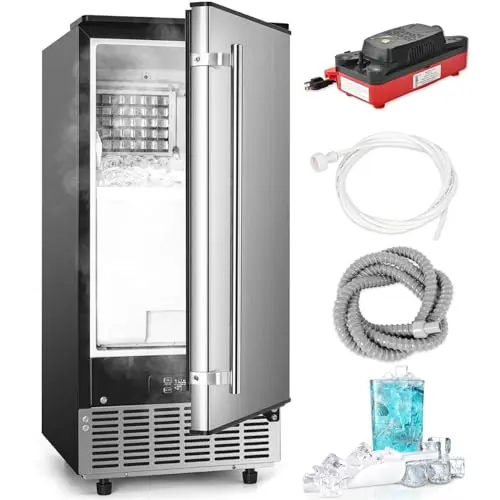
Under Counter Ice Maker with Drain Pump – No Floor Drain Required
A 15-inch-class stainless steel undercounter machine rated for 100 pounds of clear ice per day, with a 24-pound bin, cycle times in the 8-to-16-minute range, and an external electric drain pump that lets you place it without a floor drain. Three-layer insulation slows melt, and the door hinges on either side.
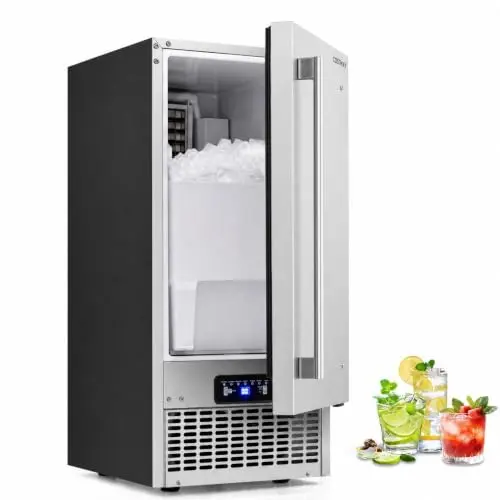
25962US-CYPE – 110 lb Output with Built-In Water Filtration
A 15-inch stainless undercounter unit rated for 110 pounds of ice per day, with a 25-pound bin, front-facing ventilation for true built-in placement, and a built-in water filter so it can run straight off a tap line. Three thickness presets and a 23-hour timer round it out.
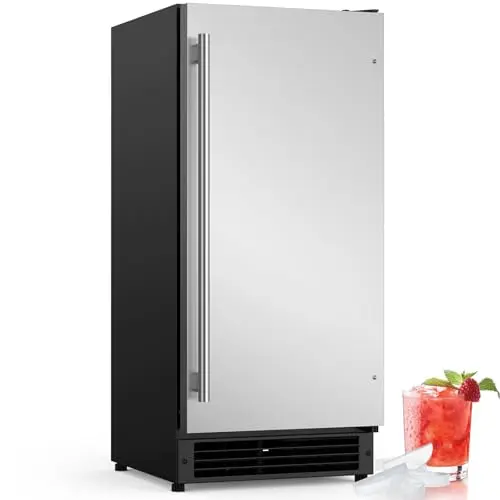
HXSeries – Truly Drainless Undercounter Install
A brushed stainless undercounter machine built around one idea: no drain plumbing at all. It holds a 22-pound bin between 26.6 and 32 degrees Fahrenheit, produces crescent-shaped cubes, and runs on a standard household circuit with an ETL listing behind it.

CIM010-0923 – Pump-Drained Output for Busy Households
A 15-inch stainless built-in or freestanding machine rated for 100 pounds of clear ice per day with a 24-pound bin and an electric drain pump. The LCD shows ambient temperature, cube thickness is adjustable, and a 24-hour timer handles scheduling.
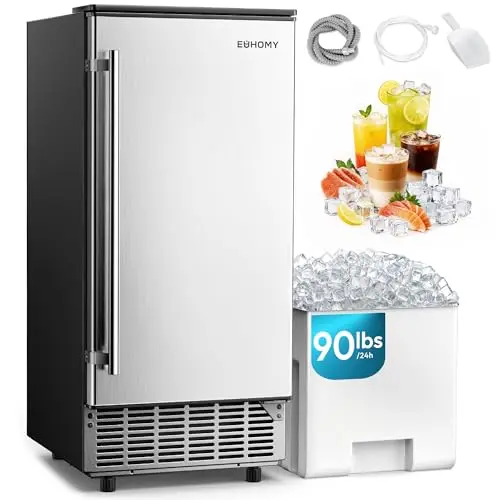
CIM002-0618 – Straightforward Gravity-Drain Workhorse
A 15-inch stainless machine rated for 90 pounds of ice per day with a 24-pound bin, three-layer insulation, and a gravity-drain setup. It runs on a standard household circuit with a self-cleaning cycle and a one-year manufacturer warranty.

CU50PA-1A – Crystal-Clear Gourmet Cube, Commercial Build
A commercial-grade undercounter machine built around Scotsman’s gourmet cube – crystal clear, slow melting, and odorless so it won’t dilute a drink. Pump drain with cord, stainless construction, a control panel that reports water condition, and approval for outdoor use.
How We Evaluated These Residential Undercounter Ice Makers
We didn’t run controlled kitchen lab tests or multi-month reliability trials on these machines. What we did: cross-referenced 6 undercounter ice maker models from 5 distinct brands across 7 decision axes – daily ice production, storage bin size, drainage method, cabinet dimensions and venting, power draw, control features, and reported noise. We triangulated published specifications, feature sets, and owner feedback where available, then mapped each option against a genuinely residential buyer profile: a standard 15-inch cutout, a normal household circuit, and usually no floor drain anywhere near the cabinet.
That last constraint did most of the sorting. Gravity-drain machines need a discharge point below the unit, which is easy in a bar with a floor sink and awkward in a kitchen island. Pump-assisted and drainless designs sidestep it entirely, and that reshaped how we weighted installation friction.
The scoring framework put real-world residential fit at 70% – how cleanly a machine installs, fits, and keeps up with a household – against feature differentiation at 30%, meaning the output, drainage engineering, and controls that actually separate one stainless box from another. We weighed published specs, audited cleaning and control features, and pressure-tested each model’s claimed production against its bin capacity. We have no commercial relationship with any brand here; recommendations track fit and differentiation, not brand preference. If you want the widest installation flexibility, the Icyglee under counter ice maker and its electric drain pump suits the most kitchen layouts. If daily output is the priority, the COSTWAY 25962US-CYPE leads the group.
How to Choose the Right Residential Undercounter Ice Maker
1. What Actually Makes an Ice Maker Residential-Grade
An undercounter ice maker earns the residential label through three practical constraints, not through marketing copy. The first is the 15-inch cutout – that’s the standard width for a built-in cabinet bay, and a machine even half an inch wider turns into a carpentry project. The second is a 115-volt household circuit. Most of these machines draw around 200 watts and plug into a normal outlet, though a genuine commercial chassis can require a dedicated 15-amp circuit.
The third is front-breathing ventilation. A built-in unit needs to pull air and shed heat from the front, because you’ve just boxed it in on three sides. Rear-venting machines wedged into a cabinet run hot, and that shortens compressor life. If drain plumbing simply isn’t available in your layout, the COTLIN HXSeries is the pick – it’s the only machine here that needs no drain at all.
2. Daily Output vs. Storage Bin: Sizing an Undercounter Ice Maker
Ignore the headline production number for a second. The daily production rating is a theoretical maximum measured under ideal conditions, and it tells you how fast the machine recovers after heavy use. The storage bin capacity tells you how much ice you actually have on hand at any moment, which is what your guests experience.
In practice, the machines here range from roughly 40 to 110 pounds a day with bins between 22 and 26 pounds. A household of two making iced coffee and the occasional cocktail rarely needs much of the low end. What the higher-output machines buy you is recovery speed during a party, and a bigger bin means less melt-back between uses. If you entertain hard, output plus bin size is the combination worth paying for; if you mostly make one drink at a time, bin size is the only number that matters.
3. Drainage Options: Drainless, Drain Pump, or Gravity
Gravity drain is the simplest and the most restrictive. Meltwater falls out of a hose that has to terminate below the machine’s drain port – easy over a floor sink, awkward in an island or a cabinet with a raised base.
An electric drain pump solves that by pushing water uphill to a sink base, standpipe, or remote drain, which opens up almost any placement. A drainless design goes further and removes the drain entirely, relying on how the machine manages melt internally. The tradeoff is usually lower daily production. If you have a discharge point nearby but no floor drain, the EUHOMY CIM010-0923 covers it with a pump.
4. Noise, Heat, and Where You Put the Machine
Every machine in this category uses a compressor, so expect an audible compressor hum during a freeze cycle and near-silence between them. Most of the 15-inch units here run quietly enough for an open-plan kitchen. A commercial chassis is another matter – the Scotsman CU50PA-1A is noticeably louder, and you’d want it away from a seating area.
Heat is the other factor. Ice makers dump warmth into the room, and a unit boxed into a tight cabinet with poor rear and side clearance runs hotter, produces less, and melts its own bin faster. Leave the clearance the manual asks for, and don’t put one in a hot garage unless the manufacturer explicitly approves outdoor or unconditioned use.
5. Ice Shape, Clarity, and What It Means in the Glass
A gourmet cube is clear, dense, and slow-melting – it chills a drink without dumping meltwater into it, which is why it’s the shape bartenders ask for. A crescent cube is softer-edged, molds around the glass, and melts a little faster but looks good in a highball. Standard cubes sit in between.
Clarity is a function of how the machine freezes and how it handles impurities, and it’s the main thing separating an expensive machine from a mid-priced one. For most home use, cube shape is a preference. For whiskey and stirred cocktails, it’s the whole point.
6. Icyglee vs COSTWAY: Two Reasonable Answers for a Home Bar
These two land at similar spots in the market but solve different problems. The Icyglee brings an electric drain pump, which means it can go where there’s water and power but no drain – the classic kitchen island or basement bar scenario. The COSTWAY brings more raw output along with a built-in water filter, but leans on gravity drainage, so it needs a discharge point below the cabinet.
Think of it as installation friction versus output-per-dollar. If routing a drain is a hassle, the pump wins and the output gap won’t matter in daily use. If a drain is already there and you want maximum ice plus filtered water without a separate cartridge, the COSTWAY 25962US-CYPE is the pick.
Frequently Asked Questions
1. Are residential undercounter ice makers just rebadged commercial machines?
Partly, and it’s worth knowing which is which. Several machines here are built on light-commercial chassis and marketed for home bars and cafes, which is fine – they’re designed for intermittent use and standard household power. A machine like the Scotsman CU50PA-1A is genuinely commercial: it’s approved for outdoor use, runs on a dedicated 15-amp circuit, and carries a build weight to match.
What matters for a home is the residential checklist – 15-inch width, 115-volt power, front ventilation, and a drain strategy that fits your cabinet. A commercial-rated machine can pass all of those; the label alone doesn’t decide it.
2. What's the difference between the Icyglee drain-pump model and the COTLIN drainless model?
Both sidestep a floor drain, but differently. The Icyglee uses an electric drain pump to push meltwater to a remote drain point, so you still need somewhere for that hose to go – it just doesn’t have to be below the machine. That lets it run at 100 pounds a day with a 24-pound bin, which is a lot of ice for a home.
The COTLIN removes the drain entirely with a drainless design. No hose, no pump, no slope. The tradeoff is output – around 42 pounds a day from a 22-pound bin – plus an ETL listing that makes it easy to trust in a residential install. If you want volume, go with the Icyglee under counter ice maker. If you want the simplest possible install, the COTLIN wins.
3. How does the COSTWAY 25962US-CYPE compare with the EUHOMY CIM010-0923?
The COSTWAY is the higher-output machine: 110 pounds a day, a 25-pound bin, a built-in water filter, and front ventilation built for true undercounter placement. Its limitation is drainage – it’s a gravity-drain unit, so the discharge hose needs to sit below the cabinet.
The EUHOMY CIM010-0923 trades a little output for an electric drain pump, which makes it the easier install if you don’t have a low drain point. Both run on standard household power and both self-clean. Choose the COSTWAY 25962US-CYPE if the drain is there and you want maximum ice; choose the EUHOMY if plumbing flexibility matters more.
4. Can a residential undercounter ice maker go outdoors or in a garage?
Only if the manufacturer approves it. The Scotsman CU50PA-1A is explicitly approved for outdoor use, which is unusual and makes it a legitimate patio-bar option. Most machines here are specified for indoor installation.
Garages are tricky for a different reason: ambient heat cuts production and accelerates melt in the bin, and some units shed warmth into the surrounding cabinet in ways that get worse in a warm room. If you’re set on an unconditioned space, check the spec sheet before you cut a hole in a counter.
5. How loud are these machines in a home kitchen?
All of these use a compressor, so there’s a freeze-cycle hum and a quieter stretch in between. The 15-inch stainless units here run quietly enough that normal conversation isn’t disrupted in an open kitchen, though individual tolerance varies a lot.
The Scotsman is the exception – it’s a commercial chassis and it sounds like one. If the machine sits next to a breakfast bar or under a counter where people gather, favor the quieter 15-inch units. If it lives in a butler’s pantry or a basement bar, noise stops being a real factor.
Final Verdict
For most homes, the Icyglee under counter ice maker is the answer. An electric drain pump removes the biggest obstacle to a residential install, and 100 pounds a day with a 24-pound bin means you stop rationing ice. If budget matters more than placement flexibility, the COSTWAY 25962US-CYPE gives you the highest output in the group plus built-in water filtration – as long as you can route a gravity drain. If there’s no drain to route at all, the COTLIN HXSeries is genuinely drainless and certified for the job; just accept the lower daily output. And if the cube in the glass is what you care about, the Scotsman CU50PA-1A is built for exactly that.
