
Best Semi-Automatic Espresso Machines With Grinder – 2026 Reviews

There’s a specific moment when home espresso stops being a novelty. The machine is warm, the portafilter is dry, the shot runs in roughly the right window, and it still tastes flat. Nine times out of ten the culprit isn’t the machine at all – it’s the grind, sitting in a bag since last Tuesday. That’s why a semi-automatic espresso machine with a grinder built into it changes the whole arithmetic.
Two things separate the good options in this category from the frustrating ones. The first is grind adjustability – not the raw setting count, but whether those steps are fine enough near the espresso end to dial in a new bag without wasting half of it. The second is thermal and pressure stability. A machine that runs cool or spikes mid-shot will make excellent beans taste sour or scorched, no matter how good your tamp was.
Semi-automatic is the sensible middle ground for anyone who wants to learn the craft without hand-pumping a lever. You own the dose, the tamp, and the grind; the pump handles the rest. We looked across the market, from compact entry-level units that grind and brew in a single footprint to full bean-to-cup setups costing several times as much, to work out where the real value sits at each tier.
Best Semi-Automatic Espresso Machines with Grinder – 2026 Reviews
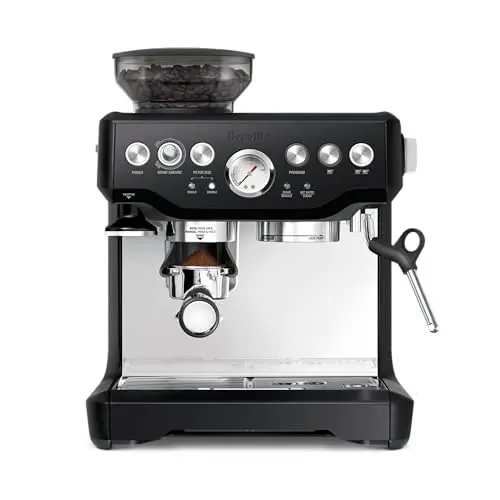
Barista Express BES870BTR – All-in-One Bean-to-Cup Benchmark
The Barista Express is the machine everything else in this category gets measured against, and the reputation holds. It grinds on demand straight into a 54mm portafilter, holds brew temperature with digital PID regulation, and opens every shot with a gentle pre-infusion ramp. The steam wand textures milk quickly, and the accessory kit covers the whole workflow out of the box.
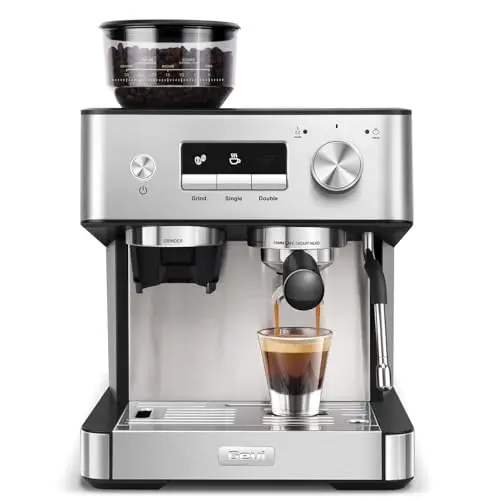
ECMI0-SS0A1 – Commercial-Size Portafilter Value
Gevi’s grinder-equipped model pairs a 20-bar Italian pump with a conical burr grinder offering 30 settings, then wraps it around a 58mm portafilter – a commercial-style size most machines below the premium tier skip entirely. NTC and PID temperature control handle stability, and both grind duration and shot volume are adjustable from one front panel.
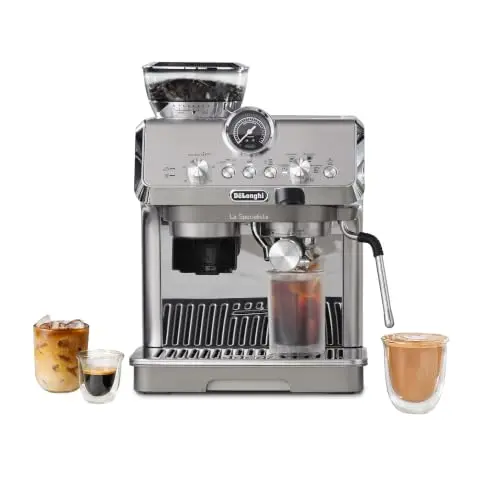
La Specialista Arte Evo EC9255M – Preset-Driven Milk and Cold Brew
La Specialista Arte Evo leans hard into convenience: four preset recipes, a commercial-style steam wand, and Cold Extraction Technology that turns out cold brew in minutes rather than hours. The built-in conical burr grinder offers eight grind settings, and Active Temperature Control lets you choose from three infusion temperatures to suit different roast levels.
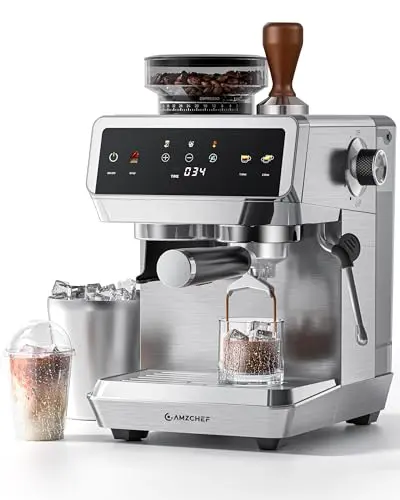
CM1626 – Widest Grind Range in the Lineup
The CM1626 packs an unusual amount of adjustability into a compact stainless body: 44 grind settings, brew temperature adjustable from 190°F to 201°F, a one-touch cold brew mode, and a touchscreen that shows grind time, brew time, and temperature simultaneously. A 60-ounce tank and a dedicated descaling function round out a machine built for daily use.
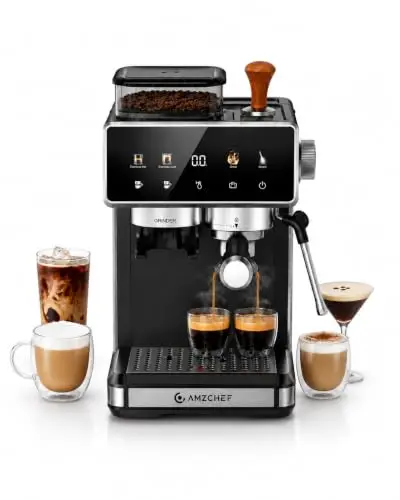
5560 – Compact Entry-Level Bean-to-Cup
The 5560 is the smallest and simplest machine here, and that’s entirely the point. A 20-bar pump, 20 grind settings, a steam wand, and three brew temperatures fit into a body barely wider than a sheet of paper. Adjustable pre-infusion from 3 to 10 seconds and a fast heating system make it a realistic weekday option.
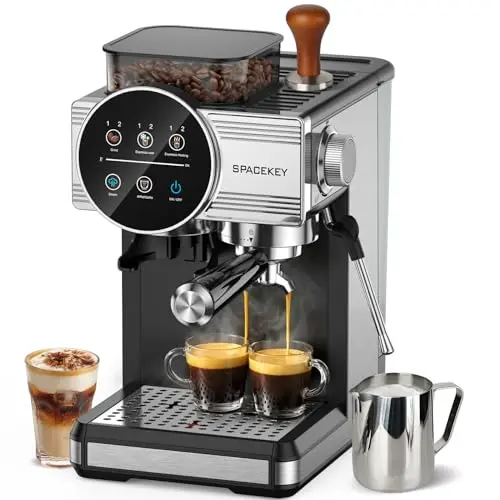
CM5510 – Pre-Infusion Control on a Budget
Spacekey’s CM5510 combines a 30-setting conical burr grinder with a 20-bar pump and PID-controlled heating, wrapped in a brushed stainless body with an LED display and a real-time heating indicator. The 61-ounce removable tank is the largest in this lineup, and the included wooden tamper and dosing ring signal a machine aimed at people who care about puck prep.
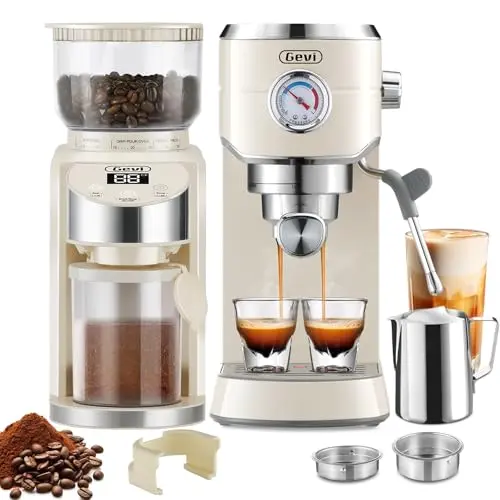
GECME418E + GECGI406 Grinder Set – Separate Grinder Flexibility
This Gevi set takes a different route entirely: rather than sealing a grinder inside the machine, you get a separate burr grinder alongside a 20-bar espresso maker. The grinder offers 35 settings with conical burrs, and the box covers a portafilter, filter baskets, tamper, frothing pitcher, two espresso glasses, and cleaning tools.
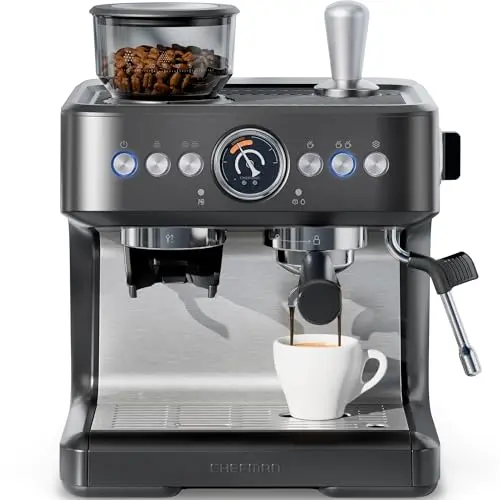
Crema Deluxe RJ54-G-SS-D-BLK – Dual Boiler on a Schedule
The Crema Deluxe’s headline is a dual boiler, which lets it brew espresso and steam milk at the same time rather than waiting for one job to finish before starting the other. Add a 30-setting conical burr grinder that dispenses into the portafilter, a 15-bar pump, adjustable shot temperature and volume, and a 3-liter removable reservoir.
How We Evaluated These Semi-Automatic Espresso Machines with Grinder
This review didn’t involve pulling hundreds of shots on a lab bench or measuring extraction yield with a refractometer. What it did involve: cross-referencing eight semi-automatic espresso machines with grinder setups from six distinct brands across six decision axes – grind adjustment range, brew pressure and temperature control, portafilter size, milk-steaming capability, reservoir capacity and footprint, and long-term reliability signal. We triangulated published specifications, manufacturer feature sets, aggregated owner feedback where available, and how each machine fits the actual morning routine of a home espresso buyer.
The scoring framework weighted real-world fit (70%) – how reliably a machine converts beans into repeatable espresso and milk drinks without excessive fuss – against feature differentiation (30%) – the specs that separate one option from the next, like a 58mm portafilter or a true dual boiler. We have no commercial relationship with any brand here; the ranking tracks fit and differentiation, not brand preference. If you want the benchmark bean-to-cup experience with manual control, the Barista Express is where to start. If you’d rather spend less and still get a commercial-size portafilter, the Gevi ECMI0-SS0A1 gets you most of the way there.
Where feedback was thin or absent on a newer model, we scored on published specs and feature set alone, and flagged it in that machine’s write-up.
How to Choose the Right Semi-Automatic Espresso Machine with Grinder
1. Semi-Automatic vs Automatic: What You're Actually Signing Up For
A semi-automatic espresso machine gives you the grind, the dose, and the tamp – then handles water delivery and pressure on its own. That’s the entire bargain. You get meaningful control over the variables that actually change flavor, without hand-pumping a lever or babysitting a boiler all morning.
Automatic machines take the tamp out of your hands too, and the trade-off is that you inherit their opinion of what a shot should taste like. Manual machines hand you everything, including the parts most people would rather not think about at 6am. If you’re unsure which side of that line you sit on, ask whether you’d rather learn to dial in a grind or press one button. Most buyers in this category land on the learning side – the machine is the hobby. Dose control, puck prep, and grind adjustment are the three skills you’ll actually develop.
2. Why a Built-In Grinder Changes the Whole Workflow
Freshly ground coffee isn’t a preference, it’s a requirement. Pre-ground espresso sheds enough aromatics within a week that no amount of technique brings them back, which is why the grinder is the single most consequential part of this purchase.
A built-in conical burr grinder also collapses the workflow. You grind into the portafilter, tamp, and lock in – no transfer funnel, no spilled grounds, no second appliance eating counter space. The trade-off is that the grinder is now part of the machine’s lifespan; if it fails, the whole unit goes with it. A few models here sidestep that by bundling a standalone burr grinder alongside the espresso maker instead. That route costs counter space but lets you keep and upgrade the grinder independently, which is worth thinking about if you plan to own this setup for a decade.
3. Grind Settings, Burrs, and Portafilter Size: Reading the Spec Sheet
Grind setting counts get marketed hard, and the number matters less than the granularity of the steps in the espresso range. Thirty settings spread evenly across the whole spectrum is less useful than twenty that cluster tightly where espresso lives. More steps generally helps with dialing in, but burr quality and adjustment precision matter more than the raw count.
Portafilter diameter is the spec that quietly shapes everything else. A 58mm portafilter is the café standard – deeper pucks, more forgiving extraction, and a wide aftermarket of baskets and tampers. Smaller 51mm portafilters work perfectly well but leave fewer upgrade paths. If you like tinkering, that single difference can decide the purchase.
4. Pressure, Temperature, and Pre-Infusion: The Stability Triangle
Nine bar at the group head is the espresso benchmark, and most machines in this category advertise 15 or 20 bar at the pump. That isn’t a contradiction – the pump figure describes peak capability, while extraction happens at a regulated lower pressure. Pre-infusion is the more useful spec: a gentle low-pressure wetting phase before full extraction saturates the puck more evenly and forgives small inconsistencies in prep.
Temperature stability is where cheaper machines give themselves away. PID control holds the brew boiler inside a tight band, while machines without it drift between the first and third shot of a session. Adjustable brew temperature is a genuine bonus – it hands you a second dial for correcting sour or bitter shots beyond grind, and it earns its keep if you rotate roast levels.
5. Matching a Semi-Automatic Espresso Machine with Grinder to Your Routine
One espresso before work and four lattes on a Sunday ask different things of a machine. If speed matters most, look at heat-up time and whether it lets you steam while brewing. A dual boiler design that runs both functions simultaneously will halve your time on back-to-back milk drinks. If you mostly pull straight shots, that capability is money you don’t need to spend.
Counter depth is the unglamorous constraint. Compact units under a foot wide fit beneath upper cabinets next to the kettle; full-size machines with big reservoirs need their own zone. If space is tight and you drink mostly milk drinks, the AMZCHEF 5560 is the pick – it’s the smallest machine here and still pulls a properly pre-infused shot. If simultaneous brewing and steaming is the priority, the Crema Deluxe is built around exactly that.
6. Budget, Mid-Range, and Premium: What Each Tier Buys You
At the entry tier you get a working grinder, a usable steam wand, and adjustable shot volume – sometimes pre-infusion too. What you generally don’t get is a wide grind range, a commercial-size portafilter, or much thermal mass. The AMZCHEF CM1626 is the exception worth knowing about, because its grind range and temperature control read like a machine from a tier above.
Mid-range is where 58mm portafilters, PID control, and better build quality converge. Premium buys tighter tolerances, longer service life, more presets, and generally better steaming. Past the mid tier, price stops tracking quality closely – what you’re paying for at the top is consistency and a brand willing to stand behind it.
Frequently Asked Questions
1. What's the difference between the Breville Barista Express and the De'Longhi La Specialista Arte Evo?
They solve the same problem from opposite directions. The Barista Express hands you a wide grind dial, a 54mm portafilter, and a workflow built around manual dosing – it rewards attention. The La Specialista Arte Evo leans on presets: four recipes, three infusion temperatures, and a Cold Extraction mode that produces cold brew in minutes. It also offers far fewer grind steps, eight against a much broader range on the Breville.
Choose the La Specialista Arte Evo if you want consistent milk drinks and fast cold brew with less dialing in. Choose the Breville if you want to learn the craft and intend to chase better shots over months rather than days.
2. Is the Gevi ECMI0-SS0A1 a real alternative to the Breville Barista Express?
For plenty of buyers, yes. The Gevi ECMI0-SS0A1 uses a 58mm portafilter – larger than the Breville’s 54mm – alongside a 30-setting conical burr grinder and NTC/PID temperature control. Where it gives ground is long-term durability signal and the depth of the accessory ecosystem. If you want the widest upgrade path for baskets and tampers at a mid-tier spend, the Gevi ECMI0-SS0A1 is the smarter buy. If you want the most documented, best-supported machine in the category, stay with the Breville.
3. How many grind settings do I actually need on a semi-automatic espresso machine with grinder?
Enough resolution in the espresso range to shift a shot by a couple of seconds. In practice that lands somewhere between 20 and 45 steps – but where those steps sit matters more than the total. A 30-setting grinder concentrated near the fine end will outperform a wider range spread evenly across the spectrum. Stepless or near-stepless adjustment is the ideal if you can find it. For reference, eight settings is workable but leaves little room when a bag fights back, while 44 settings gives you real latitude to experiment.
4. Do all semi-automatic espresso machines with grinder have the grinder built in?
No, and the distinction is worth understanding before you buy. Most machines in this category integrate a conical burr grinder directly above the portafilter cradle, which keeps the workflow tight and saves counter space. A few bundle a standalone burr grinder with a conventional espresso machine instead – that’s the approach the Gevi GECME418E set takes. You give up counter space and gain flexibility: the grinder can be serviced, replaced, or upgraded on its own, and it can double for filter or pour-over duty.
5. Are 20-bar espresso machines meaningfully better than 15-bar ones?
Less than the marketing implies. Espresso extracts at roughly 9 bar at the group head; the 15- or 20-bar figure describes pump capability, not what reaches your coffee. A 20-bar pump can indicate a machine built with more headroom, but it won’t improve flavor on its own. Pre-infusion, temperature stability, and grind quality do far more for the cup than a higher pump rating.
6. How much maintenance does a semi-automatic espresso machine with grinder need?
More than a pod machine, less than a hobby project. Daily: knock out the puck, flush the group head, and wipe the steam wand immediately after texturing milk. Weekly: backflush if the machine supports it, rinse the drip tray, and brush out the grinder chute so stale grounds don’t build up. Monthly to quarterly: run a descaling cycle if your water is hard – several machines here include a dedicated function, and a removable water tank makes the job manageable.
The grinder is the part people neglect. Burrs accumulate oils, and a cleaning brush plus a few grams of grinder cleaner every couple of months keeps retention low and flavor clean.
Final Verdict
For most people, the Barista Express is the answer. It grinds on demand, holds temperature with PID regulation, pre-infuses gently, and gives you a steam wand with real authority – the full bean-to-cup workflow with manual control exactly where it counts. You pay premium money for it, and you earn better shots as your technique sharpens.
If that’s more machine than you want to fund, the Gevi ECMI0-SS0A1 is the value argument: a 58mm portafilter, 30 grind settings, and PID control at a mid-tier outlay. Want the smallest footprint and the most forgiving first machine? The AMZCHEF 5560 is the pick. And if milk drinks plus fast cold brew are the entire point, the La Specialista Arte Evo is purpose-built for it.
