
Best Shoe Racks For Small Spaces – 2026 Reviews

There’s a particular kind of chaos that only shows up in a small apartment: the shoe pile by the door that somehow grows a second layer overnight. A full-width rack can eat the exact floor space you need for, well, walking. That’s why the useful options in this category are the ones that think vertically, expand to fit odd walls, or get shoes off the floor entirely.
The two axes that separate a good small-space shoe rack from a frustrating one are footprint and daily access. A tall narrow rack can hold a lot, but only if it stays stable and doesn’t turn into a game of Jenga every morning. An expandable or over-the-door option solves a different problem: it fits the weird gap you actually have, not the gap a product photo imagined.
We compared shoe racks across major brands with those tradeoffs in mind, from tall fabric tiers to metal expandables and door-mounted organizers. The goal is simple: help you pick the right small-space shoe rack for your entryway, closet, dorm, or rental, not just the one with the biggest capacity claim.
Best Shoe Racks for Small Spaces – 2026 Reviews

10-Tier Tall Shoe Rack – Narrow Entryway Capacity with Hooks
A tall, narrow 10-tier rack built to turn a sliver of floor into serious shoe storage. The non-woven fabric tiers and metal frame keep the footprint small, and the included hooks add a spot for keys or an umbrella near the door.
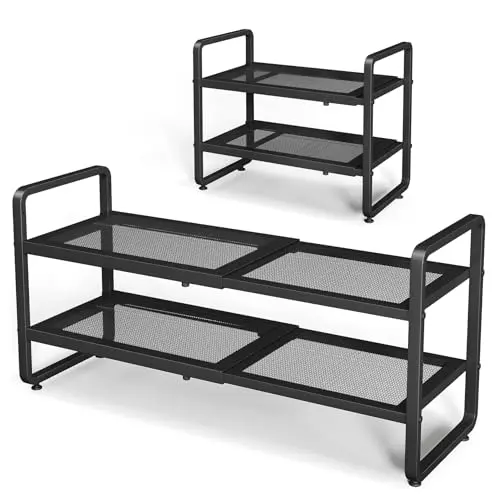
Expandable 2-Tier Metal Shoe Rack – Adjustable Width for Awkward Corners
A two-tier metal rack that expands sideways and adjusts in height, which makes it unusually good at fitting awkward corners, rental closets, and gaps between furniture.

Over-the-Door Shoe Organizer – 10 Tiers of Zero-Floor Storage
An over-the-door organizer with ten tiers of clear pockets, designed for apartments and closets where floor space is already spoken for.

Expandable 3-Tier Metal Rack – Heavy-Duty Width for Tight Spots
A three-tier iron rack with expandable width and a heavy-duty frame, aimed at narrow hallways and entryways that need more capacity than a basic two-tier stand.
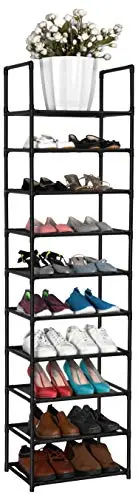
10-Tier Shoe Rack – Tall Narrow Storage That Splits in Two
A ten-tier tall rack with a very small footprint, made from fabric tiers and metal pipes. It can be split into two shorter racks for flexible placement.
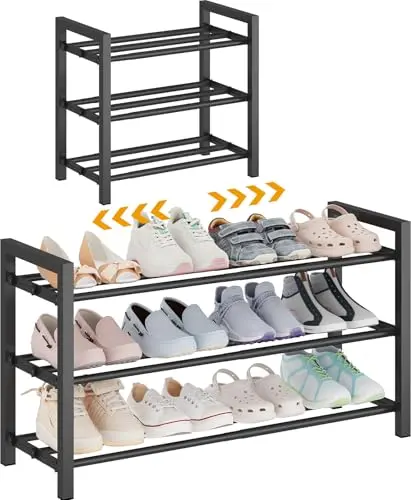
Expandable 3-Tier Steel Rack – Tool-Free Fit for Narrow Hallways
A three-tier steel rack that expands from a compact width to a wider one, with snap-together assembly and a heavy-duty frame for narrow hallways.

4-Tier Extra-Small Rack – Compact Storage for Kids and Adults
A four-tier extra-small rack designed for tight corners, kids’ rooms, and entryways where a full-size shoe shelf would be overkill.
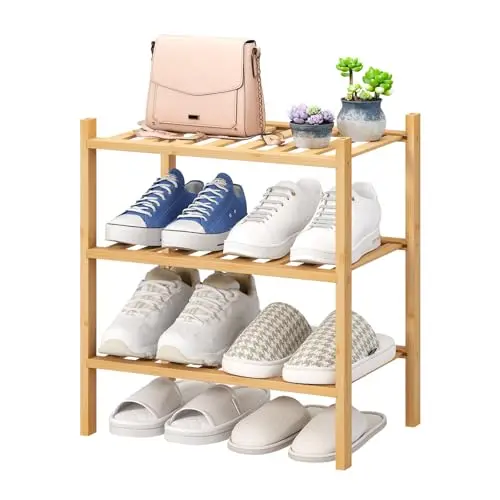
3-Tier Bamboo Shoe Shelf – Small-Space Storage That Looks Like Furniture
A small bamboo shoe shelf that looks more like furniture than utility storage. It’s stackable and has a removable row for taller boots.

3-Tier Fabric Shoe Rack – Budget-Friendly Stackable Storage
A budget-friendly three-tier fabric rack with wide shelves, stackable tiers, and a tool-free setup that works in closets, entryways, and dorms.
How We Evaluated These Shoe Racks for Small Spaces
We didn’t install these racks in a dozen apartments or run load-bearing lab tests. What we did: cross-referenced nine shoe racks from nine distinct brands across six decision axes – footprint, capacity, stability, assembly, adjustability, and material care. We triangulated published specifications, feature sets, and owner feedback where available, then mapped each option to the small-space scenarios buyers actually face: narrow entryways, closet floors, rentals, dorm rooms, and door-only storage. We also audited the practical details that show up in daily use, like whether a rack can split into two pieces, whether shelves grip heels, and whether assembly requires tools.
The scoring framework weighted real-world fit (70%) – how well a rack uses a tight footprint while keeping shoes accessible – against feature differentiation (30%) – expandability, stackability, material upgrades, and use-case-specific design. We have no commercial relationship with any brand here; recommendations track fit and differentiation, not brand preference. If your entryway is a narrow slice of wall, the LANTEFUL 10-Tier Tall Shoe Rack is the natural place to start. If your space is irregular or you need boot-friendly adjustability, the SNTD Expandable 2-Tier Metal Shoe Rack is the better route.
We didn’t physically test every rack with a full shoe collection, and we can’t promise a fabric-tier rack will feel as solid as a welded metal frame. What we can do is show where each design is strongest, where it compromises, and which small-space shoe rack is worth your floor space.
How to Choose the Right Shoe Racks for Small Spaces
1. How to Measure a Small Space Before Buying a Shoe Rack
Start with the gap you actually have, not the capacity number on the box. Measure width, depth, and height at the tightest point, then check door swing and vertical clearance so a tall rack doesn’t block a closet or hit a shelf. A rack that fits the floor but leaves no room to open a door is not a small-space solution.
Also think about the shoes you store most: bulky boots need a removable tier or adjustable shelf, while flats and sneakers work on tighter spacing. If you’re renting, choose a freestanding or over-the-door design that won’t require drilling.
2. Vertical Racks vs. Over-the-Door Storage for Small Spaces
Tall narrow racks win when you have a sliver of floor but plenty of vertical room; they keep shoes visible and use height that would otherwise be wasted. Over-the-door organizers are the better call when floor space is truly zero, because they keep everything behind a door and off the ground. The tradeoff is access: a tall rack is easier for daily shoes, while a door organizer hides clutter but can feel less convenient for heavy boots.
If your closet door is the only free surface, the UVIAHOMI Over-the-Door Shoe Organizer is the pick here. It uses a zero floor footprint and clear pockets, though you’ll want to check door thickness before buying.
3. When Expandable Shoe Racks Make Sense in Tight Rooms
Expandable width is the quiet hero of awkward spaces. A rack that starts compact and extends to fit a hallway, closet, or gap between furniture can solve a fit problem that fixed-width racks can’t. Look at the minimum and maximum extension, plus depth clearance, because a rack that fits side-to-side can still stick out too far.
If you need a metal frame that adjusts to an irregular gap, the SNTD Expandable 2-Tier Metal Shoe Rack is a strong small-space fit. It also adjusts in height for boots, which is rare at this size.
4. Stability, Assembly, and Daily Usability
Tall fabric-tier racks are light and affordable, but they can wobble when full, so put heavier shoes on lower tiers and use a wall anchor if the rack sits in a high-traffic area. Tool-free assembly is worth prioritizing in rentals and dorms, and a stackable design gives you room to grow without buying a wider rack.
If you want a heavier metal frame with more capacity, the HDDTTZ Expandable 3-Tier Metal Rack is the sturdier route. Just check that the wider extension still clears your doorway.
5. Materials and Care for a Small-Space Shoe Rack
Non-woven fabric shelves are light, inexpensive, and easy to wipe, but they won’t feel as solid as metal or bamboo. Powder-coated metal is the most durable choice for heavy shoes and muddy entryways, while bamboo brings a furniture-like look that suits visible hallways. Whichever you choose, look for a wipe-clean surface and avoid piling wet shoes on fabric tiers.
In a small space, maintenance matters more because the rack is usually visible. A quick wipe-down and a little breathing room around the frame go a long way.
Frequently Asked Questions
1. What's the difference between the LANTEFUL 10-Tier and FIDUCIAL HOME 10-Tier shoe racks?
Both are tall, narrow 10-tier racks aimed at the same closet-corner problem. The LANTEFUL version adds five hanging hooks and an 18-month warranty, and its 10-inch depth is slightly easier to tuck into a tight entryway. The FIDUCIAL HOME rack is similar in height and capacity, but it has a lighter-duty frame and fewer extras. If you want the more polished daily-use pick, the LANTEFUL 10-Tier Tall Shoe Rack is the better fit; if you just need basic vertical storage, the FIDUCIAL HOME model can work.
2. How does the SNTD expandable rack compare with the HDDTTZ expandable rack?
The two-tier SNTD rack is the better pick for heels and boots: its mesh shelves grip thin heels, and the height adjusts for taller footwear. The three-tier HDDTTZ rack gives you more shelf space and a heavier 150-pound frame, but it’s less specialized for heel grip. Choose the SNTD for adjustability and boot duty; choose the HDDTTZ for capacity and a more industrial build.
3. Are over-the-door shoe organizers a good fit for small apartments?
Yes, especially when floor space is the real constraint. An over-the-door organizer gives you a zero floor footprint and can hold a family’s shoes on the back of a closet or entryway door. Check door thickness and the weight rating before you load it up; heavier boots are better on a floor rack. The UVIAHOMI Over-the-Door Shoe Organizer is the best example here, with clear pockets and a breathable fabric build.
4. How many pairs should I expect a shoe rack for a small space to hold?
It depends on tier count and shelf width. A compact three-tier rack may hold six to eight pairs, while a 10-tier narrow rack can hold around 20 to 25 pairs if you’re willing to go vertical. Over-the-door organizers often hold the most because each pocket takes a pair or two. Don’t assume every shelf fits bulky boots; removable tiers help.
5. Do expandable shoe racks actually fit narrow closets?
Often, yes – but only if you measure both the minimum width and the maximum extension. A rack that fits at its smallest can become too wide for a hallway once extended, and depth clearance matters just as much. Expandable metal racks with adjustable feet are the most forgiving in irregular closets and older apartments with uneven floors.
Final Verdict
For most small spaces, the LANTEFUL 10-Tier Tall Shoe Rack is the best overall answer: it turns a narrow slice of floor into room for roughly a family’s everyday shoes, and the hooks make it feel like a real entryway piece rather than a bare shelf. If your gap is irregular or you need boot-friendly height, the SNTD Expandable 2-Tier Metal Shoe Rack is the more flexible metal pick. For zero floor space, go with the UVIAHOMI Over-the-Door Shoe Organizer; it holds a lot without asking you to give up a single square foot. And if you’re furnishing a dorm or rental on a tight budget, the Kitsure 3-Tier Fabric Shoe Rack covers the basics without much risk. The right small-space shoe rack is the one that matches your actual gap, not the one with the biggest capacity claim.
