
Best Shower Curtain Rails – 2026 Reviews

A shower curtain rail is usually bought in a hurry, the day the old one finally gives out, and then lived with for years. That’s the unfortunate part, because the difference between a rail that stays put and one that sags, slips, or starts rusting at the joints comes down to a handful of specs you can check in about five minutes.
The first fork is mounting style. A tension rail wedges between two walls on spring pressure and comes down without a mark; a wall-mounted rail bolts into brackets and handles far more weight, which is why curved versions live there. The second is span – rails have a minimum as well as a maximum, and buying one whose shortest length won’t fit your opening is the most common way this purchase goes wrong. Load rating, tube thickness, and how the finish holds up to steam do the rest of the work.
Below we’ve mapped the rails worth considering across brands and price tiers, from a compact pick for tight stalls to a curved model that buys you real elbow room. Start with your measurement and your wall surface; the right answer tends to fall out from there.
Best Shower Curtain Rails – 2026 Reviews
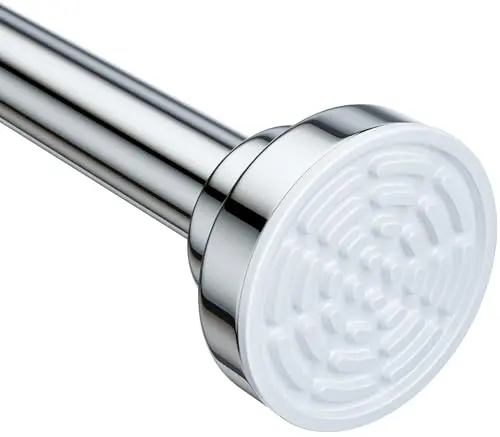
32-80 Inch Tension Rod – Wide-Range All-Rounder
A no-drill spring tension rail with a 32 to 80 inch adjustable span, a 1-inch stainless tube, and oversized rubber pads at each end. It’s designed to sit on tile, painted walls, wallpaper, and wood frames without leaving marks.
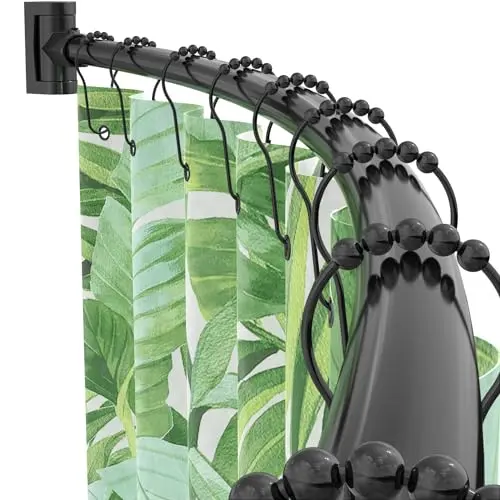
Curved Wall-Mount Rod – Extra Elbow Room
A bowed rail that sweeps outward around the tub to add usable room inside the shower rather than pressing the curtain against your shoulders. It wall-mounts with brackets that rotate to match uneven wall angles, and the aluminum tube is finished in matte black.

Industrial Tension Rod – Brushed Nickel Heavyweight
A heavy-gauge 304 stainless tension rail with a 1-inch tube and extra-large non-slip plates at each end. The 43 to 72 inch span and industrial brushed finish suit wide alcoves and open-plan bathrooms.
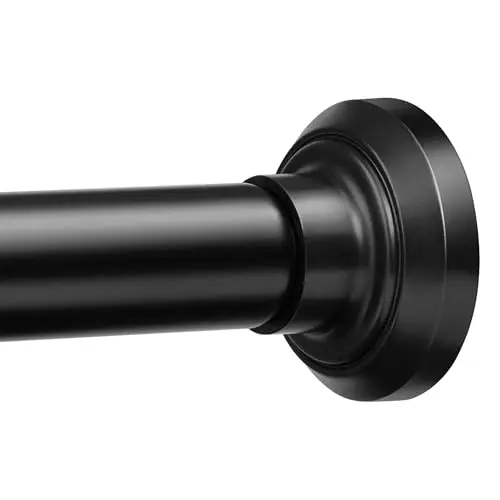
30-76 Inch Tension Rod – No-Frills Budget Pick
A budget tension rail built from a telescoping main rod plus splice sections, giving 30 to 76 inches of coverage with no tools required. Matte black stainless steel and non-slip end caps keep it looking and holding better than the tier suggests.

24-36 Inch Tension Rod – Small-Space Specialist
A short-span tension rail for tight stalls, powder rooms, and narrow windows, with a 1-inch metal rod, solid finials, and a warm gold plating that leans champagne bronze. It installs with no tools and no drilling.
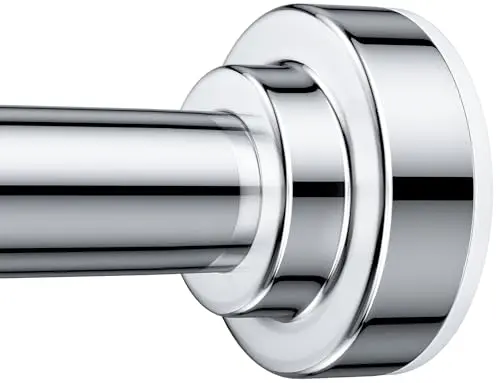
32-80 Inch Spring Tension Rod – Simple and Steady
A plain, well-executed spring tension rail covering 32 to 80 inches with a 1-inch stainless tube and large rubber ends. It installs in minutes without tools and doubles as a window or doorway rod.

5-Piece Splice Rod – Long-Reach Value
A five-piece sectional rail you build to length between 32 and 80 inches, finished in matte black stainless steel. Two curtain rod holders are included to add mid-span support, and the spring tension means no drilling.
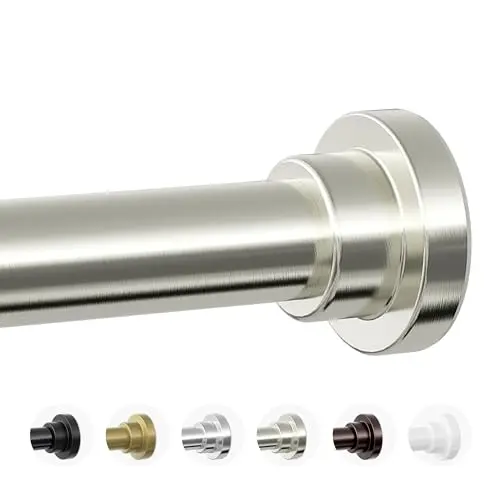
1-Inch Tension Rod – Brushed Nickel Mid-Range
A 28 to 74 inch tension rail with a 1-inch stainless tube, thick steel connectors, and a textured non-slip base at each end. The narrower starting length suits tighter bathrooms and shower stalls.

34-82 Inch Gold Tension Rod – Statement Finish
The longest reach in this group at 34 to 82 inches, built from five sections with a coated gold finish and 1.85-inch anti-slip rubber finials. It installs without drilling and comes with a spare rod section.
How We Evaluated These Shower Curtain Rails
We didn’t hang these rails in a steamy bathroom for a year and check them monthly. What we did: cross-referenced 9 shower curtain rail models from 9 distinct brands across six decision axes – adjustable span, stated load rating, tube material and wall thickness, mounting type, wall-surface compatibility, and finish durability claims. We triangulated published specifications with aggregated owner feedback where available, then mapped each rail against the bathrooms it would realistically suit.
The scoring framework weighted real-world fit (70%) – does the rail cover your opening, hold your curtain, and stay where you put it – against feature differentiation (30%) – the things that genuinely separate one rail from another, like a curved sweep, a splice-based length system, or a larger rubber contact patch. We have no commercial relationship with any of the brands featured; the ranking tracks fit and differentiation, not brand preference. If your opening is a standard alcove, the Ausemku 32-80 Inch Tension Rod is the straightforward answer; if you want more shoulder room, the PrettyHome Curved Rod is the one to look at.
One caveat worth stating plainly: load ratings are manufacturer figures, not results from a pull-test rig, and never-rust claims stay marketing until enough long-term feedback accumulates to confirm or contradict them. Where owner reports consistently pointed to a specific weakness – slipping on gloss tile, rust at the joints, sagging mid-span – we treated it as a real limitation rather than an outlier.
How to Choose the Right Shower Curtain Rail
1. Tension Rod vs Wall-Mounted Shower Curtain Rail
A tension rail wedges between two walls using spring pressure. Nothing gets drilled, nothing gets patched, and you can take it with you when you move. A wall-mounted rail bolts brackets into the wall and carries considerably more weight, which is why curved designs almost always live in that camp.
For rentals, tiled bathrooms you’d rather not puncture, or a curtain that isn’t unusually heavy, tension is the default answer. Wall-mounted earns its keep when the opening is wide, the load is substantial, or you want the rail to bow outward. The PrettyHome Curved Rod is the clearest example: it buys real elbow room, and it does it with brackets rather than springs.
2. Measure the Opening, Then Check the Span Twice
Measure wall to wall at the height you want the rail, then check that number against both ends of the product’s listed range. Tension rails need to sit inside their span with a little compression left over; a rod that’s already maxed out has no spring force holding it. This single step prevents most of the disappointment in this category.
Short openings are the awkward zone. Most rails here start around 30 inches, so a 26-inch stall or a narrow window leaves long models sitting on the shelf. The Ivilon 24-36 Inch Tension Rod exists for exactly that gap, and its shorter span is also why it holds so steadily.
3. Load Rating, Tube Thickness, and What Actually Holds
Stated capacities across this category run from 22 pounds to 80 pounds, and the number tracks mounting type more than marketing. Tension rails cluster around 22 to 35 pounds; drilled rails go much higher. A wet fabric curtain plus a liner is heavier than most people assume, so leave headroom rather than buying to the limit.
Tube wall thickness matters as much as diameter. A 1-inch tube with a thin wall flexes and sags mid-span, while a thicker wall holds its line. Just as important is the size of the rubber contact patch – large pads spread pressure and resist creeping, small ones concentrate force and mark softer walls.
4. Rust, Finish, and Humid Bathrooms: Reading Between the Claims
Every rail in this category claims rust resistance, and several claim it never happens at all. Treat that as a marketing phrase rather than a standard. Stainless steel grades, plating thickness, and coating quality vary widely, and the place rust usually appears first is the joints and connectors, not the long tube in the middle.
Dark coated finishes hide water spots better than polished chrome; plated gold finishes look warmer but show wear at the edges. Whatever you choose, wipe the rail down occasionally and dry the ends after cleaning – that does more for longevity than any coating claim.
5. No-Drill Shower Curtain Rails and the Walls They Actually Grip
Rubber pads grip best on smooth, non-porous surfaces: glazed tile, glass, sealed paint, and metal. They struggle on wallpaper, fresh paint, textured plaster, and uneven grout lines, where the pad only touches the high points. If your wall falls into the second group, a drilled bracket is the honest answer.
Equally important is not over-tightening. Cranking a tension rail to its absolute limit can crack a tile or bow drywall, and it doesn’t hold any better than a firm, properly seated fit. Extend, seat, twist until snug, then stop.
6. Ausemku vs TEECK: Two Takes on the 32-80 Inch Tension Rail
These two occupy almost identical territory: same span, same 1-inch stainless tube, same no-drill approach. The split comes down to detail. Ausemku lists a 30 lb capacity with 2-inch rubber pads and a claim of working on rough and smooth surfaces alike. TEECK lists 30 lb in its overview but 22 lb in the spec table – check that before you hang a heavy liner.
Ausemku edges ahead on finish options and overall reception; the TEECK 32-80 Inch Spring Tension Rod is the quieter, cheaper-feeling pick that gets the basics right. Neither will disappoint in a standard alcove, but only one gives you margin on the weight.
Frequently Asked Questions
1. Do tension shower curtain rails really hold without drilling?
Yes, within limits. A tension rail holds through spring pressure and friction, so its grip depends on three things: the span being inside the rail’s range with compression left over, the wall being smooth enough for the pads to bite, and the load staying under the stated rating.
Where they fail is predictable – gloss tile that’s slightly damp, textured plaster, and rails extended to their maximum. If you need serious holding power from a no-drill rail, look for a thick tube and large contact plates; the BRIOFOX Industrial Tension Rod is built around exactly that idea.
2. What's the difference between the Ausemku tension rod and the PrettyHome curved rod?
They solve different problems. The Ausemku rail is no-drill tension, spans 32 to 80 inches, and carries around 30 pounds – a general-purpose pick for a standard alcove. The PrettyHome model is wall-mounted and curved, spans 38 to 72 inches, and carries up to 80 pounds while bowing outward to add roughly a foot of interior room.
Choose the curved rail if shoulder room is your complaint and you can drill. Choose the tension rail if you rent, have tile you’d rather not puncture, or simply want the rail up in five minutes.
3. How does the CorkLatta splice rail compare with the ENJOYBASICS tension rod?
Both are budget tension rails, but they get there differently. CorkLatta uses a five-piece sectional build you assemble to the exact length you need, plus two holders for mid-span support. ENJOYBASICS pairs a telescoping main rod with four splice sections, landing between 30 and 76 inches.
The practical difference is adjustability. Sectional systems are more adaptable but harder to land on an exact measurement, and every joint is a potential flex point. If you want the simplest install at this tier, the ENJOYBASICS 30-76 Inch Tension Rod is the more forgiving of the two.
4. Will a tension rail damage tile, paint, or wallpaper?
Usually not, if it’s installed sensibly. The rubber pads are designed to grip without scratching, and most marks come from over-tightening rather than normal use. On fresh paint, give the wall a few weeks to cure before pressing a pad against it, and remove the rail slowly rather than letting it snap free.
Wallpaper and textured plaster are the risky surfaces – the pad can’t make full contact, so you end up tightening further to compensate. That’s the scenario where a drilled bracket is the safer call.
5. Can a shower curtain rail double as a window or closet rod?
Often, yes. Most tension rails in this category list multi-purpose use for windows, doorways, closets, and room dividers, and the mechanism is identical. What changes is the humidity exposure – a rail that spends its life in a bathroom faces far more moisture than one in a closet, so rust resistance matters less in dry rooms.
For small windows specifically, check the minimum span first. The Ivilon 24-36 Inch Tension Rod is the one that fits narrow frames most rails overshoot.
Final Verdict
For most bathrooms, the Ausemku 32-80 Inch Tension Rod is the answer – it covers the widest range of openings without drilling, holds a heavy curtain plus liner, and doesn’t leave a mark when you move out. If budget is the deciding factor, the ENJOYBASICS 30-76 Inch Tension Rod gets you a similar no-drill setup for less, with the caveat that its long-term rust story is shakier.
A tight stall or powder room? The Ivilon 24-36 Inch Tension Rod is the only rail here built for a genuinely short span. And if the complaint is shoulder room rather than anything else, the PrettyHome Curved Rod is worth picking up the drill for. Start with the measurement, then let the wall decide the mounting type.
