
Best Shower Head Filters For Well Water – 2026 Reviews

If you’re on a private well, you know the tells. The orange ring around the drain. The sulfur smell that greets you on a hot morning. A spray that starts strong in March and turns into a dribble by August. Municipal water gets treated and tested; well water gets whatever the aquifer hands you, which usually means sediment, iron, manganese, hardness minerals, and sometimes hydrogen sulfide.
A shower head filter can’t turn a well into city water, but it can pull a lot of that out before it reaches your skin and your spray face. Two things separate the good options from the shelf filler: filtration media chemistry and pressure retention. A deep media stack that chokes your flow is a bad trade, and a free-flowing filter that only touches chlorine won’t do much on a well.
The picks below span fixed heads, handhelds, and inline canisters, because the right answer depends on whether you’re replacing the shower head or keeping the one you’ve got. Here’s how they sort out for well-water households.
Best Shower Head Filters for Well Water – 2026 Reviews
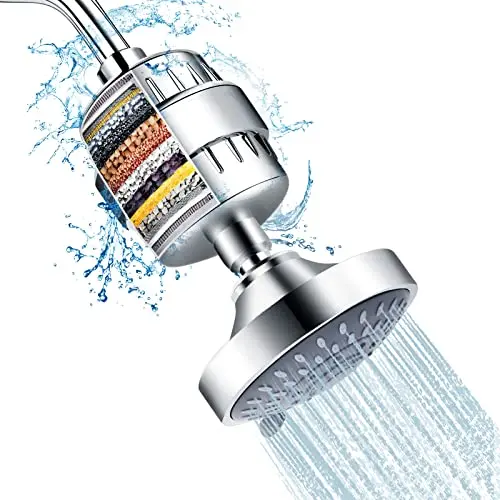
Filtered Shower Head Combo – 15-Stage Filtration for Well Water
A two-piece combo: a 15-stage filter canister and a 4-inch fixed shower head with five spray settings. The cartridge handles chlorine, heavy metals, and sediment before water reaches the spray face, and the chrome-plated ABS body stays light enough for any standard shower arm.
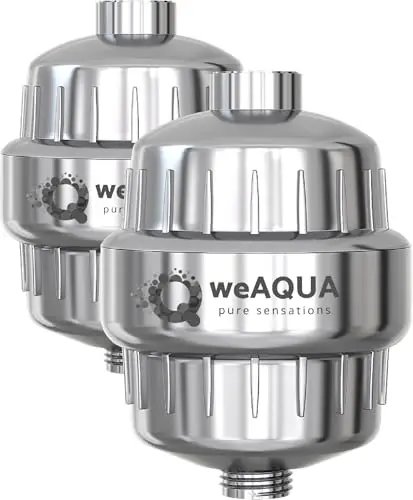
Heavy Duty 2-Pack Shower Filter – Real Media, Zero Pressure Loss
A two-pack of inline canisters that sit between your shower arm and whatever head you already own. Real filtration media – sediment, carbon, KDF, and calcium sulfite – in a chrome-plated ABS housing engineered to avoid pressure loss.
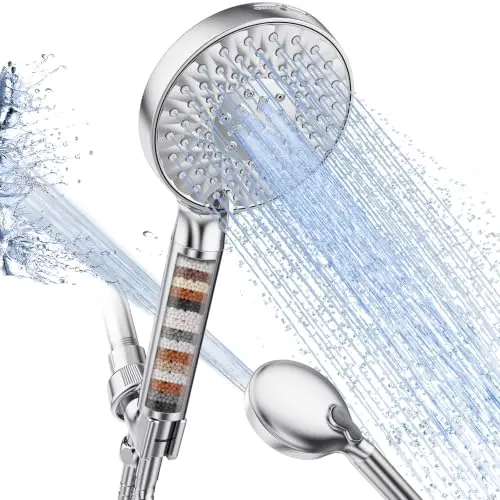
ARB011-GG Filtered Handheld – 9 Sprays, Five-Year Coverage
A filtered handheld with nine spray patterns, a 71-inch kink-resistant hose, and a replaceable cartridge using KDF, maifanstone, and vitamin C media. The pressure-boosting face is built to hold a strong spray even when your well pump is running weak.
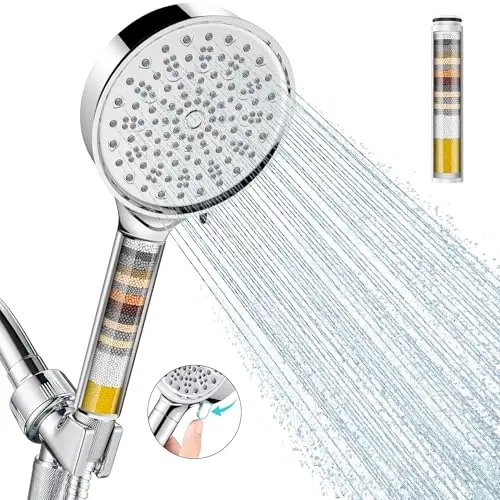
KSCD401-3 Filtered Handheld – One-Thumb Six-Mode Control
A handheld filtered head with a thumb-press mode switch, a 144-hole spray face, and a cartridge loaded with KDF-55 and calcium sulfite. The 60-inch hose and one-hand control make it easy for kids and older users to manage.
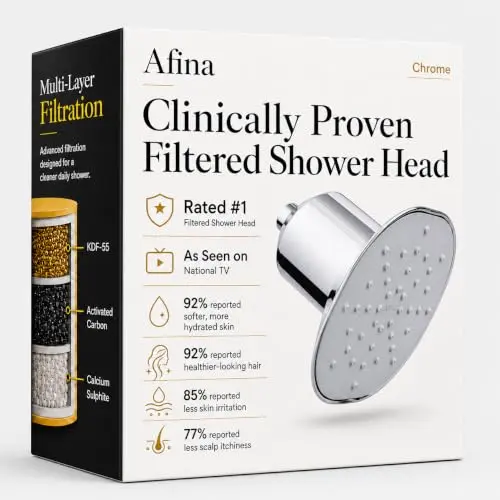
A-1981-CH Rainfall Filtered Head – KDF-55 Spa Spray
A fixed rainfall head with KDF-55 and calcium sulfite filtration built into a square chrome body. Single spray setting, 2.0 GPM, and a two-minute install with a filter that swaps out without tools.
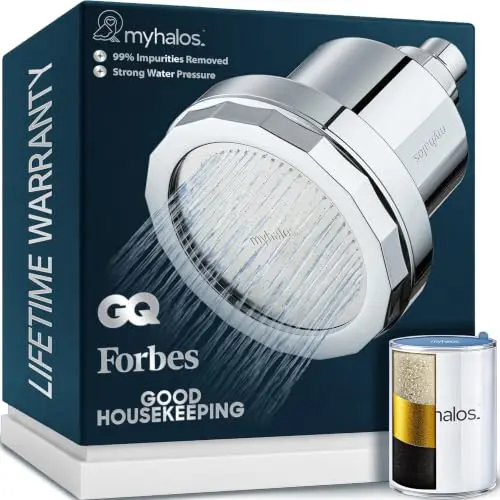
Fixed Filtered Shower Head – Three-Stage Rain Spray
A fixed filtered head with three-stage filtration – calcium sulfite, KDF-55, and activated charcoal – in a compact chrome body. High-pressure rain spray, universal fit, and plumber’s tape included.
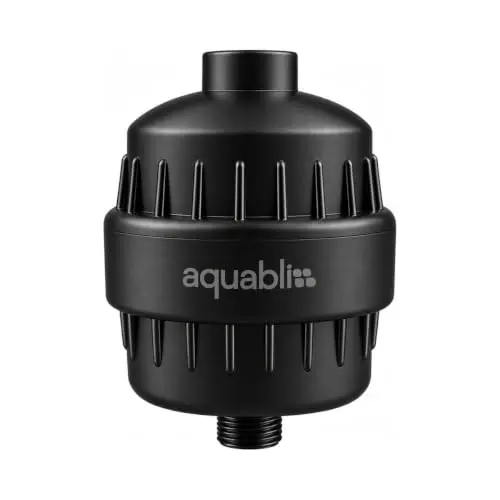
SF100 Daily Revitalize – Inline Vitamin C Filter
An inline canister that threads onto a standard half-inch shower arm and works with fixed, rain, handheld, or combo heads. Vitamin C media targets chlorine, sediment, and organic impurities without restricting flow.
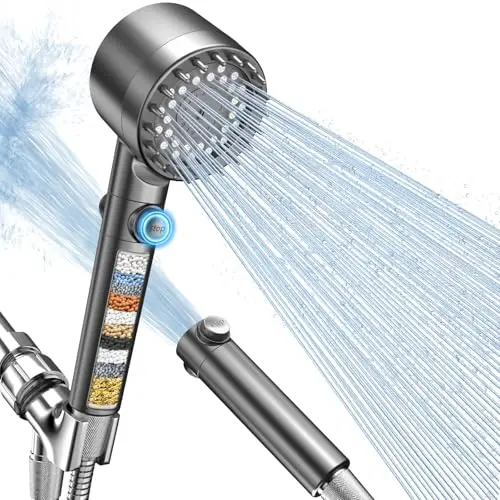
Filtered Handheld with Pause Switch – Four Modes and Power Wash
A handheld filtered head with a one-touch pause button, four spray modes including a detachable power-wash setting, and KDF-55, calcium sulfite, carbon, and vitamin C filtration. Ships with a 60-inch stainless hose and adjustable bracket.
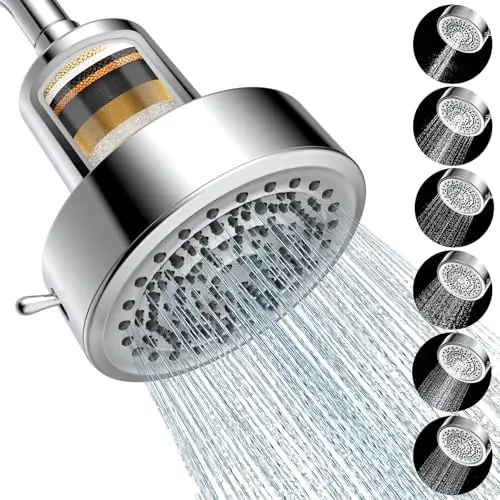
SH7 Filtered Shower Head – Pop-Out Cartridge, Six Modes
A fixed filtered head with six spray modes, a side-mounted trigger for mode changes, and a cartridge that pops out via an access button instead of requiring you to unscrew the whole head. Runs calcium sulfite, KDF-55, and activated charcoal.
How We Evaluated These Shower Head Filters for Well Water
We didn’t run these shower filters through a full year of private-well supply. What we did: cross-referenced 9 shower head filters from 8 distinct brands across 5 decision axes – filtration media chemistry, pressure retention, cartridge replacement interval and restock cost, spray adjustability, and install footprint on a standard half-inch shower arm. We triangulated published specifications, mapped each unit against what actually comes out of a private well (sediment and rust grit, iron staining, sulfur odor, hardness, and the variable pressure of a pump-fed line), and weighed owner feedback where available.
Two axes carried the most weight. Media depth separated the field more than spray count did – a head running KDF-55 plus calcium sulfite plus a sediment layer handles well water differently than one leaning on vitamin C alone. Pressure retention came second, because a filter that fixes the water and kills the spray just trades one annoyance for another. The scoring framework weighted real-world fit for well water (70%) against feature differentiation (30%) – the spray modes, cartridge designs, and install flexibility that go beyond baseline filtration.
We have no commercial relationship with any brand here, and recommendations track fit and differentiation rather than brand preference. If your well is heavy on grit and staining, the FEELSO filtered shower head is the most complete single-box answer; if you’d rather keep the head you already own, the weAQUA two-pack is the more practical route.
How to Choose the Right Shower Head Filter for Well Water
1. What Well Water Actually Does to a Shower Head
Well water isn’t one problem, it’s several overlapping ones. Sediment and rust grit are physical particles that clog nozzles and abrade the spray face. Iron and manganese stain fixtures orange and brown and can feed the bacteria behind that sulfur smell. Hardness minerals – calcium and magnesium – leave the white scale that seals off jets. And because a well is pump-fed rather than pressure-regulated the way municipal lines are, flow can already be marginal before a filter makes it worse.
That combination is why a chlorine-only filter underperforms on a well. Chlorine is a municipal problem. Sediment, iron, and hardness are well problems, and they need media that can physically trap or chemically bind them.
2. Filtration Media: Which Layers Actually Matter for Well Water
Read the media list before the spray count. A filter built for well water should start with a sediment layer to catch grit, then move through KDF-55 – a copper-zinc alloy that handles chlorine, some heavy metals, and hydrogen sulfide – plus calcium sulfite for chlorine reduction and activated carbon for odor and organic compounds. Vitamin C media is excellent at neutralizing chlorine but does comparatively little for iron or sediment.
Ignore ballast. Language about energy balls or ceramic spheres rarely describes functional media. weAQUA is unusually blunt about this, publishing sediment, carbon, KDF, and calcium sulfite as its full media list – which is exactly the stack a well-water household should be hunting for.
3. Why Pressure Retention Is the Real Test for Shower Head Filters
A filter’s second job is to disappear. If your well pump already delivers a modest stream, a restrictive cartridge turns a decent shower into a chore. Look for heads that explicitly claim pressure-boosting spray geometry or zero pressure loss, and prefer ones with anti-clog silicone nozzles, which wipe clean instead of sealing over with scale.
Handhelds and fixed heads built around low-flow, high-velocity jets tend to hold up better here than dense rainfall faces with tiny orifices. The SR SUN RISE filtered handheld is the clearest example in this lineup, with a face engineered to keep a strong spray at reduced pressure.
4. Head-Integrated vs. Inline Shower Head Filters: Which Setup Fits
Integrated filters put the cartridge directly in the head – fewer parts, cleaner look, but you’re locked into that brand’s replacement cartridges and you replace the whole unit if the housing fails. Inline canisters thread between the arm and any head you choose, which is the better call if you’ve already invested in a rainfall head or a handheld you like.
Inline designs also tend to carry more media volume, since they aren’t fighting for space inside a spray face. The tradeoff is extra height on the shower arm and one more threaded joint to keep sealed.
5. FEELSO vs. weAQUA: Two Approaches to a Well-Water Shower
These two represent the split in this category. The FEELSO filtered shower head is a complete replacement: cartridge and spray face in one unit, with five modes and a swivel joint. The weAQUA pair is purely filtration – two inline canisters that leave your existing head alone.
Choose the integrated route if your current head is old, cheap, or already clogged and you’d be replacing it anyway. Choose the inline route if you like your shower head and only want the water changed underneath it.
6. Cartridge Life, Restock Cost, and Maintenance Reality
Every filter in this category is a subscription in disguise. Published intervals run from 90 days to six months, and well water pushes you toward the shorter end – heavy sediment loads and high iron content exhaust media faster than the label suggests. A cartridge that costs little but needs quarterly swaps can outrun a pricier one that lasts twice as long.
Two practical hedges: buy a two-pack or a spare cartridge up front so you’re never showering through a spent filter, and record the replacement part number when you install. Cross-compatibility between brands is the exception, not the rule.
Frequently Asked Questions
1. Do shower head filters actually help with well water?
Yes, with honest limits. A filter with sediment media, KDF-55, and calcium sulfite will reduce chlorine, some heavy metals, grit, and odor, and most people notice softer-feeling water and less dryness within a week or two. What it won’t do is solve a serious iron problem – a water test and a whole-house treatment system are the right tools for that.
Think of a shower head filter as a point-of-use polish, not a well treatment plant. It’s the difference between showering in water that smells and stains and showering in water that doesn’t.
2. What's the difference between the FEELSO filtered shower head and the SR SUN RISE handheld?
Both filter, both install without tools, and both offer multiple spray modes. The FEELSO unit is a fixed head with a 15-stage cartridge, so the filter sits above the spray face and you get five settings on a swivel joint. The SR SUN RISE is a handheld on a 71-inch hose with nine settings, a detachable power-wash side, and a five-year limited warranty.
Pick the fixed head for a cleaner wall look and simpler plumbing. Pick the handheld if you need reach for tubs, kids, or pets.
3. How often should I change the filter on well water?
Sooner than the box says. Published intervals run from 90 days to six months, but heavy sediment, iron, or sulfur pushes you toward the short end. Watch for the signals: flatter lather, returning odor, dropping pressure, or visible discoloration in the cartridge.
On a heavily mineralized well, a quarterly swap is a reasonable default. Keep a spare on hand so you’re never tempted to stretch one past its useful life.
4. Is an inline filter like the weAQUA as good as a filtered shower head?
Often better, if you already own a head you like. Inline canisters hold more filtration media than cartridges crammed into a spray face, and the weAQUA two-pack runs sediment, carbon, KDF, and calcium sulfite – the full stack – while claiming no pressure loss. What you give up is the integrated package: no new spray modes, no swivel joint, and one more joint to seal.
If your current shower head is old or clogged, an integrated filtered head usually makes more sense than pairing a filter with a failing unit.
5. Will a filter fix low water pressure from my well pump?
Not by itself – filtration only adds restriction. What helps is a head designed around pressure-boosting jet geometry and anti-clog nozzles, paired with a cartridge that isn’t an oversized sediment brick. If pressure is genuinely poor, have the pump and pressure tank checked first; no shower accessory compensates for a failing pump.
Final Verdict
For most well-water households, the FEELSO filtered shower head is the answer – it bundles the deepest filtration stack in this lineup with a genuinely adjustable spray, and it’s the one owners on private wells describe most favorably. If you’d rather keep the shower head you already own, the weAQUA two-pack fixes the water without touching your hardware and stretches coverage across a full year of showers. Reaching the far end of the tub, or washing a dog, is where the SR SUN RISE handheld earns its place. And if water quality matters more than spray options, the Afina is purpose-built for that trade.
