
Best Side Sleep Headphones – 2026 Reviews

Falling asleep with a podcast is easy. Falling asleep on your side with earbuds in is not. The moment your cheek hits the pillow, anything sticking out of your ear becomes a tiny lever pressing plastic into cartilage – and the pillow always wins.
So the real dividing line in this category isn’t sound quality or Bluetooth version. It’s form factor. A fabric headband, a contoured sleep mask, and a flush in-ear bud each solve the pillow problem a different way, and picking the wrong one for how you actually sleep is the number one reason people give up on sleep headphones entirely.
The second axis is intent. Some of us want music or a podcast until we drift off; others are trying to outlast a partner who snores. Those are different jobs that call for different designs and different overnight battery math. Below we’ve mapped the market across brands and price tiers so you can match the design to the way you sleep, not to whoever has the loudest listing.
Best Side Sleep Headphones – 2026 Reviews
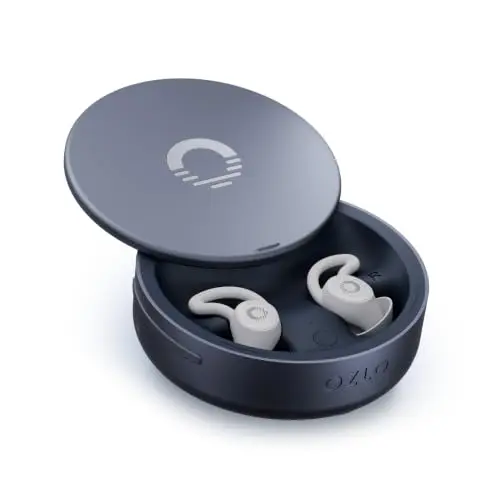
Sleepbuds 2 – Purpose-Built for Side Sleepers
The Sleepbuds 2 were designed for sleep first and audio second. Each bud weighs roughly 1.6 grams and sits flush with the ear, so rolling onto your side doesn’t drive a hard shell into cartilage. Four tip sizes cover a wide range of ear canals, and the battery is sized to clear a full night with room to spare.
There are more than 50 built-in sleep sounds for masking snoring or street noise, plus Bluetooth streaming for podcasts and music. A private in-ear alarm wakes only you, and the smart case measures bedroom noise, light, and temperature overnight, feeding those readings into the companion app.
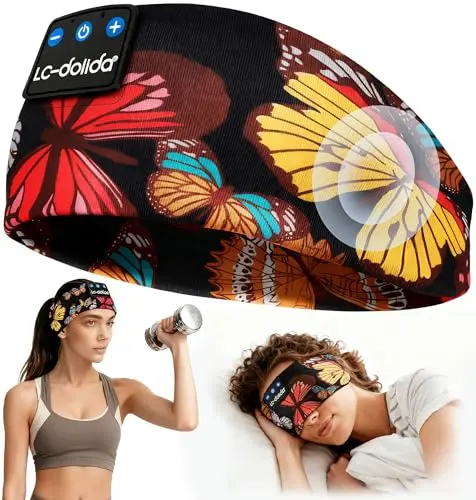
Butterfly Sleep Headband – Thin Speakers for Side Sleeping
A sports headband with a sleep problem solved. The speakers measure about a quarter inch thick, the electronics sit inside the fabric rather than on top of it, and the knit is quick-drying enough to survive a workout before it goes to bed with you. Bluetooth 5.4 handles pairing, and a built-in microphone lets you take calls without unwrapping anything.
Playtime runs past fifteen hours on a one-to-two-hour charge, which covers a full night plus a morning run. The electronics pull out so the headband can be washed, and the elastic cut is meant to fit a wide range of head shapes.

Sleep Headphones Bluetooth Headband – 40mm Drivers and All-Night Playtime
This is the headband for people who care what music sounds like. Instead of the usual wafer-thin speakers, it uses 40mm composite drivers, so bass has some body and vocals stay clear. The fabric is a breathable, elastic blend with a sweat-absorbent lining that stretches to fit most heads.
Battery life runs to about fourteen hours on a short charge, and the built-in microphone handles calls. It doubles as a workout headband, which is why it ends up living on a nightstand rather than in a gym bag.

S36 Sleep Earbuds – Tiny In-Ear Fit with LED Case
An ultra-mini in-ear bud that sits deep enough in the canal to stay out of the pillow’s way. Each bud weighs about 3 grams, and the low-profile shell is the point – there’s no stem to jam into your ear when you turn over. The charging case carries an LED battery readout so you can see where you stand without opening an app.
Single-charge playback runs about four hours, with the case adding enough capacity to reach roughly thirty-two hours of total listening. Bluetooth 6.2 handles pairing, and a built-in microphone covers calls.

S10 Pro Sleep Earbuds – ANC and Built-In White Noise
A mini in-ear bud built around a specific sleep routine. The 115-degree shell angle and liquid silicone cushion are shaped to sit against the ear without pressure when you’re on your side, and each bud weighs under 3 grams. Active noise cancellation plus passive isolation handles steady background drone.
The companion app carries a library of white noise and calming sounds, and a Sleep Mode disables low-battery alerts and accidental touch triggers so nothing chirps at you at 2 a.m. Single-charge playback is rated around eight hours, with the case extending total listening considerably.
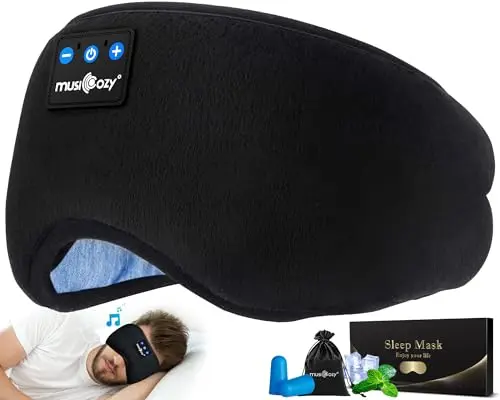
Sleep Mask Headphones – Velvet Mask with 14-Hour Playtime
A sleep mask with headphones built in, aimed at people who need darkness as much as they need sound. The velvet and stretch cotton shell with extra cushioning blocks light from the top and sides, and the adjustable strap is meant to fit a wide range of head sizes.
Inside, a 200mAh battery delivers more than fourteen hours of playtime on a single USB-C charge – enough that you’re not plugging it in every morning. Bluetooth 5.4 handles pairing, the electronics detach for washing, and a small carry bag is included for travel.
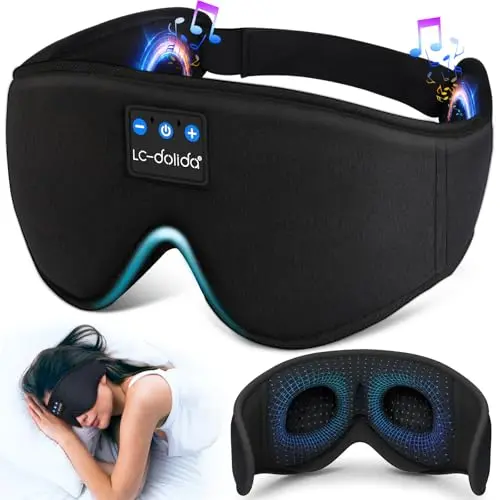
3D Contoured Sleep Mask Headphones – Zero Eye Pressure
The contoured eye cups are the story here. Instead of pressing flat fabric against your eyelids, the mask is molded deeper over the eyes so lashes and lids have room to move – which solves the tightness problem most flat sleep masks create. Memory foam and soft fabric pad the rest.
Bluetooth 5.4 pairs with anything within range, and the adjustable strap is designed not to catch hair. Playtime runs about eight to ten hours on a one-to-two-hour charge, which covers a standard night. The mask blocks light effectively and is angled at side sleepers specifically.

PTL01 Sleep Headband – Ultra-Thin Speakers at the Entry Tier
A three-in-one headband that works as a sleep headphone, a light-blocking eye cover, and a sports band. The speakers are ultra-thin and the control module sits at the center of the band rather than over an ear, so nothing presses when you lie down.
Bluetooth pairing reaches across a room, and the braided cord with breathable mesh lining stretches to fit most head sizes. Playtime is rated past twelve hours on a two-to-two-and-a-half-hour charge, and the whole band is machine washable once the control pod comes out.

SE04 Sleep Earbuds – Wired, So There's No Battery to Die
A completely different approach: no battery, no Bluetooth, no charging case. The SE04 is a tiny wired earbud in a flat silicone housing that disappears into the ear, so there’s nothing protruding to press against a pillow. Each pair weighs about 10.6 grams.
Two pairs ship in the box along with a zippered case and carabiner. A three-button remote with microphone handles volume, track skipping, and calls on both iOS and Android, and the 3.5mm plug works with laptops, MP3 players, and older phones.

FULH01 Sleep Headband – Sweatproof and Machine Washable
A three-in-one headband combining wireless audio, a light-blocking cover, and a sports band. The drivers are ultra-thin, the electronics are removable, and the fabric is a moisture-wicking hypoallergenic blend that’s built to be washed.
Bluetooth 5.4 pairs quickly, and playtime is rated up to fourteen hours on a one-to-two-hour USB-C charge. A built-in microphone handles hands-free calls, and the elastic cut is meant to fit most head sizes snugly.
How We Evaluated These Side Sleep Headphones
We didn’t sleep a full night in every pair on this list. What we did: cross-referenced 10 sleep headphone models from 8 distinct brands across five decision axes – form factor and pillow-side fit, overnight battery, audio and masking performance, fabric and washability, and controls and connectivity. We triangulated published specifications, feature sets, and aggregated owner feedback where available, then mapped each option against the two buyer profiles this category actually serves: the music-and-podcast sleeper and the noise-masking sleeper with a snoring partner.
The scoring framework weighted real-world fit and performance (70%) – how well a given design survives eight hours with a cheek on a pillow – against feature differentiation (30%) – thin-speaker engineering, masking libraries, in-ear alarms, and app controls. We have no commercial relationship with any brand featured here; the rankings track fit and differentiation, not brand preference. One thing we can’t measure is how a battery behaves in month seven, so the long-term charge reports in owner feedback carried extra weight in our scoring.
If you want a bud built around side sleeping rather than adapted from daytime earbuds, the Ozlo Sleepbuds 2 is the closest thing to a purpose-designed answer. If you’d rather stay in headband territory, the Butterfly Sleep Headband delivers most of the night-time comfort for a fraction of the commitment.
How to Choose the Right Side Sleep Headphones
1. Why Side Sleepers Need Different Headphones
Side sleeping turns your ear into a lever. Anything that sits outside the ear canal – a stem, a disc, a hard pod – gets pressed into cartilage by the weight of your head, and after twenty minutes that’s the only thing you can think about. The fix isn’t more cushioning; it’s a flatter profile.
Three things decide whether a pair survives the night: how far the speaker or bud protrudes past your ear, how much pillow-side pressure it transfers onto cartilage, and whether the fabric traps heat against your face. That’s why the same headphones can be fine on a flight and miserable in bed. Soft, thin speaker housings and flush in-ear shells are the two designs that genuinely solve it, and both show up in this lineup.
2. Headband, Sleep Mask, or In-Ear Bud: Choosing a Form Factor
Headband designs wrap flat speakers over your ears and stay put when you roll over. They’re the most forgiving option and the easiest to live with, at the cost of some sound quality and no light blocking. Contoured eye masks add blackout and put the audio in the same piece of fabric, which suits people who need darkness as much as sound. Flush in-ear buds are the quietest and most targeted solution, but small buds mean small batteries and a narrower fit window.
If you want music with zero ear pressure and don’t need blackout, the Butterfly Sleep Headband is the easy entry point. If you need darkness too, skip straight to a mask-style unit.
3. How Much Overnight Battery Side Sleep Headphones Actually Need
A full night is seven to nine hours, and most people fall asleep with audio running and wake before it ends, so aim for eight hours minimum of single-charge runtime. Headbands and masks generally clear that bar. Mini in-ear buds often don’t, and lean on a charging case for total playtime instead – fine for naps and short nights, less fine if you’re swapping buds at 3 a.m.
Watch for two quieter annoyances: low-battery chimes that fire at the worst possible moment, and touch panels that trigger when your cheek meets the pillow. Some models now ship a sleep mode that disables both, which is worth more than an extra hour of runtime.
4. Masking a Snoring Partner vs. Listening to Music
These are different jobs. Music is a comfort feature; masking is a sleep tool, and it depends on steady broadband sound tuned toward the low frequencies of snoring rather than on raw volume. Active noise cancellation helps with constant drone like traffic or a fan, but it does very little against irregular snoring, and in a bud this small the effect is modest. Passive isolation from a good silicone seal often achieves more than an ANC spec sheet suggests.
If masking a partner is the actual goal, the Ozlo Sleepbuds 2 is the one model in this lineup built around masking rather than around audio fidelity.
5. Fabric, Washability, and Light Blocking
You’ll wear these against your skin for eight hours a night, so the material matters as much as the driver. Look for breathable knits, memory foam in the eye contours, and electronics that detach before washing. Machine washable is the easier maintenance path, though some mask-style units ask you to hand wash instead – not a dealbreaker, but it changes the routine.
If you also need darkness, a mask-style unit does double duty. The MUSICOZY Sleep Mask Headphones combines velvet padding with full light blockout and detachable components.
6. What Sleep Headphones Cost at Each Tier
Entry-level covers fabric headbands and wired in-ear pairs – thin speakers, decent battery, no app, and the fastest way to learn whether you can sleep with audio at all. The mid-range adds contoured masks, faster charging, microphones, and better drivers. The premium tier is a different product in spirit: purpose-built sleep buds with masking libraries, in-ear alarms, and smart cases, priced several times higher.
Decide which tier you’re shopping before you compare specs, because a fabric headband and a smart sleep bud aren’t really answering the same question. Start cheap if you’re unsure about the whole idea; spend up only once you know audio helps you sleep.
Frequently Asked Questions
1. Are sleep headphones actually comfortable for side sleepers?
Only the ones with a flat profile. A fabric headband or a contoured mask spreads pressure across cloth rather than one point of cartilage, so lying on your side feels like lying on a slightly thicker pillow. Flush in-ear buds work too, as long as the shell doesn’t protrude past the ear. Standard earbuds with stems rarely work.
Fit, not padding, is the variable that decides it – a loose headband will slide and bunch under your cheek by morning, and a mask that’s too tight will press on your brow no matter how soft the foam is.
2. Ozlo Sleepbuds 2 vs. MUSICOZY sleep headband – which should a side sleeper buy?
They answer different questions. The Ozlo Sleepbuds 2 is a purpose-built sleep device: flush buds, a masking library, an in-ear alarm, and a smart case that logs bedroom conditions. If your problem is a snoring partner or a brain that won’t switch off, it’s the more targeted tool.
The MUSICOZY headband is a comfort-first fabric solution with 40mm drivers and no blackout. It’s the better pick if you want fuller sound, a lower commitment, and don’t need alarms or masking. Choose the Ozlo for outcomes, the MUSICOZY for simplicity and value.
3. What's the difference between the LC-dolida Butterfly headband and the MUSICOZY headband?
The Butterfly is built around 0.25-inch thin speakers and a lighter band, which makes it feel almost nonexistent on a pillow. It also runs longer per charge, includes a built-in microphone, and uses a quick-drying knit aimed at workouts. If you mostly want music at low volume while you drift off, the Butterfly Sleep Headband is the more comfortable of the two.
The MUSICOZY headband trades some of that thinness for 40mm composite drivers, so music has real body and bass. It’s the better choice if you fall asleep to actual albums rather than white noise, at the cost of a slightly looser stretch fit.
4. Do sleep headphones actually block snoring?
Not the way noise-cancelling headphones block engine drone. Snoring is irregular and low-frequency, which is exactly the pattern active noise cancellation struggles with – especially in a bud the size of a pea. What works better is masking: a steady bed of sound that keeps the spikes of a snore from registering as a wake event.
After that, passive isolation from a well-sealed silicone tip does the quiet heavy lifting. A wired flat-profile earbud with a good seal can outperform an ANC bud with a loose fit.
5. Can you wash sleep headphones?
Yes, but only after the electronics come out. Headbands are usually the most washable – most are machine washable once the control pod and speakers are removed, and a few ask for hand washing instead. Mask-style units more often specify hand wash because the foam and sealed speakers don’t survive a spin cycle.
Either way, air-dry rather than tumble, and check that the detachable components are fully dry before they go back in. Skipping that step is the fastest way to turn a washable headband into a dead one.
Final Verdict
For most side sleepers, the Ozlo Sleepbuds 2 is the honest answer. It’s the one pair here designed around a cheek on a pillow rather than adapted from daytime earbuds, and the masking library plus in-ear alarm covers the two jobs this category actually does. It’s a real spend, and worth it if sleep is the point.
If you’d rather test the idea first, the Butterfly Sleep Headband delivers thin speakers, all-night playtime, and a microphone for a fraction of the commitment – it’s the pair we’d hand a first-timer without hesitation. And if you can’t stand charging one more thing every night, the Hearprotek SE04 sidesteps batteries entirely, as long as your phone still has a headphone jack.
