
Best Stainless Steel Dish Drying Racks – 2026 Reviews

There’s a particular kind of disappointment that comes with pulling a supposedly dry plate out of the rack and finding a rust freckle on the rim, or a puddle that’s been quietly spreading under the whole thing for an hour. A dish rack is one of the few kitchen items that’s wet almost every day of its life, which is why the material and the drainage path matter far more than the shape.
Stainless steel has become the default answer to the rust problem, but the label covers a lot of ground. Some racks are bare 304 wire, some are steel frames wrapped in a non-scratch coating, and a few mix metal with silicone or food-safe plastic trays. That distinction drives how long the rack still looks new and how carefully you can load it.
The second axis is footprint and where the water actually goes. Countertop racks with angled drainboards, in-sink and over-sink racks that borrow the basin, and roll-up mats that fold into a drawer all solve the same problem differently, and choosing the wrong format for your kitchen is the most common regret we see in this category. So we compared models across all three formats to help you pick the shape that fits your sink first and your dishes second.
Best Stainless Steel Dish Drying Racks – 2026 Reviews
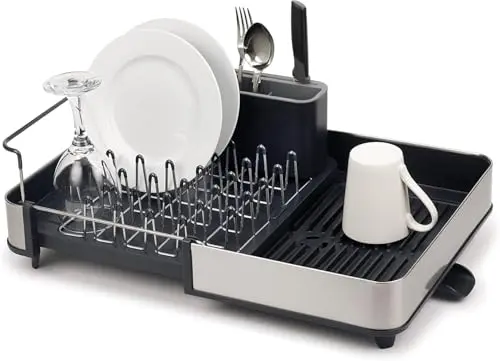
Extend Steel Expandable – Grows With the Load
The Extend Steel is two racks in one: a compact unit for a light wash and a full-width rack when you’ve cooked properly. The two halves separate and recombine without tools, the cutlery drainer moves wherever it’s useful, and a drainage spout aims runoff into the sink instead of across the counter.
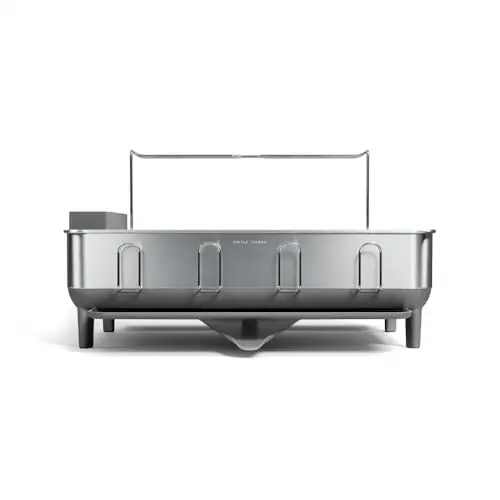
Steel Frame Dishrack – Premium Drying Station
A full-size drying station with a moisture-control tray that spreads water thin so it evaporates instead of pooling, a spout that rotates a full circle to reach your sink, and silicone-tipped dividers that hold fine china without scratching. It’s the largest format in this lineup, and it’s built like an appliance.
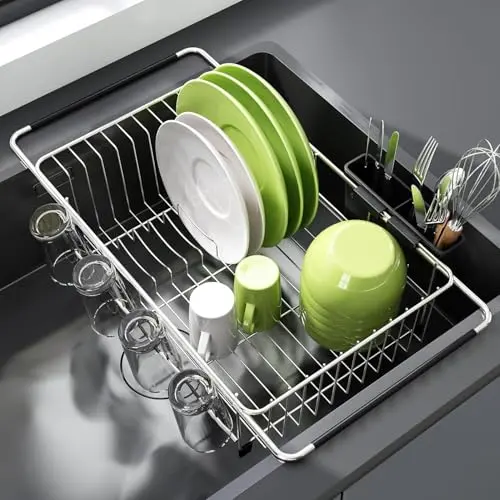
In-Sink Expandable Rack – Compact Sink Solution
An expandable rack that sits inside or over the sink, with support bars that stretch from roughly fifteen and a half to twenty-three inches to span most single and double basins. Water drips straight into the basin, dedicated slots keep plates upright, and there’s nothing to assemble.
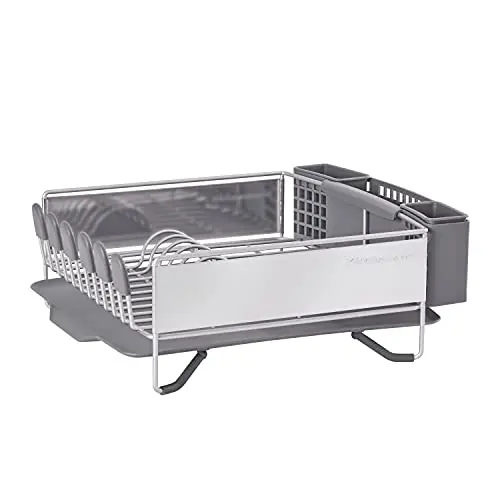
Compact Dish Rack – Small-Kitchen Countertop Pick
A compact countertop rack with satin-coated rust-resistant wire, a removable flatware caddy with a built-in handle, and an angled drainboard that tips water toward the sink. Soft non-slip feet keep it planted without scratching the counter.
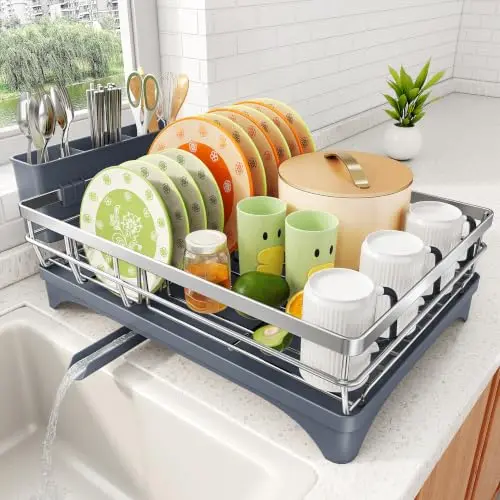
Dish Drying Rack with Utensil Holder – Everyday Counter Rack
A mid-size countertop rack built around three zones – a plate section, a bowl section, and a three-slot cutlery holder – with an angled drainboard and a rotating spout that aims water into the sink. No tools needed to put it together.
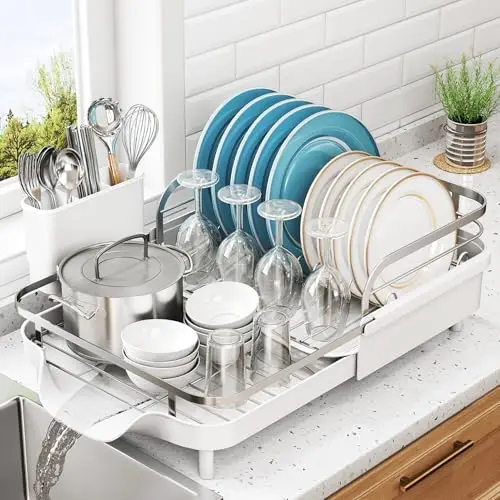
Expandable Dish Drying Rack – Flexes With Your Load
A countertop rack that widens from about fifteen to twenty-two inches, with high-sided guardrails, an angled drip tray feeding a large outlet, a detachable utensil caddy, and raised feet that lift the spout above the counter line.
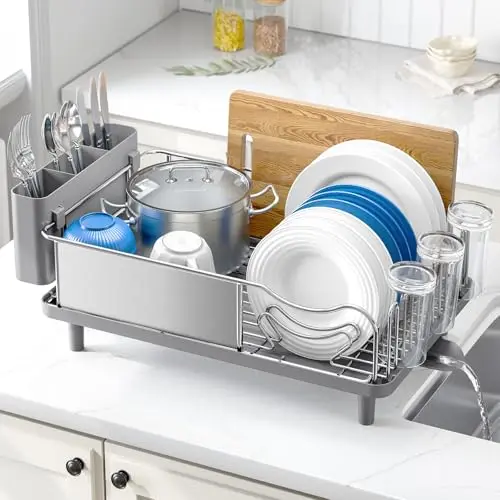
304 Stainless Steel Rack – Built for the Long Haul
A modular countertop system in 304 stainless steel with a detachable three-slot utensil holder, a removable cup shelf, and a sloped drainboard that empties into a lift-out drip tray.
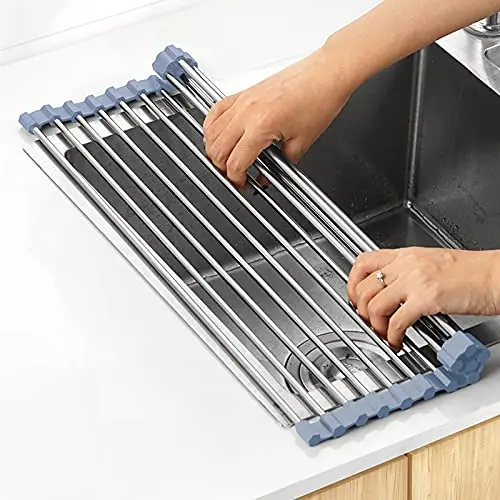
Roll-Up Over-Sink Rack – Foldable Space Saver
A foldable over-sink mat made from 304 stainless steel rods bonded to food-safe silicone. It unrolls across the sink as a drying surface, doubles as a cooling rack or produce drainer, and rolls up into a cabinet when you’re done.
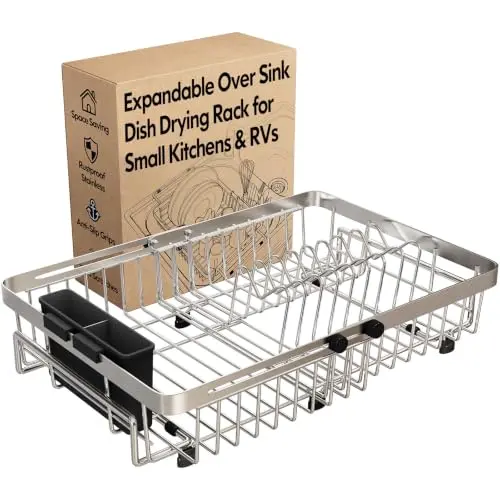
Over-Sink Expandable Rack – Grippy Sink Fit
An expandable over-sink rack with silicone grip points on the handles, six protective feet, and an open frame that lets water fall straight into the basin. Sized for small kitchens, apartments, and RVs.
How We Evaluated These Stainless Steel Dish Drying Racks
We didn’t run a dish rack through a dishwasher stress cycle or time how long a wet plate takes to dry. What we did: cross-referenced nine stainless steel dish drying racks from nine distinct brands across six decision axes – capacity, drainage path, footprint and format, material and coating, care and cleaning, and load stability. We triangulated published specifications, feature sets, and owner feedback where available, then mapped each rack against realistic buyer profiles: the studio-apartment hand-washer, the family of four, the RV owner, and the dinner-party host.
The scoring framework weighted real-world performance (70%) – how well a rack handles a normal week of dirty dishes in its intended setting – against feature differentiation (30%), the specific engineering that separates one model from another: swivel spouts, evaporative trays, expandable frames, silicone-tipped dividers. We audited capacity claims against stated dimensions rather than taking them at face value, because a rack that lists a dozen plates and ships with narrow slots behaves differently in a real kitchen. We have no commercial relationship with any of the brands featured, and recommendations track fit and differentiation rather than brand preference.
A few things we can’t tell you: we didn’t watch these racks age through years of hard-water exposure, which is exactly where coatings and welds fail. What we can tell you is which format suits which kitchen. If counter space is contested, the Extend Steel is the flexible answer; if you have the room and want the most polished build, the Steel Frame Dishrack is it.
How to Choose the Right Stainless Steel Dish Drying Rack
1. Why Stainless Steel Dish Drying Racks Beat Coated Wire and Plastic
A dish rack lives wet. That single fact eliminates most of the market: uncoated carbon steel rusts, cheap chrome plating flakes at the welds, and plastic trays develop a sour smell once water sits in a seam for a week. Stainless steel – particularly 304-grade – resists corrosion at the joints where failure usually starts, and it doesn’t hold odors.
What stainless steel doesn’t automatically buy you is stiffness. Thin-gauge wire flexes under a stack of dinner plates, so look at how the frame is braced and whether the rack uses silicone-capped dividers or bare wire. Bare wire is more durable; coated wire is gentler on china. Neither is wrong, but they suit different dishware.
2. Match the Format to Your Sink: Countertop, In-Sink, and Over-Sink Dish Racks
Format matters more than any single feature. Countertop racks with angled drainboards hold the most and dry the fastest, but they claim permanent real estate. In-sink and over-sink racks borrow space you already have and drain by gravity, which means no tray to empty – at the cost of capacity and, occasionally, stability on a wet rim.
If your counter is the constraint, the In-Sink Expandable Rack is the pick; its bars span most single and double basins and the grid drains straight through. If you’re washing full dinner sets, a countertop unit still earns its footprint.
3. Capacity Claims vs. Real Capacity in a Stainless Steel Dish Rack
Manufacturers count plates in ideal conditions. In practice, capacity depends on slot spacing and plate support height – a rack with tight slots may technically hold twelve plates but refuse to hold your twelve plates. Check the stated support height against your tallest dinner plates, because racks with short supports let plates lean and clatter.
Also weigh the utensil holder design. A three-slot caddy keeps cutlery separated and dries faster than one deep cup, and a removable caddy you can carry to the drawer saves a small daily annoyance.
4. Drainage: The Difference Between a Dry Counter and a Wet One
Every rack in this category drains somehow; the variable is how much attention it needs. Angled drainboards with a spout are the most reliable – water runs to a single low point and into the sink. Hydrophilic surfaces take a different approach, spreading water thin so it evaporates instead of pooling. Open-grid over-sink racks skip the tray entirely.
The failure mode to watch for is a drainboard that sits flat or a spout that ends below the sink rim. If the outlet isn’t above the water line, you get backflow onto the counter no matter how good the tray is.
5. Stainless Steel Isn't One Material: 304, Coatings, and Mixed Construction
Grade matters. 304 stainless steel is the standard worth paying for; 201-grade and generic rust-resistant wire show corrosion sooner. But plenty of racks labeled stainless are actually steel frames with satin or non-scratch coatings, plus plastic trays and silicone feet. That’s fine – coatings protect dishes – but they’re a wear item, and moisture trapped under a chipped coating is where rust begins.
Mixed construction also affects weight and rigidity. A heavier frame with silicone-tipped feet stays put when you load it one-handed, which matters more than most spec sheets admit.
6. Care, Cleaning, and Keeping a Dish Rack Looking New
Racks fail at the waterline, not the top. Wipe the drainboard weekly, pull the utensil caddy out and rinse it, and dry the underside of the tray where mineral film accumulates. In hard-water areas, a periodic vinegar wipe keeps spotting from baking onto the finish.
If you’re in a hard-water area and hate descaling, the Expandable Dish Drying Rack is worth a look for its fingerprint-resistant tray, though its plastic caddy is the part to handle carefully.
7. Budget, Mid-Range, and Premium Dish Racks: What You Actually Get
Entry-level racks are usually simple wire frames with a plastic tray. They drain fine for a year or two, and they’re the right call if you’re outfitting a rental or an RV. Mid-range racks add real stainless construction, better caddies, and spouts that reach the sink. Premium tiers buy engineering: evaporative trays, silicone-tipped dividers, swivel spouts, and longer warranties.
Going premium makes sense if you hand-wash daily and want the rack to look intentional on an open counter. If it lives in a cupboard or a rental kitchen, a mid-range model is the better value. The Steel Frame Dishrack is the clearest example of what the top tier buys; the Roll-Up Over-Sink Rack shows how little you can spend and still solve the puddle problem.
Frequently Asked Questions
1. What's the difference between the Joseph Joseph Extend Steel and the simplehuman Steel Frame Dishrack?
They solve different problems. The Joseph Joseph Extend Steel is a flexibility play: two halves that separate so you can run a compact rack most days and a full-width rack after a big cook, plus a moveable cutlery drainer and a drainage spout. The simplehuman Steel Frame is a capacity and engineering play, with a hydrophilic tray that spreads water thin so it evaporates rather than pooling, a 360 swivel spout, silicone-tipped plate dividers, a wine glass holder, and a five-year warranty.
Choose the Extend Steel if your counter space fluctuates or you want the option to split the rack in two. Choose the Steel Frame if you hand-wash daily, have the counter depth for a full-size unit, and want the most refined build.
2. Is an in-sink dish rack or a countertop rack better for a small kitchen?
Usually in-sink. A rack that spans the basin drains by gravity with no tray to empty, and it uses space you’ve already given up. The JASIWAY In-Sink Expandable Rack is the strongest example here: adjustable bars fit most single and double basins, the open grid lets water fall straight through, and there’s no assembly.
Countertop still wins if you wash large volumes or routinely dry pots and cutting boards, because in-sink racks trade capacity for a smaller footprint. A compact countertop unit like the KitchenAid Compact is the middle path.
3. Do stainless steel dish drying racks actually rust?
Less than coated wire or chrome, but stainless isn’t rust-proof. 304-grade steel holds up well; 201-grade and thin generic wire pit sooner. The more common failure point is a coated frame: once the coating chips at a weld or a bend, moisture gets underneath and corrosion starts at the exposed edge.
Hard water accelerates spotting, and standing water in a tray seam is what damages most racks. Weekly wiping and an occasional vinegar rinse will do more for longevity than any spec on the box.
4. How much counter space does a stainless steel dish drying rack need?
Budget the footprint listed in the specs plus a couple of inches of clearance on the drain side. Compact countertop racks run around fifteen by thirteen inches; full-size units push past twenty inches in both directions, which is a lot of a standard-depth counter. In-sink and over-sink racks need none.
If you’re tight on space, measure the sink opening before anything else, because expandable over-sink racks only work if their bars can span your basin. The Over-Sink Expandable Rack adjusts across a range of basin widths and grips the wet rim rather than sliding.
Final Verdict
For most kitchens, the Extend Steel is the answer: full-size drying capacity on the nights you need it, a compact footprint the rest of the time, and a drainage spout that keeps the counter dry either way. If your counter is genuinely spoken for, the In-Sink Expandable Rack moves the whole operation over the basin without permanent hardware. And if you want the most refined build in the category and have the space to house it, the Steel Frame Dishrack is a legitimate splurge. Tiny kitchens on a tight budget should look at the Roll-Up Over-Sink Rack – it stores in a drawer and solves the puddle problem without a drainboard. Pick the format first, then the model. That order saves more regret than any spec sheet.
