
Best Tablet Pillow Holders – 2026 Reviews

You know the ritual. You’re propped against the headboard, one arm holding the tablet, the other one slowly going numb. Twenty minutes in, your neck starts complaining and the tablet slides down your chest. A tablet pillow holder exists to end that fight – but the category has quietly split into three very different designs, and the one you pick should depend far more on how you read than on which listing looks softest.
The split runs like this: molded cushions with fixed grooves, foldable pads with hook-and-loop angle control, and microbead pillows built around an articulated clamp arm. Each is good at something the others aren’t. A pillow with shallow decorative slots is fine for an e-reader and hopeless with a large iPad Pro. A pad that folds flat for a flight can be too light to stay put on a mattress. And clamp-arm holders nail screen position right up until you want to shift your legs.
We cross-shopped the field across major brands and sorted out what each design genuinely does well, then matched them to real situations: reading in bed, streaming on the sofa, Kindle-only readers, and people who want one holder that fits in a carry-on. What follows is a market-wide comparison, not a pitch for any one label – groove depth, fill density, and device range do most of the work here.
Best Tablet Pillow Holders – 2026 Reviews
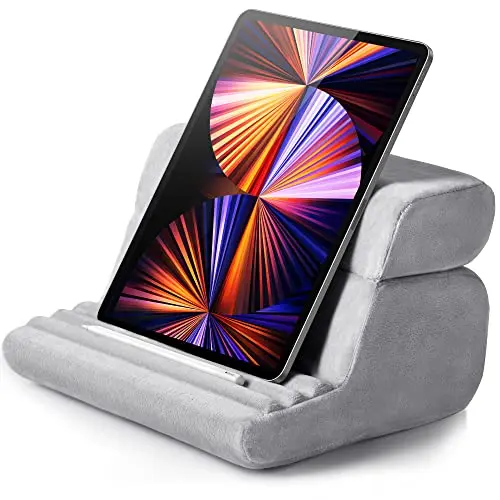
60646 Pillow Stand – Deep-Groove Stability With Pocket Storage
A plush molded pillow with three groove positions, a washable cover, and a side pocket that swallows headphones, a phone, or a charging cable. The deeper front groove is the headline: it holds a tablet at a steeper, more upright angle than most cushions in this class.
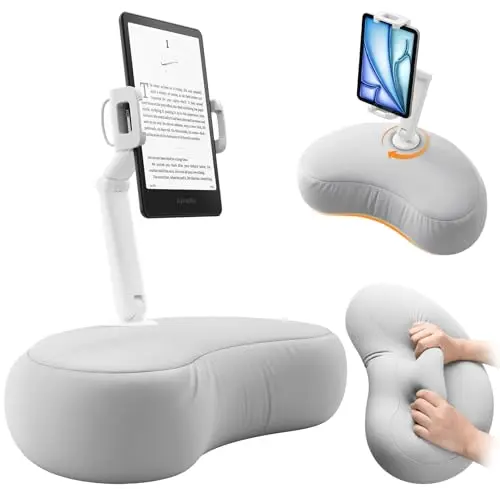
U5T Kindle Pillow Stand – Rotating Clamp Arm for Bed Reading
A crescent microbead pillow with an articulated arm and a spring clamp, so the device floats in front of you instead of resting in a groove. The base swivels a full circle, the middle joint sweeps, and the clamp rotates – you set the angle once and it holds.
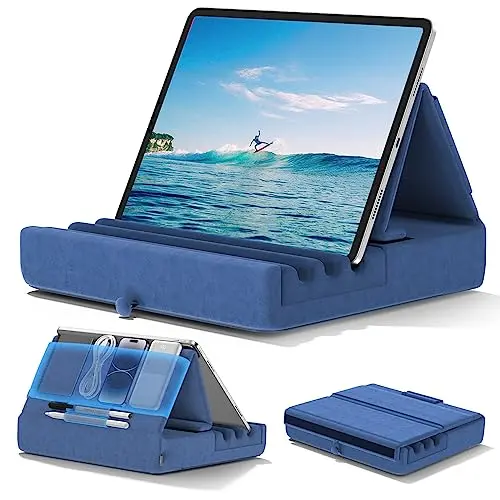
KDD-722 Foldable Pillow Stand – Pockets, Pens, and Flat-Fold Travel
A foldable plush pad that collapses flat, with wide deep grooves, a large storage pouch, and two pen slots. It’s built for people who read on the sofa at home and want the same holder on a plane.

PL02 Pillow Stand – Memory Foam With Side Pocket
Memory foam in a triangular shape, four angle positions, wider grooves, and a side pocket for a phone or stylus. The detachable cover washes, and there’s room to park two devices at once.
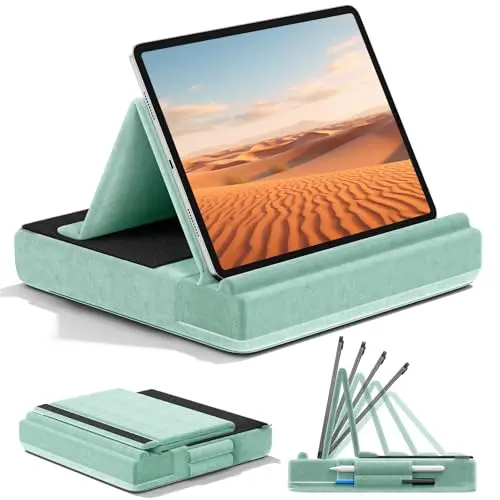
Velcro-Adjust Pillow Stand – Continuous Angles in a Slim Fold
Hook-and-loop fastening instead of fixed grooves, so the angle is continuous rather than stepped. Slim, foldable, with two stylus holders on the side.
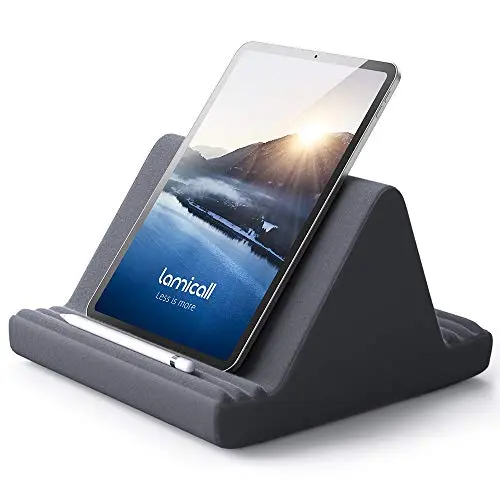
Six-Angle Tablet Pillow – Dual-Device Versatility
Six angle positions, a triangular pillow shape, and room for two devices at once. The cover detaches for washing and the fill is designed to spring back rather than dent.
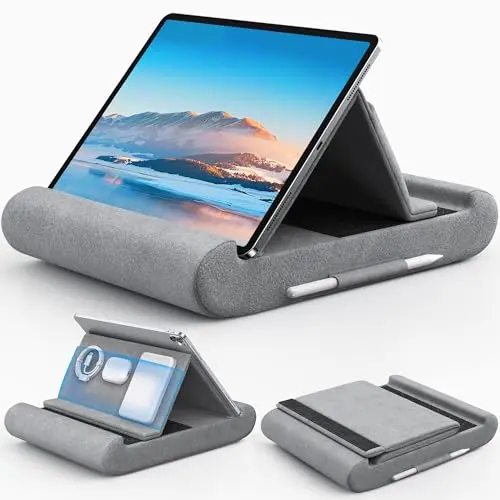
Foldable Velcro Pillow Stand – Precise Angles and Storage Pockets
A hook-and-loop pad with storage pouches, a stylus pocket, a plush cover, and a foldable build. Aimed at the 4-to-13-inch range with portability as the priority.
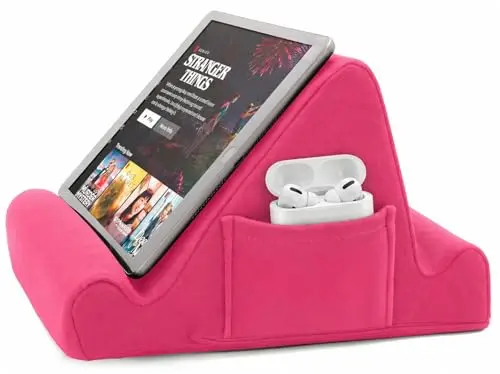
BK1779 Memory Foam Lap Cushion – Plush Hands-Free Viewing
A memory foam lap cushion with a plush cover, designed to sit across your thighs rather than grip a device in a groove. Suits tablets, phones, Kindles, and paper books.

SN0301 Foldable Pillow Stand – Travel-Ready With Pencil Holder
A foldable pillow holder combining hook-and-loop strips with deeper grooves, a mesh cable pocket, and a pencil holder. Rated for devices from roughly 4 to 11 inches.
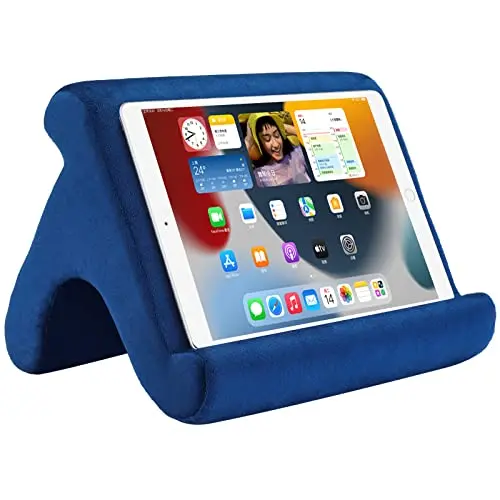
Three-Angle Pillow Stand – Lightweight Suede-Soft Holder
A lightweight sponge pillow with a non-slip suede cover, three viewing angles, and a hollow center that makes it easy to grip and carry. Washes, travels, and asks for very little.
How We Evaluated These Tablet Pillow Holders
We didn’t run lab load tests or put these holders through months of nightly use. What we did: cross-referenced 10 tablet pillow holder models from 10 distinct brands against six decision axes – device size range, angle flexibility, groove or clamp retention, storage, materials and care, and stability on soft surfaces. We triangulated published specifications, feature sets, owner feedback where available, and use-case fit against the situations people actually buy these for: reading in bed, streaming on a sofa, Kindle-and-e-reader use, and travel.
Three design families kept showing up, and they’re the honest dividing line here: molded cushions with fixed grooves, foldable pads with hook-and-loop angle control, and microbead pillows on an articulated clamp arm. Each is genuinely good at something the others aren’t, so we weighed how well a holder serves its own design brief before comparing across families.
The scoring framework weighted real-world performance (70%) – whether a holder actually keeps a tablet where you put it without neck strain – against feature differentiation (30%), meaning the design choices that separate one pillow from another. We have no commercial relationship with any of the brands here; recommendations track fit and differentiation, not brand preference. If you read mostly in bed with a large tablet, the UGREEN 60646 is the natural starting point. If your primary device is a Kindle and you want the screen floating at eye level, the SAIJI U5T solves that problem more precisely.
How to Choose the Right Tablet Pillow Holder
1. Match the Tablet Pillow Holder to Your Device Size
Almost every holder here claims a 4-to-13-inch range, and almost every one of them is telling a half-truth. Small devices are easy – a phone or a 6-inch Kindle sits happily in any groove. The stress case is the far end of the range: a 13-inch iPad Pro is heavy, top-plated, and perfectly willing to tip a light cushion forward.
Two numbers decide whether a holder will work for you: your screen size and your weight with a case on. If you carry a large tablet, favor deeper grooves, a denser fill, or a clamped arm that grips the device instead of leaning it. If your daily driver is an e-reader, you can buy on comfort alone.
2. Groove Depth Is the Spec Nobody Lists
This is the number that separates a holder you keep from one that ends up in a drawer. Deep, wide grooves wrap the bottom edge of a tablet, so it stays put when you tap the screen. Shallow decorative slots look identical in photos and let a tablet skate out the moment you tilt the pillow.
Look for phrasing like widened and deepened slots in the description. If a listing only talks about angles and softness and never mentions the slot, that’s a reasonable signal that retention design isn’t the selling point.
3. Fixed Angles, Hook-and-Loop, or Clamp Arm
There are three real approaches. Fixed groove angles – three, four, or six of them – are the simplest and most stable, because nothing moves except which slot you choose. Hook-and-loop pads offer continuous adjustment, better for reclined reading and more dependent on the fastener over time. Clamp-arm holders sit on a microbead pillow and put the screen exactly where you want it, at the cost of setup time and portability.
If you mostly sit up straight, fixed grooves do everything you need. If your main device is a Kindle and your goal is the screen at eye level with your hands free, the SAIJI U5T is purpose-built for exactly that.
4. Stability: Where a Tablet Pillow Holder Lives Matters
Soft surfaces are the hard case. A cushion that feels rock-solid on a tabletop can roll or sink into a duvet, and a tablet’s weight sits high enough to tip the whole assembly. Wide bases, memory foam or microbead fill, and a low center of gravity all help – as does a groove that sits closer to the pillow’s core rather than perched on a thin lip.
Think about where it will actually live. A holder that never leaves the bed should prioritize fill density and footprint. A holder that moves between desk, sofa, and plane should prioritize folding flat and staying light – the KDD foldable leans travel-first for that reason.
5. Covers, Pouches, and How These Holders Age
These live on beds, so they collect lint, crumbs, and cat hair. A detachable, washable cover is the single most useful maintenance feature in the category, and it isn’t universal. Where the cover doesn’t come off, look for a surface you can wipe with a damp cloth.
Storage is the other aging factor. A side pocket or mesh pouch keeps a phone, stylus, or cable from disappearing between the mattress and the wall – a small feature that turns out to matter daily. And expect some of these to arrive vacuum-compressed; they need time, or a short tumble in a dryer, before they look like the photo.
6. KDD Foldable vs. Lamicall PL02: Same Idea, Different Tradeoffs
Both are soft lap pillows with plush covers and built-in storage, and they land in the same rough price bracket, so the decision comes down to how you use them. The KDD foldable collapses flat and carries a pouch plus pen slots – the better pick if the holder travels or migrates around the house.
The Lamicall PL02 uses memory foam and wider slots, and its two-sided triangle seats two devices at once. Pick the KDD for portability and storage. Pick the Lamicall if you want the fill to hold its shape and you’d rather have firmer retention than foldability.
Frequently Asked Questions
1. Do tablet pillow holders actually help with neck strain?
They help with one specific problem: holding a device at eye level so you’re not chin-tucking to look down. A holder that puts the screen at a comfortable angle takes load off your neck, shoulders, and hands, which is the most common reason people buy one in the first place.
What a pillow can’t do is fix posture. If you’re still hunched against a headboard for three hours, the pillow is doing its half of the job. Angle range and where the cushion sits on your body matter more than any single spec on the box.
2. What's the difference between the UGREEN 60646 and the Lamicall PL02?
Both are molded pillows with fixed angle positions and washable covers, aimed at the same lap-and-bed use. The UGREEN 60646 has three positions and a deeper front groove, and it doubles as a neck pillow when folded away. The Lamicall PL02 uses memory foam, offers four positions, and adds a side pocket plus a two-sided triangle that can seat two devices.
Pick the UGREEN for grip and simplicity. Pick the Lamicall if you want the fill to recover its shape and you like having a pocket for a stylus. The UGREEN 60646 is our overall pick for the category.
3. Is a foldable tablet pillow holder stable enough for a 12.9-inch iPad?
Usually yes, with caveats. Foldable pads like the KDD foldable use a high-elasticity sponge base and wide grooves, and they hold a large tablet at moderate angles without drama. What they don’t have is the mass of a one-piece molded cushion.
If your 12.9-inch iPad lives in a heavy keyboard case, lean toward a denser pillow, or accept that steep, near-vertical angles are where any soft holder starts to struggle. For reference, the UGREEN 60646 and Lamicall PL02 both put more material under a big tablet than the thinnest foldable designs do.
4. Can a tablet pillow holder hold a Kindle or a paper book?
Yes – e-readers are the easy case. A Kindle or a paperback is light, so almost any holder here will carry it comfortably, and a groove-based pillow is genuinely pleasant for reading in bed with the screen at eye level.
If a Kindle is your main device and you want it floating in front of you rather than resting in a slot, the SAIJI U5T with its rotating clamp arm is the more precise tool. For casual reading, a three-angle pillow is plenty.
5. How long does a vacuum-compressed tablet pillow holder take to expand?
Most of these ship compressed for freight, and most need six to 24 hours at room temperature to reach full shape once you open them. If you don’t want to wait, several makers suggest 10 to 20 minutes in a dryer on medium heat to speed things along.
Expect some surface wrinkles at first; they usually settle on their own within a few days. Don’t judge the firmness on day one – a freshly unpacked pillow reads much flatter than it will after a week.
Final Verdict
For most people, the UGREEN 60646 is the answer: three well-chosen angles, a deep groove that actually holds a tablet, and a plush, washable body that lives comfortably on a bed. It doesn’t chase features it can’t back up. If your reading is Kindle-first and you want the screen exactly where your eyes are, the SAIJI U5T and its clamp arm are worth the premium. Shoppers who want maximum adjustability on a tighter budget should look at the Lamicall six-angle pillow, which offers the most positions at the entry tier. And if the holder needs to travel, the KDD foldable packs flat and carries its own storage. Match the design to your device and your posture, and the neck-strain problem largely solves itself.
