
Best Tabletop Ironing Boards – 2026 Reviews

A full-size ironing board is one of those things you don’t realize you don’t have room for until you’re trying to press a shirt on a towel-covered counter. That’s where a tabletop board earns its keep: it turns a kitchen island, laundry counter, or dorm desk into a real pressing station, then disappears when you’re done.
The catch is that not every small board is a good small board. The useful ones separate themselves on surface size, stability under pressure, padding quality, and how little space they take up when folded. A board that slides across the counter or flexes at the hinge makes quick touch-ups feel like a chore.
We compared tabletop ironing boards across major brands to find the ones that balance a real pressing surface with genuine portability. The picks below cover full-size surfaces, compact travel boards, budget options, and premium builds, so you can choose by how you actually iron rather than by brand name.
Best Tabletop Ironing Boards – 2026 Reviews

Pocket Max – Full-Size Pressing in a Foldaway Frame
A premium tabletop board that opens to a full-size 43-inch pressing surface and folds into a compact unit with an integrated iron compartment. The separate hanging hook and easy-change cotton cover make it a polished choice for small laundry areas or apartments.

BTIB-440 – Secure-Lock Bi-Fold Board
A 32×12 tabletop board with a locking center hinge, non-slip rubber feet, and a retractable metal iron rest. It folds in half to a 16×12 footprint and arrives with a scorch-resistant cotton cover already installed.

133012-1 – Oval Board with Door Hanger
A 30×12 oval tabletop board with an elastic-bound cotton cover, a built-in iron rest, and a door hanger for vertical storage. The steel frame and neutral gray-and-white finish suit laundry rooms, dorms, and small apartments.
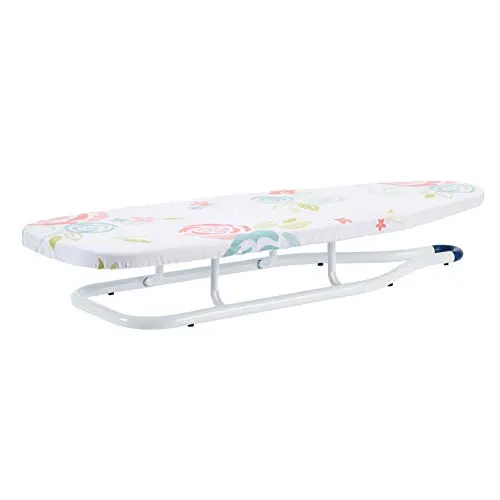
77×29 cm Tabletop Board – Budget-Friendly Workhorse
A budget-friendly tabletop board with a 77×29 cm pressing surface, extra-thick comfort padding, anti-slip feet, and a V-shaped hook for hanging storage. The folding frame and safety lock make it easy to collapse and store between uses.
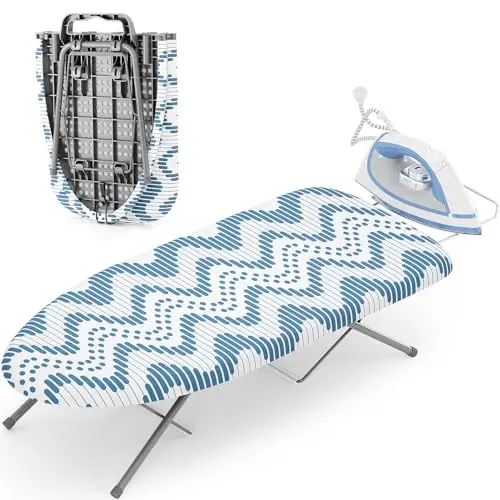
1230D-12 – Compact Board with Iron Rest
A 30×12 folding tabletop board with a breathable mesh panel, a heat-resistant cotton cover, a built-in iron rest, and non-slip feet. It folds to 12×16.5 inches and includes a hanging hook for closet storage.

23.6×14.3 Compact Board – Tiny-Space Pick
A very small tabletop board with a 23.6×14.3 pressing surface, folding legs, non-slip feet, and a machine-washable chevron cover. It folds flat for closet or wall storage and weighs just 2.8 pounds.

Metal Mesh Panel Board – Drawer-Friendly Flat Fold
A 31.5×11.8 tabletop board built around a metal mesh panel, with an 8mm cotton pad, heat-resistant cover, cushioned hinges, and a hanging hook. It folds to about 2 inches thick for drawer or closet storage.

Y82-1501 – Slim Fold with Iron Rest
A gray 31×12 tabletop board with a metal mesh panel, heat-resistant cotton cover, non-slip silicone feet, a dampened folding hinge, and an iron rest. It folds to 1.96 inches thick for tight storage.

WK1232D5-16 – Two-Cover Travel Board
A blue 12×32 tabletop board that folds in half to 12×16, with two replaceable cotton covers, a mesh heat-dissipation layer, adjustable TRP feet, an iron holder, and a hanging hook.

OMUA2024BLACK – Budget Mesh Board
A black 32×12 tabletop board with a metal mesh panel, heat-resistant cotton cover, non-slip silicone feet, and a folding frame that collapses to about 2 inches thick. An iron rest is included.
How We Evaluated These Tabletop Ironing Boards
We didn’t set up every board on a kitchen counter and iron a full wardrobe over several weeks. What we did: cross-referenced 10 tabletop ironing boards from 9 distinct brands across six decision axes – surface size and shape, frame stability, padding and cover quality, folded footprint, iron rest and storage features, and non-slip footing. We triangulated published specifications, feature sets, and owner feedback where available, then mapped each board against realistic buyer profiles for small apartments, dorms, laundry rooms, and travel use. We also weighed how each board folds, whether the cover is replaceable or washable, and whether the iron rest is a real convenience or an afterthought. That meant looking past marketing language and focusing on the details that change daily use: whether the board shifts, whether the cover stays taut, and how much counter space it actually consumes.
The scoring framework weighted real-world fit and performance (70%) – how well each board delivers a stable, usable pressing surface in a small space – against feature differentiation (30%) – unique advantages like integrated iron storage, locking hinges, mesh panels, or spare covers. We have no commercial relationship with any of the brands featured; recommendations track fit and differentiation, not brand preference. If you want the most complete tabletop package, the Joseph Joseph Pocket Max is the pick; if stability is your priority, the Bartnelli BTIB-440 is the better fit. The result is a lineup built for different kinds of small-space ironers rather than a single definition of best.
How to Choose the Right Tabletop Ironing Board
1. What Makes a Tabletop Ironing Board Actually Stable?
A tabletop board lives or dies on stability. Look for a locking hinge or a frame that braces when open, plus non-slip feet that grip a counter rather than skate across it. A board with a narrow footprint can still feel solid if the legs are well braced; a wide board with flex at the fold will still annoy you. If wobble is your main concern, the Bartnelli BTIB-440 is the pick thanks to its secure-lock center hinge and rubber feet.
2. Surface Size and Shape: Matching the Board to Your Ironing Load
Surface size is the other big trade-off. A full-size 43-inch surface lets you press a dress shirt without re-positioning, but it takes more counter room when open. A 32-inch surface is the practical middle ground for most households, while a 23.6-inch compact board is best for collars, cuffs, and quick touch-ups. If you press dress shirts regularly, the Joseph Joseph Pocket Max gives you the most room; if you mostly iron small items, a compact board is easier to live with.
3. Padding, Covers, and Heat Management
Padding and cover quality change how smoothly the iron glides. A metal mesh panel helps heat and moisture dissipate, while a cotton cover with a padded underlay cushions the surface and reduces board lines. Removable or washable covers are worth prioritizing if you iron with starch or spray sizing. A thin cover can make even a good frame feel cheap.
4. Folding, Storage, and Real-World Footprint
Folding is where tabletop boards earn their keep. A bi-fold design that collapses to a true low-profile footprint is easier to stash than a board with protruding legs or a bulky iron rest. Check the folded thickness if you plan to slide it into a drawer, and look for a hanging hook if closet space is tighter than drawer space.
5. Iron Rests and Hanger Details
An iron rest is a small feature that makes a big difference in daily use. A retractable iron rest keeps a hot iron off your counter and folds away for storage, while an integrated iron storage compartment is useful if you want the board and iron to live together. A basic iron holder can work well too, but check that your iron actually fits before relying on it.
6. Budget vs. Premium Tabletop Ironing Boards
Tabletop boards range from budget-friendly to premium, and the sweet spot is usually mid-range. Budget boards often get you a usable surface and basic folding, while premium models add feature uplift like integrated iron storage, thicker padding, or a more stable hinge. For a budget-friendly starting point, the Amazon Basics 77×29 cm board is the value pick; step up only if you need a specific feature.
Frequently Asked Questions
1. Are tabletop ironing boards actually stable enough for regular use?
They can be, but stability depends on the frame and footing more than the size. A locking hinge, braced legs, and non-slip feet matter more than a wide surface. A board that flexes at the fold or slides on a smooth counter will feel unstable even if it looks sturdy. For regular use, prioritize a board with a secure open position and use it on a flat, textured surface. The Bartnelli BTIB-440 is built around this idea, with a locking center hinge and rubber feet.
2. What's the difference between the Joseph Joseph Pocket Max and the Bartnelli BTIB-440?
The Pocket Max is the full-size surface option: it opens to 43 inches, includes an integrated iron storage compartment, and folds into a compact unit with a separate hanging hook. The Bartnelli is the stability-first pick: its secure-lock center hinge, retractable iron rest, and 16×12 bi-fold storage make it easier to live with in a tight laundry corner. Choose the Joseph Joseph Pocket Max if you press shirts and want the iron to store with the board; choose the Bartnelli BTIB-440 if you want a locked-in feel and a smaller folded footprint.
3. How does the Amazon Basics tabletop board compare with the Household Essentials model?
The Amazon Basics 77×29 cm board is the budget-friendly workhorse, with a generous pressing surface and a V-shaped storage hook. The Household Essentials model is more feature-focused, adding a built-in iron rest and a door hanger for vertical storage. If you want the most surface for the least money, Amazon Basics is the practical choice; if an iron rest and hanging storage matter more, Household Essentials is the better fit.
4. Can a tabletop ironing board handle dress shirts and quilting projects?
Yes, within limits. A board with a 32-inch or longer surface can handle dress shirts if you re-position sleeves and collars, while a compact 23.6-inch board is better for touch-ups. Quilting is possible on a tabletop board, but you will want a flat, stable surface and a smooth cotton cover so fabric does not snag. If quilting is a regular hobby, choose the largest surface you can store and pair it with a thicker padded cover for pinning and pressing seams.
5. Do you really need an iron rest on a tabletop ironing board?
Not strictly, but it is one of the most useful extras. An iron rest gives you a safe place to park a hot iron while you adjust a garment, which reduces the risk of scorching a counter or the board cover. A retractable rest folds away for storage, while an integrated iron storage compartment is better if you want the iron and board to live together. If you always set the iron on its heel or use a separate stand, you can skip this feature and prioritize surface size and stability instead.
Final Verdict
For most buyers, the Joseph Joseph Pocket Max is the tabletop ironing board to get. It pairs a genuinely full-size pressing surface with integrated iron storage and a compact fold, which is exactly the combination that makes small-space ironing feel less like a compromise. If stability is your priority, the Bartnelli BTIB-440 is the board we would point to next: its locking hinge and retractable rest make it feel planted. Budget-conscious shoppers should start with the Amazon Basics 77×29 cm board, which offers a generous surface and thick padding for a value price. And if your storage is genuinely tiny, the Amazon Basics 23.6×14.3 compact board is the one to tuck away. Choose by the space you have and how often you iron, and you will end up with a board that disappears when you are done.
