
Best Throw Pillow Inserts – 2026 Reviews

You buy a beautiful pillow cover, stuff in whatever insert is rattling around the closet, and the whole arrangement looks deflated by Tuesday. The corners droop. The pattern warps across the middle. Guests assume you bought the cover at a discount store.
It’s almost never the cover’s fault. Two things separate an insert that holds a crisp square from one that pancakes the moment someone leans on it. The first is sizing math – inserts are supposed to run an inch or two larger than the cover they’re filling, and most people buy them true-to-size. The second is fill quality and rebound: how densely the polyester is packed, how the shell is stitched, and whether the pillow comes back after a night of being squashed behind someone’s back.
We cross-shopped the category the way you would if you had a free afternoon and a tape measure – cotton covers against brushed polyester, sparse fill against generously packed, single inserts against multi-packs. What follows is a market-wide look at which inserts suit which covers, so you can match a pillow to the room you already have instead of rebuilding the room around a pillow.
Best Throw Pillow Inserts – 2026 Reviews
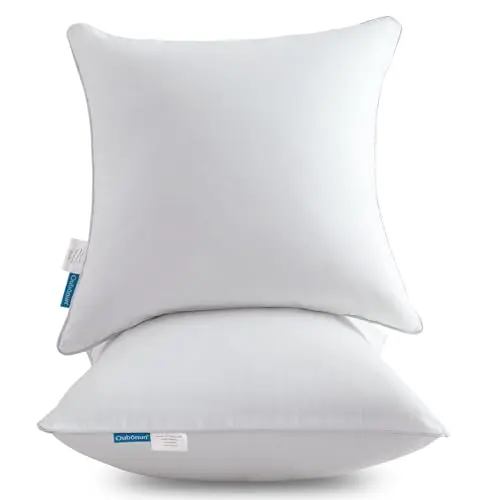
MOMA032 18×18 Cotton Inserts – Loft That Holds Its Shape
A two-pack of 18×18 inserts built on a 100% cotton cover with a dense 3D polyester fill. The cotton shell is breathable and skin-friendly, the fill holds a firm-but-plush balance that works for both decor and leaning, and the zipper closure lets you add or pull fill if you want a different loft.
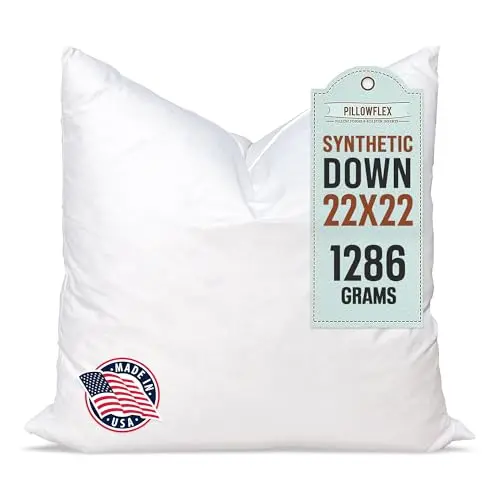
Synthetic Down 22×22 Insert – The Karate-Chop Look
A single 22×22 insert meant for a 20×20 sham, built with a down-like polyester fill inside a poly-cotton shell. It has the dense, softly creased hand of real down, holds its shape without sagging corners, and comes in a size range that covers nearly any sham, lumbar, or accent cover you own.

20×20 Cotton Inserts – Firm Fill for Full Covers
Two 20×20 inserts with a 100% cotton cover and a firm polyester fill. The hidden zipper makes it easy to remove or add fill, the cotton shell is breathable, and both inserts are machine washable with a low tumble dry – a practical setup for couch pillows that get leaned on daily.
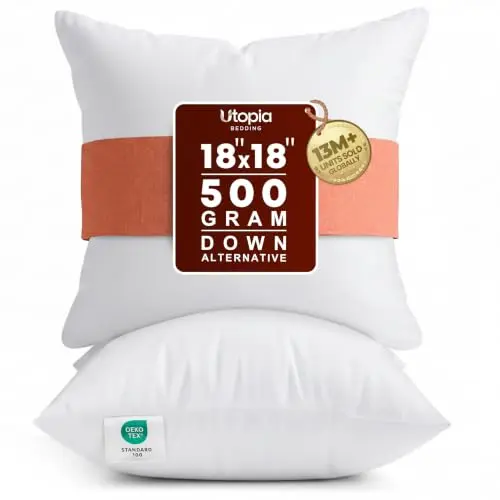
18×18 Virgin Fiber Inserts – The Value Two-Pack
A two-pack of 18×18 inserts filled with 100% virgin fiber and wrapped in a 115 GSM brushed fabric shell. They’re lightweight, supportive enough for casual use, labeled for indoor and outdoor spots like patio furniture, and sit at the entry level of the category.

Cotton 18×18 Single Insert – Crisp Piped Edges
A single 18×18 insert with a 100% cotton cover and hypoallergenic microfiber fill, finished with poplin piping along the edge. It’s the practical way to replace one collapsed pillow without buying a set, and the piping keeps the silhouette crisp inside a cover.

18×18 Brushed Fabric Inserts – Firm Lumbar Support
A two-pack of 18×18 inserts with a 110 GSM brushed fabric cover and 100% virgin microfiber fill, packed at 500 grams per insert for a firm, supportive feel. They’re built for back and lumbar support as much as for decoration, and the heavier fill is meant to resist the slow flattening that plagues cheaper inserts.
How We Evaluated These Throw Pillow Inserts
We didn’t sit on these inserts for months, run repeated hot-wash cycles, or measure loft recovery with calipers. What we did: cross-referenced six throw pillow inserts from six distinct brands across five decision axes – fill type and density, cover fabric and stitching, loft recovery, sizing guidance, and care requirements. We triangulated published specifications, each product’s feature set, and aggregated owner feedback where available, then mapped every insert against the two buyer profiles that dominate this category: the decorator filling a set of covers on a made bed, and the person who just wants a couch pillow that doesn’t collapse behind their back.
Owner feedback was uneven across the lineup, so we weighted the stronger signals more heavily and leaned on published specifications where commentary was thin. Where an insert claimed long-term shape retention, we cross-checked that claim against fill weight and cover construction instead of taking the marketing copy at face value. The scoring framework put real-world fit (70%) first – how completely an insert fills its stated cover size and how it behaves under daily leaning – against feature differentiation (30%): cover material, adjustability, washability, and pack sizes. We have no commercial relationship with any of the brands here, and recommendations track fit and differentiation rather than brand preference.
If you want the low-risk default for standard 18×18 covers, the Oubonun MOMA032 is the pair we’d hand a friend. If you’re chasing that soft, creased hotel-sham look in a larger cover, the Pillowflex Synthetic Down is built for exactly that.
How to Choose the Right Throw Pillow Inserts
1. Throw Pillow Insert Sizing: Measure Tight, Then Size Up
The most common mistake is buying an insert the same size as the cover. Measure your cover corner to corner, pulling the fabric taut along the outer edges rather than trusting the size printed on the tag – handmade and imported covers routinely run an inch off. Then size up: an 18×18 cover wants a 20×20 insert, and a 20×20 cover wants a 22×22. That extra inch or two is what pushes fill into the corners and gives you a clean, full silhouette instead of a pillow with four empty points.
There’s one exception. If you like the relaxed, under-stuffed look – the soft, slightly slouchy pillow on a made bed – buy the insert at or one size below the cover. Just know that a true-to-size insert in a large cover will read flat within a week of daily use. Size range matters here too: the Pillowflex Synthetic Down covers everything from lumbar to 22-inch shams in a single line, which is handy if you’re outfitting more than one shape.
2. Fill Types Compared: Down Alternative, Virgin Fiber, and Microfiber
Almost every insert in this category is polyester in one form or another, so the label matters less than the fill density. Down-alternative clusters are engineered to mimic the soft, creased hand of real down and tend to hold a karate-chop fold. Virgin fiber fills – the 100% virgin fiber called out on many spec sheets – are loftier and springier, good for a fluffy modern look. Microfiber fill is the firmest of the three and the most common choice for back support.
What separates a good insert from a bad one isn’t the fill name, it’s how much of it is inside. An 18×18 insert packed at roughly 500 grams feels noticeably fuller than the sparse builds, and the difference shows up immediately at the corners and along the top edge. Under-filled inserts feel fine the first week and then start to sag along the seam.
3. Cover Fabric and Stitching: The Details You Only Notice Later
The shell does two jobs: it holds the fill in and it controls how the insert feels through your cover fabric. A 100% cotton cover is breathable, quiet, and moves with the fill, which is why it’s the house standard for anything nicer than a budget insert. Brushed polyester shells – often specified in GSM, like 110 or 115 – are softer than plain woven polyester and more tolerant of spot cleaning.
Stitching is the quiet tell. Poplin piping along the edge holds a squarer silhouette and keeps seams from puckering, while a hidden zipper means you can adjust the fill or replace it entirely. Loose, single-stitched seams are where cheap inserts fail first: the fill migrates, the corner goes hollow, and no amount of fluffing brings it back.
4. Loft, Firmness, and How Much Rebound You Actually Need
Loft is how tall the insert sits; rebound is whether it comes back after you lean on it. Both matter more than the initial puff you feel in the package. A plush insert that photographs beautifully but takes a permanent dent is worse than a slightly firmer one that recovers every time.
Firm versus plush is a genuine fork in the road. If the pillows live on a couch and get leaned on, held, or used as a backrest, go firm – the Leeden 20×20 inserts are the pick in this lineup for that job. If they’re purely decorative – a pair on a guest bed, a pillow on a bench nobody sits on – plush is fine and often looks better.
5. Care and Fluffing: Getting Vacuum-Packed Inserts Back to Full
Nearly every insert ships compressed, and the first couple of days matter. Unpack, shake, and pat from the edges toward the center; a short run in the dryer on low with dryer balls does more than any amount of hand fluffing. Don’t judge loft on day one.
Then match your care routine to the shell. Cotton covers on mid-range inserts typically allow machine washing and a low tumble dry. Budget shells often specify spot clean only, and a few insert lines are labeled dry clean only – worth checking before you buy if the pillow lives somewhere messy. Washing restores loft on most inserts, but repeated hot cycles are what break fill down early.
6. How Much Should You Spend on Throw Pillow Inserts?
Inserts break into three rough tiers. Entry-level two-packs are the cheapest way to fill a whole couch, and they’re fine for guest rooms or pillows that get moved rather than leaned on – the tradeoff is lighter fill and a shorter lifespan. Mid-range sets step up to cotton covers, denser fill, and zippers, and that’s where most buyers should land. Premium single inserts cost more per pillow but deliver a down-like hand and sizing options you won’t find in a two-pack.
One practical note: budget is better spent on the right size than on a fancier insert. An entry-level insert in the correct size looks better than a premium one that’s an inch too small. If you want to cover a whole sofa cheaply, the Utopia Bedding 18×18 inserts are the value play; put the savings toward covers.
Frequently Asked Questions
1. What's the difference between the Oubonun cotton inserts and the Pillowflex synthetic down insert?
It comes down to hand and format. The Oubonun MOMA032 is a two-pack with a cotton cover and a moderately firm fill that recovers well – the practical choice for standard 18×18 covers on a couch. The Pillowflex Synthetic Down is a single insert with a denser, down-like hand, sold across a wide size range and built to sit one size larger than your sham. If you want two working pillows and a washable cotton shell, go Oubonun. If you want that soft, creased hotel-sham look in a 20×20 or larger cover, go Pillowflex.
2. Utopia Bedding vs. MIULEE: which throw pillow inserts are fuller?
On paper, MIULEE publishes the heavier fill – roughly 500 grams per 18×18 insert – while Utopia doesn’t specify a number. In practice the gap is mostly about firmness: MIULEE’s virgin microfiber feels denser and more supportive behind your back, while Utopia’s virgin fiber fill is springier but more prone to settling. If you want maximum support for the money, the MIULEE 18×18 inserts have the edge on spec. If you’re outfitting a whole couch on a budget and don’t need back support, Utopia is the smarter spend.
3. How do I fluff vacuum-packed throw pillow inserts?
Give them time and a little heat. Unpack each insert, shake it out, and pat from the edges toward the center to break up compressed fill. Then tumble on low with dryer balls for 15 to 20 minutes, or press the insert flat with both hands a few times and let it rest for 48 to 72 hours. Most inserts reach full loft within a day. If one still feels hollow at the corners after three days, that’s usually a fill density problem rather than a fluffing problem.
4. Are cotton-cover inserts actually better than brushed polyester?
Usually, yes – if the pillow sits against skin. Cotton covers breathe better, feel cooler, and don’t trap heat the way synthetic shells can. Brushed polyester has its own advantages: it’s typically softer straight out of the package, more forgiving of spills, and cheaper. For decorative pillows on a bed, cotton is the nicer choice. For a couch pillow that gets used hard or lives near a patio door, brushed fabric is the more practical one.
5. Can one insert work for both decoration and back support?
Sometimes, but it’s a compromise. Decorative inserts are usually filled for looks – plush, full, soft – while back support wants density and rebound. A firm insert in a decorative cover can look overstuffed and stiff; a plush one used as a backrest pancakes after a few weeks. If you need one pillow to do both, aim for a mid-weight insert with a zipper so you can correct the loft yourself. And if you’re only rescuing one collapsed pillow rather than redoing the room, the Phantoscope 18×18 insert is the sensible single-piece swap.
Final Verdict
For most people, the Oubonun MOMA032 is the answer: a cotton cover, a fill that recovers after a movie night of leaning, and a zipper in case you want more loft. If budget is the deciding factor, the Utopia Bedding 18×18 inserts get you a full-looking couch for less – just expect to fluff them regularly and replace them sooner.
And if the look you’re after is that softly creased down pillow on a hotel bed, the Pillowflex Synthetic Down is built for it – pair the 22×22 with a 20×20 sham and it reads full from across the room. Whatever you pick, buy one size up from your cover. That decision matters more than which brand ends up in your cart.
