
Best Towel Warmer Brands – 2026 Reviews

A warm towel is one of those small luxuries that sounds ridiculous until you use one in a hotel bathroom and then spend the rest of the trip wondering why your own bathroom doesn’t have one. The good news is that this is no longer a spa-only purchase. The category has settled into a few clear formats, and most of them are priced like a small appliance rather than a renovation.
Two things separate a towel warmer you’ll use every morning from one that ends up in a closet by month three. The first is even heating – a bucket that warms the outside of a folded towel and leaves the middle cold is worse than useless, because now you have to think about it. The second is routine fit: a long timer without a delay function doesn’t help if you shower at the same time every day, and a drum sized for facial towels won’t do anything for a bath sheet.
We cross-shopped the brands that actually build this category – appliance names, spa-supply names, and newer direct-to-consumer labels – and sorted them by what each one is genuinely good at instead of which spec sheet looks longest. Some are built for hot-towel service. Some are built for a family fighting over one bathroom at 7 a.m. Here’s how they line up.
Best Towel Warmer Brands – 2026 Reviews
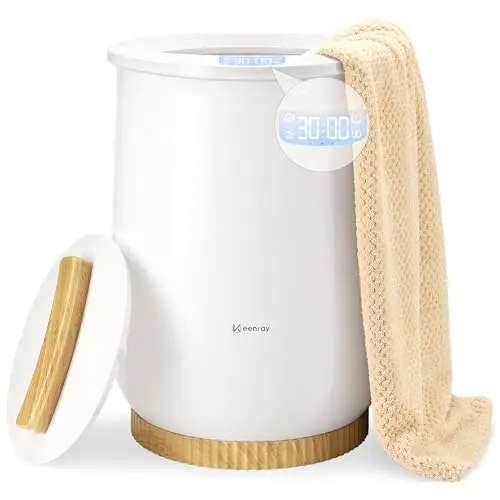
CL1Plus – Smart Delay Timer and Stainless Liner
The CL1Plus is Keenray’s upgraded bucket, and the upgrades are the ones that matter: a stainless steel liner that resists corrosion, a touch control panel in place of the single button, and a 24-hour delay timer so towels are warm when you walk in rather than when you remember to press something. The 360-degree system warms the floor and walls of the 20L drum, and a fragrance disc in the lid scents the air as it works.
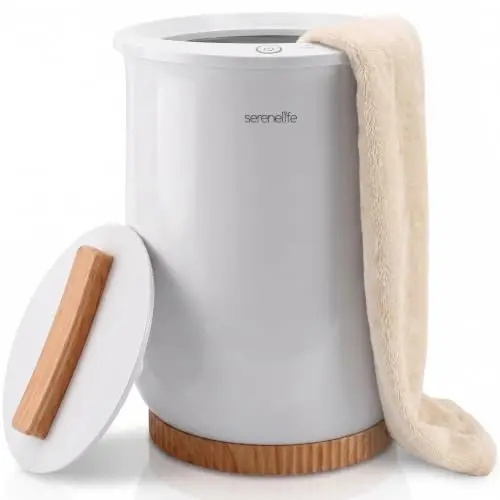
SLTLW100 – Insulated Double-Wall Lid
A round, compact bucket with a double-walled lid that traps heat inside and stays cool on the outside. One touch starts the cycle and it shuts itself off after an hour. It holds two full-sized towels or a throw blanket, and the smooth white shell disappears into almost any bathroom.
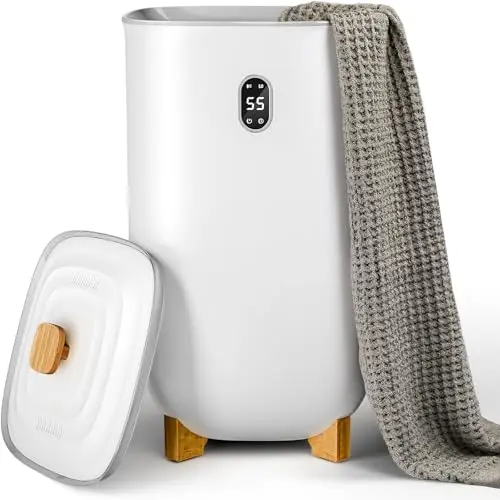
TB82 – 40L Capacity for Blankets and Robes
A 40L drum – the biggest in this lineup – with an LCD panel, two heat modes, and keep-warm cycles of 20, 40, 60, or 90 minutes. It’s built for blankets and robes as much as towels, and the lid holds a fragrance disc.
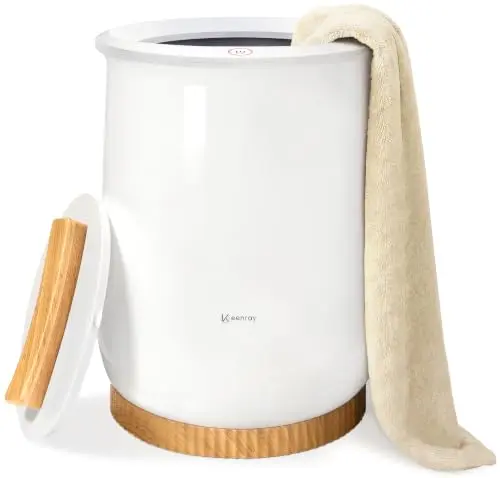
CL1 – One-Button Warmth for Everyday Showers
The bucket that put Keenray on the map in this category, and still a sensible starting point: a single button, near-instant heat, a 60-minute cycle, and a 21L drum that fits two oversized bath towels. The lid lifts off so the interior can be wiped down.

E1819Z-US – Five-Side Heating with Aroma Tray
VEVOR’s bucket heats from five sides – the floor plus all four walls – and lets you pick from three temperature levels and four timer lengths. It’s ETL and FCC certified with flame-retardant housing, and the top holds aromatherapy tablets.
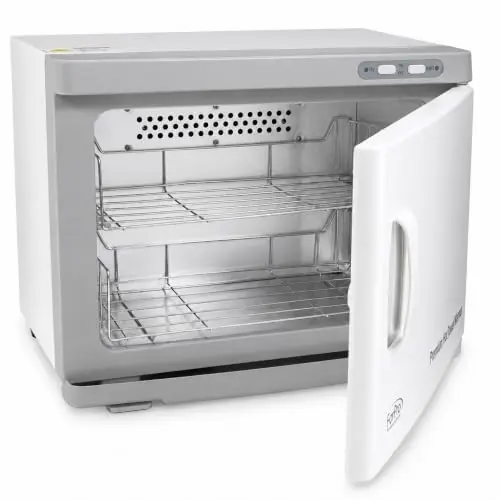
Premium Hot Towel Warmer – 23L Cabinet with Dual Stainless Racks
A different animal from the buckets: a 23L insulated cabinet with two stainless steel racks, a drip tray, and a simple on/off switch. It reaches roughly 180F in about half an hour and holds around two dozen facial-sized towels – the setup you’ve felt at a spa or barbershop.
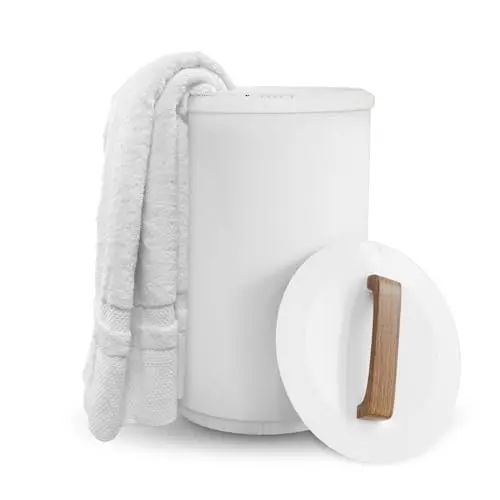
TW-ST1912 – Four-Stage Timer with Wood Handle
A thermos-style bucket with a wood handle on the lid and four timer presets: 30 minutes, 1 hour, 2 hours, or 4 hours. It fits two oversized towels or a pile of smaller ones, and it’s ETL certified with a 30-day return window and a 12-month warranty.
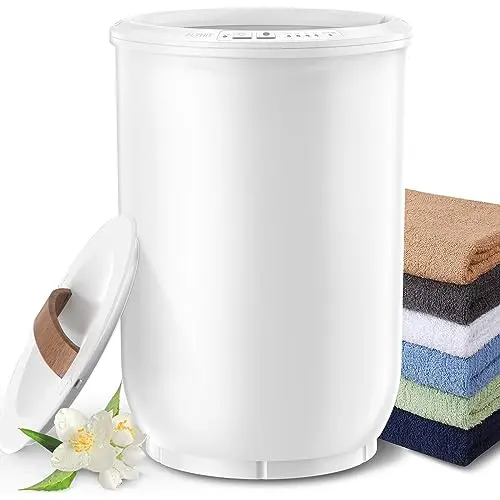
Large Bucket Warmer – 450W with Triple-Layer Safety
A 450W bucket with a wooden lid, a 20L drum, and a triple-layer temperature control that cuts power if the internal bucket gets too hot. The timer runs 1 to 4 hours, and the whole thing is ETL certified with a fire-resistant plastic shell.
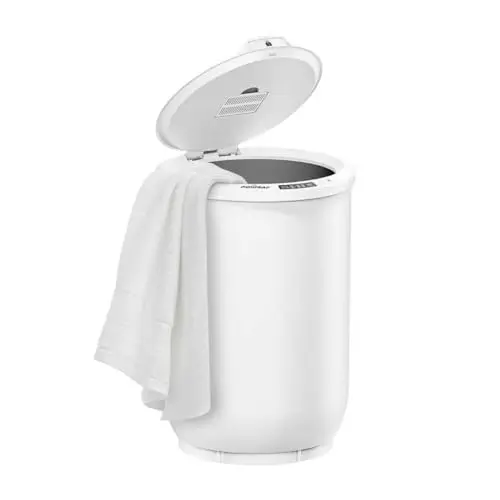
TW-ST1912C – Child Lock and Aroma Tray
A 20L bucket with a one-piece flip lid, four timer settings running up to four hours, a child lock, and an overheat warning. It runs quietly, moves easily between rooms, and the lid includes an aroma tray for scented discs.
How We Evaluated These Towel Warmer Brands
We didn’t run controlled heat-output measurements or multi-month durability trials. What we did: cross-referenced nine towel warmer models from eight distinct brands across six decision axes – drum capacity and shape, heating method and heat distribution, timer behavior and auto shut-off, safety certifications and flame ratings, liner and shell materials, and everyday footprint plus cleanup. We triangulated published specifications against the routines these units actually get used for, audited each listing for the details that change a morning, and weighed owner feedback where available to see which features survived contact with daily use. We also pressure-tested the marketing language, since even heating means something different on a five-sided element than on a single bottom plate. We compared how each unit announces its state – indicator lights, readable displays, warning labels – because a towel warmer you have to think about is one you stop using.
The scoring framework weighted real-world fit (70%) – how reliably a unit delivers warm towels for the way people actually bathe, dress, and store things – ahead of feature differentiation (30%), which covers the timers, liners, aroma trays, and safety systems that separate one bucket from another. Where a spec sheet was richer than the available feedback, we leaned on the specs and said so in the write-up. We have no commercial relationship with any of the brands featured, and recommendations track fit and differentiation rather than brand preference. If you want the most complete package in this category, the Keenray CL1Plus is the pick; if simplicity matters more than features, the SereneLife SLTLW100 earns its place.
How to Choose the Right Towel Warmer Brand
1. Towel Warmer Buckets vs Cabinets: Which Shape Fits Your Bathroom
Almost every model in this category falls into one of two shapes. Bucket-style warmers are round or squarish tubs with a lid on top, usually around 20 to 21 liters, that warm towels by contact and convection. They’re portable, they almost always include a timer, and they’re sized for a couple of bath towels. Cabinet warmers are rectangular boxes with racks inside. They run hotter, hold far more small items, and are built for repeated service rather than one person’s shower.
The tradeoff is speed versus heat. Buckets reach a comfortable temperature in minutes and run on a timer; cabinets take closer to half an hour and are usually controlled with a simple on/off switch. If you’re setting up hot-towel service for a salon, spa room, or barbershop, the ForPro Premium Hot Towel Warmer is the shape that makes sense. For a home bathroom, a bucket is almost always the better fit.
2. Why Heat Distribution Matters More Than Top Temperature
A single bottom-plate heating element warms the bottom of your towel stack and leaves the top folds cool. Better designs heat from the floor and the walls – sometimes marketed as five-sided or 360-degree heating – and that difference is obvious when you’re wrapping up in something that’s supposed to be uniformly warm.
The other variable is what you load. Thick cotton terry needs more time and more contact than a thin towel, and stacking three on top of each other guarantees cold spots. Load loosely and give the drum room to breathe. It’s also worth resetting expectations: warm, not hot, is the right target for a bath towel. Anything approaching hot-towel service temperature is meant for hands and faces, not full-body use.
3. How Much Capacity Do You Need for Oversized Towels?
20 to 21 liters is the standard bucket size and comfortably holds two 40 by 70 inch bath towels, or one towel plus a robe. A cabinet is a different calculation entirely – its interior holds far more pieces, but they’re washcloth and facial-towel sized rather than plush bath sheets. If blankets, robes, or several people’s towels need to fit in one cycle, step up: the AGLUCKY TB82 goes to 40 liters, roughly double a standard bucket.
Match capacity to your actual bottleneck. One person showering once a day needs a standard bucket. A family sharing one bathroom between 7 and 8 a.m. needs volume. And a household that mostly wants warm pajamas and throw blankets needs volume more than heat.
4. Timers, Auto Shut-Off, and Safety Certifications Worth Checking
Every bucket here has auto shut-off, but the ranges run from about 20 minutes to four hours, and some add a delay timer so the cycle starts before you get home. Longer cycles are convenient; shorter minimums are safer if you’re the type to forget things.
Look for an ETL or UL listing – a third-party safety mark rather than a self-declared claim – and for housings described as flame-retardant. A hot-surface indicator is worth having, because the inside of these drums genuinely gets hot enough to sting. And follow the manufacturer’s own care note to unplug the unit when it isn’t in use. That habit is what separates a warm towel from a much worse morning.
5. Keenray vs SereneLife: Two Towel Warmer Brands, Two Different Buyers
These two brands bracket the category neatly. Keenray’s approach is feature density: stainless liners, delay timers, temperature levels, fragrance discs, and touch panels. SereneLife’s is restraint – one button, one heat level, one 60-minute cycle, a well-insulated lid, and a footprint that fits a small bathroom without rearranging anything.
If you’ll use it daily and want it to feel like part of a routine, the Keenray CL1Plus is the more satisfying machine. If you want something a houseguest can operate without instructions, SereneLife’s philosophy is the right one, and the savings are real.
6. The Durability Question Every Towel Warmer Buyer Should Ask
These are hot, damp appliances with heating elements and plastic shells, and the honest answer is that longevity is the weakest part of the category. Stainless steel liners resist corrosion better than bare plastic drums, and cabinet units with metal racks hold up better than tubs where a damp towel sits against the wall.
Warranty terms here run from 12 months to two years, and support quality varies as much as the hardware. Buy from a brand that answers messages, dry the interior between uses, and don’t leave a damp towel sitting in a warm drum overnight. Those three habits do more for lifespan than any spec on the box.
Frequently Asked Questions
1. Keenray CL1Plus vs AGLUCKY TB82: which towel warmer is better for a family?
They solve different problems. The AGLUCKY TB82 wins on volume – 40 liters means robes, blankets, and several towels can share one cycle, which matters when multiple people shower in the same window. The Keenray CL1Plus wins on control: a delay timer, four heat durations, three temperature levels, and a stainless steel liner that should outlast a plastic drum.
For two adults on staggered schedules, the CL1Plus is the more pleasant daily machine. For a busy family bathroom where capacity is the bottleneck, go with the AGLUCKY TB82. Either way, measure the floor space first – both are tall units with lids that need clearance.
2. SereneLife vs VEVOR: which budget towel warmer brand is the better buy?
Both sit in the entry tier, and they trade off differently. The VEVOR gives you more hardware for the money – five-sided heating, three temperature levels, and four timer lengths – but it’s the bulkier of the two and its reliability record is less settled. The SereneLife offers one heat level and one cycle length, wrapped in a compact, well-insulated body that’s easy to live with in a small bathroom.
If you want adjustable warmth and have the floor space, take the VEVOR. If you want the simplest thing that reliably works, take the SereneLife SLTLW100.
3. Do you put wet towels in a towel warmer?
Mostly no. A towel warmer is a warmer, not a dryer. Several manufacturers here explicitly warn against loading damp towels, and the ones that allow it ask you to wring them out first. Wet fabric holds heat unevenly, encourages mildew inside the drum, and in a closed bucket it leaves a musty smell that lingers long after the towel dries.
Start with dry towels, or dampen-and-wring only for hot-towel service in a rack-style cabinet with a drip tray. And skip synthetic fabrics entirely – polyester and blends aren’t rated for these temperatures.
4. How much capacity do you need for oversized bath towels and robes?
A 20 to 21 liter bucket handles two oversized bath towels, or one towel plus a robe, which covers most single-person households. Add a second regular user, or a habit of warming blankets and pajamas, and you’ll want more room – 40 liters is roughly double and stops the cramming that causes cold spots.
Cabinet-style warmers are a separate case. Their 23-liter interiors hold many more pieces, but they’re sized for washcloth and hand-towel formats rather than thick bath sheets, so don’t buy one expecting to warm a plush body towel.
5. How long do towel warmers last?
Longer than a year, usually, but this isn’t a buy-it-once category. Heating elements and control boards are the common failure points, and plastic housings take a beating from constant heat and humidity. A stainless steel liner and metal racks slow corrosion; keeping the drum dry between uses helps more than most people expect.
Warranty coverage ranges from 12 months to two years, so factor it into the decision. A slightly pricier unit with a longer warranty and responsive support is often the better math than the cheapest bucket on the page.
Final Verdict
For most bathrooms, the Keenray CL1Plus is the towel warmer to buy. The stainless liner, delay timer, and temperature control make it the one that still feels worth owning six months in, and its drum covers everyday use without taking over the room. If you’d rather keep it simple and spend less, the SereneLife SLTLW100 is the easiest unit here to live with – one button, one honest cycle, a lid that stays cool.
Families who want to warm robes and blankets alongside towels should go straight to the AGLUCKY TB82 and its 40L drum. And if you’re setting up hot-towel service for a salon or treatment room, the ForPro cabinet is the only shape here built for that job.
