
Best Travel Adapter Converters – 2026 Reviews

The first time you push a two-prong charger into a wall socket in Rome and watch it sag under its own weight, the romance of international travel loses a little shine. Travel adapters are one of those small purchases that can quietly wreck a day – a loose fit, a blown fuse, or a single USB port when four people need to charge before dinner. Get it right and you never think about it again.
The confusion starts with the name. Almost everything sold as a travel adapter converter is an adapter only: it changes the shape of the plug, not the voltage coming out of the wall. That distinction drives everything else, from whether your hair dryer survives the trip to why some units cost several times more than others. Past that, the real separators are plug coverage, USB power budget, and how securely the thing sits in an outlet.
We compared adapters across the whole spread – tiny single-region cubes, universal all-in-ones, and multi-packs built for a two-week European loop – and sorted them by the kind of trip they actually suit. Whether you want one brick that handles every continent or a cheap two-pack that lives in your suitcase permanently, there’s a right answer below.
Best Travel Adapter Converters – 2026 Reviews
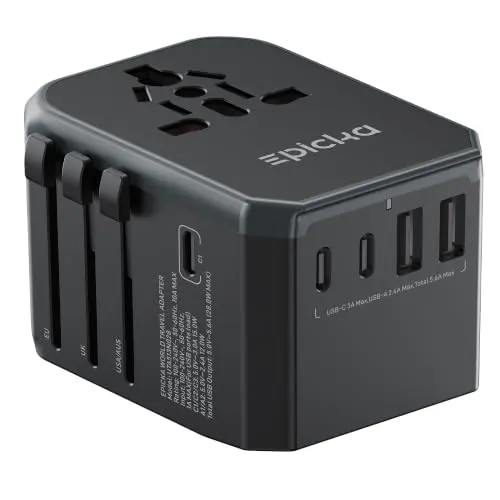
TA-105+ – Six Devices From One Cube
A four-plug universal adapter with six charging ports in a pocket-sized cube. One AC socket, three USB-C, and two USB-A cover a family’s devices from a single wall outlet, and the fuse system is one you can service yourself.
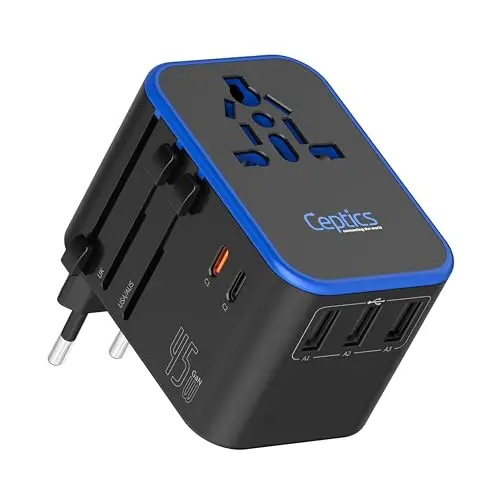
UP-11KU – 45W PD for Laptop Days
A universal adapter built around one genuinely powerful USB-C port. Two USB-C, three USB-A, and a universal input socket give you seven ways to charge, with laptop-class output on the Power Delivery port.
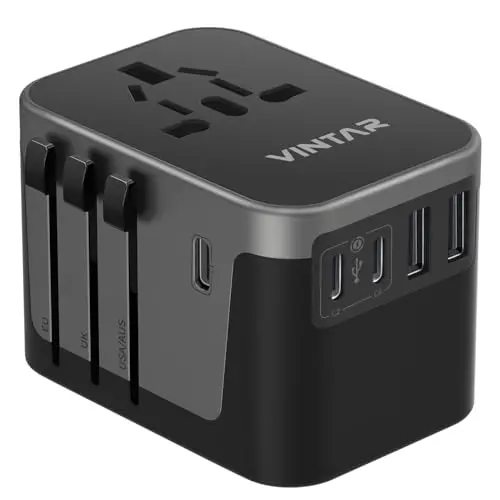
JY-305B-C3 – 30W Across Three USB-C Ports
A thirty-watt universal cube with an unusual emphasis on USB-C. Three USB-C ports, two USB-A ports, and a universal AC outlet share one compact body, and a storage pouch keeps it tidy in transit.
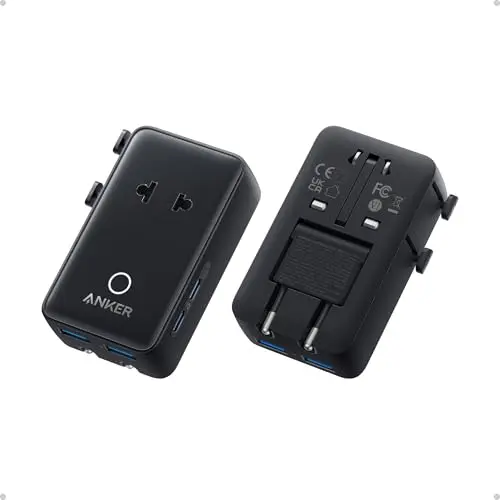
Nano Travel Adapter – Pocket-Sized Five-Device Hub
The most packable universal adapter here. A credit-card footprint, retractable pins, and a two-pin AC outlet make it a jacket-pocket companion for phones, earbuds, and watches.
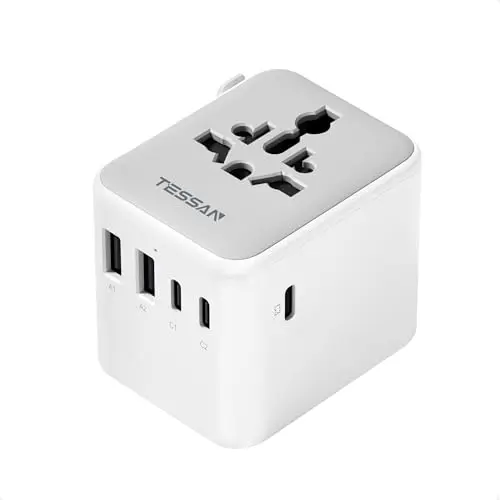
TS-WTA08 – Six Ports in a Compact Cube
A balanced universal cube with one AC outlet and five USB ports. Three USB-C and two USB-A share a 28W budget, and dual 10A fuses add a safety layer most rivals skip.
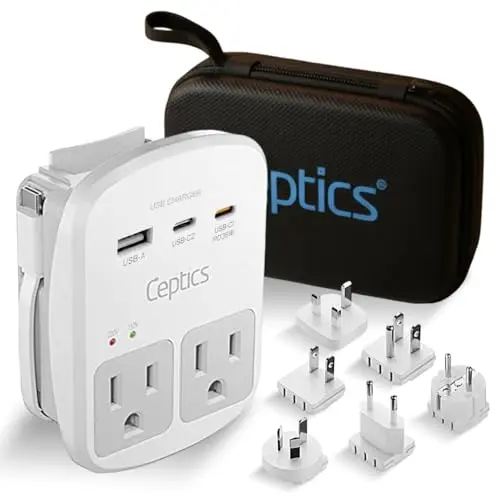
WPS-2B+ Kit – Surge Protection and a Voltage Indicator
A traveler’s kit rather than a single cube: two US outlets, three USB ports including a 35W PD USB-C, six interchangeable plug adapters, a USB-C cable, and a travel pouch.
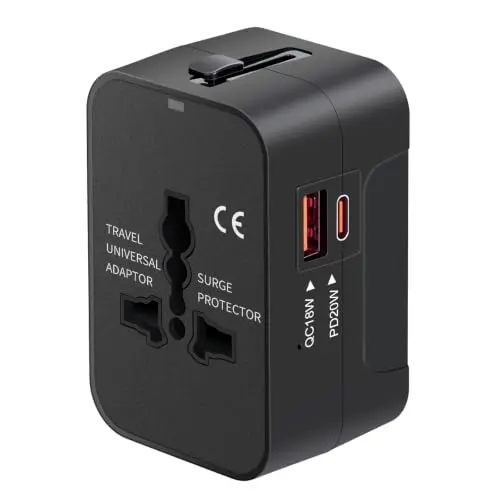
HHT202A – Lightweight Worldwide Backup
A light, low-cost entry into worldwide plug coverage. Three AC outlets, a 20W PD USB-C port, and dual 8A fuses in a body that weighs barely more than a smartphone.
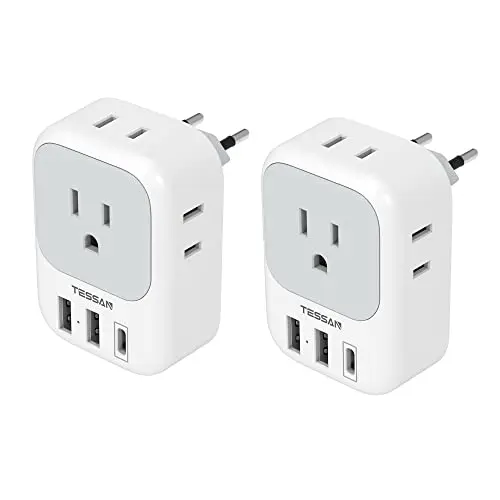
TS-161-EU-C-PD – Two-Pack for European Trips
Two Europe-only adapters, each turning one Type C socket into four AC outlets and three USB ports. Built for hotel rooms where outlets are scarce and travelers are not.

OB3W3CT – Double Up for Europe
A two-pack of Europe-only adapters with three AC outlets and four USB ports each. Straightforward, compact, and easy to leave permanently in a suitcase.

HN23T – Tiny Euro Adapter for Light Charging
The lightest adapter in this roundup: two AC outlets and three USB ports in a body small enough to forget. A nightstand charger for light electronics abroad.
How We Evaluated These Travel Adapter Converters
We didn’t plug these adapters into outlets in twelve countries or measure voltage output with a meter. What we did: cross-referenced 10 travel adapter models from 8 distinct brands across six decision axes – plug and socket coverage, USB power budget, physical footprint and weight, fuse and safety architecture, device compatibility with dual-voltage electronics, and how well each one handles several devices at once. We triangulated published specifications, feature sets, and owner feedback where available, then mapped each option to representative traveler profiles: the business traveler hauling a laptop, the family charging four phones, and the light packer who wants nothing extra in the bag.
The scoring framework weighted real-world fit for a traveler’s actual routine (70%) – how many devices it charges, how securely it sits in an outlet, whether it covers the regions someone is really visiting – against feature differentiation (30%) – things like power delivery wattage, surge protection, spare fuses, and plug-lock mechanisms that separate one option from the next. We have no commercial relationship with any brand featured here; recommendations track fit and differentiation, not brand preference.
One axis we weighed heavily is the one most travelers miss: almost none of these products convert voltage, so dual-voltage device support matters more than anything printed on the box. If you’re traveling with a laptop and phone only, the Ceptics UP-11KU covers the power-hungry end; if you want one no-fuss cube for everything else, the EPICKA TA-105+ is the safer default.
How to Choose the Right Travel Adapter Converter
1. Adapter vs. Converter: The Difference That Ruins Trips
Almost everything sold as a travel adapter converter is an adapter. It changes the shape of the pins so your plug fits the wall. It does not change the electricity. A voltage converter – a separate, heavier device – steps 220V down to 110V or up the other way, and it’s what high-wattage heating appliances actually need.
The good news: phones, laptops, tablets, camera chargers, and most modern electronics are dual voltage, rated 100-240V, and only need the pins re-shaped. The bad news: hair dryers, straighteners, curling irons, and some coffee makers usually aren’t. If the label says 120V only, no adapter in this roundup will help you.
2. Which Plug Types Does Your Travel Adapter Need to Cover?
Four standards do most of the work. Type A covers the US, Canada, Japan, and Mexico. Type C is the two-pin European plug used across most of the continent. Type G is the UK, Ireland, Singapore, and Hong Kong. Type I handles Australia, New Zealand, China, and Argentina.
A universal travel adapter carries all four in one body and typically claims coverage of 150 to 200+ countries. A region-specific adapter – the ones sold as Europe-only or UK-only – is cheaper, smaller, and lighter, but it stops working the moment your itinerary crosses a border. Multi-country trip or frequent flyer, pay for the universal. One city for one week, the regional model is the smarter buy.
3. How Much USB Power Do You Really Need?
Count the things you charge and how fast you want them done. A 20W USB-C port tops a modern phone quickly but won’t run a laptop. A shared 28W to 30W budget across five ports keeps a family moving, though each device slows as more get added. A 45W Power Delivery port is the threshold where USB-C laptops become realistic.
If your bag is a phone, earbuds, and a watch, don’t overpay for wattage you won’t use – the Anker Nano Travel Adapter handles that load in a genuinely pocket-sized body. If a laptop comes along, prioritize one high-wattage PD port over raw port count, because five slow ports won’t charge a laptop overnight.
4. Universal All-in-One vs. Region-Specific Two-Packs
Universal adapters are the flexible choice, but flexibility has a cost: they’re heavier, bulkier, and more expensive than a fixed-plug unit. A region-specific two-pack flips the tradeoff – two small adapters for about what one universal costs, each with more AC outlets than a cube typically offers.
For a ten-day loop through France, Italy, and Spain, that’s the better math, and the TESSAN TS-161-EU-C-PD two-pack is built exactly for it. For anyone whose calendar jumps between London and Berlin, a universal adapter earns its space in the bag.
5. Fuses, Safety Shutters, and Cruise Ship Rules
Every adapter here routes power through a fuse. A replaceable fuse with a spare in the box is worth more than a slightly higher port count, because a blown fuse ends the adapter’s usefulness for the rest of the trip. Safety shutters block the live contacts when nothing is plugged in, and a plug lock mechanism keeps the pins from sliding back into the body mid-charge.
Then there’s surge protection. Counterintuitively, many cruise lines ask passengers to leave surge-protected devices at home, so adapters without it – most of this lineup – are the safer bet on board.
6. What Each Price Tier Actually Buys You
Entry-level adapters cover the plugs, add a couple of USB ports, and stop there. They work, but the plastic feels lighter, the fuses may not be replaceable, and the port count is modest.
Mid-range is where most travelers should land: three to five USB ports including USB-C, a replaceable fuse with a spare, plug lock, and a warranty measured in years rather than months. If you want worldwide coverage at the entry-level end, the NEWVANGA HHT202A is the value play, while cubes like the EPICKA TA-105+ sit at the top of the mid-range.
The premium tier buys real power delivery – 35W to 45W USB-C – plus surge protection, voltage indicators, included cables, and longer support windows. You’re paying for laptop-capable output and better safety electronics, not a fancier logo.
Frequently Asked Questions
1. What's the difference between the EPICKA TA-105+ and the Ceptics UP-11KU?
They’re aimed at different travelers. The EPICKA TA-105+ spreads its power across six ports – three USB-C, two USB-A, one AC – and adds a replaceable 10A fuse with a spare plus a two-year warranty. It’s the better family adapter because everyone gets a port.
The Ceptics UP-11KU instead concentrates output in a single 45W Power Delivery port, which is the difference between a laptop trickling and a laptop charging. It also throws in a universal input socket and an 8A fuse with a spare. Carry a laptop and it’s the stronger choice; charge phones and accessories and the port spread wins. For most trips, the EPICKA TA-105+ is the one we’d pack.
2. Do I need a voltage converter for a hair dryer or straightener?
Probably, and definitely not one of these. Every product in this roundup is an adapter only – it changes pin shape, not electrical pressure. A hair dryer built for 120V plugged into a 220V socket through an adapter will either die or run dangerously hot.
Check the label. If it reads 100-240V or dual voltage, an adapter is all you need. If it reads 120V only, you need a proper step-down converter rated for the appliance’s wattage, and those are heavy and rarely worth packing. Most experienced travelers buy a dual-voltage travel dryer at the destination instead.
3. Anker Nano Travel Adapter or NEWVANGA universal: which is the better minimalist pick?
Both are light, but they solve different problems. The Anker Nano is the more refined object: credit-card footprint, retractable pins, smart temperature control, and a 2-pin AC design that removes a lot of shock anxiety. The catch is that outlet – no grounded three-prong plugs, so a grounded laptop brick won’t fit.
The NEWVANGA gives you three AC outlets and a 20W PD USB-C port at about the same weight, but owner reports suggest the build isn’t as tight and the slider mechanisms are the weak point. For a carry-on-only traveler with phones and earbuds, the Anker body wins. For flexibility at the wall, the NEWVANGA does more.
4. Will a universal travel adapter work on a cruise ship?
Usually yes, with one caveat. Cruise lines and airlines generally prohibit devices with surge protection because the ship’s electrical system is sensitive to it. Most adapters here – including the TESSAN, One Beat, HANYCONY, and NEWVANGA models – are listed as having no surge protection, which is exactly the quality the cruise lines ask for.
The Ceptics WPS-2B+ kit is the exception, since it advertises built-in surge protection. That makes it a great hotel adapter and a questionable cruise companion. Cabin outlets are also limited, so a multi-port unit with one AC socket and several USB ports tends to be more useful than a power strip.
5. Which travel adapter should I pack for a multi-country trip through Asia and Europe?
You need a true universal body. The VINTAR universal travel adapter is the most balanced option for that itinerary: Type A, C, G, and I plugs cover 150+ countries, and three USB-C ports plus two USB-A give you more fast-charge slots than most cubes. The 30W shared USB budget handles phones, tablets, and accessories without a laptop.
If a laptop is coming, jump to a 45W PD port instead. And if you’re only doing Europe, a cheaper Type C two-pack frees up budget for something else.
Final Verdict
For most travelers, the EPICKA TA-105+ is the answer. It covers the four plug standards that matter, spreads six ports across a family’s worth of devices, and ships with a spare fuse – the details that separate a good adapter from one that strands you.
Working from the road? The Ceptics UP-11KU earns its extra weight with a 45W Power Delivery port that actually charges a laptop, and the Anker Nano Travel Adapter is the pick when bag space is the binding constraint. If you want the budget-friendly route to worldwide coverage, the NEWVANGA HHT202A is hard to argue with.
Match the adapter to the trip, not the other way around: universal for multi-country itineraries, a two-pack for a single European base, and one high-wattage PD port the moment a laptop joins the bag.
