
Best Travel Adapters For Portugal – 2026 Reviews

You land in Lisbon, drop your bag, and run straight into the same small puzzle every trip to Portugal produces: two round holes in the wall, a hotel room with exactly two sockets, and four devices that all want to be charged before dinner. Portugal runs on 230V power through Type C and Type F outlets, so nothing you packed for the US plugs in directly.
The adapter you buy matters less than two things most people haven’t thought through yet. First, whether a plain Type C plug is enough or you want a universal body that also covers the UK if the trip continues north. Second, how many outlets and USB ports you can realistically live with when the room has two sockets and four chargers competing for them.
We compared the travel adapters sold for Portugal across the major brands – from tiny five-port cubes to full universal kits with interchangeable plug heads – and weighed plug coverage, outlet count, USB-C output, safety hardware, and warranty against what a Portugal trip actually demands. Here’s how they stack up.
Best Travel Adapters for Portugal – 2026 Reviews
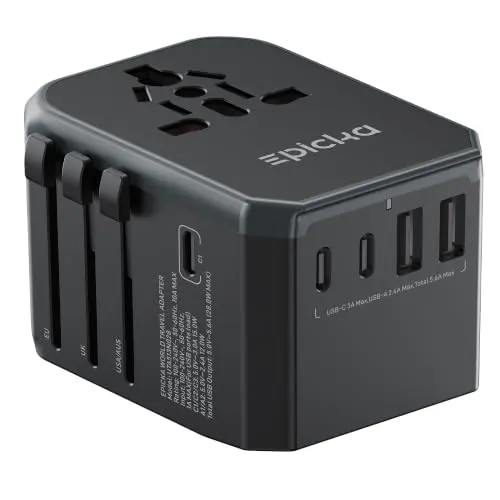
TA-105+ – Six-Device Universal Charging Cube
A palm-sized cube with four retractable plug heads tucked inside. Slide out the Type C head for Portugal and keep going with UK, US, and Australia coverage for the rest of the trip. One AC socket and five USB ports let you charge six devices from a single wall outlet, with a replaceable 10A fuse sitting behind safety shutters.
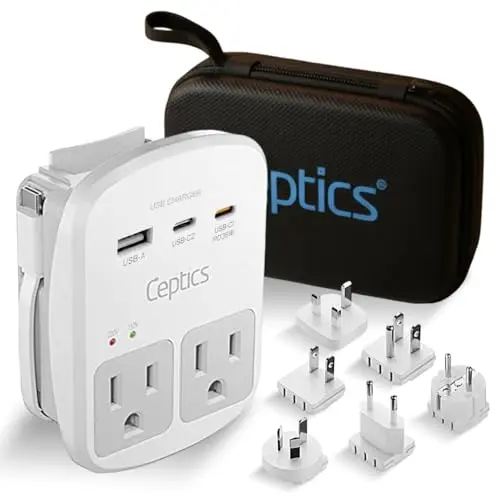
WPS-2B+ – Surge-Protected Universal Kit with 35W PD
A kit rather than a cube. The main body carries two US outlets, USB-A, USB-C, and a 35W USB-C PD port, while six interchangeable plug heads cover Europe, the UK, the US, Australia, and Japan. Built-in surge protection and a voltage indicator are the real differentiators.
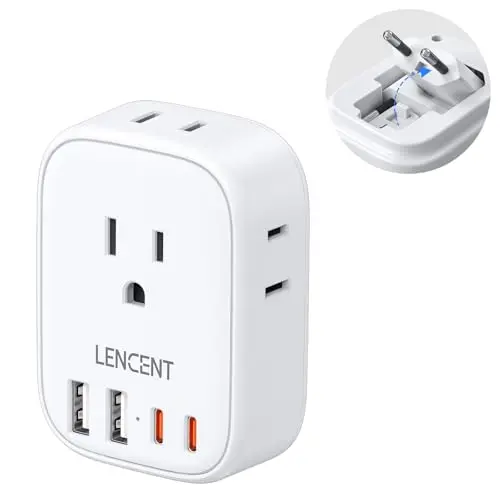
PA050USEU – Foldable Eight-Port Type C Adapter
Eight ports in a body that folds flat. One Type C socket becomes four US outlets plus two USB-C and two USB-A ports, and the folding prongs protect both the plug and whatever else is bouncing around in your bag.
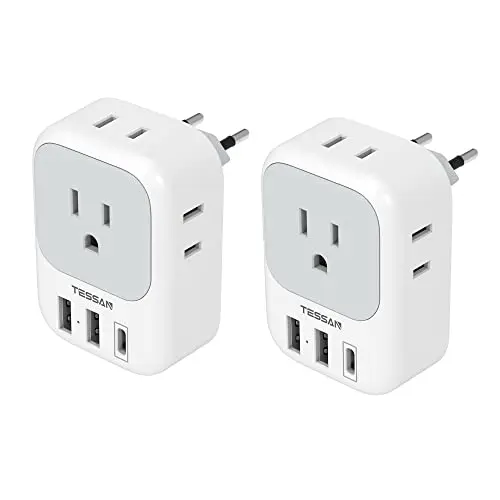
TS-161-EU-C 2-Pack – Two Adapters for Two Travelers
Two identical Type C adapters, each turning one European socket into four US outlets plus three USB ports. Sized for a couple or a family where a single adapter in the room isn’t going to cut it.

OB3W3CT 2-Pack – Three Outlets and Four USB Ports
A compact two-pack that turns one Type C socket into three US outlets and four USB ports. Built for travelers who want a spare adapter waiting in the suitcase and a low profile in the bag.
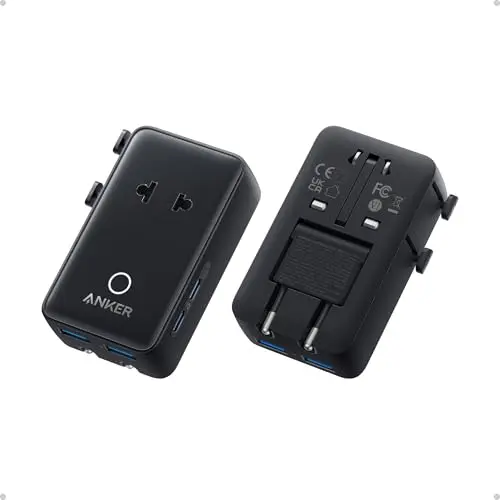
Nano Travel Adapter – Pocket-Sized Universal Charger
A credit-card-sized universal adapter with retractable pins and a 2-pin AC socket. Two USB-C and two USB-A ports share 20W, and the whole thing folds into something closer to a thick coaster than a cube.
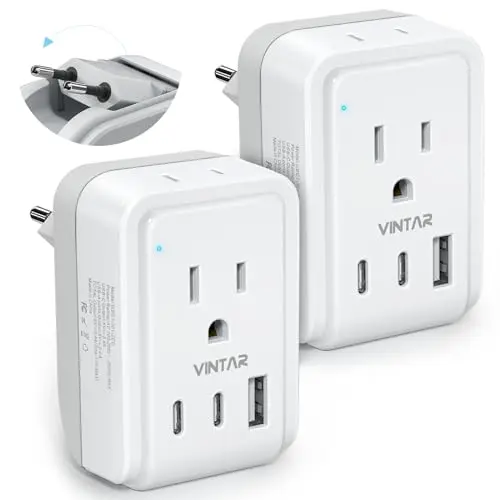
USC1-301-2CU 2-Pack – Foldable Pins, Two Adapters
A foldable Type C two-pack. Each unit offers two US outlets and three USB ports, one of them a 17W USB-C, in a body whose pins tuck away cleanly for transit.

HN23T – Ultra-Compact Five-in-One Adapter
The smallest and simplest adapter in this lineup. Two US outlets and three USB ports, two of them USB-C, in a body barely bigger than a deck of cards.

771 – European Extension Cord with USB
An adapter with a three-foot cord. That extra reach turns a badly placed European wall socket into a usable bedside or desk setup, with three US outlets and four USB ports waiting on the other end.
How We Evaluated These Travel Adapters for Portugal
We didn’t plug these into a Lisbon hotel wall for a week. What we did: cross-referenced 9 travel adapter models from 9 distinct brands against six decision axes – plug-type coverage, AC outlet count, USB port count and output wattage, physical footprint and weight, safety hardware like fuses and surge protection, and warranty length. We triangulated published specifications, feature sets, and owner feedback where available, then mapped each option against the realities of Portuguese travel: Type C and Type F sockets, 230V supply, and the dual-voltage check every device needs before it goes in a suitcase.
The lineup spans a wide range on purpose, from a bare-bones five-port cube to a full universal kit with interchangeable heads – the right adapter for a weekend in Lisbon looks nothing like the right one for a three-week multi-country trip.
The scoring framework weighted real-world fit for Portugal (70%) – whether an adapter covers the right socket type, handles a realistic device load, and survives a hotel room with two outlets – against feature differentiation (30%) – unique hardware like surge protection, folding prongs, or high-wattage USB-C PD. We have no commercial relationship with any brand here, and recommendations track fit and differentiation rather than brand preference. If you want one adapter that handles Portugal and everything after it, the EPICKA TA-105+ is the closest thing to a default; if a laptop is in your bag, the Ceptics WPS-2B+ is the one to look at instead.
How to Choose the Right Travel Adapter for Portugal
1. Which Plug Type Do You Actually Need in Portugal?
Portugal runs on 230V at 50Hz and uses two socket types: Type C, the two-round-pin Europlug, and Type F, the recessed Schuko socket with grounding clips. A Type C plug fits both. That’s the good news – there’s no regional variation to worry about the way there is in Italy, where Type L sockets still turn up in older buildings.
The catch is grounding. Type F sockets are grounded, but a plain Type C plug doesn’t connect to that ground. For phones, tablets, and most laptop bricks it’s irrelevant. For anything with a metal chassis and a three-prong plug, it’s worth knowing before you pack.
2. Type C Adapters vs Universal Adapters: Which Suits Your Trip?
A regional Type C adapter is smaller and cheaper. It does one job – US plug to Portuguese socket – and if Portugal is the whole trip, that’s all you need. Most of the picks here fall into that category, ranging from tiny five-port units to eight-port bricks with folding prongs.
A universal adapter swaps plug heads and covers the UK, Australia, the US, and much of Asia as well. It’s bulkier and costs more, but if your itinerary continues into the UK or you travel often, the flexibility earns its space. If you want one adapter for everything, the EPICKA TA-105+ is where I’d start.
3. Why a Travel Adapter Is Not a Voltage Converter
This is the mistake that kills devices. An adapter changes the shape of the plug, nothing more. It does not change voltage. A 110V-only appliance plugged into a Portuguese 230V socket will not survive the experience.
Check the label on every device you plan to bring. If it says 100-240V or dual voltage, an adapter alone is fine. Laptops, phones, tablets, camera chargers, and electric toothbrushes almost always qualify. Hair dryers, curling irons, and straighteners frequently don’t – and even dual-voltage models can behave oddly on 50Hz power. A voltage converter is a separate, heavier piece of equipment, and no adapter in this lineup is one.
4. How Many Outlets and USB Ports Do You Actually Need?
Count your devices before you shop, then add one. A solo traveler with a phone, a watch, and a laptop does fine with two AC outlets and a couple of USB ports. Two people traveling together typically want double that, which is exactly why two-packs are worth a look.
Watch the USB spec closely. A 15W USB-C port charges a phone overnight without drama but won’t meaningfully top up a tablet. If a USB-C laptop is coming along, you want PD output at 35W or more, and that narrows the field fast. For couples, a paired set like the TESSAN TS-161-EU-C 2-Pack covers both travelers and both nightstands.
5. EPICKA TA-105+ vs Ceptics WPS-2B+: Comparing Two Universal Adapters
Both cover Portugal and much of the rest of the world, so the choice comes down to how you travel. The EPICKA TA-105+ is the packable option: one AC socket, three USB-C, two USB-A, with all four plug heads built into a cube that disappears into a pocket. It’s the better pick for a carry-on-only trip.
The Ceptics WPS-2B+ trades size for capability. You get two AC outlets, a 35W USB-C PD port that will fast-charge a lightweight laptop, and built-in surge protection that nothing else here offers. If you’re traveling with a laptop and camera gear and want one hub for all of it, the Ceptics WPS-2B+ earns its extra bulk.
6. Buying a Travel Adapter for Portugal Without Overpaying
The category splits into three rough tiers. Budget adapters get you a working Type C plug and a few USB ports for very little, and there’s no shame in buying one. Mid-range models add more outlets, better USB-C output, and sturdier build. The premium tier buys surge protection, higher-wattage PD, and longer warranties.
My honest advice: if you’re charging phones and a tablet, budget is plenty. If a laptop is coming along, or you’ve had an adapter fail on you before, move up a tier. And whatever you buy, confirm the listing names Portugal or Type C explicitly – ‘Europe’ in a title isn’t always enough, since the UK and Ireland use a completely different plug.
Frequently Asked Questions
1. What travel adapter do I need for Portugal?
You need a Type C plug adapter, which fits both the round-pin Type C sockets and the recessed Type F sockets found across Portugal. A Type F adapter with a grounding clip also works, but grounding isn’t necessary for phones, tablets, or laptop chargers.
What matters more is the port count on the other side. A tiny single-port adapter is fine for one phone; if you’re carrying a tablet, a watch, and a camera, look for USB-C ports and at least two AC outlets. The HANYCONY HN23T is the smallest sensible option if you’re traveling light.
2. What's the difference between the EPICKA TA-105+ and the TESSAN TS-161-EU-C?
The EPICKA TA-105+ is a true universal adapter – four retractable plug heads cover the UK, US, Australia, and Europe, so it keeps working after Portugal. It gives you one AC socket and five USB ports, including three USB-C, in a cubed body.
The TESSAN TS-161-EU-C is regional: Type C only, no UK coverage. In exchange you get four AC outlets per unit and a two-pack, which suits a couple who each want their own adapter. Pick EPICKA for one-adapter-fits-everything travel; pick TESSAN if Portugal and Europe are the whole itinerary and outlet count matters more than plug versatility.
3. Can I use a hair dryer in Portugal with one of these adapters?
Only if the hair dryer is labeled dual voltage (100-240V). Most travel hair dryers are; most full-size ones aren’t. Plugging a 110V-only dryer into a Portuguese socket through an adapter will damage it, sometimes immediately.
Even dual-voltage dryers can run oddly on 50Hz power – expect reduced output or a hotter motor. A voltage converter is the correct tool for a single-voltage high-wattage appliance, and none of the adapters here is one. The same rule applies to curling irons, straighteners, and electric kettles.
4. Do I need a different adapter for Lisbon, Porto, and the Algarve?
No. Portugal uses the same Type C and Type F sockets nationwide, so one adapter covers the whole country, Madeira and the Azores included.
The variable is the building, not the region. Older guesthouses and converted apartments sometimes have fewer sockets, or sockets tucked behind furniture – which is where a multi-outlet adapter, or one with a short cord, earns its keep. If your itinerary leans toward small independent hotels, buy for outlet count rather than portability.
5. How does the Ceptics WPS-2B+ compare with the Anker Nano Travel Adapter?
They’re aimed at different travelers. The Ceptics WPS-2B+ is a kit: two AC outlets, a 35W USB-C PD port, surge protection, and six interchangeable plug heads. It’s the better choice if you’re carrying a laptop and want one hub for everything.
The Anker Nano Travel Adapter is about size. It’s credit-card sized with retractable pins and a 2-pin AC socket, which means no grounded three-prong plugs. If your gear is all phones, tablets, and USB-C chargers, the Anker Nano Travel Adapter is the one to grab; if you need grounded outlets or fast laptop charging, the Ceptics kit earns its bulk.
Final Verdict
For most people heading to Portugal, the EPICKA TA-105+ is the answer. It covers Type C and Type F without a second thought, packs into a pocket, and has enough USB-C capacity to charge a phone, a tablet, and a power bank from one socket. It also keeps working in the UK, the US, and Australia long after Portugal.
If you’re traveling light and just need a plug shape, the HANYCONY HN23T does the job for less and disappears into a bag. And if a laptop and camera gear are coming along, the Ceptics WPS-2B+ is worth the extra bulk – the 35W USB-C PD port and surge protection are features nothing else here matches.
Buy for your device count, check the voltage label on everything, and you’ll never think about a wall socket again.
