
Best Travel Espresso Machines – 2026 Reviews

Travel espresso is a packing problem with a flavor problem attached. You want a real shot or at least a concentrated, crema-rich cup, but you also need something that fits in a bag, survives a car ride, and does not require a full kitchen setup. The machines that do this well tend to separate on two axes: how they heat water and how much control they give you over the brew.
Manual presses ask you to bring hot water but reward you with low weight and no charging anxiety. Battery-powered machines self-heat and simplify the process, but they add bulk, cost, and a battery to manage. Capsule models split the difference on convenience, while electric moka pots trade portability for larger batches and a more traditional, syrupy cup.
Below we break down the travel espresso machines worth considering across those trade-offs, from ultralight hand pumps to cordless self-heating brewers and plug-in moka-style options. The goal is not to crown one universal winner, but to match the machine to how you actually travel.
Best Travel Espresso Machines – 2026 Reviews
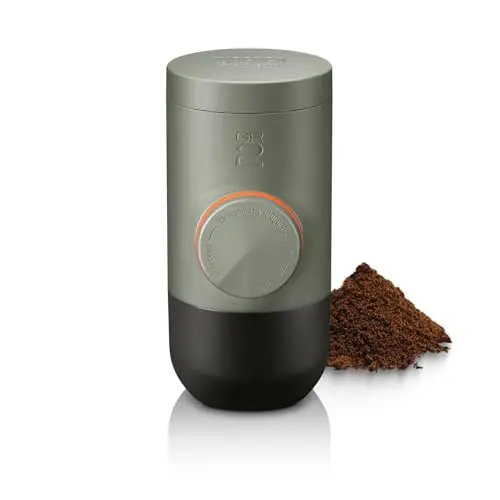
Minipresso GR2 – Manual Espresso for Ground Coffee
The Minipresso GR2 is a hand-pumped espresso maker for ground coffee, with an adjustable basket and a built-in 80 ml water tank. It packs down small enough for a backpack and needs only hot water to brew.
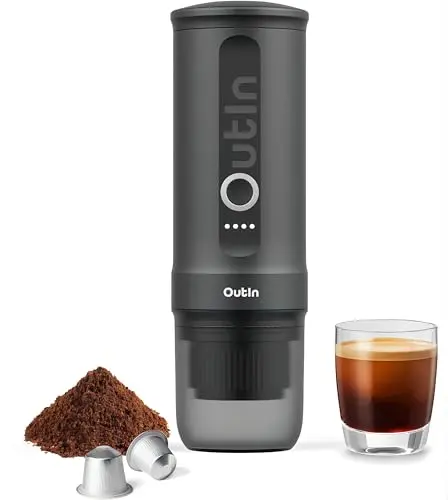
Nano – Self-Heating Cordless Espresso
The OutIn Nano is a cordless espresso maker with a self-heating system, USB-C charging, and a 2-in-1 basket for ground coffee or NS capsules. It is built for hotel rooms, campsites, and car trips where an outlet is not guaranteed.
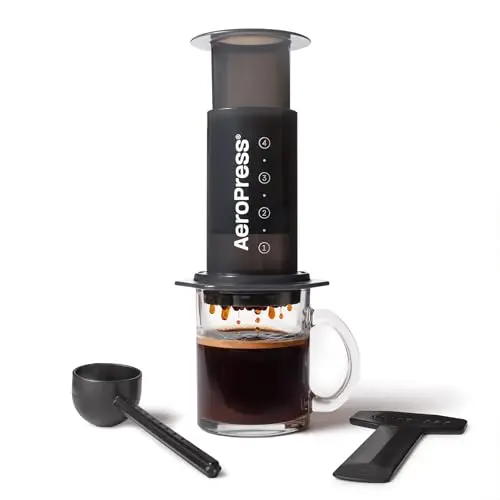
Original – Compact Manual Espresso-Style Brewer
The AeroPress Original is a compact manual brewer that makes espresso-style concentrates plus pour-over and French press-style coffee. It is light, shatterproof, and easy to clean, with no battery or outlet required.
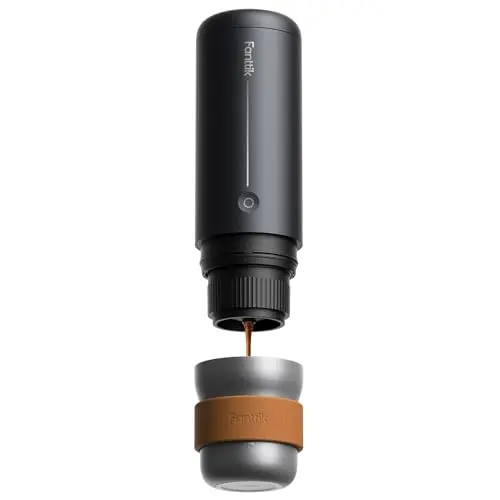
Cafein 11 – Fast-Heating Portable Espresso
The Fanttik Cafein 11 is a battery-powered portable espresso maker with fast self-heating, 20-bar extraction, and IP65-rated touch controls. It handles ground coffee or NS capsules and is aimed at campers, road-trippers, and office travelers.
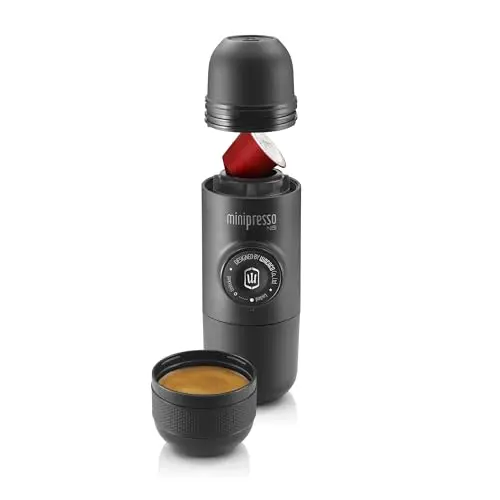
Minipresso NS – Capsule Espresso for Travel
The Minipresso NS is a manual capsule espresso maker for NS Original capsules. It needs hot water but no battery or outlet, and its compact body is designed for travel, camping, and office use.
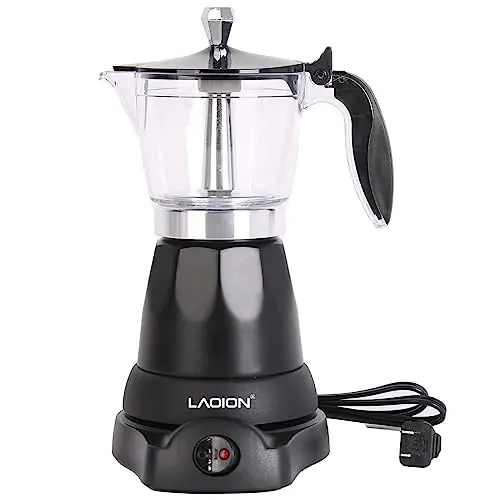
Cuban Coffee Maker – Electric Moka for Small Groups
The LAOION is an electric moka-style coffee maker with a detachable base, transparent top, and six-cup capacity. It is best for apartment stays, car trips, and shared coffee rather than backpacking.
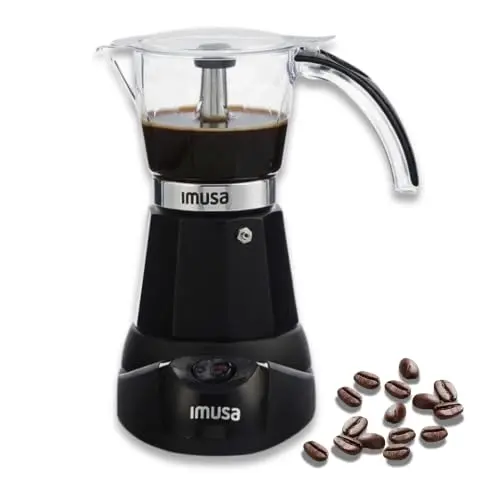
Electric Espresso Maker – Cuban Coffee with Cool-Touch Base
The IMUSA electric espresso maker is a moka-style brewer with a cool-touch handle, detachable base, and a choice of six or three espresso cups. It is a plug-in option for Cuban coffee and strong espresso-style drinks.
How We Evaluated These Travel Espresso Machines
We didn’t take these machines on a multi-week backpacking trip or run lab pressure and temperature tests. What we did: cross-referenced seven travel espresso machines from six brands across five decision axes – portability and packed size, heat source, extraction pressure and basket capacity, coffee compatibility, and cleanup routine. We triangulated published specifications, feature sets, owner feedback where available, and use-case fit for travelers who brew in hotel rooms, campsites, cars, and offices. We also mapped each machine against the reality of travel: whether it needs an outlet, whether it can self-heat water, how much counter or picnic-table space it occupies, and how fussy it is to clean without a sink. That matters more in this category than raw pressure numbers, because a machine that brews a great shot but is a pain to pack or clean will stay home.
The scoring framework weighted real-world travel fit (70%)-how well each machine delivers drinkable espresso with the least friction on the road-against feature differentiation (30%)-unique advantages like self-heating, capsule compatibility, or adjustable dose. We did not reward specs that do not change the travel experience, and we treated owner feedback as a signal, not a verdict. We have no commercial relationship with any featured brand; recommendations track fit and differentiation, not brand preference. If you want the most satisfying manual shot, the Minipresso GR2 is the pick; if you’d rather skip the kettle and hot-water hunt, the OutIn Nano is the more convenient route.
How to Choose the Right Travel Espresso Machines
1. What Makes a Travel Espresso Machine Truly Portable
A travel espresso machine earns the label only if it fits the way you move. Packed size and weight matter more than countertop footprint, and a tall, narrow shape often packs better than a wide one. You also need to think about whether it can operate without an outlet; that single feature separates a true travel machine from a compact kitchen appliance.
If your priority is the smallest possible setup that still pulls a real espresso-style shot, the Minipresso GR2 is the pick.
2. Heat Source: Manual, Battery, or Plug-In
Manual brewers require you to bring hot water, but they are light, quiet, and free of charging anxiety. Self-heating battery machines add convenience and independence, at the cost of weight and one more device to charge. Plug-in moka pots are best for car trips, apartment stays, or office use, not backpacking.
If you want self-heating without a kettle, the OutIn Nano is the obvious starting point.
3. Pressure, Basket Size, and the Espresso You Actually Get
Pressure numbers are not the whole story, but they matter. Portable espresso machines range from around 8 bar to 20 bar, and the higher-pressure models generally produce more crema and a more espresso-like body. Basket size is just as important: an adjustable basket that holds 8-12 grams lets you tune strength, while a fixed small basket limits you to one style of shot.
4. Capsules vs Ground Coffee on the Road
NS Original capsules are the easiest route: no grinding, no tamping, no loose coffee to spill. The trade-off is less control and dependence on capsule availability. Ground coffee gives you freshness control and usually a better cup, but it adds a grinder, dosing, and cleanup to your travel kit.
If you want maximum flexibility without capsules, the AeroPress Original is the most forgiving option.
5. Cleaning and Packing Without a Kitchen Sink
Cleanup is where travel espresso machines quietly succeed or fail. Look for rinse-and-go cleanup, few detachable parts, and a design that does not trap coffee grounds in hard-to-reach corners. If you will brew daily in a hotel room, a machine that needs a full sink session will wear thin fast.
6. Budget, Mid-Range, and Premium Travel Espresso Machines
Entry-level travel espresso usually means manual brewers and simple moka pots. Mid-range options add better baskets, capsules, or more refined manual pumps. Premium models bring self-heating batteries, fast USB-C charging, and more complex brew paths. Spend up only if the convenience changes how often you will actually brew.
Frequently Asked Questions
1. What's the difference between the WACACO Minipresso GR2 and the OutIn Nano?
The Minipresso GR2 is a manual hand-pump machine for ground coffee: you bring hot water, pump by hand, and get a compact shot with no battery. The OutIn Nano is a self-heating battery machine that can use ground coffee or NS capsules, so it removes the kettle but adds weight and charging. Choose the GR2 for ultralight simplicity; choose the OutIn Nano if cordless convenience matters more than pack weight.
2. Are all travel espresso machines actually portable enough for a carry-on?
No. Some compact espresso machines still weigh several pounds and need an outlet, which makes them better for car trips or long hotel stays than for a carry-on. True carry-on portability usually means a manual brewer or a small battery machine that fits in a daypack. Check the packed dimensions and whether you need to carry a separate hot-water source before you commit.
3. How does the AeroPress Original compare with the WACACO Minipresso NS for travel?
The AeroPress Original is more versatile: it brews espresso-style concentrates, pour-over, and French press-style coffee, and it is forgiving with grind size. The Minipresso NS is narrower by design: it only works with NS Original capsules, but it gives you a faster, more espresso-like workflow with no loose grounds. For budget flexibility, go with the AeroPress Original; for capsule simplicity, the Minipresso NS is the better fit.
4. Do battery-powered travel espresso machines really heat water?
Yes, but with limits. Models like the OutIn Nano and Fanttik Cafein 11 use self-heating systems that can bring room-temperature water up to brewing temperature, usually in a few minutes. The catch is battery capacity: heating water drains power quickly, so hot-shot counts are lower than cold-water brew counts. If you plan to brew several shots a day, a manual machine plus a kettle may be more reliable.
5. Can I use Nespresso capsules in a portable espresso maker?
Some portable machines are built for NS Original capsules, including the WACACO Minipresso NS, OutIn Nano, and Fanttik Cafein 11. Compatibility is usually limited to Original-line capsules, not Vertuo, and some third-party capsules may fit poorly. Check the capsule specification before you buy, and expect less control over dose and freshness than you get with ground coffee.
Final Verdict
For most travelers, the Minipresso GR2 is the best travel espresso machine because it balances real espresso flavor, packability, and no-battery reliability. It asks you to bring hot water, but that trade-off keeps it light and simple. If you want the lowest-friction entry into travel espresso, the AeroPress Original is the value pick: it is not true espresso, but it is forgiving, affordable to own, and easy to clean. And if you would rather skip the kettle entirely, the OutIn Nano is the premium cordless option, with self-heating and capsule flexibility. The Fanttik Cafein 11 is worth a look for faster heat-up and rugged controls, but battery reliability keeps it behind the OutIn for most buyers. Choose based on whether you value manual control, budget flexibility, or cordless convenience most.
