
Best Turkish Coffee Makers – 2026 Reviews

Turkish coffee is four things – coffee, water, sugar, and heat – and the pot decides whether the foam cap rises or the whole thing boils over onto your burner. That’s why the cezve matters more than people expect going in. Get the pot right and the ritual takes about four minutes. Get it wrong and you’re scrubbing scorched copper while the morning gets away from you.
The first fork in the road is material. Copper moves heat almost instantly, which is what lets you pull the pot off at exactly the right second, while stainless is more forgiving and far easier to live with. The second fork is who’s doing the heating. A stovetop cezve puts you in charge of the rise; an electric Turkish coffee maker handles it with a sensor and a timer and asks almost nothing of you.
We looked across the market – hand-hammered copper cezves from Turkey, dishwasher-safe stainless pots, and one-touch electric machines – to sort out which ones actually earn counter space. Below you’ll find picks for every kind of brewer, plus the details that change the cup more than the branding does.
Best Turkish Coffee Makers – 2026 Reviews
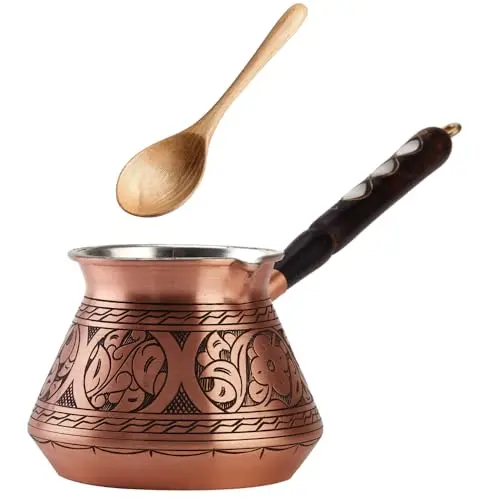
Tombul Islemeli Cezve – The Traditional Benchmark
A 1mm solid copper cezve with a food-safe tin lining, a wooden handle, and hand engraving done in Turkey. The 9 fl oz body brews about three demitasse servings and is rated for gas and electric coil burners.
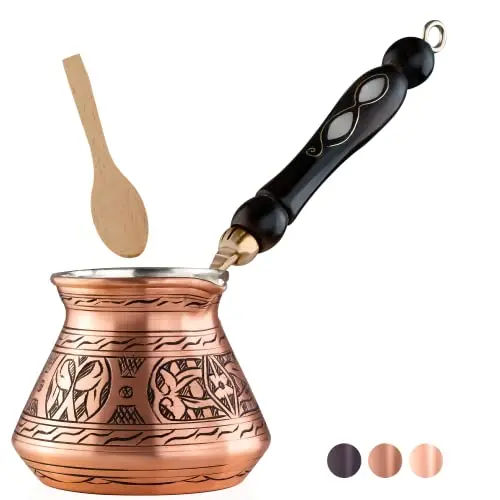
12 oz Hand-Engraved Cezve – Four Cups, Gift-Ready
A 1mm copper cezve, hand-engraved in Turkey and lined with lead-free tin. The 12 oz body brews up to four demitasse cups, and the long wooden handle keeps your hand away from the heat. Ships with a wooden spoon, a brewing guide, and a gift box. Works on gas, electric, and ceramic hobs but not induction.
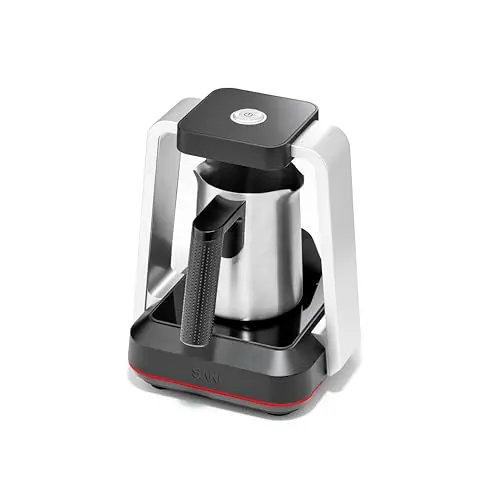
SKK1AN Open-Form Brewer – Watch the Foam Rise
An electric Turkish coffee maker with an open-form design so the pot sits in view while it brews. SandBrew heating wraps the stainless pot in even heat, a peak-foam sensor ends the cycle, and the pot lifts off for the dishwasher. Brews one to five demitasse cups. Includes a measuring spoon and a coffee sample.
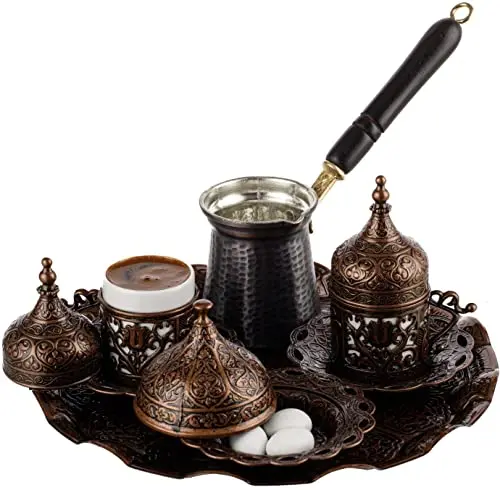
12-Piece Coffee Set – Make and Serve for Two
A complete make-and-serve kit for two: an 8 fl oz hand-hammered copper cezve with a tin-lined interior, two 2 oz porcelain cups in ornate metal holders, matching saucers and lids, a lidded sugar or Turkish delight dish, and an engraved 10-inch serving tray. Twelve pieces total, made in Turkey.
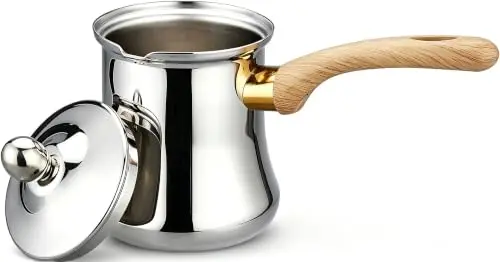
CF-720 Cezve with Lid – Family-Size Stainless
A 720 ml stainless steel cezve molded in one seamless piece, with a heat-insulated wood-grain handle and a matching lid. The flat wide base suits gas, electric, and ceramic hobs and is not rated for induction. Doubles as a milk warmer, butter melter, and chai pot, and it’s dishwasher safe.
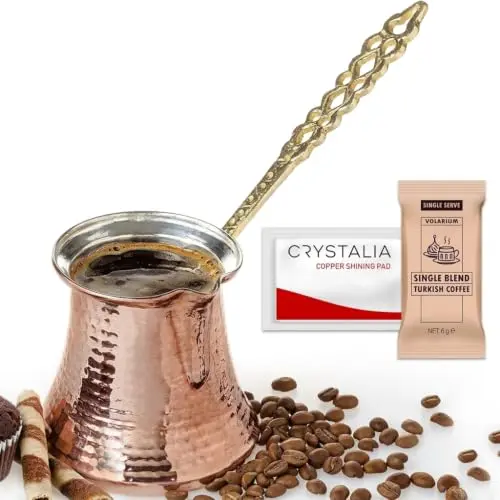
Hammered Copper Cezve – Large-Batch Brewing
A large hammered copper cezve, handmade with a food-safe tin lining and a brass engraved handle. The 14.4 oz body is sized for four to five servings, and the package includes a single-serve portion of Turkish coffee to start you off. Stovetop use only.
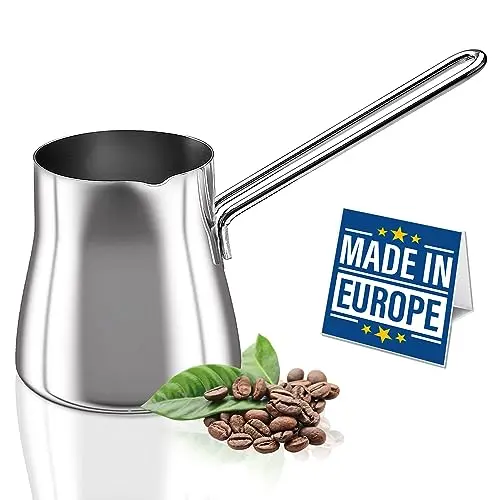
18/10 Stainless Pot – Dishwasher-Safe Multi-Tasker
A 700 ml cezve in 18/10 stainless steel with a non-drip spout and a heat-resistant handle. Sits on gas, ceramic, or electric hobs, goes in the dishwasher and the microwave, and doubles as a milk warmer, tea maker, or butter melter. Brews five to seven small cups.
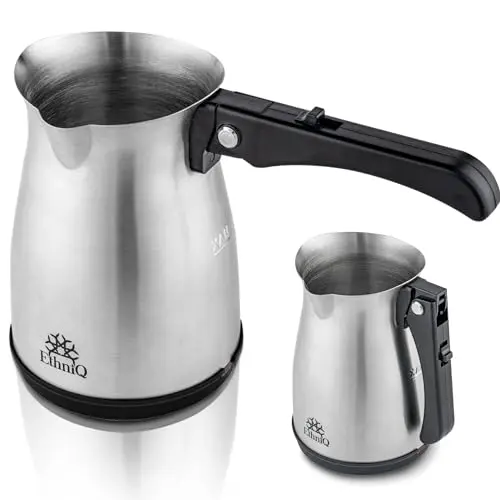
SS-Ember Electric Pot – Foldable Travel Handle
A 0.3 liter electric Turkish coffee pot in stainless steel with a foldable handle and a single on-off button. 800 watts, 120 volts, sized for one to four cups. The stainless body rinses clean in seconds and packs down small. Ships with a spoon.
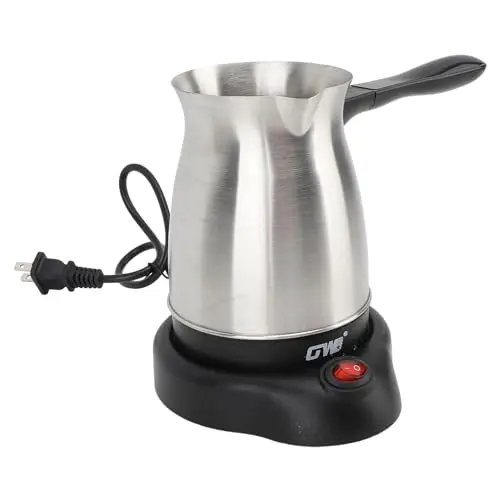
GW-8054 Electric Pot – Budget One-Button Brewing
A 600 ml electric Turkish coffee maker in food-grade stainless steel with a one-button dual system and a removable anti-scald handle. The pot lifts off a cordless base and is rated for five to six cups. Also brews tea and warms milk. 600 watts, 110 volts.
How We Evaluated These Turkish Coffee Makers
We didn’t stand at a stove pulling foam off the rise for a month. What we did: cross-referenced 9 Turkish coffee maker models from 8 distinct brands across 7 decision axes – capacity and serving count, heat-source compatibility, body material and lining, handle insulation, foam control, cleaning and care, and included accessories. We triangulated published specifications, feature sets, and owner feedback where available against how each pot actually gets used on an ordinary weekday morning.
The scoring framework weighted real-world fit (70%) – whether the pot delivers on its stated job, from a three-cup traditional brew to a hands-off electric cycle – against feature differentiation (30%), meaning the details that separate one option from another: a one-piece seamless body, a lid, a sensor that watches the foam, or a complete serving set. We have no commercial relationship with any of these brands; recommendations track fit and differentiation, not brand preference. If you want the traditional benchmark, the DEMMEX Tombul Islemeli Cezve is your match; if you’d rather the machine watched the foam, the SAKI Open-Form Brewer gets you there.
A few things we can’t tell you: how a tin lining holds up after a year of daily brewing, or whether a handle stays cool on your particular burner. What we can tell you is how each option is built, what comes in the box, and which buyer it fits. Structural claims come from manufacturer specs; the lived-in complaints come from aggregated owner feedback, weighted by how often they surfaced.
How to Choose the Right Turkish Coffee Maker
1. Copper, Stainless Steel, and Tin Linings: What Turkish Coffee Makers Are Made Of
Nearly every traditional Turkish coffee maker you’ll see is one of two things: copper or stainless steel. Copper is the classic for a reason – it conducts heat fast and evenly, which means the pot responds the moment you move it toward or away from the flame. That responsiveness is what lets you catch the foam at its peak instead of boiling it down. Copper pots are almost always tin lined inside, because bare copper isn’t meant to sit in contact with the coffee you’re about to drink.
Stainless is the pragmatic alternative. It heats more slowly and less responsively than copper, so the foam rise is a bit less dramatic, but it’s rustproof, needs no lining, and usually goes in the dishwasher. If you know yourself well enough to know you won’t hand-polish a pot, buy stainless. If you want the last word in foam control, buy copper and accept the upkeep.
2. Sizing a Turkish Coffee Maker: Capacity and Serving Count
Turkish coffee is served in demitasse cups of roughly two ounces, so capacity numbers that look small on paper are usually right. An eight- or nine-ounce pot makes around three servings; twelve ounces gets you four; anything from fourteen ounces up is a hosting pot. The common mistake is buying the smallest pot you can find and then discovering you can’t pour two cups without a second cycle.
Leave headroom in whatever you buy. The foam needs room to climb, and a pot filled to the rim will crown over the side before it’s ready. A slightly larger capacity than your household strictly needs is usually the better purchase – it costs you nothing in the cup and buys you flexibility when guests turn up.
3. Stovetop or Electric: Matching a Turkish Coffee Maker to Your Kitchen
Stovetop cezves work on gas, electric coils, and ceramic glass hobs. What they don’t work on is induction – copper isn’t magnetic, and the stainless models in this category are generally not rated for it either, so check your hob before you commit. A stovetop cezve also asks something of you: you stand there, you watch, you lift the pot at the right moment.
An electric Turkish coffee maker takes that job off your hands with a heating element and, on better models, a foam sensor. The trade-off is control – you’re trusting the machine’s read of the rise rather than your own. If you want a stovetop pot that also handles milk, chai, and sauces without fuss, the SANQIAHOME CF-720 is the multi-purpose pick in this lineup.
4. Handles, Spouts, and Lids: The Turkish Coffee Maker Details That Matter
A handle is either insulated or it isn’t, and the difference shows up the first time you reach for a hot pot. Wood, bakelite, and composite handles stay comfortable; bare brass and metal handles transfer heat and will teach you to keep a mitt nearby. Handle length matters too – a longer one keeps your knuckles clear of the flame and gives you leverage for a slow, controlled pour.
The pouring spout is the other detail worth checking. A narrow, defined lip lets you fill small cups without cascading coffee over the rim; a wide, vague rim turns every pour into a cleanup. A lid is optional but genuinely handy – it holds heat while the grounds settle and keeps the pot useful for milk and tea.
5. DEMMEX Copper Cezve vs. SAKI Electric: Two Ways to Brew Turkish Coffee
These two represent the fork in the road. The DEMMEX Tombul Islemeli Cezve is the traditional answer: a tin-lined copper body, a wooden handle, nine ounces for about three cups, and total control over the rise. It rewards attention and punishes distraction. The SAKI Open-Form Brewer is the modern one: a stainless pot wrapped in even heat, a peak-foam sensor that ends the cycle, and a pot that goes in the dishwasher. It rewards convenience and gives up some nuance.
Pick the copper pot if the brewing is the point. Pick the electric if the coffee is the point and the brewing is overhead. Neither is a compromise – they’re answering different questions.
6. What Turkish Coffee Makers Cost at Each Tier
Entry-level pots are almost always stainless, often generous in capacity, and perfectly capable of a good cup – the main thing you give up is the heat responsiveness of copper and, sometimes, build refinement. Mid-range is where handmade copper lives: tin-lined, engraved, one-millimeter bodies with wooden handles, priced for something you’ll keep for years. Premium covers two things – electric machines with sensors and stated warranties, and serving sets that include cups, saucers, and a tray.
Spend on the pot before you spend on the accessories. A good cezve plus two ordinary cups beats a beautiful tray with a thin, badly balanced pot sitting on it.
7. Care and Cleaning for Copper and Stainless Turkish Coffee Makers
Tin-lined copper should be hand washed with a soft sponge, rinsed of all coffee residue, and dried immediately – trapped moisture is what drives tarnish and spotting. Skip abrasive pads and skip the dishwasher; both wear at the lining. A copper pot will darken over time regardless. Some people polish it back, some let the patina develop, and both are fine as long as the interior stays intact.
Stainless is the easy one. Most stainless pots here are dishwasher safe and shrug off scratches, though a quick hand rinse keeps the inside from holding onto old oils. Whatever you buy, never heat an empty pot – dry burning is the fastest way to ruin a base.
Frequently Asked Questions
1. What's the difference between the DEMMEX copper cezve and the BCS hand-engraved cezve?
Both are 1mm copper cezves with tin-lined interiors, hand engraved in Turkey, and rated for gas and electric burners. The difference is size and packaging. The DEMMEX holds about nine ounces, which lands at three demitasse servings, and arrives with a wooden handle and spoon in a plain presentation. The BCS holds twelve ounces – four cups – and ships with a wooden spoon, a brewing guide, and a gift box.
If you usually brew for two, the smaller pot is easier to control. If guests are routine, the BCS gives you headroom, and its longer handle makes a slow pour easier.
2. How does the SAKI electric brewer compare to a DEMMEX copper cezve?
Easier, yes. Better, not necessarily. An electric machine with a foam sensor handles the timing for you, which removes the one skill a cezve demands: catching the rise before it boils. The SAKI Open-Form Brewer splits the difference by leaving the pot visible so you can watch the foam even while the machine manages the heat. A copper cezve gives you finer control – you decide exactly when the pot leaves the burner – but that’s a learned skill, and the first few attempts usually boil over.
3. Do I need a tin-lined copper Turkish coffee maker?
If you buy copper, yes. Bare copper isn’t meant to sit in contact with an acidic drink, which is why traditional cezves are tin lined inside. The lining is what separates your coffee from the metal. Check that the listing specifies food-safe tin or lead-free tin, and treat the interior gently – no abrasives, no dishwasher. If upkeep sounds like a chore, a stainless steel pot needs no lining at all and is the simpler long-term buy.
4. How fine should the coffee be ground for a Turkish coffee maker?
Powder fine – finer than espresso, closer to flour. That’s what lets the grounds stay suspended in the cup and what produces the foam cap the drink is known for. Add your sugar before brewing rather than after, and stir the grounds, water, and sugar together before the pot goes on the heat. Cold water and a low flame give the most predictable rise; a hard boil flattens the foam and leaves grit in the cup.
5. Can any of these Turkish coffee makers be used on an induction cooktop?
No. Copper isn’t magnetic, and the stainless pots here are rated for gas, electric coil, and ceramic hobs rather than induction – the BCS and SANQIAHOME listings both note the exclusion explicitly. Check your cooktop before ordering. If you’re set on induction, an electric Turkish coffee maker sidesteps the question entirely, since it provides its own heat instead of relying on the hob.
Final Verdict
For most people, the DEMMEX Tombul Islemeli Cezve is the answer. It’s the version of this pot that’s been refined for centuries: thick copper, a tin lining, a handle that won’t burn you, and a size that suits a two-person household. Buy it, learn the rise, and you’ll stop thinking about equipment.
If you’d rather have a pot that goes in the dishwasher and can also warm milk or chai, the SANQIAHOME CF-720 is the practical choice – bigger than you need for two cups and happy to do more than coffee. If the whole point is not standing at the stove, the SAKI Open-Form Brewer takes the timing off your hands while still letting you watch the foam. And if this is a gift – a wedding, a housewarming, a host who already has everything – the DEMMEX 12-Piece Coffee Set arrives looking like the answer. Start with the cezve. Add the machine later.
