
Best Waiter Wine Openers – 2026 Reviews

It usually happens about eight minutes into hosting. The foil comes off cleanly, the screw goes in, and then the cork starts to crumble – half of it in the bottle, half of it wrapped around the worm. Nine times out of ten the culprit isn’t the bottle or your technique. It’s a cheap wine key with a blunt screw and a hinge that folds under any real load.
A waiter wine opener is a small, cheap-looking tool with an outsized job: pierce a cork cleanly, hold it, and lever it out without tearing through the sides. The keys that do it well share a handful of traits – a sharp spiral worm with even coil spacing, a two-step hinged fulcrum that gives you a second bite on longer corks, and a handle that doesn’t slip when your hands are cold or wet. The ones that fail almost always fail at exactly one of those three points.
We lined up the waiter wine openers sold across the major brands and compared them on the things that actually break under repeated use – worm machining, hinge bracing, grip, and foil-cutter quality. What follows is a buyer’s map of the category: picks for the home bar, the apron pocket, the gift box, and the bartender who opens a case a night.
Best Waiter Wine Openers – 2026 Reviews
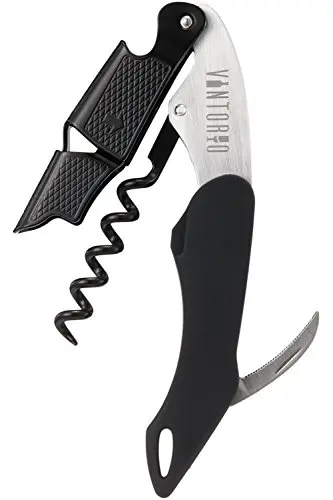
VWC01 Professional Waiters Corkscrew – Non-Stick Worm, No-Slip Grip
The Vintorio is a classic two-step waiter’s corkscrew built around a non-stick stainless steel worm and a double-hinged fulcrum. The rubber-coated handle is the differentiator: it’s weighted and balanced to give a firm, no-slip hold even when your grip is compromised. The fulcrum doubles as a bottle opener, and a long serrated foil cutter folds out from the side. At 88 grams it disappears into an apron pocket without feeling hollow.
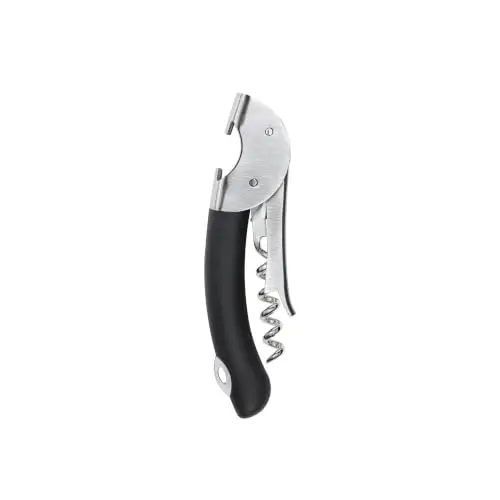
Steel Double Lever Waiter's Corkscrew – Cushioned Grip for Long Hosting Nights
OXO’s take on the waiter’s corkscrew keeps the double-lever two-motion pull but wraps it in a soft, non-slip body that’s noticeably more forgiving than bare stainless. The stainless steel screw is non-stick coated, and a foil cutter and bottle opener are built into the frame. It’s the most substantial-feeling key in this lineup by a comfortable margin.
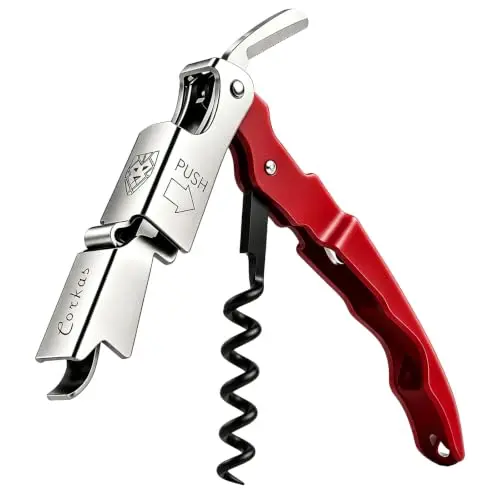
Wine Key – Teflon-Coated Worm, Hand-Assembled Steel Build
The CORKAS is a hand-assembled key in solid 430 stainless steel with a Teflon-coated worm and a double-hinged fulcrum. The lever arm swings the foil knife closed automatically as it returns, and there’s a cap opener at the end. It’s compact at under five inches and light enough to forget it’s in your pocket.
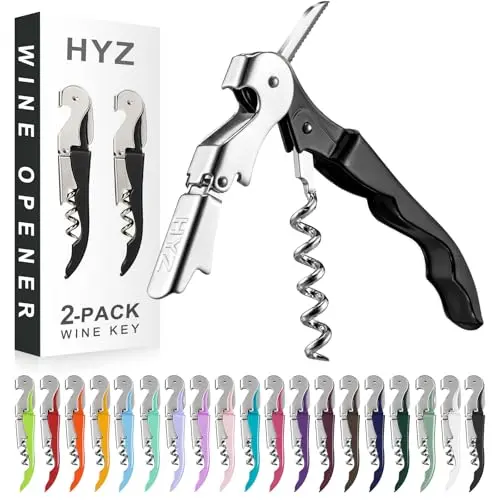
WK-01 Waiter Corkscrew 2-Pack – One for the Bar, One for the Bag
Two identical waiter corkscrews in one box, each built from 420 stainless steel with a zinc alloy handle. The double-hinged design, foil cutter, and cap opener are all standard here, and the thick worm is mounted so it resists bending. Compact enough to disappear into an apron pocket, a glovebox, or a bar kit.
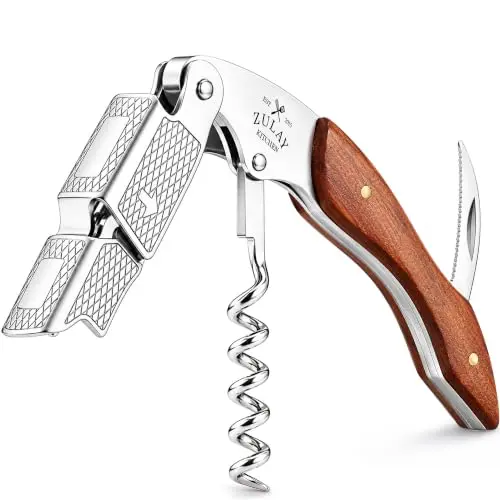
Rosewood Wine Key – Wood Handle With Lifetime Warranty
The Zulay is a rosewood-handled waiter’s corkscrew with a 420 stainless steel body and a double-hinged fulcrum. The wood handle is the visual hook, and it’s paired with a serrated foil cutter, a cap remover, and a lifetime warranty. It’s one of the longer keys in this lineup, so check your drawer depth before you commit.
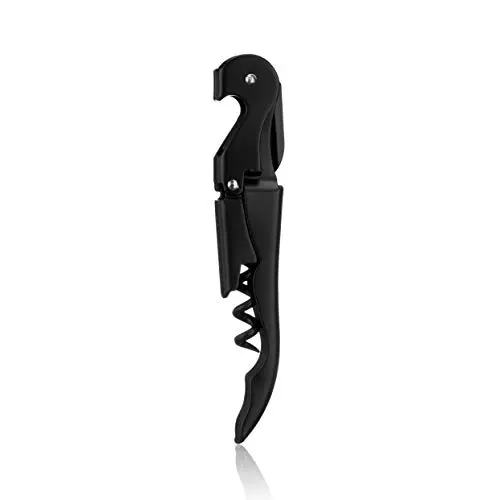
Truetap Double Hinged Corkscrew – Matte Black Bar Cart Staple
A matte black double-hinged waiter’s corkscrew from True Fabrications, with a stainless steel body, flat-blade foil cutter, and built-in cap opener. It’s a compact, inexpensive key aimed squarely at home hosting, bar carts, and gifting rather than nightly bar service.
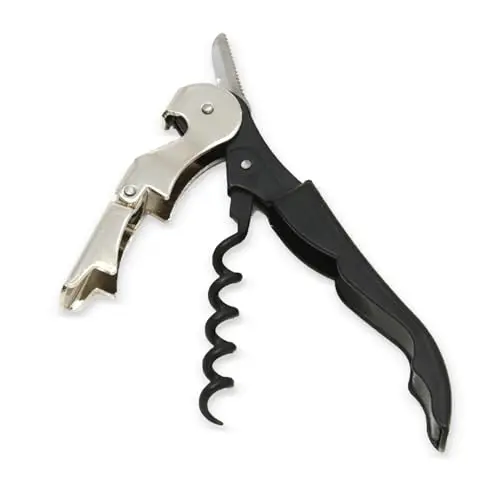
Select Waiters Corkscrew – Five-Inch Entry-Level Key
The Chef Craft Select is a five-inch waiter’s corkscrew with a foil cutter, cap opener, and two-step pull, all at an entry-level price. It’s dishwasher safe, which is unusual for the category, and light enough at around two and a half ounces to carry without noticing.
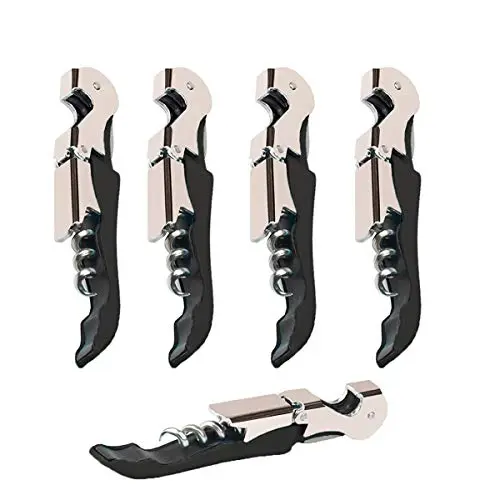
Professional Waiter Corkscrew 4-Pack – Reinforced Hinges for Busy Bars
A four-pack of waiter corkscrews built with thickened hinges and a heavier-gauge worm than the typical budget key. Each one includes a foil cutter and cap opener, folds to under five inches, and weighs about 70 grams thanks to the reinforced hardware. Sold as a set for bars, restaurants, and anyone who keeps losing wine keys.
How We Evaluated These Waiter Wine Openers
We didn’t put these keys through a few hundred bottles of dinner-service duty, and we didn’t measure worm wear under a microscope. What we did: cross-referenced 8 waiter wine opener models from 8 distinct brands across 5 decision axes – worm design and coating, hinge and fulcrum geometry, handle grip and balance, foil cutter and cap opener utility, and build weight as a rough proxy for hardware robustness.
We triangulated published specifications, mapped feature sets against the parts that actually fail in this category, and weighed owner feedback where available – particularly around screw bending, hinge stiffness, and foil cutter blades, which are the three recurring weak points. The scoring framework weighted real-world fit and performance (70%) – how cleanly a key pierces, grips, and levers a cork in ordinary use – against feature differentiation (30%) – coating, grip materials, warranty coverage, and multi-tool utility. We have no commercial relationship with any of the brands featured, and the ranking tracks fit and differentiation rather than brand preference. For most buyers the Vintorio Professional Waiters Corkscrew is the safest landing spot; if comfort over a long evening of pouring matters more than anything else, the OXO Steel Double Lever is the one we’d hand you.
Where published detail was thin, we leaned on the specification and the physical logic of the design rather than guessing, and we scored those models conservatively. A waiter wine opener is a narrow tool with a narrow job, so the tells are visible: how the worm is machined, how much material sits in the hinge bracket, whether the foil knife is stamped or ground. We audited those details across the full lineup before sorting anything.
How to Choose the Right Waiter Wine Opener
1. Why the Worm Is the First Thing to Check on a Waiter Wine Opener
The worm – the spiral screw – is where a wine key either works or ruins your evening. Look for uniform coil spacing and a sharp, tapered tip: a blunt tip has to be forced into the cork, which is exactly how corks get pushed in sideways and split. A single-piece worm is stronger than one welded to a separate shaft, because the joint is the first thing to give.
Coatings matter more than most shoppers expect. A Teflon or non-stick coated worm slides through natural cork with less friction and comes out cleaner, which reduces tearing on older, softer corks. Bare stainless works, but it grabs more on the way in and out. Diameter consistency is the other tell – worms that narrow or widen along their length are the ones that crumble fragile corks.
2. Hinge Geometry: What a Two-Step Fulcrum Actually Buys You
The fulcrum is the arm that rests on the bottle lip, and its geometry decides how much control you have over the last inch of the pull. A double-hinged fulcrum gives you two resting positions: you lever once with the cork half out, reposition, then lever again with the arm closer to the bottle. That second bite keeps the cork travelling in a straight line instead of angling toward the glass.
A single hinge forces one long lever motion, which works fine on short corks and gets risky on long ones. This is the single upgrade worth paying for. If you open a lot of older bottles, the Vintorio Professional Waiters Corkscrew is the pick here – its two-step fulcrum gives the most confident pull in this lineup.
3. Grip and Balance: Why the Handle Matters More Than You'd Think
Waiter wine openers get used with cold hands, wet hands, and one hand steadying a bottle. A rubber-coated or soft-touch handle is the difference between pulling with your wrist and wrestling with your whole arm. Bare stainless bodies look sharp and slip badly once condensation gets involved.
Balance matters too. A key that’s weighted toward the handle feels planted; one that’s top-heavy wants to twist out of your grip mid-pull. Wood and zinc alloy both add useful mass without much bulk. For the most forgiving grip in this group, go with the OXO Steel Double Lever, which is built around a cushioned, non-slip body.
4. Foil Cutters and Cap Openers: The Half of the Tool People Ignore
The foil cutter is the least-loved part of a wine key and the most likely to disappoint. Serrated blades with a long curved edge clear a capsule in one pass; short flat blades often need two or three attempts and leave ragged edges. Sharpness out of the box varies wildly across the category, so it’s worth knowing this is a common weak point even on otherwise good keys.
The cap opener on the end of the lever arm is the freebie – genuinely useful if your gatherings involve beer as well as wine, and no reason to choose one key over another unless everything else is a tie.
5. What Should You Budget for a Waiter Wine Opener?
This is a category where entry-level keys cost little and can still work fine as spares. At the bottom of the market you’re usually getting a stamped body, a bare worm, and a single hinge – usable, but the parts that wear out wear out fast.
Moving up a tier buys you a coated worm, a properly braced double hinge, and a handle material that doesn’t slip. That’s the sweet spot for most households. The top of the category adds hand-assembled construction, tighter pivot tolerances, and lifetime warranties – worth it if the tool is going to be used daily. The CORKAS Wine Key is the clearest case of an entry-level price buying mid-tier hardware.
6. Care and Longevity: Getting Years Out of a Wine Key
Most wine keys don’t die from use – they die from neglect. Wipe the worm after every bottle; dried wine residue hardens in the coils and makes the next cork drag. Keep the hinge clear of grit, since a fulcrum that binds gets forced, and forcing is what bends hardware.
Dishwasher exposure is a judgment call. Stainless bodies with no coating generally tolerate it; wood handles and coated worms don’t, and heat plus detergent will strip a coating faster than any cork will. When in doubt, hand wash and dry immediately.
Frequently Asked Questions
1. What's the difference between the Vintorio Professional Waiters Corkscrew and the OXO Steel Double Lever?
Both use a double-hinged fulcrum, so the pull mechanics are similar. The Vintorio is lighter and built around a non-stick worm with a rubber-coated handle; the OXO is heavier, with a soft non-slip body and a coated stainless screw. The practical split is portability versus comfort – the Vintorio is easier to carry through a shift, the OXO is easier on the hand over a long evening.
If you want a single answer for mixed use, the Vintorio Professional Waiters Corkscrew is the safer bet.
2. Is the HYZ two-pack or the Kit-Home four-pack the better buy for a busy bar?
They’re aimed at different buyers. The HYZ set gives you two keys with a thick, well-mounted worm and a zinc alloy handle – better consistency per unit, which matters if the keys get handed out to staff. The Kit-Home four-pack stretches further and reinforces the hinge brackets, but blunter screw tips and variable build consistency are a real drawback when bottles are coming back to back.
For a small team, the HYZ 2-pack is the better starting point; for spares that live in a drawer, the four-pack is fine.
3. Do coated corkscrews actually make a difference?
Yes, mostly in two places. A non-stick or Teflon coating reduces friction going in and coming out, which keeps fragile and older corks intact. It also quiets the squeal you get from bare metal in synthetic corks. The trade-off is durability – coatings wear with heavy use, and dishwasher cycles strip them faster than hand washing.
If you open a bottle a week, a coating is a small luxury. If you open a case a night, expect it to dull eventually and plan on replacing the key.
4. Why do waiter wine openers break corks?
Almost always one of three things: a blunt screw tip that has to be forced, a single-hinge fulcrum that levers at a bad angle, or a worm whose coil spacing isn’t uniform, so the cork tears around the screw instead of riding up it. Older corks make all three worse.
A key with a sharp tapered worm and a two-step fulcrum removes most of the risk. The rest is technique: enter at the center, pull slowly, and use the second hinge position instead of one long lever.
Final Verdict
For most people, the Vintorio Professional Waiters Corkscrew is the answer. It pairs a non-stick worm that doesn’t chew corks with a two-step fulcrum that keeps long pulls under control, and the rubber-coated handle stays put when your hands don’t. If comfort matters more than portability, the OXO Steel Double Lever is the upgrade worth making – same lever logic, a far more forgiving body.
If you’re outfitting several drawers, a travel bag, and a bar kit at once, the CORKAS Wine Key delivers restaurant-style hardware for entry-level money and won’t make you wince when one goes missing. And if your bar tools sit out between pours, the Zulay Kitchen Rosewood looks the part without giving up the double hinge.
