
Best Whole Home Dehumidifiers – 2026 Reviews

A dehumidifier that is undersized for the whole house will run nonstop and still leave the upstairs feeling sticky. The label ‘whole home’ should mean the unit can handle the total damp space, not just one soggy corner of the basement.
The two numbers that separate a real whole-home pick from a pretender are coverage and moisture removal at the humidity you actually have. A big square-footage claim means little if the tank fills overnight or the unit shuts down in a cool basement. Drainage setup and defrost behavior matter just as much as pint capacity.
We looked across the market at high-capacity dehumidifiers from several brands and focused on the ones that can plausibly dry a whole home without constant babysitting. The goal is to match your square footage, dampness level, and installation setup to the right machine, not to crown the biggest number on the box.
Best Whole Home Dehumidifiers – 2026 Reviews

50 Pint WiFi Dehumidifier – Smart Whole-Home Moisture Control
A 7,000-square-foot coverage rating, WiFi control, and a 1.6-gallon tank make this a practical fit for large basements and open living areas. It removes up to 50 pints per day at standard conditions and can ramp higher in hot, humid air. Continuous drainage is supported with a hose, and the unit shuts off when the tank fills.
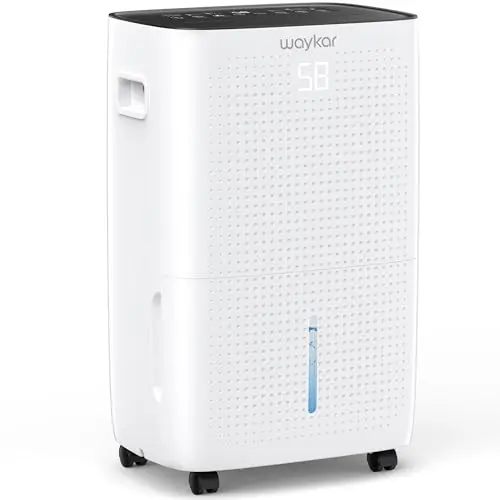
150 Pint Dehumidifier – High-Capacity Whole-Home Drying
Built for heavy moisture, this Waykar is rated for up to 7,000 square feet and removes up to 150 pints per day in hot, humid conditions. The 90-degree auto-swing airflow helps distribute dry air, while the 30% to 80% humidity range allows deeper drying. A 2.11-gallon tank, included drain hose, and defrost protection support continuous use in basements and whole-home setups.
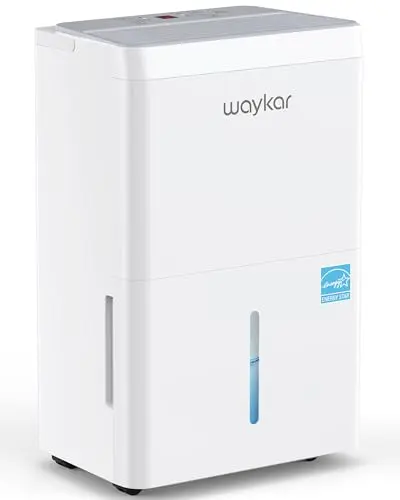
120 Pint Energy Star Dehumidifier – Quiet Whole-Home Comfort
This Waykar pairs a 6,000-square-foot coverage rating with up to 120 pints of daily moisture removal in hot, humid conditions. The 2025 Energy Star rating, 40 dB low-noise operation, and Auto Comfort mode make it a strong fit for finished basements and living areas. It includes a 1.24-gallon tank, a 6.56-foot drain hose, and three fan speeds.
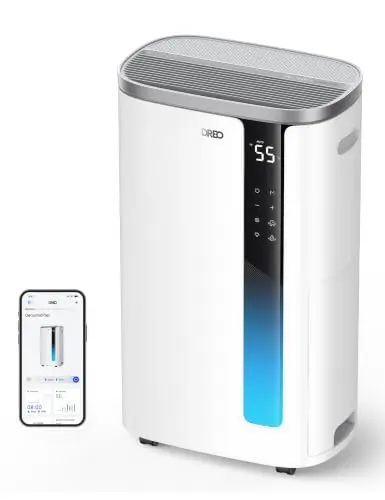
DR-HDH003S – Smart App-Controlled Whole-Home Drying
DREO’s DR-HDH003S is rated for rooms up to 4,500 square feet and removes up to 75 pints per day in hot, humid conditions. The 1.85-gallon tank runs longer between empties, and the included hose supports continuous drainage. App control adds real-time energy monitoring, scheduling, and filter reminders, while 41 dB operation and a sleep mode suit bedrooms and living areas.
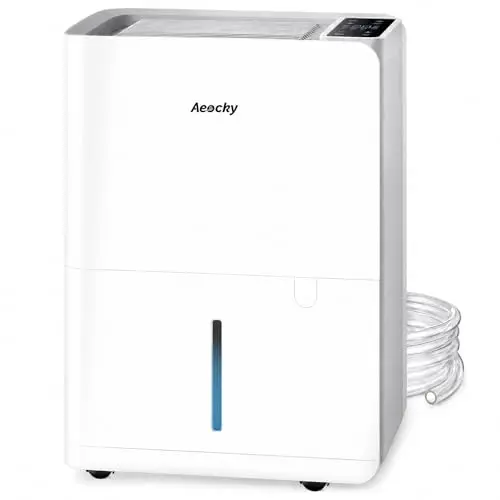
BOREAS-001 – Compact Quiet Dehumidifier for Smaller Homes
The BOREAS-001 is a compact 50-pint dehumidifier rated for spaces up to 3,500 square feet. It runs at roughly 40 dB, includes a 2-meter drain hose, and adds a three-color ambient humidity light plus a 24-hour timer. The 0.8-gallon tank is small for heavy moisture, so continuous gravity drainage is the practical setup for a whole-home or basement application.
How We Evaluated These Whole Home Dehumidifiers
We didn’t run controlled psychrometric chamber tests or multi-season durability trials. What we did: cross-referenced 5 dehumidifier models from 4 distinct brands across six decision axes – square-footage coverage, pint capacity at realistic humidity, humidity-control range, drainage and tank usability, noise, and smart or energy features. We triangulated published specifications, feature sets, owner feedback where available, and use-case fit against whole-home buyer profiles. That means we weighed basement and open-living-area demands more heavily than small-room convenience.
The scoring framework weighted real-world fit (70%) – how well each unit matches its claimed coverage, moisture load, and drainage setup – against feature differentiation (30%) – smart controls, defrost protection, efficiency certifications, and portability. We have no commercial relationship with any brand here; recommendations track fit and differentiation, not brand preference. If you want the most balanced whole-home package, the hOmeLabs 50 Pint WiFi Dehumidifier is the pick; if your basement is genuinely soaked, the Waykar 150 Pint Dehumidifier earns the capacity-first call.
We also audited the practical details that decide whether a unit works in a whole-home setup: whether the tank is realistic, whether a hose is included, how the unit behaves in cooler spaces, and whether the controls stay usable after setup. We mapped those details against the way large basements and open-plan homes actually run. We treated drainage, defrost behavior, and controller usability as first-class criteria rather than footnotes.
How to Choose the Right Whole Home Dehumidifier
1. What Makes a Dehumidifier Whole-Home Ready
A whole-home label should be earned by coverage, capacity, and drainage, not just a big square-footage claim. Look for a unit rated for your total conditioned space, then check the pint removal figure at the humidity and temperature your basement actually sees. A model that removes 50 pints at a moderate condition may struggle in a hot, wet cellar. whole-home dehumidifiers also need continuous drainage, because a 1- to 2-gallon tank fills fast when the air is heavy. auto-defrost matters in cool basements, and adjustable humidity control lets you target a comfortable range instead of running flat-out. If you need maximum drying for a soaked space, the Waykar 150 Pint is the capacity-first pick.
2. Match Pint Capacity to Square Footage and Dampness
Start with square footage, then adjust upward for dampness. A sealed, finished basement with moderate humidity needs less capacity than an unfinished cellar with weeping walls or a whole-home setup that pulls moist air from several levels. pint ratings are measured under specific conditions, so treat them as a comparison tool rather than a promise. coverage ratings are similarly optimistic in open, humid spaces. For a balanced large-home setup, the hOmeLabs 50 Pint WiFi is the pick.
3. Drainage, Tank Size, and Placement in a Whole-Home Setup
Continuous drainage is the difference between a dehumidifier that works and one you resent. A gravity drain hose is simplest if you can place the unit above a floor drain; a pump adds flexibility but also noise and maintenance. Tank size matters less if you run a hose, but a small tank is a real limitation in a damp room. Place the unit where air can circulate and leave space around it. For a compact setup where quiet matters, the AEOCKY BOREAS-001 is the budget-friendly pick.
4. Humidity Control, Defrost, and Temperature Limits
Look for a humidity range that reaches the mid-30s or lower if you need deep drying, and confirm the unit has auto-defrost for cool basements. auto-restart and overflow protection are small features that matter during long runs. Avoid running a dehumidifier in near-freezing conditions unless the manufacturer explicitly supports it. Sensor accuracy and placement also affect how well the unit holds a target.
5. Noise, Energy Use, and Smart Controls
noise ratings in the low 40 dB range are a meaningful upgrade for finished spaces. Energy Star certification is a useful efficiency screen, but wattage and real runtime still determine operating cost. smart controls are helpful for scheduling and monitoring, but they should not replace a good manual interface. A washable filter and clear filter reminders keep performance from fading.
6. Whole-Home Dehumidifier Pricing Tiers and Common Pitfalls
Entry-level whole-home dehumidifiers typically trade app control and quieter operation for capacity. Mid-range models add Energy Star efficiency, better humidity control, and more usable drainage. Premium high-capacity units focus on raw pint removal and continuous-duty hardware. Common pitfalls include buying on coverage claims alone, ignoring drainage setup, and expecting a small tank to handle a wet basement. Also check warranty terms and defrost behavior before you commit.
Frequently Asked Questions
1. Are whole-home dehumidifiers different from standard basement dehumidifiers?
Yes, but the difference is practical rather than magical. A whole-home dehumidifier should have enough coverage and pint capacity for the total damp space, plus continuous drainage so you are not emptying a tank every few hours. Many standard basement units are built for a single room or a smaller moisture load. Check the humidity range and defrost behavior too, because a large unit that shuts down in a cool basement is not really whole-home ready.
2. How does the hOmeLabs 50 Pint WiFi compare with the Waykar 150 Pint?
The hOmeLabs is the more balanced pick for most large homes: WiFi control, a 7,000-square-foot coverage rating, and lower power draw make it easier to live with. The Waykar 150 Pint is the capacity-first choice, with 150-pint removal and 90-degree auto-swing airflow for very damp basements. If your space is genuinely soaked or you need maximum moisture removal, go with the Waykar 150 Pint; if you want smarter daily control, the hOmeLabs is the better fit.
3. DREO DR-HDH003S vs Waykar 120 Pint: which is better for a finished basement?
For a finished basement where noise and app visibility matter, the DREO DR-HDH003S is appealing because of its 41 dB sleep mode, app energy monitoring, and 1.85-gallon tank. The Waykar 120 Pint has the higher 120-pint capacity and 2025 Energy Star certification, so it is the stronger choice for a larger or wetter finished space. If you want the quieter smart-control experience, choose the DREO DR-HDH003S.
4. How many pints do I need for whole-home dehumidification?
Start with square footage, then add headroom for dampness. A 50-pint unit can suit a smaller home or a moderately damp large space, while 75 to 150 pints is a better match for very wet basements and open multi-level layouts. Do not rely on the pint rating alone; check the coverage rating, drainage setup, and whether the unit has auto-defrost for cooler conditions.
5. Can a whole-home dehumidifier run continuously?
Yes, most whole-home units are designed for long runs, but continuous operation only makes sense with continuous drainage. A gravity drain hose is the simplest setup; a pump adds placement flexibility but also another part to maintain. Make sure the unit has auto-restart, overflow protection, and a washable filter so it can handle longer service intervals.
Final Verdict
For most whole-home buyers, the hOmeLabs 50 Pint WiFi is the answer – it pairs large-space coverage with WiFi control, continuous drainage, and manageable power draw. If your basement is genuinely soaked or you need maximum pint removal, the Waykar 150 Pint is the capacity-first pick. If you want high capacity with quieter operation and an Energy Star rating, the Waykar 120 Pint is the better fit for finished living space. And if you are drying a smaller home or a single damp zone on a tighter budget, the AEOCKY BOREAS-001 gets the basics right in a compact, quiet package. Start with your square footage and moisture load, then choose the unit that matches the job rather than the biggest number on the box.
