
Best Whole House Dehumidifier Systems – 2026 Reviews

Walk into a basement in July and you can usually tell within ten seconds whether the humidity problem belongs to one room or to the whole building. A room problem smells like a room problem. A building problem is the one where the musty smell follows you up the stairs, the joists feel damp to the touch, and a portable unit running full tilt barely moves the needle.
That second kind is what whole house dehumidifier systems exist for, and it’s a genuinely different category from the bucket-and-hose units most people picture. These machines are built to drain on their own, run for weeks unattended, and move enough air to affect thousands of square feet instead of one damp corner. Two things separate the good ones from the mediocre: drainage flexibility and honest capacity at realistic conditions. A unit that needs a bucket emptied twice a day isn’t a system, no matter what the box says.
We looked at what’s actually on the market across the major brands and sorted the lineup by how each unit handles a whole-house load rather than by which one has the biggest headline number. Some of these are purpose-built for the job. Others get close with the right placement and the right drain.
Best Whole House Dehumidifier Systems – 2026 Reviews
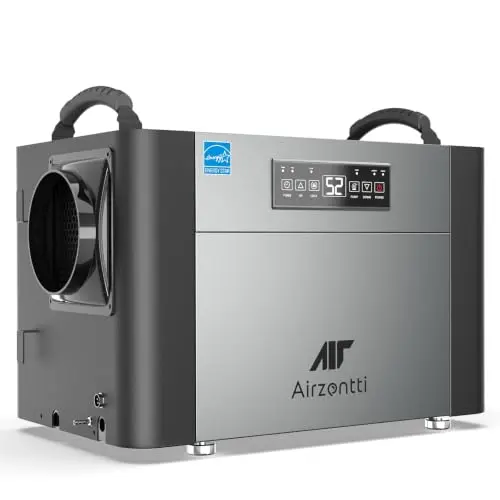
ACD155P – Whole-House Capacity With Ducting
A commercial-grade unit that treats whole-house humidity as a load problem rather than a room problem. It’s rated for up to 155 pints per day at near-saturation conditions with 220 CFM of airflow, and the built-in pump pushes condensate up to 16.4 feet so the unit can sit in a far corner and still drain itself.
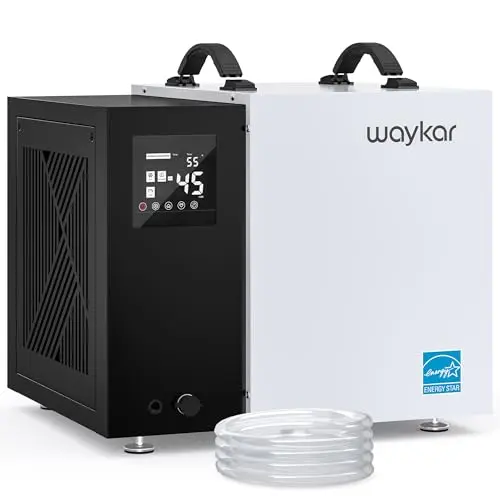
AFW1.5DPM – Metal-Bodied Crawl Space Workhorse
A metal-bodied 70-pint unit built for crawl spaces and basements where a plastic cabinet would get chewed up. Two drainage paths – a 16.4-foot pump hose and a 6.6-foot gravity hose – let it drain vertically or downhill depending on what the space allows.
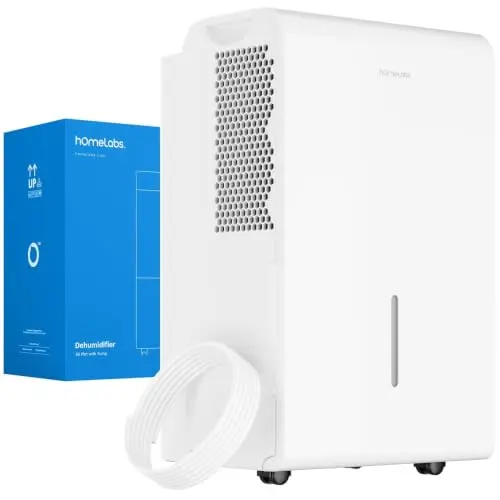
HME1004 – Wi-Fi Control With Built-In Pump
A pump-equipped unit with Wi-Fi control and a broad coverage claim, aimed at basements and large rooms where you’d rather not walk downstairs to adjust a dial. Comfort, Turbo, and Continuous modes cover the usual scenarios, and the digital panel gives you a clear humidity readout.
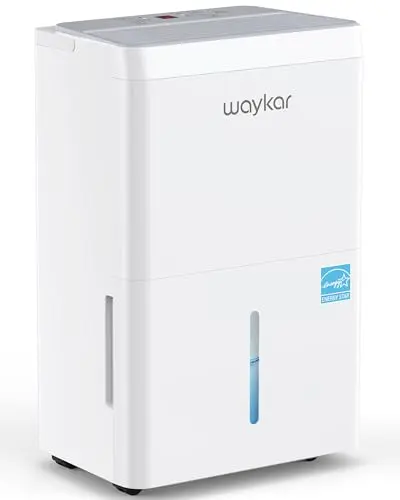
CTH120A – High-Capacity Value With Quiet Operation
A 120-pint unit with a genuinely quiet low setting and an automatic comfort mode that adjusts its humidity target based on room temperature. It’s the value pick of the group – large-space capacity without a commercial footprint.
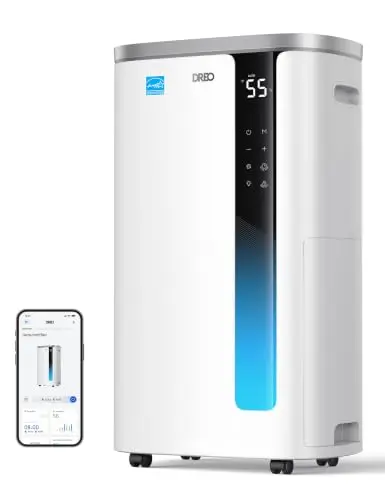
DR-HDH003S – App-Connected Comfort for Living Spaces
A 75-pint smart unit with a large 1.85-gallon tank and app-based energy monitoring, aimed at finished living spaces where noise and looks matter as much as raw output.
How We Evaluated These Whole House Dehumidifier Systems
We didn’t install these systems into ductwork or run them through a full humid season. What we did: cross-referenced 5 dehumidifier models from 4 distinct brands across 6 decision axes – pint capacity at rated conditions, pump lift and drainage flexibility, airflow in CFM, stated coverage area, cabinet build material, and smart controls. We triangulated published specifications, mapped each unit’s coverage claim against realistic whole-house demand, and weighed owner feedback where available on noise and reliability.
The scoring framework weighted real-world performance (70%) – how much moisture each unit actually moves and how easily it drains without babysitting – against feature differentiation (30%) – duct collars, app control, metal housings, and warranty depth. We have no commercial relationship with any of the brands featured; recommendations track fit and differentiation, not brand preference. If you’re drying a full basement or a ducted crawl space, the ACD155P is the one built for it; if you want metal construction and deep pump lift without a commercial footprint, the AFW1.5DPM is the closer match.
One thing we can’t tell you: how any of these hold up over three or four humid seasons. What we can tell you is that capacity numbers on the box are measured at aggressive test conditions – typically 95°F and 90% relative humidity – so a unit rated at 120 pints won’t pull 120 pints out of a cool 68°F basement. We read every spec with that gap in mind and flagged where the marketing runs ahead of realistic household performance.
How to Choose the Right Whole House Dehumidifier System
1. What Makes a Dehumidifier a Whole-House System
The word system is doing real work here. A whole-house dehumidifier isn’t just a bigger portable unit – it’s a machine designed to drain continuously, run for weeks at a time, and either sit in a central location or tie into ductwork so treated air reaches more than one room.
Three things separate the category. First, pump-assisted drainage, because a basement unit with a bucket is a chore, not a system. Second, coverage rated in the thousands of square feet rather than hundreds. Third, build quality aimed at permanent installation – metal cabinets, leveling feet, serviceable filtration. A portable with a hose can approximate this, but it’s usually the first thing to fail when you ask it to run nonstop.
2. Pint Ratings Explained: Why 120 Pints Isn't 120 Pints
Almost every capacity figure in this category is measured at roughly 95°F and 90% relative humidity. That’s a swamp, not a house. In a cool finished basement sitting at 68°F and 60% humidity, expect a unit to pull a fraction of its rated number.
The practical consequence is simple: compare units at the same test conditions, and discount aggressively when a brand publishes only its maximum. Where an AHAM rating appears alongside the max figure, the AHAM number is the one that maps to a real house. A doubled capacity claim rarely means double the real-world drying – it usually just means a more generous test standard.
3. Pump Lift and Drainage: The Spec Most People Skip
Pump lift tells you how high a unit can push condensate. Ten feet is common; some units manage 16.4 feet, which is the difference between draining into a utility sink and giving up on a floor drain entirely.
Treat the drainage options as a set. A gravity hose is the most reliable path when your drain is downhill – nothing to fail. A pump handles upward runs. A tank is a fallback for spaces with neither. If you have a floor drain within hose reach and a slope working for you, gravity alone is fine; if your only option is up and out through a rim joist, the ACD155P is the unit here with the headroom for it.
4. Ducting, Airflow, and Coverage Area Math
Airflow in CFM tells you how much air the unit can process, and it’s the number that determines whether a big coverage claim is realistic. Units in this lineup run roughly 158 to 230 CFM. Higher CFM paired with matching capacity means the unit can keep up in an open space rather than drying a pocket around itself.
A duct collar changes the calculus. If a unit accepts a duct, you can push conditioned air into a specific zone or tie into a return, which is the closest a standalone machine gets to a true whole-house system. Without one, placement does the work – a central, open spot beats a corner every time. The AFW1.5DPM trades ducting for a sealed metal cabinet and deep pump lift, which suits crawl spaces better than open-plan floors.
5. Noise, Placement, and Where Whole-House Units Actually Live
Quiet-mode ratings in this category land around 40 to 41 dB, roughly refrigerator territory. High-speed operation is louder on every unit here, and a single-speed fan gives you no choice at all.
Where the unit lives decides how much the noise matters. In a crawl space, nobody cares. In a finished basement or a hallway off the living room, it matters a lot. Give the unit clearance on all sides, keep it out of the path of return air you’re trying to keep cool, and don’t box it into an unvented closet – a dehumidifier that can’t shed heat just runs longer and louder.
6. ENERGY STAR, Smart Controls, and Running Costs
A dehumidifier is a compressor appliance that may run for months, so efficiency certification is worth more than it looks on a spec sheet. ENERGY STAR models in this group claim meaningful reductions over standard DOE units, and that gap compounds across a wet season.
App control and energy monitoring are the other modern addition. Remote humidity adjustment is convenience; consumption tracking is the feature that changes behavior, because it makes an always-on appliance visible. Neither is essential, but if the unit lives somewhere inconvenient, remote control earns its keep fast.
7. How Much Whole House Dehumidifier System Do You Actually Need?
Start with the space, not the spec sheet. A damp 1,200-square-foot basement is a different problem from a 3,000-square-foot open floor sitting over a wet crawl space, and a 50-pint unit can be genuinely adequate for the first while being hopeless for the second.
Match rated coverage to your actual conditioned area, then add margin if the space is below grade or unsealed. Choosing between two units at similar capacity? Take the one with better drainage options and longer compressor coverage. And if a finished living space is in the picture, the DR-HDH003S puts the tank, noise floor, and app in the right place for that use.
Frequently Asked Questions
1. What's the difference between the Airzentti ACD155P and the Waykar AFW1.5DPM?
They solve the same problem at different scales. The ACD155P is the higher-capacity, higher-airflow unit with a 6-inch duct collar, which makes it the better fit for a large open space or a semi-ducted setup. The AFW1.5DPM is a sealed metal-bodied unit built for crawl spaces and rough environments, with a single fan speed and no ducting.
Choose the Airzentti if coverage and airflow are the constraint. Choose the AFW1.5DPM if the unit is going somewhere ugly, cramped, and permanent.
2. Do I need a whole house dehumidifier system, or will a portable unit do?
If the problem is one room, a portable with a hose is fine. If humidity is coming from the building itself – a wet crawl space, a below-grade slab, a basement that smells musty all summer – a portable is treating a symptom while the source keeps producing.
The signals that you need the bigger class of unit: a space over a few thousand square feet, continuous drainage being a requirement rather than a nice-to-have, and a machine that has to run unattended for weeks. That’s exactly where pump lift and build material start to matter more than pint ratings.
3. How does the hOmeLabs HME1004 compare to the DREO DR-HDH003S?
Both are consumer-grade units with app control, but they’re aimed at different rooms. The HME1004 leans on higher turbo airflow and a broader coverage claim, and it has a built-in pump for continuous drainage – better for a basement you don’t visit often.
The DR-HDH003S counters with a much larger 1.85-gallon tank and a quieter floor, so it works in a finished space without hose plumbing. Pick the hOmeLabs for raw coverage; pick the DREO if the unit has to live where people do.
4. Can a whole house dehumidifier be ducted into existing HVAC?
Only if the unit is built for it. In this group, the ACD155P is the one that ships with a duct collar, which lets you direct supply air rather than relying on the room to mix on its own.
That said, a standalone dehumidifier is not a substitute for a properly sized central system. Ducting one unit into a return is a pragmatic retrofit, not a design solution – plan the drain path before you plan the ducting, because condensate still has to go somewhere.
5. How much maintenance does a whole house dehumidifier system need?
Less than a portable, mostly because you’re not emptying a bucket. The recurring jobs are filter cleaning – most units here use a removable washable mesh screen – and an occasional check that the drain line is clear.
Beyond that, auto defrost and full-tank shut-off handle the failure modes that would otherwise cause damage. If a unit has a service reminder or filter indicator, use it. The compressor is the expensive part, and unrestricted airflow is what keeps it from working too hard.
Final Verdict
For most whole-house setups, the ACD155P is the answer – it pairs the largest capacity and airflow in this lineup with a duct collar and 16.4 feet of pump lift, which is exactly the combination a full basement or semi-ducted install needs. If your space is a crawl space or a rough unfinished basement, the AFW1.5DPM gives you the same pump lift inside a metal cabinet built to survive the environment. Buyers who want maximum capacity for the least outlay should look at the CTH120A, provided they’re comfortable with a shorter compressor warranty and hose-based drainage. And if the whole-house problem is really one finished living space, the DR-HDH003S is the quietest, easiest unit to live with here.
