
Best Women’S Running Compression Socks – 2026 Reviews

Somewhere around mile four, a bad sock announces itself. The cuff has crept down, the toe seam has started to rub, and the whole reason you put the thing on has evaporated. Compression socks for running live or die on that exact moment, not on the label copy.
The tricky part is that the women’s label doesn’t mean much on its own in this category. Plenty of pairs sold as women’s are a smaller unisex last with a different colorway, and the ones that actually work are sized to your calf circumference with a taper that matches where your leg narrows. Layer on the demands of running, which are moisture moving off the skin, cushioning where your foot lands, and a cuff that grips without digging in, and the field narrows fast.
We surveyed the brands competing here and sorted them by what they’re genuinely good at: firm support, easy-on recovery pressure, anatomical fit, or sheer multipack value. Here’s how they stack up for runners who want a sock that behaves on the move.
Best Women's Running Compression Socks – 2026 Reviews
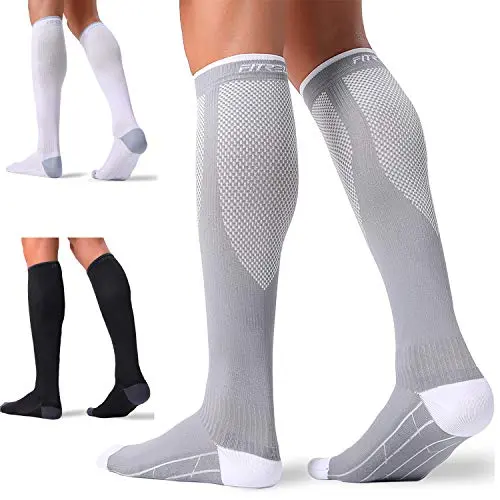
3-Pair 20-30 mmHg Knee-High – Cushioned Running Support
A three-pack of knee-high compression socks built around athletic use, with graduated pressure, a seamless toe, and cushioning underfoot. The 20-30 mmHg rating puts it at the firmer end of this lineup.
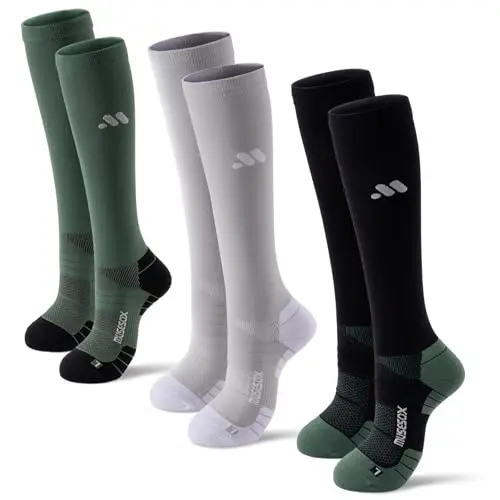
MS2403 3-Pair – Left/Right Anatomical Fit
A three-pack with left and right foot labeling, a seamless toe, and 15-20 mmHg graduated pressure. Sizes run from small through extra-large based on calf circumference.
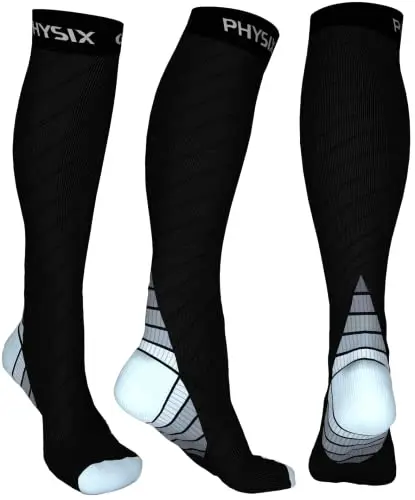
Graduated 20-30 mmHg – Arch and Heel Support
A single-pair, firm 20-30 mmHg knee-high with targeted arch and heel support. It’s the most established name here and comes in a range of sizes.
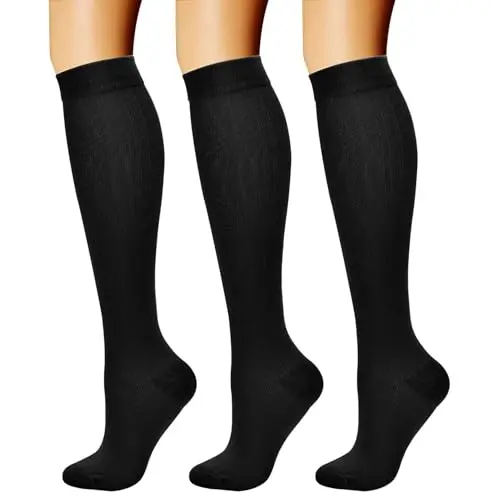
3-Pair 15-20 mmHg – Easy-On Everyday Compression
Three pairs of 15-20 mmHg knee-highs in a breathable nylon blend. The mild, easy-on pressure makes them a friendly entry point for runners new to compression.
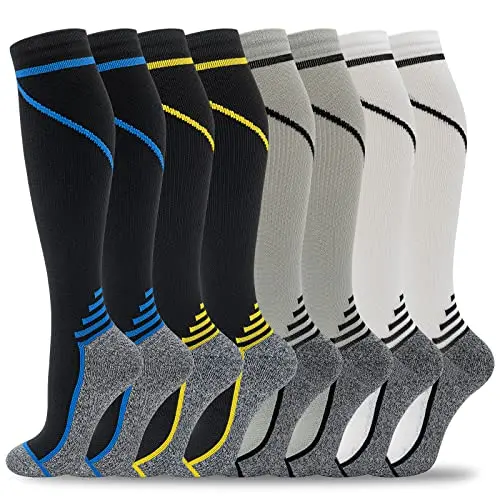
8-Pair 20-30 mmHg – Non-Slip Ribbed Compression
Eight pairs of 20-30 mmHg knee-highs with a non-slip ribbed cuff, thickened heel and toe, and arch support. The biggest multipack in this lineup by a wide margin.
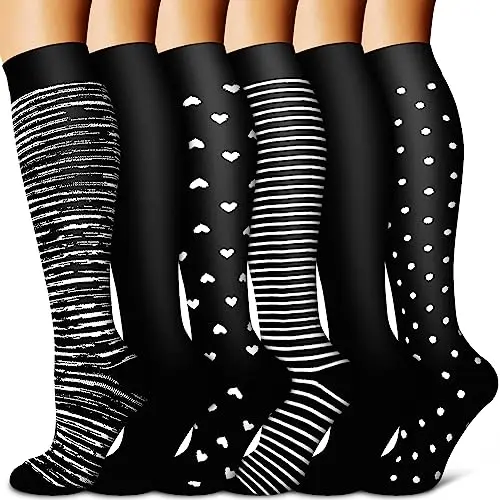
6-Pair Copper-Infused – Wide-Band All-Day Support
Six pairs of copper-infused knee-highs with a wide non-roll band. The copper blend is paired with a zoned compression design intended for all-day wear.
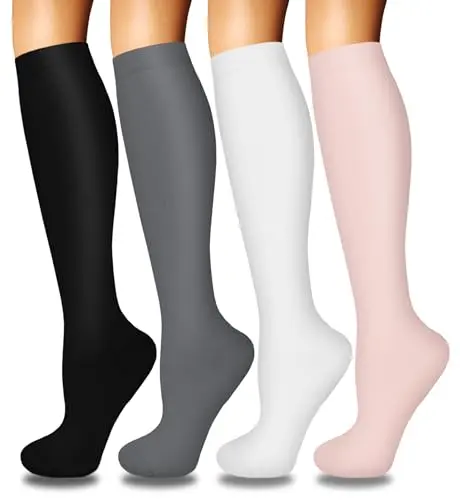
4-Pair 15-20 mmHg – Soft Wide-Band Comfort
Four pairs of nylon knee-highs with a wide comfort top band and a graduated compression profile. Available in a range of colorways with a small-to-medium option.
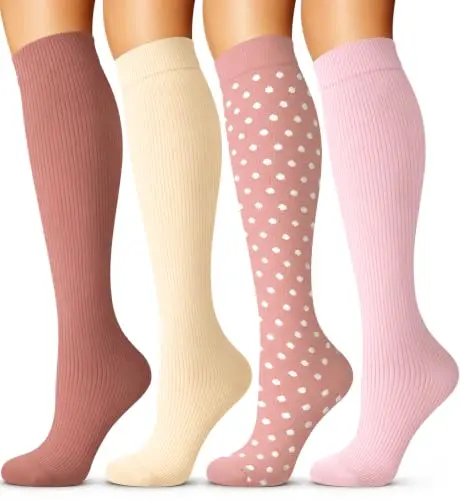
4-Pair 15-20 mmHg – Patterned Everyday Set
Four pairs of 15-20 mmHg graduated knee-highs in a range of patterns and colors. A budget-tier multipack aimed at all-day wear.
How We Evaluated These Women’s Running Compression Socks
We didn’t log training miles in these socks or put them through a marathon block. What we did: cross-referenced 8 compression sock models from 8 distinct brands across five decision axes – compression level and graduation, fabric and moisture handling, seam and cushioning construction, calf-based sizing range, and how the cuff behaves once you start moving. We triangulated published specifications, manufacturer sizing charts, and owner feedback where available, then weighed all of it against the specific demands of running rather than a hospital shift. Where owner feedback was thin, we leaned harder on published specifications and construction instead of guessing.
That last part matters. A sock tuned for twelve hours of standing and a sock tuned for a 10K want different things: one prizes sustained firmness, the other wants graduated pressure that won’t fight your foot through a stride. We weighted real-world running fit (70%) – pressure that holds at the ankle, cushioning where your foot lands, ventilation through the calf – against feature differentiation (30%), the construction details that separate one pair from the next. We have no commercial relationship with any of the brands featured, and recommendations track fit and differentiation, not brand preference. If you want the most athletic build in the lineup, the FITRELL 20-30 mmHg is your match; if a milder, better-sized squeeze suits you, the musesox MS2403 serves you better.
How to Choose the Right Women's Running Compression Socks
1. What Actually Matters in Women's Running Compression Socks
Most of the marketing in this category is noise. What separates a good pair comes down to a short list: calf-based sizing, a graduated pressure profile, a band that grips without pinching, and fabric that moves moisture. Everything else is a colorway.
The women’s part deserves a caveat. A lot of socks sold as women’s are simply a smaller cut of a unisex pattern, which only works if your calf happens to land inside that range. The pairs worth your money publish an actual circumference range and tell you what to do when you’re between sizes. Running adds a second filter: your foot rolls through a stride thousands of times, so a seamless toe, some underfoot cushioning, and a cuff that stays put matter more than the mmHg number printed on the box.
2. Compression Level: 15-20 mmHg vs 20-30 mmHg
This is the biggest fork in the category. 15-20 mmHg is a gentle, graduated squeeze. It’s easy to pull on, comfortable for hours, and the better starting point for most runners. 20-30 mmHg is firmer, and it’s what you want if you like knowing the sock is there or if you’ll use the same pair for travel and long days on your feet.
For running specifically, mild often wins. A very firm sock can fight the natural expansion of your calf through a stride, and it’s genuinely harder to get on. If you already know you like a serious squeeze, the Physix Gear Sport is the firmest option here. If you’re new to compression, start gentler and work up.
3. Sizing a Compression Sock to Your Calf, Not Your Shoe
Here’s the mistake almost everyone makes: buying compression socks by shoe size. Shoe size tells you about foot length. Compression is about calf circumference measured at the widest point, usually while standing.
Measure once, write it down, and buy against that number. If you’re between sizes, the honest answer is that it depends on what you want. Sizing down gives you firmer pressure and a higher risk of a fight at 6 a.m.; sizing up gives you comfort and less squeeze. A pair like the musesox MS2403, which publishes four calf-based sizes and says outright to size up when you’re borderline, removes a lot of that guesswork.
4. Fabric, Seams, and Cushioning: What Changes on a Run
Nylon-spandex blends dominate this category for a reason: they stretch, recover, and hold pressure without bagging out after a few washes. The differentiator is what else is in the knit. Mesh panels around the calf vent heat. A seamless toe removes the ridge that rubs inside a snug shoe, and thickened heel and toe zones add durability where socks wear first.
Cushioning is worth thinking about. A lightly cushioned sole takes the edge off pavement without changing how the shoe fits, while a heavily cushioned sock can make a tight racing shoe feel tighter. If you run in a roomy trainer, cushioning is free comfort. If you race in something snug, keep the sock thin.
5. How Much to Spend on Running Compression Socks
This category splits into three rough tiers, and the cheapest tier is not the worst one. Budget multipacks, the four-, six-, and eight-pair bundles, get you a rotation and a low cost per pair, with the tradeoff being lighter pressure and shorter lifespans. Mid-tier three-packs tend to be the sweet spot, with better fabric and more thoughtful construction. Single firm pairs at the top of the range buy you the strongest compression and the most established fit records.
If value is your priority, the CHARMKING three-pack and the bigger multipacks here are hard to argue with. Just go in knowing that a mild sock won’t feel like a firm one, no matter how many pairs come in the box.
6. Care, Rotation, and Making a Pair Last
Compression socks die quietly. The knit stretches, the pressure fades, and one day the sock that used to hold your calf feels like a regular knee-high. Machine wash cold on a gentle cycle, skip the fabric softener, and hang dry, because heat is what kills elasticity.
Rotation is the other half of longevity. Owning three or more pairs spreads the wear and gives the elastic time to recover between runs. Retire a pair when the cuff stops gripping or the fabric starts fraying at the toe, since a sock that’s lost its pressure is just an expensive knee-high.
Frequently Asked Questions
1. Are women's running compression socks actually cut differently from unisex pairs?
Sometimes, but not reliably. Plenty of pairs sold as women’s are a smaller version of a unisex pattern, which only works if your calf lands inside that range. The genuinely women’s-specific designs adjust the calf-to-ankle taper, narrow the heel, and publish several circumference-based sizes instead of two.
The practical test is the size chart. If a sock lists a real calf circumference range and gives guidance for the in-between case, the cut was probably considered. If it only lists shoe sizes, treat it as unisex and measure your calf before ordering.
2. What's the difference between the FITRELL three-pack and the musesox MS2403?
They sit at opposite ends of the pressure spectrum. The FITRELL is the firm option, with 20-30 mmHg graduated pressure, a cushioned sole, mesh venting, and a seamless toe, which makes it the better pick for hard efforts and long runs. The musesox MS2403 runs 15-20 mmHg, adds left and right foot labeling, and offers four calf-based sizes.
Choose the FITRELL if you want athletic support you can feel; choose the musesox MS2403 if you want a gentler squeeze and a more precise fit.
3. How do the CHARMKING and Physix Gear Sport socks compare for running?
CHARMKING is the easy-on option: a 15-20 mmHg graduated squeeze, a soft nylon blend, and three pairs per pack at a budget tier. It suits runners who want mild support they can wear all day. Physix Gear Sport goes the other way, with 20-30 mmHg, stronger arch and heel support, and a fit that owners describe as running large.
For most runners logging easy miles, the CHARMKING is the more comfortable daily choice. If you want firm pressure for recovery days and travel, the Physix pair is the more versatile tool.
4. Will compression socks stay up through a long run?
Only if the band and the sizing are right. A wide, ribbed cuff grips without needing to be tight enough to leave a mark, and a sock sized to your actual calf has no reason to slide. Socks that roll down are almost always undersized at the top or built with a too-narrow band.
Construction matters too. Graduated compression creates pressure that decreases upward, which helps the cuff stay seated. If a pair keeps slipping, the fix is usually a size review rather than a tighter sock.
5. How many pairs do you actually need in rotation?
Three is the realistic minimum if you run regularly: one on your feet, one in the wash, one in the drawer. Multipacks make that easy and drive the cost per pair down, which is why the four-, six-, and eight-pair bundles here are worth considering even when the pressure is milder than a single firm pair.
If you only wear compression for recovery days and travel, two pairs is plenty.
Final Verdict
For most runners, the FITRELL 20-30 mmHg three-pack is the answer. It’s the only pair here built like running gear first: five-zone graduated pressure, a cushioned sole, mesh venting, and a cuff that stays where you put it. If that firm squeeze sounds like a chore, the musesox MS2403 gives you a milder 15-20 mmHg profile with left and right foot labeling and four calf-based sizes, which is the better call for anyone between sizes. And if you want to spend as little as possible per pair while still getting honest support, the CHARMKING three-pack or one of the bigger multipacks will do the job on easy days and recovery.
Measure your calf, buy against that number, and rotate at least three pairs. That’s the whole game.
