
Best Wool Compression Socks – 2026 Reviews

Compression socks spent decades stuck in the pharmacy aisle – beige, scratchy, and about as appealing as a medical device. Wool changed that. A good merino or alpaca knit moves moisture, regulates temperature, and doesn’t turn into a swamp by hour four, which means the sock you need for a long flight or a standing shift is now also a sock you don’t mind wearing.
Two things separate a wool compression sock that works from one that ends up in a drawer. The first is fiber content. A label that says ‘wool blend’ can mean thirty percent merino or sixty-two percent baby alpaca, and that gap shows up in warmth, breathability, and how the knit feels against your skin. The second is compression level. A light gradient suits travel and desk days; firm pressure suits long shifts and real swelling, but it’s also harder to haul on at six in the morning.
We looked across the market rather than within one brand’s lineup. Below you’ll find merino, alpaca, and blended options spanning light to firm pressure, with honest notes on who each pair actually suits – the frequent flyer, the nurse on her feet all day, the winter hiker, and the person who just wants their ankles to look normal again after a flight.
Best Wool Compression Socks – 2026 Reviews

Merino Wool 2-Pair – Unisex Travel and All-Day Support
A unisex two-pair set built on merino wool and viscose from bamboo, with a calibrated graduated gradient that runs firmest at the ankle and eases below the knee. Reinforced footpads and Lycra help it hold shape through repeated washes.

Women's Pulse – Firm 20-30 mmHg in Merino Wool
Firm 20-30 mmHg graduated compression in a merino wool blend, with an ultra-light cushion sole, arch support, and a seamless toe. Cut for women’s sizing and built to hold pressure over the long haul.
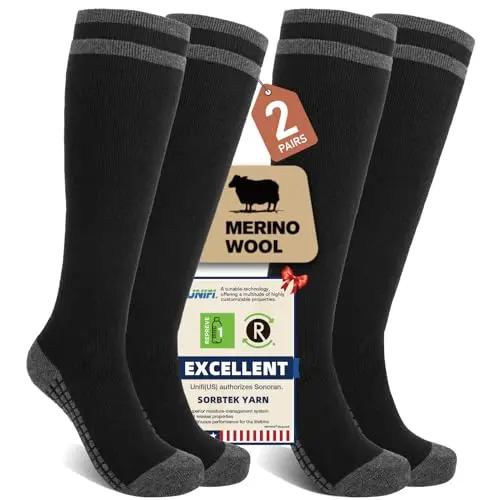
Merino Wool 2-Pack – Warm Winter Compression
A two-pair merino wool set with a moderate 15-20 mmHg gradient, a non-slip over-the-calf cuff, and REPREVE Sorbtek fibers for moisture management. Thicker and warmer than a typical compression sock.
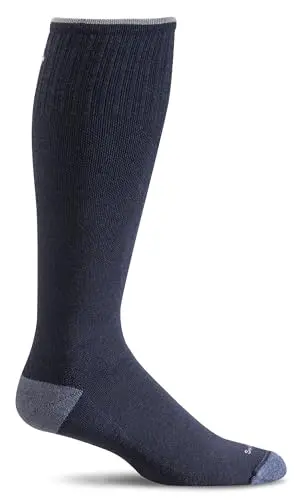
Men's Elevation – Firm Everyday Work Compression
Firm 20-30 mmHg graduated compression across four zones, knit from high-performance yarns that manage moisture and temperature. Over-the-calf length with arch support and an ultra-light cushion sole.
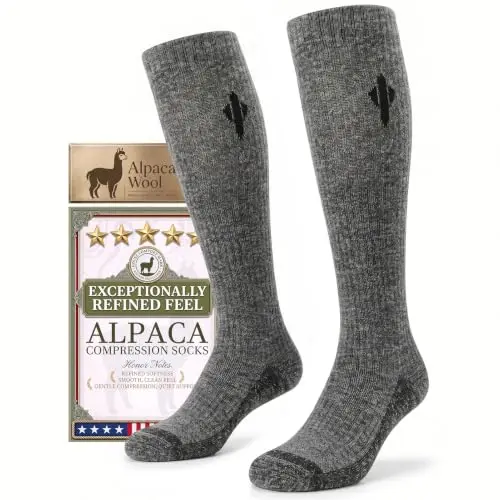
Alpaca-Merino – Refined 15-20 mmHg Support
A baby alpaca and merino blend at 15-20 mmHg, with terry cushioning, instep mesh for airflow, arch support, and a nylon-reinforced sole. Latex-free and built for four-season wear.

Alpaca Wool Heavyweight – Deep Winter Warmth
A heavyweight 15-25 mmHg knee-high built from Peruvian baby alpaca and merino, with a cozy fleece lining and a reinforced toe area. Engineered for cold-weather use rather than clinical pressure.
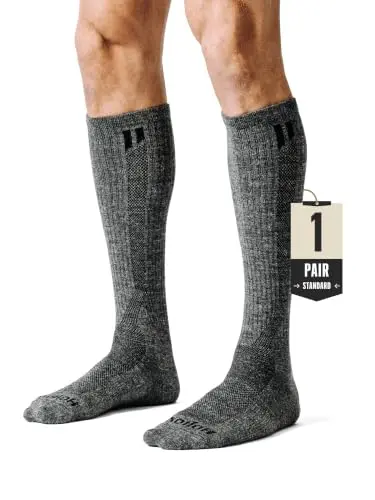
Alpaca Compression – Soft Lanolin-Free Daily Wear
An alpaca blend at 15-20 mmHg with a stretch-designed standard fit that eases pressure at the top band. Lanolin-free, moisture wicking, and reinforced at the heel and toe.

Silky-Soft Merino 2-Pair – Adaptive Stretch Fit
A two-pair merino and bamboo viscose set with generous Lycra stretch and a 15-20 mmHg gradient. Smooth knit, seamless toe, and a cushioned sole for extended wear.

Alpaca 2-Pair – Stable Everyday Leg Support
A two-pair knee-high set at 15-20 mmHg with Lycra spandex for stretch and shape retention. Wool blend knit aimed at travel, hiking, and long hours on your feet.
How We Evaluated These Wool Compression Socks
A few things we can’t tell you: how these socks hold up after a hundred washes, or how they behave on your specific calf shape. What we can tell you is how the lineup stacks up on paper and in owner experience. We cross-referenced 9 wool compression socks from 8 brands across six decision axes – fiber blend and wool percentage, compression level, graduated zonation, sizing range, moisture and thermoregulation claims, and construction details like toe seams, cuff design, and reinforced soles. We triangulated published specifications, absorbed owner feedback where available, and mapped each pair against realistic buyer profiles: the long-haul flyer, the nurse on a twelve-hour shift, the runner logging cold morning miles, and the hiker who wants warmth without a synthetic feel.
The scoring framework weighted real-world fit and performance (70%) – how well each sock delivers on its stated compression and comfort claims – against feature differentiation (30%) – unique fiber blends, cuff construction, and use-case specificity. We have no commercial relationship with any of the brands featured, and recommendations track fit and differentiation rather than brand preference. If you want one pair that covers travel, work, and recovery, the Iambamboo Merino Wool is the safest call; if you need genuine firm pressure, the Sockwell Women’s Pulse is where to start.
How to Choose the Right Wool Compression Socks
1. What Makes a Compression Sock Genuinely a Wool Sock
The label is where most shoppers get misled. A sock described as a wool blend might carry 30% merino or 62% baby alpaca – or a token percentage that’s mostly there for the hangtag. The rest of the blend is usually nylon for durability, rayon or viscose for softness, and spandex or Lycra for recovery. None of that is bad; a pure-wool compression sock wouldn’t hold pressure or survive many washes. What matters is that the fiber percentage is high enough to actually deliver on wool’s promises.
In practice, anything in the 30% wool range gives real breathability and odor control. Blends above 60% animal fiber, which is where the alpaca options sit, feel noticeably softer and warmer for the weight. Read the composition before you read anything else on the package.
2. Merino vs Alpaca: Which Wool Suits Your Legs?
Merino is the safer default. The fibers are fine, it wicks efficiently, and it holds shape through washing better than most luxury fibers. It’s also the more common choice in firm compression socks, because makers can knit it tightly without losing recovery.
Alpaca is smoother and silkier against the skin, and it’s naturally lanolin-free, which matters if you’re sensitive. Its hollow fiber structure delivers more warmth per ounce, making it the better pick for cold weather. The tradeoff is usually price and, in heavier weights, bulk. If winter warmth is the entire reason you’re shopping, the Juclise Alpaca Wool Heavyweight is built for exactly that brief.
3. Matching Compression Level to Your Day
Compression is measured in millimetres of mercury, and the range you pick matters more than almost anything else. 15-20 mmHg is the everyday tier: good for flights, desk work, hiking, and mild fatigue. It’s forgiving enough to wear for ten hours and easy enough to pull on half-awake.
20-30 mmHg is firm, and it’s aimed at people with real swelling or jobs that keep them standing all day. It works, but it’s harder to don and it isn’t the pair you’ll reach for casually. Plenty of people end up owning both. If you’ve been pointed toward firm pressure, the Sockwell Women’s Pulse is the wool option here that actually hits that range.
4. Fit, Sizing, and Getting Them On
Sizing charts for compression socks usually key off shoe size, but calf circumference is the measurement that determines whether the sock actually fits. Two people with the same shoe size can need different sizes. Measure your calf at its widest point before you order anything.
The other variable is the top band. A turn welt top or a stretch-designed cuff reduces the digging that makes people stop wearing compression socks altogether. Thinner knits go on faster; thicker fleece-lined styles take more effort. If you have limited hand strength or a shoulder issue, favor the lighter gradient and the thinner knit every time.
5. What Wool Compression Socks Cost
The market splits into three rough tiers. Entry-level two-pair packs cost well under what a single premium pair runs and usually land in the 30% wool blend range – a reasonable way to test whether compression socks fit your routine at all. Mid-range single pairs step up to better yarns, tighter quality control, and construction details like seamless toes and reinforced soles.
The premium tier is where high-content alpaca blends live. You’re paying for fiber, not marketing: baby alpaca and merino blends at 60%+ animal fiber feel genuinely different on the leg. Whether that’s worth it depends on how many hours a day the sock is on your leg.
6. Care and Longevity for Wool Compression Socks
Wool compression socks survive machine washing – most are pre-shrunk – but heat is what kills the elastic. Air-dry them rather than running a dryer cycle and the compression gradient will hold far longer. Wash on cold with a gentle detergent and skip fabric softener, which coats the fibers and cuts down on wicking.
The failure point to watch is the heel, especially on thicker knits. Rotating two pairs rather than wearing one into the ground roughly doubles service life, which is one reason two-pair packs are more practical than they first appear. Check the heel for thinning every few months, and expect elastic recovery at the cuff to be the second thing to go.
Frequently Asked Questions
1. Are wool compression socks worth it over synthetic compression socks?
For most people, yes – with one caveat. Wool’s advantage isn’t compression; it’s everything around it. Merino and alpaca fibers move moisture away from skin, regulate temperature across a wider range than polyester, and resist odor in a way synthetics don’t, which matters when a sock is on your leg for twelve hours. They’re also softer against the skin, so people actually keep wearing them.
The caveat is durability and cost. Wool blends lean on nylon and Lycra for structure, and the cheapest wool socks can wear thin at the heel faster than a heavy synthetic. If you want a low-risk way in, the SONORAN merino two-pack sits at the most accessible tier without a token wool content.
2. What's the difference between the Sockwell Pulse and the SONORAN merino socks?
Compression level and knit weight, mostly. The Sockwell Pulse is a firm 20-30 mmHg sock at roughly 32% merino, built for prolonged standing, travel swelling, and anyone who wants genuine medical-style pressure in a slimmer profile. The SONORAN set is a moderate 15-20 mmHg at 30% merino, but it’s a thicker, warmer knit with a non-slip cuff – closer to a cozy winter sock with support built in.
Choose the Pulse if pressure is the priority and you want it to disappear inside normal shoes. Choose the SONORAN if warmth and all-day comfort matter more than firmness.
3. How do the Iambamboo merino socks compare with the Heat equation alpaca socks?
They occupy different fiber and price tiers. The Iambamboo set is two pairs of merino and bamboo viscose with a calibrated 15-20 mmHg gradient and a soft, low-friction knit that’s easy to pull on – a strong everyday and travel choice with rotation built in.
The Heat equation pair steps up to 62% baby alpaca and 22% merino, which reads noticeably smoother and warmer against the skin, with terry cushioning and instep mesh. It’s the more refined sock; the Iambamboo is the more practical buy. If you have sensitive skin or hate the feel of synthetic compression socks, the alpaca blend justifies the step up.
4. Can you wear wool compression socks in warm weather?
Yes, and merino is the better choice for it. Fine merino is thermoregulating rather than purely insulating – it wicks sweat and helps regulate temperature instead of trapping heat the way a heavy wool sweater does. Look for lighter knit weights, a higher nylon or viscose share, and mesh or ventilated zones.
Skip the heavyweight fleece-lined styles in summer; those are purpose-built for cold weather and will run hot. A 15-20 mmHg merino blend in a light knit handles a warm-weather flight or a summer shift perfectly well.
5. Do wool compression socks lose their compression after washing?
The gradient fades over time, but washing usually isn’t the culprit – heat is. Machine washing on cold is fine, and most of these are pre-shrunk. What degrades elastic is a hot dryer cycle, so air-dry instead.
The bigger variables are how many pairs you rotate and how hard you are on the heel. Expect the cuff to loosen before the ankle loses pressure. If a sock starts sliding down mid-day, the elastic recovery is gone and it’s time to replace it, even if the fabric still looks fine.
Final Verdict
For most people, the Iambamboo Merino Wool is the answer – a unisex, two-pair set with a precise light gradient that’s genuinely easy to pull on and comfortable enough for a long-haul flight or a full workday. If you actually need firm pressure for swelling or hours on your feet, the Sockwell Women’s Pulse delivers real 20-30 mmHg support in a merino blend that holds up over years. Budget-minded shoppers should look at the SONORAN merino two-pack, which brings warmth and a non-slip cuff at the most accessible tier. And if cold weather is the whole point – hunting, skiing, winter hiking – the Juclise Alpaca Wool Heavyweight is built for exactly that. Start with your compression need, then let fiber and fit narrow the rest.
